How to Buy Bitcoin in Pakistan in 2026: 5 Exchanges Compared — Fees, PKR Payments and the PVARA Licence Rule
28.9 million Pakistanis now use crypto — and in 2026 buying Bitcoin became legal under a brand-new regulator, PVARA. Here are the 5 exchanges that actually work with PKR, their fees, and the one check that keeps your money safe.
28.9 Million Pakistanis Now Use Crypto — and Buying Bitcoin Legally Changed Completely in 2026
An estimated 28.9 million Pakistanis are expected to hold or use cryptocurrency in 2026 — and for the first time, buying Bitcoin in Pakistan is legal under a dedicated regulator, the Pakistan Virtual Assets Regulatory Authority (PVARA). The catch: no exchange holds a full PVARA licence yet, so the platform you choose — and the payment route you use — decides whether your rupees turn into Bitcoin safely or disappear into a scam. This guide compares the 5 exchanges that actually work with PKR, their real fees, and the one check that keeps your money safe.
Bitcoin is trading at around $75,867 as of November 7, 2026 — roughly 40% below its all-time high of $126,080 — while the Crypto Fear and Greed Index sits at 25, deep in "Extreme Fear" territory.
Is Bitcoin Legal in Pakistan in 2026?
Yes — owning, buying and selling Bitcoin is legal for individuals in Pakistan in 2026. But Bitcoin is not legal tender, and the businesses that sell it to you now need a licence.
Pakistan's journey from ban to regulation happened fast:
- April 2018: the State Bank of Pakistan (SBP) issued BPRD Circular 03/2018, barring banks from processing virtual-currency transactions. For seven years, crypto lived in a grey zone.
- March 2025: the government created the Pakistan Crypto Council and appointed Bilal Bin Saqib as Special Assistant to the Prime Minister on Blockchain and Cryptocurrency. Pakistan also announced plans for a government Bitcoin reserve.
- July 2025: President Zardari signed the Virtual Assets Ordinance, 2025, creating PVARA to license exchanges, custodians and token issuers.
- March 2026: Parliament passed the Virtual Assets Act, 2026 (Act No. XIII of 2026), converting the ordinance into permanent law. Section 3 states plainly that virtual assets "are not legal tender".
- April 14, 2026: the State Bank reversed its 2018 ban with BPRD Circular Letter No. 10 of 2026, permitting banks to open accounts for PVARA-approved virtual asset service providers.
- August 2026: PVARA notified its licensing regulations (S.R.O. 1419 and 1420 of 2026) and opened its licensing portal, with a September 5, 2026 deadline for firms already serving Pakistani users to file for a No Objection Certificate (NOC).
- December 2025: Binance and HTX became the first platforms to receive PVARA No Objection Certificates; Bitget has since joined them.
The nuance that trips people up: an NOC is a preliminary clearance, not a full operating licence. PVARA's own FAQ states that "an NOC does not constitute a license to carry on any Virtual Asset Service." As of October 2026, no exchange holds a full PVARA licence. The Act's penalties — fines of up to PKR 50 million and imprisonment of up to five years — target unlicensed providers, not ordinary buyers. For you as a buyer, the practical rule is simple: use a platform that has at least filed for an NOC, and check PVARA's official announcements at pvara.gov.pk before trusting any platform's claims.
For the full legal picture, see Pakera's guide to crypto legality in Pakistan.
The 5 Best Exchanges to Buy Bitcoin in Pakistan in 2026
There is no licensed local Pakistani exchange yet, so every realistic option is a global platform serving Pakistan — mostly through peer-to-peer (P2P) trading, where you pay a seller in rupees and the platform holds the Bitcoin in escrow until payment confirms.
| Exchange | Spot fee | PKR payment methods | PVARA status | Best for |
|---|---|---|---|---|
| Binance | 0.10% | P2P: bank transfer, Easypaisa, JazzCash, Raast | NOC received (Dec 2025); Easypaisa MoU; AML-registered | Deepest PKR P2P market, any hour |
| Bybit | 0.10% | P2P: Easypaisa, JazzCash, bank transfer | No NOC yet | Lowest all-in costs, fast escrow |
| OKX | 0.08–0.10% | P2P: bank transfer, Easypaisa, JazzCash | No NOC reported | Clean interface, strong security record |
| Bitget | 0.10% | P2P: bank transfer, Easypaisa, JazzCash | NOC received | Copy trading, competitive P2P rates |
| HTX | 0.10–0.20% | P2P: bank transfer, Easypaisa, JazzCash | NOC received (Dec 2025) | Early compliance mover, wide coin range |
Binance is the default answer for most Pakistanis: its rupee P2P desk carries by far the largest merchant count in the country, so orders in Easypaisa, JazzCash, bank transfer and Raast fill at any hour. In December 2025 it became one of the first two platforms to win a PVARA No Objection Certificate, then signed a memorandum of understanding with Easypaisa and registered for local anti-money-laundering supervision by June 2026 — further along the compliance path than any rival. Its 0.10% spot fee is among the lowest anywhere, and its SAFU fund and quarterly proof of reserves add a safety layer. The honest caveat: the NOC is a first step, not a full licence, and its 2023 settlement with the US Department of Justice still sits on the record. Independent comparison data is available at Datawallet's Pakistan exchange comparison.
Bybit is the account many experienced Pakistani traders open first. Its PKR P2P book is slightly thinner than Binance's but still liquid, merchants accept Easypaisa, JazzCash and bank transfer, and escrow releases clear fast. It offers an interface in Urdu and English, copy trading, and proof of reserves. Its weakness is compliance: Bybit does not yet hold a PVARA No Objection Certificate like Binance and HTX.
OKX is the cleanest option for beginners who want a straightforward app and strong security defaults. Its P2P market covers the same PKR rails, and its spot fees start at 0.08% for high-volume traders. It has no reported PVARA NOC.
Bitget combines a PVARA NOC with competitive P2P rates and copy trading. Its PKR merchant pool is smaller than Binance's, so very large orders can move the spread.
HTX was, alongside Binance, one of the first two platforms to receive a PVARA NOC in December 2025. It lists a wide range of coins and accepts the standard PKR P2P methods, but its spot fees can run higher than Binance or Bybit, so compare the all-in cost before making it your main exchange.
How to Buy Bitcoin in Pakistan: Step by Step
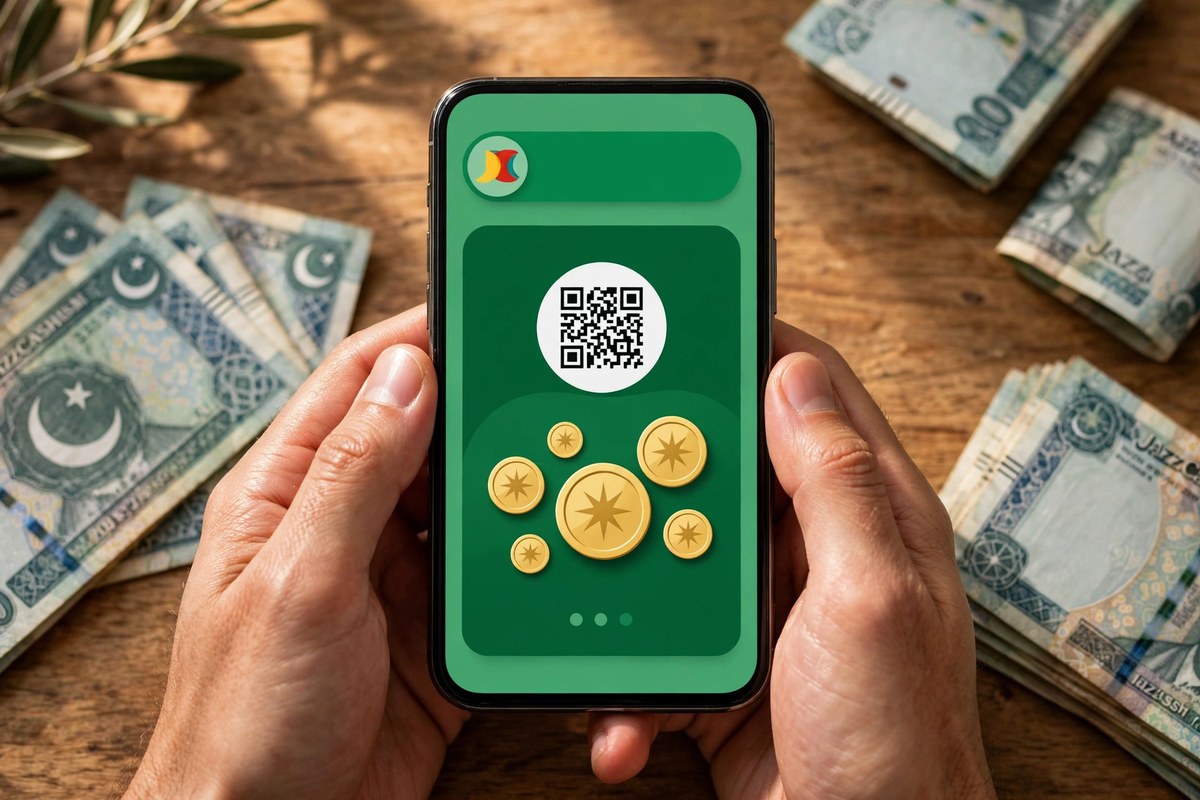
Most Pakistanis buy Bitcoin the same way: rupees go into a P2P trade for USDT (Tether), then USDT converts to Bitcoin. Direct PKR-to-BTC order books barely exist, so the USDT step is normal, not a workaround.
Step 1: Choose your exchange
Start with Binance for the deepest PKR liquidity, or Bybit for the lowest all-in cost. Open one account first — add a second later to compare P2P rates.
Step 2: Create an account and complete KYC with your CNIC
Register with your email or phone number, then complete identity verification using your Computerised National Identity Card (CNIC). Exchanges require this under anti-money-laundering rules, and unverified accounts face strict P2P limits. Use your real name exactly as it appears on your CNIC — your P2P payment account name must match it, or sellers will reject your trades.
Step 3: Buy USDT with PKR through P2P trading
Open the P2P section, select "Buy USDT", set the currency to PKR, and filter by your payment method — bank transfer, Easypaisa or JazzCash. Pick a merchant with a high completion rate (98% or above) and hundreds of completed trades. Enter the PKR amount, confirm, and pay the seller exactly as instructed. The platform holds the seller's USDT in escrow; once the seller confirms your payment, the USDT releases to your wallet. Never mark a trade "paid" before you have actually sent the money, and never pay outside the platform.
Step 4: Convert USDT to Bitcoin
Go to the spot market, open the BTC/USDT pair, and place a market or limit order. At a Bitcoin price near $75,867, even PKR 5,000 buys a meaningful fraction — you do not need to buy a whole coin.
Step 5: Move your Bitcoin to a wallet you control
Leaving coins on an exchange means trusting the exchange's security. After the $6.3 billion Binance hack in October 2026, that trust is no longer free. For amounts you plan to hold for months, withdraw to a hardware wallet or a reputable self-custody wallet. Our guide How to Buy Bitcoin Safely in 2026 walks through the 7 steps that keep your BTC yours, and What Is Bitcoin? The Complete Beginner's Guide explains how wallets and private keys work.
Step 6: Keep records from day one
Save every P2P receipt, bank transfer screenshot and trade confirmation. The Federal Board of Revenue (FBR) has issued no crypto-specific tax rule yet, but gains are likely taxable under general rules — and records are the difference between a clean filing and a painful one.
PKR Payment Methods Compared: Bank Transfer, Easypaisa, JazzCash and Raast
Your payment method decides your speed, your cost and your risk. Here is how the four PKR rails stack up for buying Bitcoin:
- Bank transfer (IBFT): the most common P2P method. You pay into the seller's bank account; escrow releases the coins. Best for larger amounts, because bank transfers leave a clear paper trail. Make sure the account name matches the merchant's verified profile name — a mismatch is the most common reason trades get cancelled.
- Easypaisa: Pakistan's largest mobile wallet, and the fastest way to settle small and mid-size P2P trades. Binance's MoU with Easypaisa signals where the market is heading, but for now Easypaisa still moves through P2P merchants rather than a direct exchange deposit.
- JazzCash: the other major mobile wallet, accepted by the same P2P merchants. Functionally similar to Easypaisa; use whichever wallet already holds your rupees.
- Raast: the State Bank's instant payment system. Growing fast as a P2P settlement rail on Binance, with near-instant transfers and no interbank fee.
- Debit or credit card: card purchases work on a few platforms such as Coinmama, but Pakistani bank cards frequently decline crypto transactions, and card fees plus foreign-exchange charges make this the most expensive route. Treat cards as a backup, not a plan.
One warning that applies to every method: P2P is where the scams live. A seller who asks you to pay outside the platform, to a different name, or via a gift card is running a scam — full stop.
What It Costs: Fees, Spreads and the Hidden P2P Markup
The headline spot fee of 0.10% is the smallest part of what you pay. The real cost hides in three places:
- The P2P spread: P2P sellers quote USDT above the market rate — typically 0.5% to 2% over the interbank rate, depending on the amount, the hour and the payment method. Compare at least three merchants before every trade.
- Spot trading fees: 0.10% on Binance and Bybit, 0.08–0.10% on OKX. On a PKR 100,000 purchase, that is roughly PKR 100.
- Withdrawal fees: moving Bitcoin off the exchange costs a network fee that varies with congestion. Withdrawing as USDT on a cheap network (such as TRC-20) and converting later can be cheaper than a direct BTC withdrawal for small amounts — but check the fee before you click, because it changes daily.
Tax on Bitcoin in Pakistan: What FBR Actually Says
This is the section most guides get wrong, so here is the honest position as of late 2026: there is no crypto-specific tax rate in Pakistan.
The Federal Board of Revenue has issued no dedicated crypto tax rule. The Finance Act, 2026, in force from July 1, 2026, added no crypto-specific rate, even though higher rates were discussed before the budget. That does not make crypto profit tax-free. Section 37 of the Income Tax Ordinance, 2001 taxes gains on the disposal of a "capital asset" — defined as "property of any kind held by a person" — and most readings put crypto gains under that general rule. An FBR official was reported in June 2026 as saying mining counts as business income and gains on sales as capital gains. How much you pay depends on how your activity is classified, so no fixed "crypto tax rate" exists to quote — beware any guide that states one as fact.
Three practical consequences follow. First, keep records of every buy, sell and transfer, with PKR values and dates — the FBR's 2026 return deadline was October 15, 2026, and crypto holdings are assets you must declare. Second, Pakistan has not yet signed onto the OECD's Crypto-Asset Reporting Framework (CARF), under which exchanges share user data automatically with tax authorities from 2027 — but PVARA is building its own compliance net. Third, frequent trading can be reclassified as business income at higher rates, so get advice from a tax professional if you trade often. This section is general information, not tax advice — see TaxWizard's Pakistan crypto tax guide and the CARF explainer for Pakistani traders.
7 Mistakes That Cost Pakistani Bitcoin Buyers Money
- Buying from a seller with no track record: a merchant with 12 trades and a 91% completion rate is not a bargain — it is a risk. Stick to 98%+ completion and hundreds of trades.
- Paying outside escrow: any payment that bypasses the platform's escrow has zero protection. No exceptions, no matter how convincing the discount.
- Ignoring the P2P spread: a 2% spread on PKR 500,000 costs PKR 10,000 — ten times the spot fee. Always compare the all-in PKR cost, not the headline fee.
- Leaving large amounts on an exchange: $6.3 billion was stolen from Binance itself in October 2026. Withdraw what you plan to hold — our 10 checks after the Binance hack show how.
- Buying at the top of a fear spike: with the Fear and Greed Index at 25 and Bitcoin 40% below its peak, volatility cuts both ways. Our Fear and Greed Index explainer shows how to read the sentiment gauge before you buy.
- Forgetting the tax record: no receipt means no proof of your cost basis. Screenshot every P2P payment and export your trade history monthly.
- Trusting "PVARA-licensed" claims: no exchange holds a full PVARA licence yet. Any platform advertising one is lying — verify at pvara.gov.pk instead.
What Most People Get Wrong About Buying Bitcoin in Pakistan
"Crypto is banned in Pakistan." Wrong since 2026. The Virtual Assets Act legalised buying and holding through regulated channels, and the State Bank reversed its banking ban in April 2026. What remains banned is unlicensed providers selling crypto services — not you buying Bitcoin.
"I need lakhs of rupees to start." Wrong. Bitcoin is divisible to eight decimal places. PKR 5,000 buys a fraction of a coin, and most beginners start around PKR 15,000. The minimum is set by the P2P merchant, not by Bitcoin.
"P2P is illegal." Wrong. P2P is the dominant legal route today, used by millions of Pakistanis on the world's largest exchanges. What is illegal is fraud inside P2P — and the escrow system exists precisely to stop it.
"A PVARA NOC means the exchange is fully licensed." Wrong. An NOC is a preliminary clearance that lets a platform keep operating while its licence application proceeds. Binance, HTX and Bitget hold NOCs; nobody holds a full licence yet.
"Bitcoin's price will just go back up because it always does." Wrong — and expensive. Bitcoin is 40% below its $126,080 peak, and our history of Bitcoin's past crashes shows recoveries took anywhere from months to years, and some coins never recovered at all. Buy with money you can afford to leave alone, and decide your exit rules before you buy — our 5 tests for selling Bitcoin help you make that call without panic.
Frequently Asked Questions
Is it legal to buy Bitcoin in Pakistan in 2026?
Yes. The Virtual Assets Act, 2026 made owning, buying and selling crypto legal for individuals, regulated by PVARA. Bitcoin is not legal tender, and the businesses selling it need a PVARA licence — but no offence in the Act targets an ordinary person buying and holding crypto.
Which exchange is best for buying Bitcoin in Pakistan?
Binance is the strongest all-round choice: the deepest PKR P2P market, a PVARA No Objection Certificate, an Easypaisa MoU and a 0.10% spot fee. Bybit is the best alternative on cost and speed, while Bitget and HTX also hold NOCs. Compare P2P spreads on at least two platforms before every trade.
Can I buy Bitcoin with Easypaisa or JazzCash?
Yes, through P2P trading. You pay the seller via Easypaisa or JazzCash and the platform releases the Bitcoin from escrow once payment is confirmed. There is no direct Easypaisa-to-exchange deposit yet — any service claiming one is a scam.
How much money do I need to start buying Bitcoin in Pakistan?
As little as PKR 5,000. Bitcoin is divisible, so you buy a fraction of a coin. Most beginners start with around PKR 15,000 and add gradually. P2P merchants set their own minimums, usually between PKR 1,000 and PKR 10,000.
Do I have to pay tax on Bitcoin in Pakistan?
Probably yes, under general rules — but there is no crypto-specific rate. Gains are likely taxable as capital gains under Section 37 of the Income Tax Ordinance, 2001, and frequent trading can count as business income. Keep full records and consult a tax professional; this is general information, not tax advice.
Is Binance safe to use in Pakistan after the $6.3 billion hack?
Binance remains the largest exchange and holds a PVARA NOC, but the October 2026 hack proved no exchange is unhackable. Use it to buy, then withdraw Bitcoin you plan to hold into a wallet you control. Never keep your entire stack on any single exchange.
The Bottom Line
Pakistan went from banning crypto banking to regulating it in eighteen months — a Virtual Assets Act, a new regulator in PVARA, a reversed State Bank ban, and 28.9 million people already in the market. The opportunity is real, but so is the trap: no exchange is fully licensed yet, P2P is where the scams concentrate, and the tax rules are still general rather than specific. Buy on a platform with a PVARA NOC, pay through escrow with a payment method that leaves a paper trail, compare the full PKR cost before every trade, move long-term holdings off the exchange, and keep records from your very first purchase.