How to Buy Bitcoin in Saudi Arabia in 2026: 5 Exchanges Compared — Fees, SAR Payments and the 0% Tax Rule
Saudi residents pay 0% personal tax on Bitcoin gains — but the Kingdom has no licensed local exchange, and banks can't process crypto payments. Here are the 5 exchanges that actually work, with fees, SAR payments and the SAMA rules, while Bitcoin trades near $76,000.
Saudi residents pay 0% personal tax on Bitcoin gains — yet the Kingdom has no licensed local crypto exchange at all, and Saudi banks are barred from processing crypto payments without central bank approval. An estimated 3–5 million Saudis trade crypto anyway, mostly through foreign platforms and peer-to-peer deals. This guide compares the 5 exchanges that actually work for Saudi residents in 2026 — real fees, SAR payment methods and the tax rules — while Bitcoin trades near $76,000, about 40% below its $126,080 all-time high.
Buying Bitcoin in Saudi Arabia is not like buying it in Dubai or London. There is no Saudi-licensed exchange, no SAMA-approved on-ramp, and your mada card will often be declined on international platforms. But owning Bitcoin is not a crime in the Kingdom, and the 0% personal tax rate makes the effort worthwhile for many residents. The trick is knowing which platforms accept Saudi customers, which payment rails actually clear, and which fees quietly eat your money.
Is Bitcoin Legal in Saudi Arabia in 2026?
Bitcoin sits in a legal grey zone in Saudi Arabia — and understanding that grey zone is the first step to buying safely. The Saudi Central Bank (SAMA) has warned the public against cryptocurrencies repeatedly since 2018, and Bitcoin is not recognised as legal tender in the Kingdom. At the same time, no Saudi law explicitly criminalises an individual owning or trading Bitcoin, and no formal ban on personal ownership has ever been issued. The practical result: millions of Saudis hold crypto, but they do it through platforms licensed elsewhere.
The restrictions fall on institutions, not individuals. SAMA prohibits licensed Saudi banks and financial institutions from dealing in virtual currencies without its prior approval, which is why your local bank will not sell you Bitcoin and may flag transfers to known crypto platforms. The Capital Market Authority (CMA) regulates securities and capital markets, and it is widely expected to introduce a formal digital-asset framework — but as of late 2026, no dedicated licensing regime for crypto exchanges exists under Saudi law, and no exchange is licensed to operate domestically.
That leaves Saudi residents with three realistic routes: regional exchanges licensed in Bahrain or Dubai, global platforms that accept Saudi customers, and peer-to-peer (P2P) trading. Each route has different fees, risks and payment options, and the comparison below is built around exactly those differences. If you are new to the asset itself, start with our complete beginner's guide to how Bitcoin works before choosing a platform. For context on how the neighbouring market works, see our guide to buying Bitcoin in the UAE, where Dubai's VARA licensing gives residents a fully regulated local market.
How to Buy Bitcoin in Saudi Arabia: 5 Exchanges Compared
These five platforms all accept Saudi residents in 2026, hold licences from recognised regulators abroad, and support SAR funding in at least one form.
| Exchange | Licence | Spot fee | SAR funding | Coins | Best for |
|---|---|---|---|---|---|
| Rain | Central Bank of Bahrain; ADGM FSRA; VARA (Oct 2026) | 0.5% in quoted price (Lite); 0% maker / 0.05% taker (Pro) | Free SAR bank transfer; debit/credit card | 150+ | Beginners and SAR bank transfers |
| Binance | VARA (Binance FZE, since Apr 2024); ADGM | 0.10% maker / taker | P2P (700+ methods); card via partners | 300+ | Lowest fees and largest selection |
| OKX | VARA (OKX Middle East Fintech FZE) | 0.40% maker / 0.60% taker (UAE framework) | Free AED/SAR bank transfer; card | 280+ | Active traders and derivatives |
| Bybit | VARA spot licence (Oct 2026); federal CMA licence | 0.10% maker / taker | Bank transfer; P2P; card | 2,000+ | Altcoins and low fees |
| Crypto.com | VARA (full licence) | 0.25% maker / 0.50% taker | AED/SAR bank transfer; card; Apple Pay | 400+ | All-in-one app and card |
Rain is the closest thing to a local option. Licensed by the Central Bank of Bahrain since 2019 — the first licensed crypto provider in the Middle East — it also holds an ADGM Financial Services Permission in Abu Dhabi and joined VARA's public register with a full licence on 5 October 2026. Its killer feature for Saudis is native SAR bank transfers with no deposit fee, and withdrawals to local Gulf banks are free. Trading costs sit inside the quoted buy and sell prices rather than as a separate commission, and its Pro screen charges 0% on maker orders and 0.05% on takers. The app is available in Arabic, and Rain is Sharia-certified — a real consideration for many Saudi buyers. The trade-off is a smaller coin list (around 150) focused on large assets such as Bitcoin, Ether, Solana, XRP and USDT.
Binance offers the lowest headline fees at 0.10% per spot trade and the deepest liquidity, operating in the Gulf through Binance FZE, which has held a full VARA licence since April 2024. For Saudis, the practical route is usually P2P: more than 700 payment methods are listed, including SAR bank transfers and mada-linked payments, though P2P prices vary by seller and carry scam risk for the careless. Direct Saudi card payments are often blocked, and the interface is the least beginner-friendly of the five.
OKX serves the region through OKX Middle East Fintech FZE under one of the broadest VARA licences, covering exchange, broker-dealer, lending and management services. Under its UAE fee framework, regular users pay 0.40% maker and 0.60% taker on spot, with futures and options cheaper at 0.10% and 0.25%. It lists 280+ coins and offers BTC/AED and ETH/AED pairs. OKX suits active traders; casual buyers will find Rain or Binance cheaper.
Bybit received its VARA exchange licence on 20 October 2026, covering spot trading, and also holds a federal CMA licence. Spot fees are 0.10% for makers and takers, deposits by local bank transfer are free (minimum AED 100, withdrawal fee AED 25), and AED balances have been directly tradable against USDT, Bitcoin, Ether and Solana since February 2026. It lists 2,000+ coins — the widest selection of the five — but beginners should stick to the majors.
Crypto.com holds a full VARA licence and is the most polished all-in-one option: 400+ coins, AED bank transfers, card, Apple Pay and Google Pay, and an AED 10 minimum. Spot fees of 0.25% maker and 0.50% taker are higher than Binance or Bybit, but the app experience makes it a strong pick for users who want one app for everything. If you are weighing platforms more generally, our beginner's exchange guide explains the fee and safety trade-offs in depth.
Step by Step: Buying Your First Bitcoin in Saudi Arabia
Step 1 — Pick your exchange and verify your identity. For a first purchase, Rain is the simplest choice: SAR bank transfer, Arabic app, and a licence from a Gulf central bank. Binance is the cheapest if you are comfortable with P2P. Whichever you choose, have your Iqama or Saudi national ID ready — KYC verification typically takes minutes to a few hours.
Step 2 — Fund your account in riyals. The cheapest route is a SAR bank transfer to Rain, which charges no deposit fee. Card payments through mada, Visa or Mastercard usually work on regional platforms but are often declined on international exchanges, and some Saudi banks treat crypto purchases as cash advances — one Gulf bank, for example, charges 3.15% or AED 103.95 on quasi-cash card transactions, and Saudi banks apply similar logic. P2P is the fallback: you pay a verified seller by SAR transfer and the platform releases the Bitcoin from escrow. Never send money outside the platform's escrow system.
Step 3 — Place your first order. At Bitcoin's current price near $76,000, one whole coin costs roughly SAR 285,000 — but you do not need to buy a whole coin. Every exchange on this list lets you buy a fraction: SAR 500 buys about 0.00175 BTC. Use a limit order on Rain Pro or Binance spot to pay 0–0.10% in fees; the one-tap "instant buy" buttons typically add 0.5% or more to the price.
Step 4 — Move your Bitcoin to your own wallet. This is the step most beginners skip, and it is the most important one. Coins left on an exchange belong to the exchange's balance sheet, not to you — the $6.3 billion Binance hack in 2026 was a reminder that even the largest platforms can be breached. Withdraw to a wallet you control: a hardware wallet for larger holdings, or a reputable mobile wallet for smaller amounts. Our guide to the best crypto wallets for beginners compares hot and cold wallets and explains which fits which budget.
Step 5 — Keep records, even though tax is 0%. Saudi Arabia levies no personal income tax, so individual crypto gains are currently untaxed — but keep a simple log of every purchase (date, amount in SAR, platform, fees) anyway. Clean records are cheap insurance if reporting rules arrive later.
Paying in Riyals: mada, Bank Transfer and P2P
How you pay matters as much as where you buy. Saudi Arabia's dominant payment method is mada, the national debit-card network, alongside Apple Pay and Visa/Mastercard credit cards. In practice, mada works smoothly on regional platforms such as Rain and BitOasis, but Saudi-issued cards are routinely declined on international exchanges, and local banks flag transfers connected to known crypto platforms. That is why P2P trading is so common in the Kingdom: you pay a seller by SAR transfer inside the platform's escrow, and the Bitcoin is released only when the seller confirms receipt.
The cost differences are stark. A SAR 10,000 Bitcoin purchase costs about SAR 50 on Rain's standard screen, SAR 5 with a market order on Rain Pro, and nothing at all with a completed limit order. The same SAR 10,000 through a Bitcoin ATM in Dubai costs 5–10% — SAR 500 to SAR 1,000. Bank transfer is almost always the cheapest funding method in Saudi Arabia, and it is the reason Rain tops this list for first-time Saudi buyers.
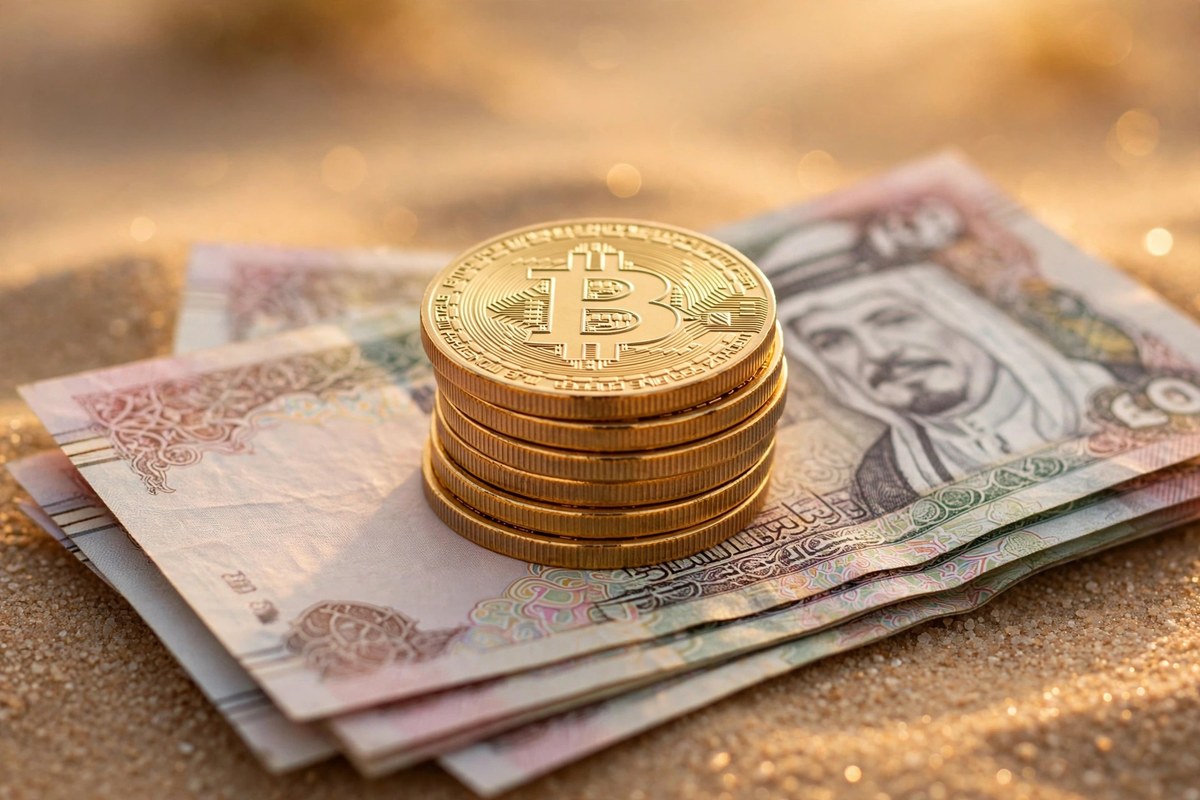
Bitcoin Tax in Saudi Arabia: The 0% Rule Explained
Saudi Arabia has no personal income tax for citizens or residents, which means there is currently no personal capital-gains tax on Bitcoin profits for individuals. Sell SAR 100,000 of Bitcoin for SAR 150,000 and the SAR 50,000 gain is yours in full — no filing, no rate, no paperwork. That is the single biggest financial advantage of buying Bitcoin as a Saudi resident, and it is the reason the Kingdom appears on every "best countries for crypto tax" list despite having no crypto regulation at all.
The picture changes for businesses. Companies pay corporate income tax of 20% on foreign-owned entities, and Zakat of 2.5% applies to Saudi and GCC-owned entities — so a trading company holding crypto is taxed very differently from an individual. VAT (15%) can also apply to some exchange services and fees. And the 0% personal rate is a feature of the tax system, not a crypto exemption: if Saudi Arabia ever introduces personal income tax, crypto gains would almost certainly be swept into it.
What Most People Get Wrong About Buying Bitcoin in Saudi Arabia
Myth 1: "Bitcoin is banned in Saudi Arabia." It is not. No law criminalises individual ownership. What is banned — or rather, unlicensed — is banks dealing in crypto and any domestic exchange operating without a licence that does not yet exist. Millions of Saudis trade openly, and the grey zone is about institutions, not individuals.
Myth 2: "If my bank blocks the transfer, I can't buy Bitcoin." Bank friction is real, but it is a payment problem, not a purchase problem. P2P markets, regional exchanges with SAR rails, and card payments on Gulf-licensed platforms all work around it. The mistake is trying the same blocked card five times and getting your account flagged — switch rails instead.
Myth 3: "0% tax means 0% risk." Tax is only one cost. The real risks are P2P scams, unlicensed platforms with no regulator to complain to, and leaving coins on an exchange. The 0% tax rate saves you money only if you do not lose the principal first.
Myth 4: "I need SAR 285,000 to buy Bitcoin." You can buy a fraction of a coin for SAR 100. At roughly $76,000 per coin, SAR 500 buys about 0.00175 BTC. Fractional buying is how almost every Saudi first-timer starts, and it is the sensible way to learn the process before committing serious money.
Myth 5: "Any exchange that accepts Saudis is safe." No. With no domestic licensing regime, the only trust signals are foreign licences — VARA, the Central Bank of Bahrain, ADGM's FSRA — plus cold-storage practices and a clean security record. An unlicensed platform offering "zero fees" is not a bargain; it is a warning sign.
5 Checks Before You Buy Bitcoin in Saudi Arabia
Run through this checklist before your first purchase — it filters out most of the ways Saudi buyers lose money.
- Check the licence first: confirm the platform on VARA's public register, the ADGM FSRA register, or the Central Bank of Bahrain's licensee list before depositing anything.
- Check the real fee, not the headline fee: add the spread to the trading fee — a "0% commission" platform can still charge 0.5% inside its quoted price.
- Check the SAR rail before you need it: test a small SAR bank transfer or mada payment first; never discover your card is blocked on a SAR 20,000 order.
- Check the P2P seller's record: only trade inside escrow, only with sellers who have hundreds of completed trades and a 98%+ completion rate, and never pay outside the platform.
- Check your exit before your entry: know how you will withdraw — to your own wallet, and eventually back to SAR — before you buy, not after the price moves.
Bitcoin at $76,000: Why Saudis Are Buying Now
Timing matters, and the current moment is unusually interesting for Saudi buyers. Bitcoin trades near $76,000 in early November 2026, roughly 40% below its $126,080 all-time high, after a week in which US spot Bitcoin ETFs recorded $430 million of outflows in a single day and $1.5 billion across seven days. The Fear and Greed Index sits at 28 — firmly in fear territory — and on-chain data shows the market near capitulation levels, with the MVRV ratio around 1.4 and the SOPR at roughly 0.97.
None of that is a buy signal on its own. But the combination — a 40% drawdown, fear readings, ETF flows turning negative for the year, and a 0% personal tax rate on any recovery — is exactly the setup that has historically rewarded patient buyers in the Kingdom. The counterweight is real: the US Federal Reserve's December hike odds sit near 79%, and Bitcoin is sitting almost exactly on its 50-week moving average near $75,550. Buying in tranches — a little each week rather than everything at once — is the standard answer to that uncertainty, and it works particularly well when every purchase is tax-free.
Frequently Asked Questions
Is Bitcoin legal in Saudi Arabia?
Owning and trading Bitcoin as an individual is not criminalised under Saudi law, but Bitcoin is not legal tender, no domestic exchange is licensed, and SAMA bars Saudi banks from facilitating crypto transactions without its approval. Most residents buy through Gulf-licensed regional platforms or international exchanges.
Do I pay tax on Bitcoin profits in Saudi Arabia?
No. Saudi Arabia levies no personal income tax, so individuals currently pay 0% tax on Bitcoin gains. Businesses are different: corporate income tax of 20% applies to foreign-owned entities and Zakat of 2.5% to Saudi/GCC-owned entities, and VAT can apply to some services.
Can I buy Bitcoin with mada in Saudi Arabia?
Yes, on regional platforms such as Rain and BitOasis, which accept mada debit cards and SAR bank transfers. International exchanges often decline Saudi cards, so if your card is rejected, switch to a SAR bank transfer or a P2P purchase inside the platform's escrow system.
Which exchange is best for beginners in Saudi Arabia?
Rain is the best first choice for most Saudi beginners: free SAR bank transfers, an Arabic app, a Central Bank of Bahrain licence plus ADGM and VARA licences, and Pro fees as low as 0%. Binance is cheaper per trade (0.10%) but its P2P route and complex interface suit more confident users.
Can I buy Bitcoin directly with Saudi riyals?
Yes. Rain accepts SAR bank transfers with no deposit fee, and P2P markets on Binance and Bybit let you pay sellers directly in SAR. There is no SAR trading pair on most global exchanges, so the riyal leg usually happens through the bank transfer or P2P step, with the crypto leg priced in dollars or USDT.
How much Bitcoin can I buy with SAR 1,000?
At about SAR 285,000 per coin, SAR 1,000 buys roughly 0.0035 BTC after fees. There is no minimum whole-coin purchase, so SAR 100 is enough to start.
Conclusion
Saudi Arabia is the Gulf's strangest crypto market: 0% personal tax on Bitcoin gains, an estimated 3–5 million residents trading, and not a single licensed domestic exchange. That contradiction defines the buying process. Skip the banks — they cannot help you — and go straight to a Gulf-licensed platform: Rain for the simplest SAR bank transfer and the lowest friction, Binance for the lowest fees if you can handle P2P, OKX or Bybit for active trading, Crypto.com for an all-in-one app. Pay by SAR bank transfer, buy in tranches, and move your coins to a wallet you control the same day you buy them. The 0% tax rate is a genuine edge — but only for buyers who survive the grey zone with their coins intact.
This article is for informational purposes only and does not constitute financial, tax or legal advice. Cryptocurrency regulation in Saudi Arabia is evolving; verify current requirements with SAMA, the Capital Market Authority and a qualified local adviser before acting.