How to Buy Bitcoin Safely After the $6.3B Binance Hack: 10 Checks Before You Send a Dollar
Bitcoin trades near $77,000 after a $6.3 billion Binance hack and $643 million in ETF outflows — here is the 10-check safe way to buy your first BTC, from picking a regulated exchange to moving coins to cold storage.
Payoff first: the safe way to buy Bitcoin in one paragraph
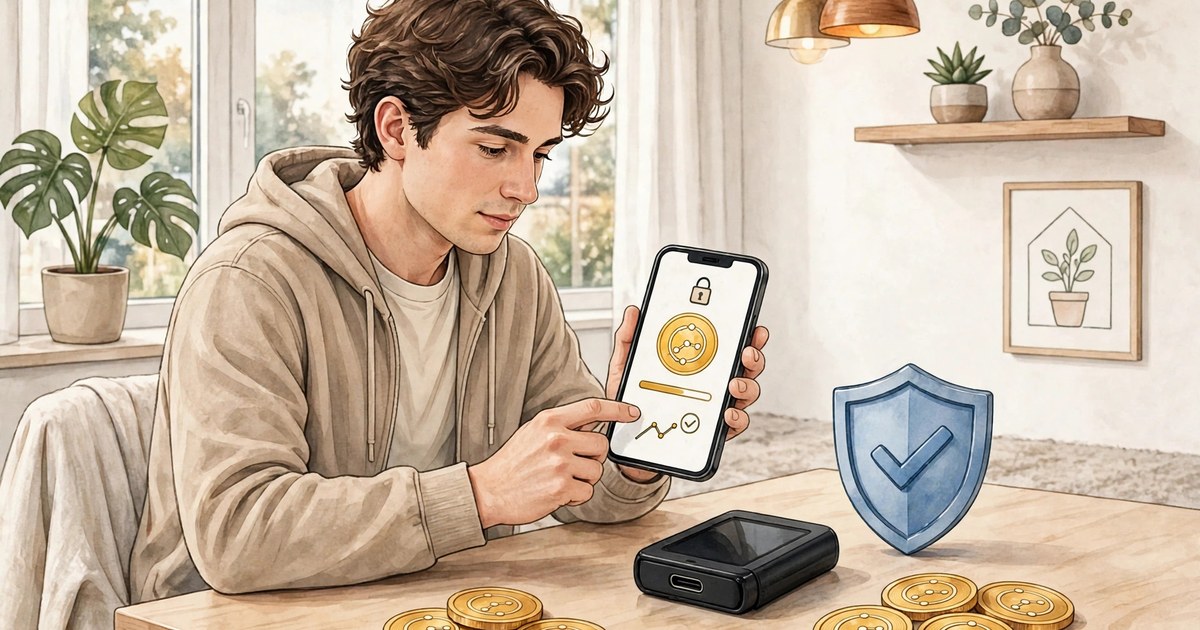
Bitcoin trades near $77,000 on October 31, 2026, days after hackers drained an estimated $6.3 billion from Binance hot wallets and U.S. spot Bitcoin ETFs lost $643 million in a single day. If that sentence makes you nervous about buying your first Bitcoin, good — it should make you careful, not fearful. The safe way to buy Bitcoin has not changed because of the hack, but the stakes of skipping steps have never been clearer: buy on a regulated exchange, start with a small test amount, turn on app-based two-factor authentication, and move anything you plan to hold long-term into a wallet only you control. Do those four things and you avoid almost every way beginners actually lose money. Skip them, and you are trusting a single company, a single password, or a single stranger's promise with money that Bitcoin transactions, once confirmed, cannot be reversed to recover.
What just happened — and why it matters to a first-time buyer
On October 29, attackers compromised Binance hot wallets and drained an estimated $6.3 billion in crypto, according to Binance's own estimate as reported across the market on October 31. Binance says it has set aside more than $6.34 billion of its own funds to restore customer balances, with about $5 billion already held in the exact tokens taken, and about $3 billion of the stolen assets frozen on-chain. Withdrawals were paused while the exchange ran security checks, with a phased restart targeted within about 34 hours and proof-of-reserves results due by November 2. Deposits, Binance said, were unaffected.
The market reaction was fast and measurable. Bitcoin traded at about $77,177 on October 31, down 0.9% over 24 hours and 4.3% over seven days, roughly 39% below its October 2025 all-time high near $126,080, according to CoinGecko data cited in October 31 market reporting. About $427 million in leveraged positions were liquidated in 24 hours, affecting roughly 93,000 traders, most of them long positions betting prices would rise. U.S. spot Bitcoin ETFs recorded $643.33 million in net outflows on Friday, October 30, led by BlackRock's IBIT at $233.7 million and Fidelity's FBTC at $201.04 million, ending a four-day inflow streak. The Crypto Fear and Greed Index sat at 30, firmly in Fear, down from 51 a week earlier.
There is a second, quieter number that matters even more for safety. Cryptocurrency scams cost Americans more than $11.4 billion in 2025, with average losses topping $62,000 per victim, according to FBI data covered in 2026 safety reporting. Scammers do not wait for hacks to create urgency; they ride them. In the days after a major breach, fake "Binance support" accounts, fake refund portals, and fake recovery services multiply. If anyone contacts you first about your crypto, offers to recover funds, or asks for your seed phrase, that is the scam, not the solution. No legitimate exchange, wallet company, or support agent will ever ask for your recovery phrase.
Step 1: Decide what you are actually buying
Before you open any app, settle three decisions. First, how much can you afford to lose without changing your life? Bitcoin fell roughly 39% from its peak in a year and dropped about 4% in a single week around the hack. A first purchase of $50 or $100 is enough to learn the mechanics — account setup, order placement, withdrawal, and storage — without turning a normal market swing into a personal crisis. Second, are you buying to hold for years or to trade? Holders need cold storage; traders need an exchange with deep liquidity and low fees, and they accept the risk of leaving funds on a platform. Most beginners who lose money are neither: they buy to hold, then leave everything on an exchange indefinitely, taking trader-level platform risk for holder-level patience. You also do not need a whole coin to start — see what a satoshi is and what $100 buys at current prices. Third, what does "owning Bitcoin" mean to you? If your coins sit on an exchange, the exchange holds the private keys. You own a claim on Bitcoin. If you move coins to a wallet whose seed phrase only you hold, you own Bitcoin itself.
Step 2: Pick a regulated exchange — and check it like a sceptic
For most beginners, a regulated exchange remains the clearest on-ramp: an account, identity verification, a bank transfer or card payment, and a buy button. Coinbase remains the simplest first stop for U.S. users, with an app that handles card and bank purchases and educational prompts inside the interface. Kraken offers lower fees once you graduate past simple buys, with maker-taker rates around 0.25% on its Pro interface and regular proof-of-reserves reports. Gemini offers a similar regulated experience, and River focuses on Bitcoin alone. None of these names is a guarantee — regulation, insurance, and proof of reserves reduce risk, they do not eliminate it, as the Binance hack proved for the world's largest exchange.
Run these checks before you deposit: Is the exchange licensed or registered in your country, and can you find that registration without trusting an ad? Does it publish proof-of-reserves or audited attestations, and how recent are they? Does 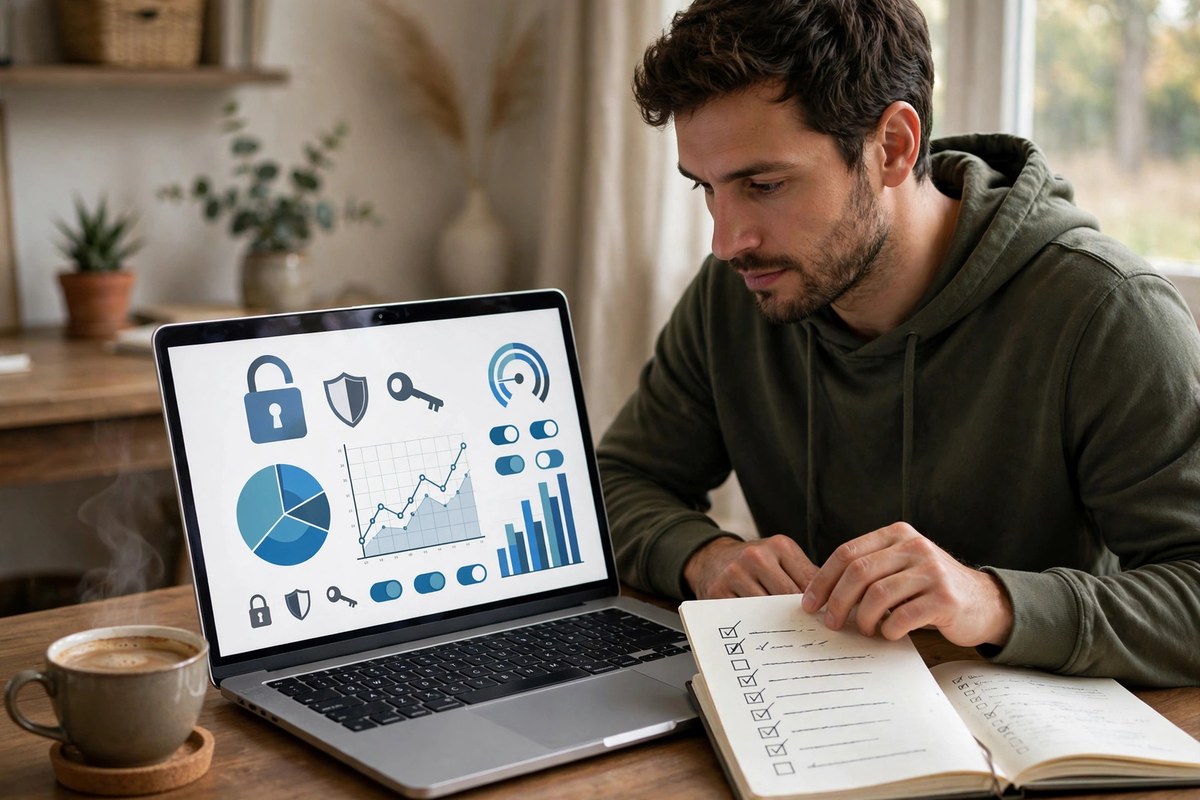 it support withdrawals to your own wallet, without a lockup that traps your coins on the platform? What happened the last time it was stressed — did withdrawals pause, and for how long? What are the real fees, including the spread, not just the advertised trading fee? And does it offer app-based two-factor authentication rather than SMS alone?
Exchange comparison: what beginners actually pay and risk
The table below compares the beginner experience across the platforms most first-time buyers consider. Fees change — confirm them on the platform's own fee page before you buy.
| Platform | Best for beginners | Typical beginner cost | Self-custody withdrawal | Safety note |
|---|---|---|---|---|
| Coinbase | Simplest first buy, in-app education | Higher on simple buy; lower on advanced trade | Yes, to your own wallet | Regulated, insured holdings, app-based 2FA |
| Kraken | Lower fees after the first buy | Pro maker-taker around 0.25% | Yes, to your own wallet | Regular proof-of-reserves reports |
| Gemini | Regulated, straightforward experience | Mid-range, varies by order type | Yes, to your own wallet | Regulated U.S. exchange |
| River | Bitcoin-only buyers | Varies; recurring buys available | Yes, to your own wallet | No altcoin clutter, Bitcoin focus |
| PayPal / Venmo / Cash App | Buying inside an app you already use | Spread plus fee; check before confirming | Yes, subject to verification tiers and limits | Convenient, but confirm withdrawal terms first |
| Bitcoin ATMs | Cash buyers without a bank account | About 8% to 20% — the most expensive route | Yes, to your wallet address | Avoid for regular buys; fees are punishing |
Step 3: Secure the account before you fund it
Security setup takes ten minutes and prevents the most common beginner loss: account takeover. Use a unique password you do not reuse anywhere else, stored in a password manager. Turn on two-factor authentication with an authenticator app — Google Authenticator, Authy, or a hardware security key — before your first deposit, not after. SMS-based two-factor is vulnerable to SIM-swapping, where an attacker convinces your mobile carrier to move your number to their SIM and then resets your passwords. Use a secure email address for the exchange account, also protected by app-based two-factor. Turn on withdrawal address whitelisting if the platform offers it, so even a compromised account cannot send coins to a new attacker address without a delay. And bookmark the real exchange website; phishing copies of exchange login pages are one of the cheapest scams to run and one of the most effective against beginners in a hurry.
Complete identity verification, known as KYC, before you need to trade urgently. Regulated platforms require a government ID, and a platform that lets you buy large amounts with no checks is a red flag, not a convenience.
Step 4: Make a small test purchase first
Place a market order for your test amount — $50 to $100 is enough — and confirm the exact Bitcoin quantity credited after fees. Then, before you buy more, practice the skill that actually protects you: withdraw a small amount to your own wallet. A test withdrawal proves three things at once: that you control a wallet address, that you can copy it correctly, and that the exchange will actually let your coins leave. Send a tiny amount first, wait for confirmation, verify it arrived, and only then move a larger amount. Check the first and last few characters of the wallet address before you hit send; malware on an infected device can silently swap a copied address for an attacker's own. Never type an address by hand if you can scan a QR code or paste from your wallet app, and never trust an address sent to you in a chat message or email without verifying it through a second channel.
Step 5: Move what you hold into self-custody
Hot wallets — free apps and browser extensions that stay connected to the internet — suit small, frequent amounts but are more exposed to malware. Cold wallets — hardware devices in the $50 to $200 range from makers like Ledger and Trezor that keep private keys offline — are the safer default for anything you plan to keep. The rule of thumb used across 2026 safety guides is consistent: move anything above roughly $1,000 into cold storage, and keep only what you are actively trading on an exchange. Our full storage manual, how to store crypto safely with cold storage and seed phrases, covers device setup, seed-phrase storage, and the inheritance question most beginners never think about until it is too late.
Your seed phrase — usually 12 or 24 words — is the master key to your wallet. Write it on paper or stamp it on metal, store it offline in a place only you can reach, and never photograph it, email it, or store it in a cloud document. Anyone with the phrase owns your coins, and no support team can reverse that. Test your backup before you trust it with a large balance: restore the wallet on a second device or in a fresh app install with the phrase, confirm the same addresses appear, and only then treat the backup as real.
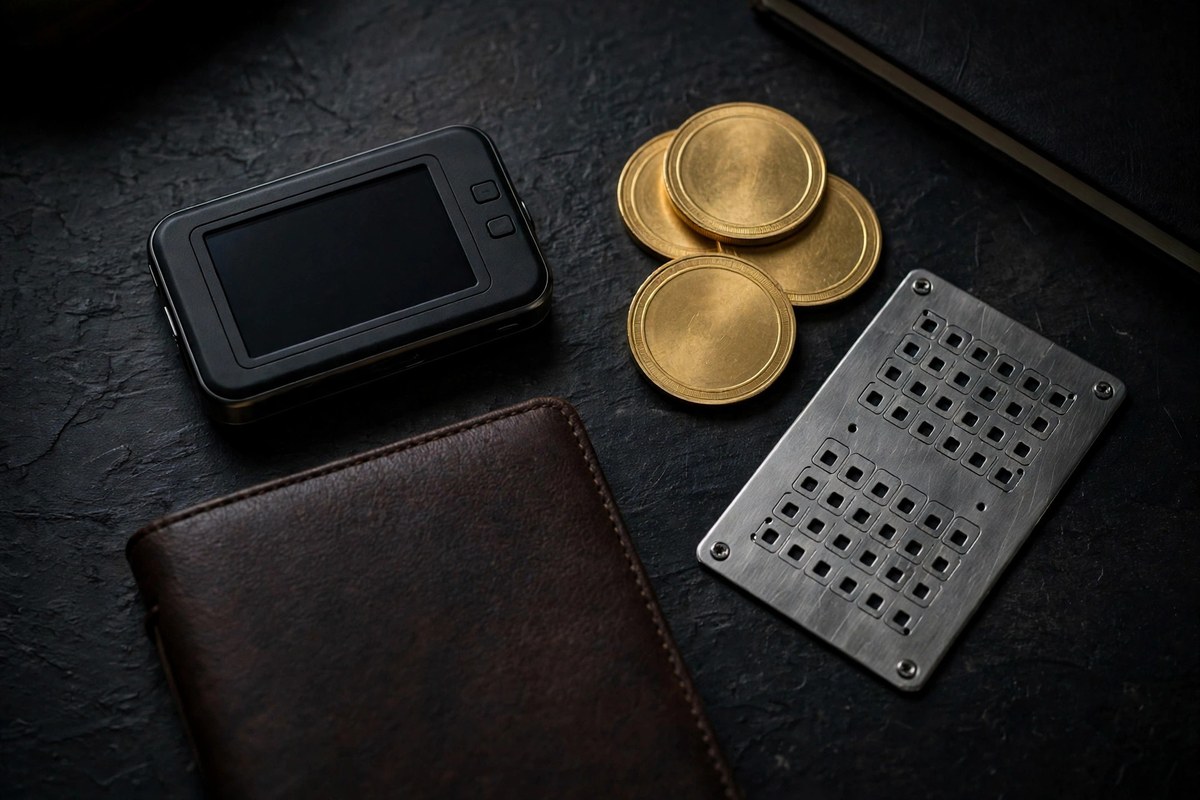
The 10 checks before you send a dollar
Print this list or keep it open on your phone for your first purchase. If any check fails, stop and fix it before you deposit.
- Regulated venue: the exchange is licensed or registered in your country and you found that registration yourself, not in an ad.
- Withdrawal proven: the platform lets you withdraw to your own wallet, and you have tested it with a tiny amount first.
- App-based 2FA on: authenticator app or security key enabled on both the exchange account and its email address; SMS-only 2FA is not enough.
- Unique password: a password used nowhere else, stored in a password manager, not written in a note or chat.
- Fees confirmed: you know the trading fee plus the spread, and the exact Bitcoin quantity you receive after both.
- Address double-checked: first and last characters of the wallet address verified, ideally via QR code, never from an unsolicited message.
- Test amount first: your first buy is $50 to $100, not your full budget, and your first withdrawal is even smaller.
- Cold storage ready: a hardware wallet or self-custody wallet is set up and its seed backup tested before a large balance lands in it.
- No one contacted you first: nobody offering guaranteed returns, recovery help, or a "support" fix reached out to you — if they did, it is a scam.
- Seed phrase offline only: the phrase is on paper or metal, never photographed, emailed, cloud-stored, or shared with anyone, including "support".
What most people get wrong about buying Bitcoin safely
Myth 1: "A big exchange cannot fail, so my coins are safe there." The Binance hack drained $6.3 billion from the world's largest exchange in one incident. Binance's $6.34 billion backstop may make customers whole, but the week of paused withdrawals is the proof: even on a solvent, well-capitalised exchange, your coins can be temporarily unreachable at exactly the moment you most want them. Size is not custody.
Myth 2: "The cheapest fee is the safest deal." The cheapest route often hides the widest spread, the weakest withdrawal terms, or no proof of reserves at all.
Myth 3: "My password is strong, so my account is safe." Passwords leak in breaches every week. Without app-based two-factor, a leaked password is a full account takeover. With it, the same leak is an annoyance. This single toggle is the highest-return safety step in this entire guide.
Myth 4: "If I lose my seed phrase, support can reset it." There is no password reset for self-custody. Lose the phrase and lose access; share the phrase and lose the coins.
Myth 5: "A dip is a deadline." Bitcoin fell from about $126,000 to about $77,000 over a year, with $427 million liquidated in a single day along the way.
Scams to recognise on sight after a major hack
After a breach, four scams surge. Fake support accounts reply to victims on social media offering to "verify" or "recover" wallets — real support never slides into your direct messages first. Fake refund portals ask you to connect your wallet or enter your seed phrase to claim compensation — Binance's real process, if any refund is owed, runs through your verified exchange account, not a random website. Guaranteed-return offers promise fixed daily profits or double-your-Bitcoin schemes — legitimate exchanges do not operate that way, and guaranteed returns in a market down 39% from its peak are a mathematical lie. And clipboard malware plus fake wallet apps wait for you to copy an address or download a lookalike app — verify app publishers, check download counts and reviews, and re-check addresses character by character.
FAQs
Is it safe to buy Bitcoin right after the Binance hack?
Buying itself, on a regulated exchange with app-based two-factor and a small test amount, remains as safe as it was before the hack — the purchase process did not change. What changed is the proof that leaving large balances on any single exchange carries real risk. Buy small, withdraw to self-custody, and treat exchange balances as temporary, not as storage.
How much Bitcoin should a beginner buy first?
Start with $50 to $100, an amount you can afford to lose, to learn the full cycle: buy, confirm, withdraw, store. Increase only after you have successfully withdrawn to your own wallet and tested your seed backup. Your first goal is competence, not position size.
Should I buy Bitcoin on an exchange or through an ETF?
An ETF gives you price exposure inside a brokerage account, with no wallet, seed phrase, or withdrawal step — but you do not own Bitcoin itself and cannot move it to self-custody. Buying on an exchange and withdrawing gives you real Bitcoin and real responsibility. Beginners who want simplicity often start with an ETF; beginners who want ownership follow this guide's custody steps. Our ETF buying guide compares the two routes in detail.
Do I need a hardware wallet for my first purchase?
Not for a $50 test buy — a reputable mobile wallet with a backed-up seed phrase is enough to learn with. Once your holdings pass roughly $1,000, or once you plan to hold for years, a hardware wallet in the $50 to $200 range is the standard recommendation, and it pays for itself the first time an exchange pauses withdrawals.
What happens if the exchange I use is hacked?
It depends on the exchange's reserves, insurance, and backstop — Binance set aside $6.34 billion to cover its $6.3 billion loss, but not every exchange could do the same, and withdrawals may pause during the response. That uncertainty is exactly why self-custody exists: coins in your own wallet are untouched by an exchange's hack, freeze, or bankruptcy.
Can I buy Bitcoin without an ID?
Regulated exchanges require identity verification, and platforms offering large no-KYC purchases are a red flag. Small peer-to-peer or ATM routes exist but carry higher fees, higher scam risk, or both. For a first buy, verified and boring beats anonymous and risky.
Conclusion: boring is the strategy
The safest Bitcoin purchase of late 2026 looks deliberately dull: a regulated exchange, a bank transfer, a $50 test buy, app-based two-factor, a small test withdrawal, and cold storage for anything you keep. The $6.3 billion Binance hack, the $643 million ETF outflow day, and the $427 million liquidation day are not reasons to never buy Bitcoin. They are reasons to buy it properly — because in a market that can move 39% from its peak and freeze withdrawals for days, the buyer with a tested wallet, a written seed backup, and an affordable position size is the one who sleeps through the next headline. Start small, prove every step with a test transaction, and let the boring process do the protecting.
Sources: CoinGecko and SoSoValue data via October 31, 2026 market reporting on Bitcoin near $77,177, $427 million in liquidations, and $643.33 million in ETF outflows; Binance's $6.34 billion backstop, $3 billion frozen, phased withdrawal restart and November 2 proof-of-reserves target via CoinDesk reporting summarised October 31; FBI 2025 scam losses via 2026 safety reporting. This article is educational only and is not financial advice.
Read next: How to Buy Bitcoin in 2026: A Complete Beginner's Guide and Binance Withdrawals Restarting: $6.34B Refund, Proof of Reserves on Nov 2 — 5 Checks Before You Move Your Crypto. External sources: CryptoTimes market report, October 31, CoinCentral liquidation report, CoinJuice daily Bitcoin recap, UseTheBitcoin safe-buying guide, SimpleMining beginner guide.