How to Buy Bitcoin in Denmark in 2026: 5 MiCA-Licensed Exchanges Compared — Fees, DKK Payments and the 42% Tax on Gains You Haven't Sold Yet
Denmark is the first country on earth to tax crypto gains you haven't sold yet — 42% on unrealized gains from January 1, 2026. Here are the 5 MiCA-licensed exchanges that can legally serve Danes, what each costs in kroner, and how to keep the tax bill from eating your profit.
Denmark is about to do something no country on Earth has ever done: tax you on Bitcoin gains you have not sold yet. From January 1, 2026, Danish crypto holders face a 42% tax on unrealized gains — taxed every year on the market value of your holdings, whether you sell or not. Around 450,000 people in Denmark owned crypto in 2025. This guide shows you exactly how to buy Bitcoin in Denmark in 2026: the five MiCA-licensed exchanges that can legally serve you, what each one costs in kroner, and how to keep the new tax rule from eating your profit.
Bitcoin trades near $75,900 as of November 7, 2026 — about 490,000 kroner — down roughly 40% from its $126,080 all-time high. That discount is exactly why Danes are buying now. But in Denmark, buying is the easy part. The hard part is buying on the right platform, in the right currency, and with your eyes open about a tax rule that punishes buy-and-hold investors more than any other country in Europe.
Is Bitcoin Legal in Denmark?
Yes. Buying, holding and trading Bitcoin is completely legal in Denmark. Crypto is regulated through EU law applied at the national level, split between two authorities: the Danish Financial Supervisory Authority, Finanstilsynet, supervises crypto service providers, implements the EU's MiCA regulation and enforces anti-money-laundering rules, while the Danish Tax Agency, Skattestyrelsen, handles everything tax-related.
The important date was July 1, 2026. That is when the EU's MiCA transition period ended. Since then, only platforms holding a Crypto-Asset Service Provider (CASP) licence — issued by Finanstilsynet or passported in from another EU regulator — may legally serve Danish customers, as DataWallet's Denmark exchange guide confirms. Any exchange without a MiCA licence should not be taking your money. Every exchange in this guide holds one.
Danish banks are not hostile to crypto either. Danske Bank has never blocked payments to exchanges, and since February 2026 it has listed three crypto ETPs from BlackRock and WisdomTree that track Bitcoin and Ethereum, available through Danske eBanking after a suitability questionnaire. If you want coins you can withdraw to your own wallet, though, you still need a MiCA-authorised exchange — a bank ETP is not the same as owning Bitcoin. If you are new to the whole process, start with our complete beginner's guide to buying your first Bitcoin before you pick a platform.
The 5 Best Exchanges to Buy Bitcoin in Denmark Compared
Here is the short version. All five hold a MiCA licence that covers Denmark. The differences are fees, how you pay in kroner, and how beginner-friendly each one is. Fee figures below are drawn from CryptoWinRate's Denmark comparison and DataWallet's Denmark guide.
| Exchange | MiCA licence | Bitcoin trading fee | Paying from Denmark | Best for |
|---|---|---|---|---|
| Bybit EU | Austria (FMA) | 0.10% | Free SEPA in euros, cards, Apple Pay, Google Pay | Lowest fees |
| Kraken | Ireland (Central Bank of Ireland) | 0.25% / 0.40% | Free SEPA in euros, cards | Security and proof of reserves |
| Coinbase | Luxembourg (CSSF) | 0.40% / 0.60% | SEPA in euros, cards, Apple Pay, Google Pay | Absolute beginners |
| Bitpanda | Austria (FMA) | 1.49% spread | DKK bank transfer, SEPA, cards | Paying directly in kroner |
| OKX EU | Malta (MFSA) | 0.10%–0.20% | SEPA, cards, Apple Pay, Google Pay, PayPal | widest payment options |
What does that fee gap mean in real money? On a 10,000 kr Bitcoin purchase, Bybit's 0.10% fee costs you about 10 kr. Coinbase at 0.40–0.60% costs 40–60 kr. Bitpanda's 1.49% spread costs roughly 149 kr — nearly fifteen times more than Bybit for the same coins. Over a year of regular buying, that gap runs into thousands of kroner. Fees are not the whole story — Bitpanda is the only one on this list that takes kroner directly — but they are the first thing to check.
Bybit EU — The Cheapest Way for Danes to Buy Bitcoin
Bybit EU is the lowest-cost option on this list, with a flat 0.10% spot trading fee and free SEPA deposits. It operates its European service under a MiCA licence from Austria's Financial Market Authority (FMA), and its EU entity onboards Danish residents directly. The platform lists more than 2,000 coins, plus copy trading, grid bots and an Earn programme for passive yield.
The catch for Danish buyers is currency. There is no direct krone bank transfer channel, so you fund your account with a euro SEPA transfer (free) or a card, and your bank converts kroner to euros. Danske Bank accounts operate in kroner, so every euro deposit involves a conversion — check your bank's exchange rate before you send a large amount. Bybit is the best pick if you buy regularly and want the fee gap working for you instead of against you.
Kraken — The Security-First Choice
Kraken holds its MiCA licence from the Central Bank of Ireland and has the cleanest security record of any large exchange: proof of reserves and no major hack in its history. Fees are 0.25% on Kraken Pro and 0.40% on the simple interface — more than Bybit, less than Coinbase's top rate.
Funding works the same way as Bybit: free SEPA in euros or a card payment. Kraken also offers staking and clean tax exports, which matters more than usual in Denmark — with the new mark-to-market tax, you will need accurate year-end valuations, and Kraken's reporting tools make that far less painful.
Coinbase — The Easiest First Purchase in Denmark
Coinbase is the simplest place for a Danish beginner to buy their first Bitcoin. It is a Nasdaq-listed public company, holds a MiCA licence through Luxembourg's CSSF, and keeps onboarding short: ID verification and you can buy within minutes. Fees are 0.40% on Coinbase Advanced and 0.60% on the simple buy screen — the highest on this list alongside Bitpanda — so you pay for the convenience.
Coinbase also has built-in tax tools and staking, and its brand recognition means Danish banks rarely flag its payments. If you want the smoothest possible first purchase and you are buying a modest amount, Coinbase is the right starting point. Just move to a cheaper platform once you know what you are doing — the fee difference compounds fast. And whatever exchange you choose, do not leave large holdings sitting on it: read our comparison of the best crypto wallets for beginners in 2026 and move your Bitcoin to a wallet you control.
Bitpanda — The Only One That Takes Kroner Directly
Bitpanda is the only exchange in this comparison that accepts a direct DKK bank transfer. That is a genuine advantage: no euro conversion, no card foreign-exchange fee, no guessing what your bank will charge. It holds a MiCA licence from Austria's FMA and offers crypto alongside stocks, ETFs and precious metals in one app.
The price of that convenience is the 1.49% spread — the widest on this list. On a 10,000 kr purchase you pay about 149 kr in spread, versus 10 kr on Bybit. Bitpanda makes sense for occasional buyers who value paying in kroner above all else, and for investors who want crypto next to their stock portfolio. For regular buyers, the spread adds up to real money over a year.
OKX EU — The Most Ways to Pay
OKX EU runs under a MiCA licence from the Malta Financial Services Authority and offers the widest funding menu for Danish buyers: SEPA, bank transfer, cards, Apple Pay, Google Pay and even PayPal. Spot fees sit around 0.10–0.20%, close to Bybit's level. One thing to know: OKX settled with US authorities in early 2025 over anti-money-laundering failings. That does not affect its EU licence or Danish customers, but it is worth knowing before you choose it over Kraken or Coinbase.
How to Buy Bitcoin in Denmark: Step by Step
Here is the process that works on every exchange above:
- Pick a MiCA-licensed exchange. Use the comparison table above. Beginners should start with Coinbase or Kraken; fee-conscious buyers should pick Bybit EU.
- Create your account and verify your identity. You will need a government ID and a selfie or face scan. Danish residents verify with MitID for bank-linked steps. Verification usually takes minutes, occasionally up to a day.
- Fund your account. Send euros by SEPA (free on most platforms, one business day) or pay by card for instant funding. Bitpanda is the only option for a direct DKK bank transfer. Remember: MobilePay cannot pay an exchange — it is limited to person-to-person and merchant payments.
- Place your Bitcoin order. On the simple buy screen, enter the amount in kroner or euros and confirm. On the Pro/Advanced screen, use a limit order to control the exact price you pay.
- Move your Bitcoin to your own wallet. Exchanges get hacked; your own wallet does not. A hardware wallet is the safest home for holdings you plan to keep for years.
- Record everything for Skattestyrelsen. Screenshot or export every trade, deposit and year-end balance. From 2027, exchanges must report your transactions to the Danish tax authorities automatically — but keeping your own records is still your responsibility.
Paying in Kroner: The DKK Problem Every Danish Buyer Hits
Denmark uses the krone, not the euro, and that creates friction most guides skip:
- MobilePay does not work for crypto. Denmark's everyday payment app — created by Danske Bank and now merged into Vipps MobilePay — is limited to person-to-person and merchant payments. It cannot fund an exchange account.
- Instant krone transfers do not reach exchanges. Straksoversførsler, Denmark's instant transfer system, only reaches Danish accounts. It cannot fund a euro IBAN.
- Most exchanges want euros. Bybit, Kraken, Coinbase and OKX all take SEPA transfers in euros. Your Danish bank converts kroner to euros, usually at its own exchange rate plus a small margin. On a 10,000 kr deposit that conversion typically costs 25–75 kr depending on your bank.
- Cards are the fastest workaround. A Danish Visa or Mastercard funds your exchange account instantly, but card deposits often carry a 1–2% fee on top of the trading fee. Use a card for your first small purchase, then switch to SEPA for larger amounts.
- Bitpanda is the exception. It accepts DKK bank transfers directly, which is why it survives on this list despite the widest spread.
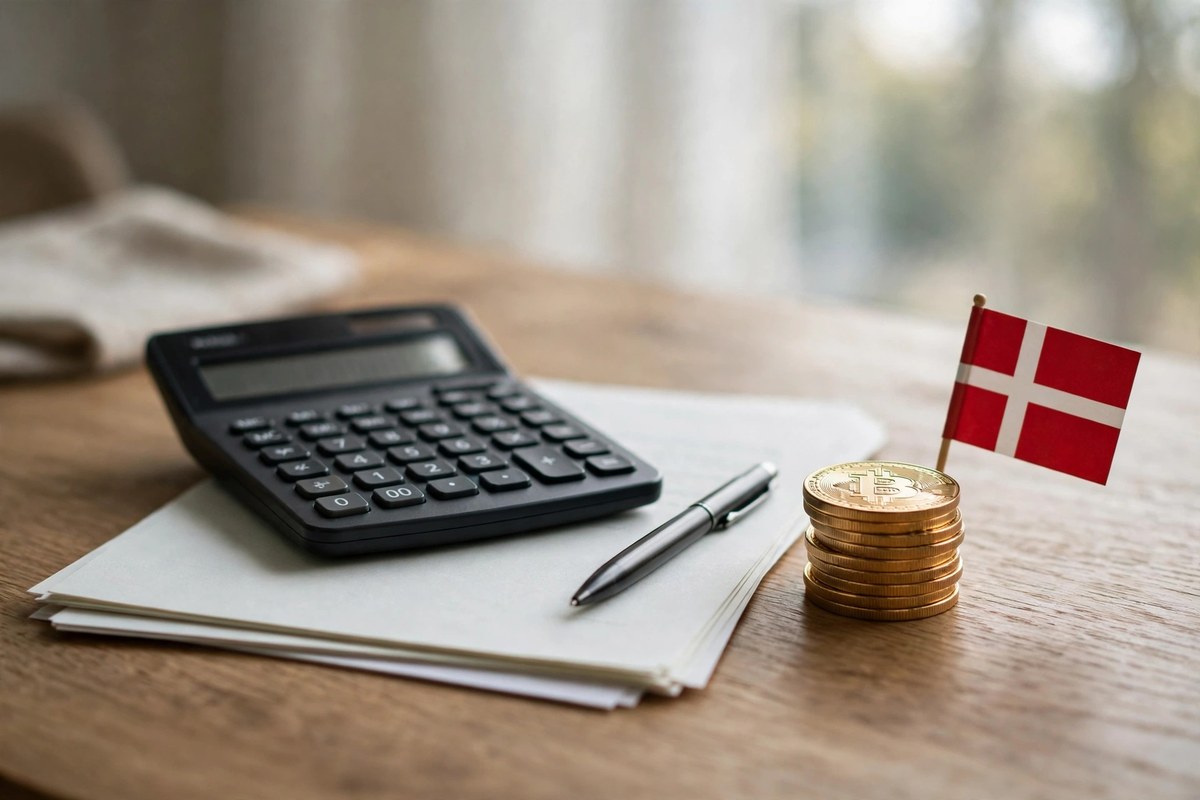
The 42% Tax Rule: Denmark Will Tax Gains You Have Not Sold Yet
This is the part of the guide that matters most, and the reason Denmark is unlike any other country in this series. Denmark is set to become the first country in the world to tax unrealized crypto gains. Here is what the rule means in practice:
- From January 1, 2026, crypto holdings are taxed on a mark-to-market basis: you pay tax each year on the increase in your holdings' value, whether you sold anything or not.
- The rate is 42% — the top rate of capital income tax in Denmark — applied to your annual gain.
- It applies to crypto acquired since Bitcoin's launch in 2009, not just coins bought after the law takes effect. Your existing holdings are in scope.
- Losses are deductible under the same system, which is the one genuine improvement: under the old rules, losses were often hard to claim.
- From 2027, crypto platforms operating in Denmark must report your transactions to Skattestyrelsen automatically.
The reform was recommended by Denmark's Tax Law Council in October 2024 and backed by Tax Minister Rasmus Stoklund, who said the aim was to tax crypto traders "more appropriately" and bring crypto in line with how Denmark already taxes other financial assets. Denmark's roughly 300,000 crypto holders are directly affected, according to Financial News and Coinspeaker's reporting on the proposal.
What the 42% rule costs you: a worked example
| Scenario (1 BTC bought at 300,000 kr) | Year-end value | Unrealized gain | Tax due (42%) |
|---|---|---|---|
| Bitcoin rises 20% in 2026 | 360,000 kr | 60,000 kr | 25,200 kr |
| Bitcoin rises 50% in 2026 | 450,000 kr | 150,000 kr | 63,000 kr |
| Bitcoin falls 20% in 2026 | 240,000 kr | −60,000 kr | 0 kr (loss carried) |
Read that first row twice: you owe 25,200 kr in tax on a gain you never cashed in. If Bitcoin doubles and you hold, the bill grows with it — and you need kroner from somewhere else to pay it, because you have not sold anything. That is the cash-flow trap of mark-to-market taxation, and it is why Danish buyers should keep a cash buffer instead of putting every spare krone into Bitcoin. For the full picture on reporting and deductions, see our complete 2026 crypto tax guide — and consider talking to a Danish tax adviser before your first big purchase, because this article is not tax advice.
5 Mistakes Danish Bitcoin Buyers Make
Most of these mistakes cost real money. All of them are avoidable.
- Buying on an unlicensed platform. Since July 1, 2026, only MiCA-licensed exchanges may serve Danes. An unlicensed platform offers no investor protection, and your bank may block the payment anyway.
- Ignoring the 42% tax until April. Under mark-to-market, your tax bill is set by your December 31 balance. Check your portfolio value before year-end and set cash aside — do not discover the bill when Skattestyrelsen sends it.
- Paying by card for every purchase. Card deposits are instant but often add 1–2% on top of the trading fee. A free SEPA transfer costs nothing and takes a day. For regular buyers, the difference is hundreds of kroner a year.
- Leaving Bitcoin on the exchange. Exchanges are hacked, frozen and bankrupted — Binance itself reopened withdrawals in November 2026 after a hack it puts at $6.3 billion. Move your coins to a wallet you control.
- Buying the top of a hype cycle. Bitcoin is down about 40% from its all-time high, which looks like a discount — but it also fell 5% in a single day in November 2026 when the Nasdaq sold off. Buy in regular amounts over time instead of one lump sum at the worst moment. Our guide on whether Bitcoin is a good investment in 2026 walks through the risks honestly.
What Most People Get Wrong About Buying Bitcoin in Denmark
"MobilePay works for crypto." It does not. MobilePay is person-to-person and merchant payments only. Every Danish buyer who tries it wastes an afternoon.
"The 42% tax only applies when I sell." That was the old rule. From January 1, 2026, Denmark taxes the yearly increase in value — sold or not. This is the single most important fact in this guide.
"Any big exchange works in Denmark." Not since July 1, 2026. Only MiCA-licensed platforms may legally serve Danish customers, and the licence must come from Finanstilsynet or be passported from another EU regulator.
"Denmark's tax rule means I should not buy Bitcoin." It means you should buy with your eyes open. The 42% rate is high, but losses are deductible under the new system, and the rule applies equally to every Danish holder — it does not change whether Bitcoin itself is a good investment, only how much of the gain you keep.
Frequently Asked Questions
Is it legal to buy Bitcoin in Denmark in 2026?
Yes. Buying, holding and trading Bitcoin is legal in Denmark. Since July 1, 2026, you must use a MiCA-licensed exchange — one authorised by Finanstilsynet or passported from another EU regulator. Finanstilsynet supervises providers and Skattestyrelsen handles tax.
How much tax do I pay on Bitcoin in Denmark?
From January 1, 2026, Denmark taxes crypto on a mark-to-market basis at up to 42% of your annual gain — including gains you have not realised by selling. Losses are deductible under the same system. Exchanges must report your transactions to the tax authorities from 2027. Talk to a Danish tax adviser for your personal situation.
Can I buy Bitcoin with MobilePay?
No. MobilePay is limited to person-to-person and merchant payments and cannot fund an exchange account. Danish buyers fund exchanges by SEPA bank transfer in euros, by card, or — on Bitpanda only — by direct DKK bank transfer.
What is the cheapest exchange to buy Bitcoin in Denmark?
Bybit EU, at a flat 0.10% spot fee with free SEPA deposits — about 10 kr on a 10,000 kr purchase. Kraken Pro charges 0.25%, Coinbase 0.40–0.60%, and Bitpanda's 1.49% spread is the most expensive on this list, though it is the only one that takes kroner directly.
Which Danish banks allow crypto purchases?
Danske Bank has never blocked payments to exchanges and now lists BlackRock and WisdomTree Bitcoin and Ethereum ETPs. Most Danish banks allow transfers to MiCA-licensed exchanges, though they convert kroner to euros for SEPA payments.
Do I need to report my Bitcoin to Skattestyrelsen?
Yes. You must declare your crypto holdings and gains on your annual tax return. From 2027, exchanges must report your transactions automatically, so the tax agency will have the data whether you declare it or not. Keep your own records of every trade and your December 31 balances.
The Bottom Line
Buying Bitcoin in Denmark in 2026 is straightforward — pick a MiCA-licensed exchange, fund it by SEPA or card, and move your coins to your own wallet. Bybit EU is the cheapest route at 0.10%, Kraken is the safest long-term home, Coinbase is the easiest first purchase, and Bitpanda is the only one that takes kroner directly.
But the purchase is only half the story. Denmark's 42% tax on unrealized gains — the first of its kind anywhere in the world — means your tax bill arrives whether you sell or not. Buy with a cash buffer, track your December 31 balances, and keep records Skattestyrelsen would accept. Do that, and Denmark's toughest-in-Europe tax rule becomes a cost you planned for, not a bill that blindsides you.
Disclaimer: This article is for information only and is not tax, legal or investment advice. Danish crypto tax rules are changing — confirm your position with Skattestyrelsen or a qualified Danish tax adviser before making large purchases.