How to Store Bitcoin Safely in 2026: 3.7 Million BTC Are Already Lost Forever — 7 Steps to Make Sure Yours Isn't Next
Analysts estimate 3.7 million Bitcoin — worth about $280 billion at today's $75,730 price — are already lost forever. Most of it vanished the ordinary way: a forgotten password, a tossed hard drive, a seed phrase nobody wrote down. Here is the 7-step setup that keeps yours out of that pile.
Analysts estimate that 3.7 million Bitcoin — worth roughly $280 billion at today's price of about $75,730 — are lost forever. Nobody stole most of it. Nobody hacked it. It vanished the ordinary way: a forgotten password, a hard drive thrown in the trash, a seed phrase nobody wrote down, an owner who died without telling anyone where the keys were. Your Bitcoin is only yours as long as you can still reach it, and this guide shows you the exact 7-step setup that keeps your coins out of that pile.
Storing Bitcoin safely is not complicated, but it is unforgiving. There is no password-reset button, no customer service line, and no court order that can override the math. Get the setup right once, and your coins survive exchange hacks, phone theft, house fires, and your own forgetfulness. Get it wrong once, and the loss is permanent. Here is how to do it properly in 2026.
The 3.7 Million Bitcoin That Will Never Move Again
Bitcoin's code caps the total supply at 21 million coins, and about 19.9 million have already been mined. But the number of coins anyone can actually spend is far smaller. Blockchain analysts estimate that between 2.3 million and 4 million BTC are permanently out of reach, with the most commonly cited midpoint around 3.7 million — roughly one in every five Bitcoin that will ever exist.
The range is wide because the blockchain cannot label a wallet as "lost." Analysts can only infer loss from silence: coins that have not moved in five or ten years, sitting in addresses whose owners appear to have disappeared. Research by Unchained Capital found that roughly 43% of all Bitcoin has not been transacted in three or more years. Some of those coins belong to patient long-term holders. Many do not.
The most famous case is a man in Newport, Wales, who threw away a hard drive containing roughly 8,000 BTC in 2013. The drive ended up in a landfill, and a court dismissed his case to dig it up in 2025. At today's price, that hard drive holds more than $600 million worth of Bitcoin, buried under years of waste. Then there is Bitcoin's creator, Satoshi Nakamoto, whose estimated 1.1 million BTC have never moved since 2009 — about 5% of the entire supply, frozen in place whether by design or by death.
The lesson is not that Bitcoin is fragile. The lesson is that Bitcoin's security is absolute in both directions: nobody can take your coins without your keys, and nobody — not you, not your family, not a judge — can recover them once the keys are gone. Storage is the whole game.
The 4 Ways People Actually Lose Bitcoin
Before choosing a storage method, it helps to know what you are defending against. Almost every permanent loss falls into one of four buckets, and each one has a different fix.
| How Bitcoin gets lost | What it looks like | How common it is | The fix |
|---|---|---|---|
| Lost or forgotten keys | Seed phrase never written down, password forgotten, hard drive discarded | The biggest cause — millions of BTC | Written backups in two places, plus a metal backup |
| Exchange failure or hack | Platform hacked, frozen, or shut down with customer funds inside | Rare but catastrophic when it hits | Move coins to your own wallet; keep only trading amounts on exchanges |
| Phishing and malware | Fake wallet app, clipboard hijacker, "support" agent asking for your seed phrase | Growing fast in 2026 | Hardware wallet, verified downloads only, never share a seed phrase |
| No inheritance plan | Owner dies and nobody else knows the keys exist | Silent and permanent | Documented recovery plan with a trusted person |
Notice what is missing from that list: the Bitcoin network itself has never been hacked. The protocol has run for 17 years without a single successful attack on its core ledger. Every loss story is a storage story. That is good news, because storage is the one part you fully control.
The 5 Ways to Store Bitcoin, Ranked From Riskiest to Safest
There are only five places your Bitcoin can live. Each one trades convenience against security, and the right answer depends on how much you hold and how often you need it.
Keeping coins on a crypto exchange is the easiest option and the riskiest. You do not hold the private keys — the exchange does — so your Bitcoin is only as safe as the exchange's security, solvency, and honesty. The $6.3 billion Binance hack in 2026 was a brutal reminder: even the biggest platforms can be breached, and the US Treasury cutting MEXC off from American banks the same year showed that regulatory action can freeze access overnight. Exchanges are fine for money you plan to trade this week. They are not a vault.
Keeping coins in a mobile hot wallet (an app on your phone) gives you control of your keys and instant access, but the keys live on an internet-connected device. That makes them reachable by malware, phishing links, and anyone who unlocks your phone. Hot wallets are the right home for small, everyday amounts — think of it as the cash in your pocket, not the safe in your wall.
Keeping coins in a desktop wallet is a step up from mobile if the computer is clean and dedicated, but most people's everyday laptops are full of browser extensions, downloaded files, and old software — exactly the environment attackers target. A desktop wallet on a machine you also use for email and downloads is barely safer than a phone wallet.
Keeping coins on a hardware wallet is the standard answer for serious holders, and for good reason. The private keys never leave the device, transactions are signed on the device itself, and even a compromised computer cannot extract them. Our comparison of the best hardware wallets in November 2026 ranks eight devices after the Binance hack, and our broader best crypto wallets guide covers hot and cold options side by side. A hardware wallet costs roughly $80 to $150 — a rounding error against the value of the coins it protects.
Keeping coins in multisig or cold storage is the top tier. Multisig splits control across two or three keys held in different places, so losing one key — or having one stolen — does not lose the coins. Deep cold storage (a hardware wallet kept offline in a safe, with a metal seed backup elsewhere) is the setup long-term holders and families use for amounts they will not touch for years.
The 7-Step Safe Storage Setup
This is the setup to follow, in order. It takes about an hour, costs less than $200 all-in, and it is the same structure security professionals recommend for holdings of any size.
- Buy a hardware wallet from the manufacturer only. Order directly from Ledger, Trezor, or another established maker's official site — never from a marketplace seller, never second-hand. A tampered device can be pre-loaded with a seed phrase the seller already knows. Check the tamper-evident seal when it arrives.
- Generate your seed phrase on the device, offline. When you first set up the wallet, it creates a 12- or 24-word recovery phrase. This phrase IS your Bitcoin — anyone who has it controls your coins, and anyone who loses it loses them. Generate it with the device disconnected from the internet and nobody watching.
- Write the seed phrase on paper, by hand, twice. Pen and paper, in your own handwriting, on two separate sheets. Never type it into a computer, never photograph it, never store it in a notes app, a cloud drive, or an email draft. Every digital copy is a copy an attacker can reach.
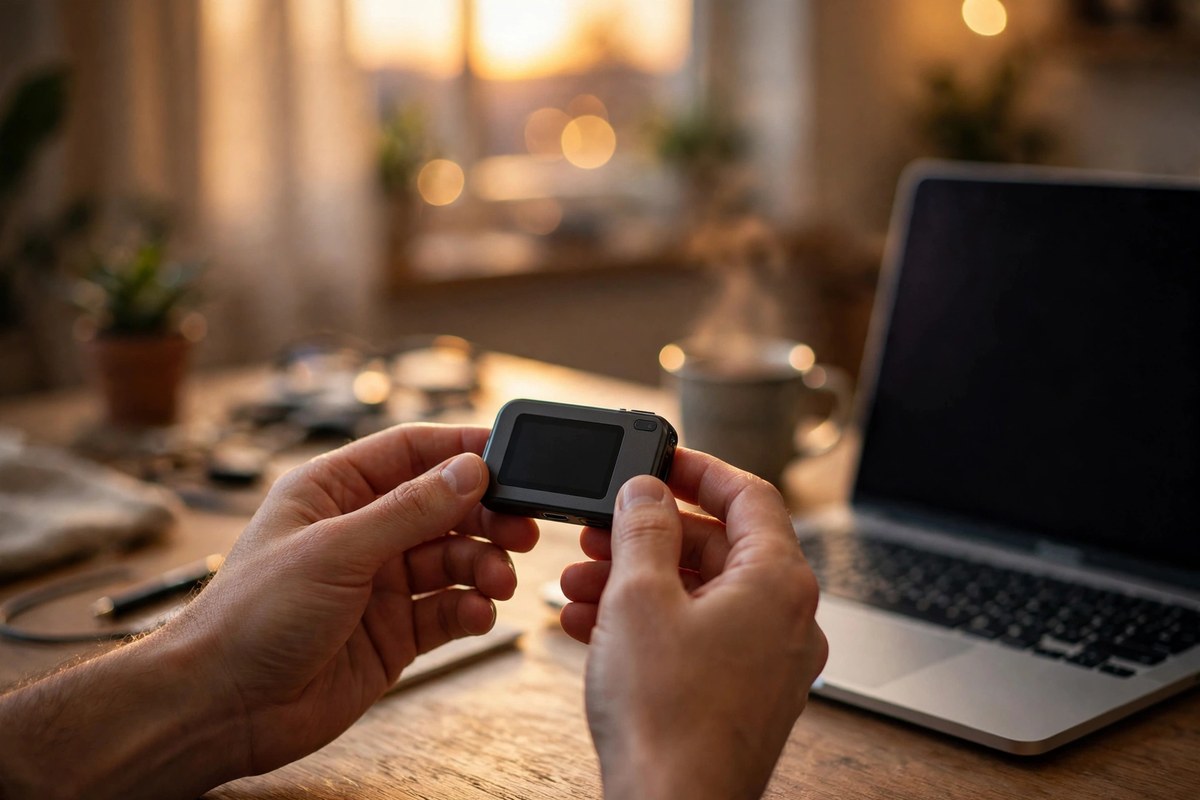
- Stamp the phrase into a metal backup plate. Paper burns, floods, and fades. A steel seed plate survives fire and water, and it costs about $50. Store the metal plate in a different place from the paper copies — a safe deposit box, a safe at a relative's house, or a home safe.
- Move your Bitcoin off the exchange in a test transaction first. Send a small amount to your new wallet, confirm it arrives, then send the rest. This catches a mistyped address before it costs you everything. Bitcoin transactions cannot be reversed.
- Verify your backup actually works before you fund the wallet fully. Reset the device (or use a second device) and restore from your written seed phrase. If the restore works, your backup is real. If it does not, you have found the problem while your coins are still on the exchange.
- Write down an inheritance plan and tell one trusted person where it is. A sealed envelope with the wallet location, the seed backup location, and simple recovery instructions — held by a lawyer, in a safe, or with a family member — is the difference between your Bitcoin passing to your family and your Bitcoin joining the 3.7 million lost coins.
5 Mistakes That Cost People Their Bitcoin
Most losses are not caused by sophisticated hackers. They are caused by confident people making ordinary mistakes. Here are the five that show up again and again.
"My exchange is too big to fail" is the most expensive assumption in crypto. Mt. Gox was the biggest exchange in the world until it collapsed with 850,000 BTC. FTX was the second-biggest until it collapsed in 2022. In 2026, the $6.3 billion Binance hack proved that size is not safety. The rule is simple: if you are not trading it this week, it does not belong on an exchange. If you are still deciding where to buy, our guide to buying Bitcoin in Europe compares MiCA-licensed exchanges by fees and safety, and the question of whether Bitcoin is a good investment in 2026 is worth settling before you store a single satoshi.
A screenshot of your seed phrase is a public document waiting to happen. Phone photos sync to the cloud. Cloud accounts get breached, phones get stolen, and old backups get restored onto new devices by people you never met. A seed phrase that has ever existed as a photo is a seed phrase that has already left your control. Paper and metal only.
"I will remember 12 words" is a bet against your own brain. Memory fades, accidents happen, and stress makes recall worse, not better. Twelve random words are not a phone number. The people who lost Bitcoin in 2013 were certain they would remember too.
One backup is the same as no backup. A single piece of paper in a single drawer is one house fire away from worthlessness. Two copies in two locations, plus a metal plate in a third, is the minimum for any holding you would miss. Redundancy is the entire point.
A hardware wallet does not make you unhackable. It protects your keys, not your judgment. The most common attack in 2026 is not breaking the device — it is tricking the owner. Fake support agents, fake wallet apps, and fake "security update" emails all ask for the same thing: your seed phrase. No legitimate company will ever ask for it, for any reason, ever. The 12 DeFi sites hijacked in a single night this year, and the Gnosis Pay breach that exposed card numbers and home addresses, both show the same pattern: the attack targets the person, not the cryptography.
What About Keeping Bitcoin on an Exchange?
Sometimes the honest answer is that an exchange is acceptable — for small amounts, for short periods, and for people who trade actively. If your total holding is a few hundred dollars and you buy and sell weekly, the friction of cold storage may cost you more in missed trades than it saves in risk. But the line is clear: the moment your holding becomes money you would be upset to lose, it belongs in your own wallet.
There is also a middle ground. Many holders keep 90% in cold storage and 10% on an exchange for trading — the same split professional funds use between vault and operating accounts. And if you hold Bitcoin through an ETF instead of owning coins directly, storage is the fund's problem, not yours. Our explainer on what a Bitcoin ETF is covers how spot ETFs work, after $1.28 billion left them in a single week.
One more thing to check before you move coins: withdrawal fees and minimums. Some exchanges charge flat fees that make small test transactions expensive, and a few impose daily withdrawal limits that stretch a large move over several days. Plan the move, do the test transaction, and do not leave the bulk of your holding sitting on an exchange while you "get around to it."
Inheritance: The Step Almost Everyone Skips
Bitcoin has no beneficiary form. There is no "next of kin" button, no probate department, and no way for your family to prove ownership to a network that only recognizes private keys. If you die without a plan, your coins are not inherited — they are lost, and they join the 3.7 million.
A workable plan needs three parts: a document that says you own Bitcoin and where the wallet is, a way for your executor to reach the seed phrase (a sealed envelope with a lawyer, a safe deposit box, or a split-key arrangement), and instructions simple enough for a non-technical person to follow under stress. Tell at least one trusted person that the plan exists and where to find it. You do not need to hand anyone your keys today — you need someone to be able to find them when you cannot help anymore.
Multisig is the strongest version of this. A 2-of-3 setup — one key with you, one with your spouse or executor, one in a safe deposit box — means no single loss or death locks the coins away, and no single theft can move them. It takes more setup, but for family holdings it is the right answer.
FAQs
Is it safe to keep Bitcoin on Coinbase or Binance?
For small amounts you trade actively, yes — major exchanges have strong security teams. For holdings you would be upset to lose, no. Exchanges get hacked, frozen, and shut down, and when they do, customers wait months or years for partial recovery, if they get anything at all. Move long-term holdings to a hardware wallet you control.
What is the safest way to store Bitcoin in 2026?
A hardware wallet bought directly from the manufacturer, with the seed phrase written on paper in two places and stamped into a metal plate stored separately. For large holdings, add multisig so no single key can move the funds alone. This setup protects against hacks, device loss, fire, and theft at the same time.
Can I store Bitcoin on a USB stick?
A USB stick can hold an encrypted wallet file, but it is not a hardware wallet. The keys are exposed to whatever computer reads the stick, USB drives fail and corrupt, and a lost stick with a weak password is a gift to whoever finds it. A dedicated hardware wallet is safer and barely more expensive.
What happens to my Bitcoin if I lose my hardware wallet?
Nothing — as long as you still have your seed phrase. The coins live on the blockchain, not on the device. Buy a new wallet, enter the 12 or 24 words, and your Bitcoin reappears. Lose the device AND the seed phrase, and the coins are gone forever. The device is replaceable. The phrase is not.
Should I tell anyone I own Bitcoin?
Tell as few people as possible, and never advertise holdings or amounts online. The fastest-growing attack in 2026 is targeted: criminals use leaked data, like the Gnosis Pay breach that exposed home addresses, to find people known to hold crypto. One trusted person should know your inheritance plan exists. Nobody else needs to know the details.
Is a paper wallet still a good idea?
Paper wallets — a printed private key — were popular years ago but are outdated now. They are easy to generate insecurely, easy to damage, and hard to spend from safely. A hardware wallet with a metal seed backup does everything a paper wallet does, better, and it is much harder to get wrong.
Conclusion
Bitcoin worth roughly $280 billion is already gone — not because the network failed, but because ordinary people made ordinary storage mistakes. The fix is not expensive or technical: a hardware wallet from the manufacturer, a seed phrase written on paper twice and stamped in steel, a test transaction before you move the bulk, and an inheritance plan someone you trust can find. Do those seven steps this week, while your coins are still reachable, and your Bitcoin stays yours — through hacks, hard-drive failures, and everything else the next decade throws at it.
This article is for informational purposes only and is not financial advice. Cryptocurrency prices are volatile and storage practices carry their own risks. Always do your own research before moving funds.