How to Buy Bitcoin in Malta in 2026: 5 MiCA-Licensed Exchanges Compared — Fees, Euro SEPA Payments and the 0% Tax Rule
Malta is the only EU country where long-term Bitcoin gains are taxed at 0% — and its regulator licensed OKX and Crypto.com before almost anyone else. We compare 5 MiCA-licensed exchanges: OKX charges €0.80 per €1,000, Coinbase €4.00. The cheapest legal way to buy BTC in Malta, step by step.
Malta Is the Only EU Country Where Your Bitcoin Gains Can Be Taxed at 0% — and Only 210 Exchanges Passed the EU's Licence Test
Here is the number that decides everything about buying Bitcoin in Malta: 0%. Long-term gains on Bitcoin held as a private investment are not taxed in Malta, because coins are not on the closed list of assets Malta's capital gains rules cover. And here is the number that decides where you buy it: only about 210 crypto firms in all of Europe held a full MiCA licence when the transition period ended on 1 July 2026 — roughly 7% of the companies that applied. Binance, the world's biggest exchange, is not one of them, and it is closing affected EU accounts on 31 December 2026.
Malta is not just another EU country with a Bitcoin guide. It wrote the EU's first crypto rulebook — the Virtual Financial Assets Act of 2018 — and its regulator, the Malta Financial Services Authority (MFSA), handed OKX and Crypto.com their MiCA licences on 27 January 2025, among the first granted to any major exchange. Buying Bitcoin in Malta in 2026 therefore means two things: pick a licensed exchange, and understand the line between tax-free investing and trading taxed at up to 35%.
Is Bitcoin Legal in Malta?
Yes — unequivocally. Bitcoin is a legal asset class in Malta, though it is not legal tender; the euro is. Malta's framework rests on three laws passed in 2018: the Virtual Financial Assets (VFA) Act, the Malta Digital Innovation Authority Act and the Innovative Technology Arrangements and Services Act. The MFSA licenses and supervises crypto firms, while the Financial Intelligence Analysis Unit (FIAU) enforces anti-money-laundering rules.
Since 30 December 2024, Malta has implemented the EU's Markets in Crypto-Assets Regulation (MiCA) through Chapter 647 of its laws, with the MFSA as the competent authority. That matters for buyers in two practical ways. First, a MiCA licence from any EU regulator is valid across all 27 member states, so a Maltese resident can legally use an exchange licensed in Ireland, Luxembourg or Austria as well as one licensed in Malta itself. Second, since 1 July 2026, an exchange without a full MiCA licence is serving EU customers illegally — there is no protection framework if your money is lost. If you are new to how Bitcoin itself works, start with our complete beginner's guide to Bitcoin before you send a single euro.
The 5 Best MiCA-Licensed Exchanges in Malta Compared
Every exchange below holds a full MiCA CASP (crypto-asset service provider) licence verifiable on the ESMA register. Fees are the published spot trading fees; card purchases and instant-buy options cost more on every platform, so the table compares like with like.
| Exchange | MiCA licence | Spot fee (maker/taker) | Cost on a €1,000 buy | Euro funding | Best for |
|---|---|---|---|---|---|
| OKX | MFSA, Malta — 27 Jan 2025 | 0.08% / 0.10% | €0.80 | SEPA, SEPA Instant, card | Lowest fees; licensed in Malta itself |
| Kraken | Central Bank of Ireland — 25 Jun 2025 | 0.25% / 0.40% | €2.50 | SEPA, SEPA Instant, card | Security record and deep euro order books |
| Coinbase | CSSF, Luxembourg — Jun 2025 | 0.40% / 0.60% | €4.00 | SEPA, card, Apple Pay, PayPal | Beginners who want the simplest app |
| Bitpanda | FMA, Austria (plus Germany and Malta) | 0.25% (Fusion) | €2.50 | SEPA, card, PayPal, Apple Pay | Buying Bitcoin next to stocks and metals |
| Crypto.com | MFSA, Malta — 27 Jan 2025 | Varies by tier | Check live schedule | SEPA, card | App, card and all-in-one ecosystem |
The fee gap is bigger than it looks. On a €1,000 purchase, OKX charges €0.80 while Coinbase charges €4.00 — five times as much. Over ten €1,000 buys in a year, that is €8 versus €40, before spreads. Coinbase earns its premium with the softest landing for a first-time buyer and quarterly audited accounts as an S&P 500 company; OKX earns its place with the lowest fees in Europe and a licence issued by Malta's own regulator. Kraken sits in the middle: its European arm, Payward Europe Solutions, holds the Irish MiCA licence alongside e-money and MiFID permissions, and it has the strongest custody record of any exchange on this list.
Two warnings belong in any honest comparison. First, OKX's Maltese entity was fined just over €1 million in April 2025 for historic anti-money-laundering shortcomings — a licence is a floor, not a guarantee. Second, Crypto.com and Gate both hold MFSA MiCA licences yet still list Malta on their restricted-countries pages, so Maltese residents should attempt sign-up and let the exchange confirm availability rather than assuming access. A licence is also not a lifetime guarantee: Austria's FMA banned KuCoin's EU arm from onboarding new customers in February 2026 over compliance staffing gaps, even after it had been licensed.
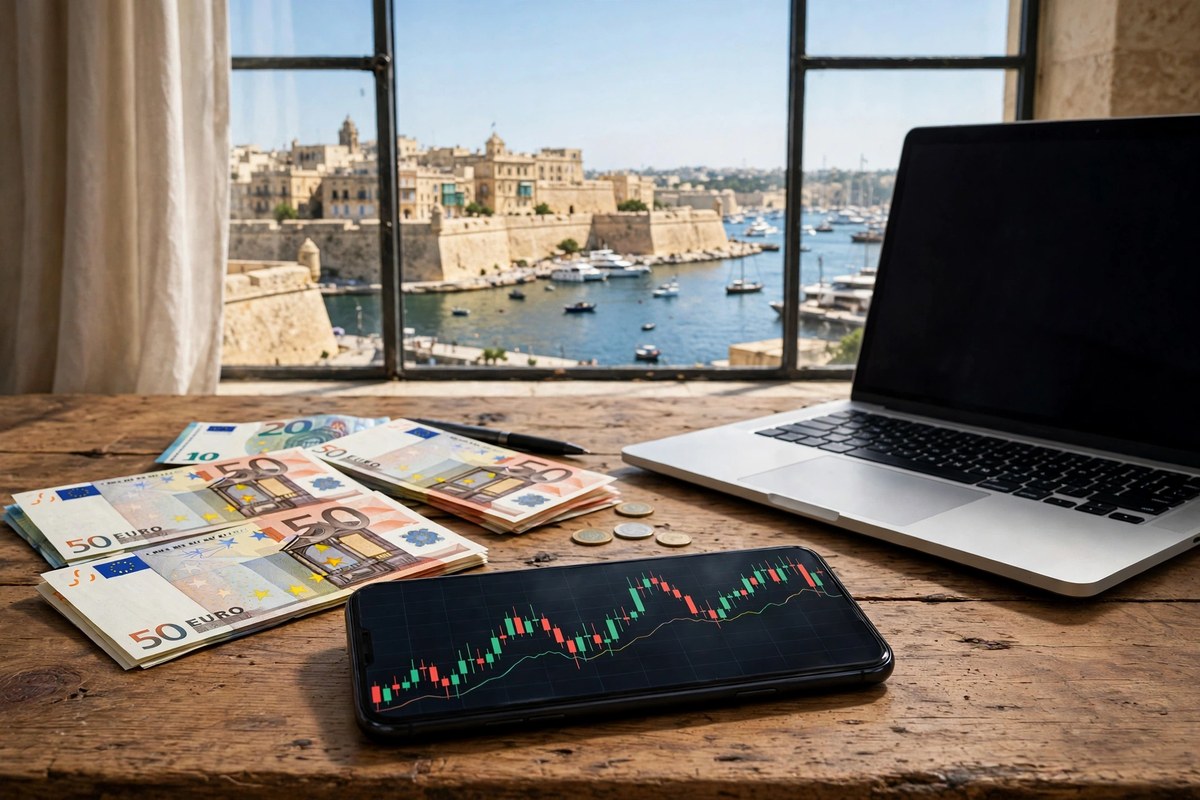
How to Buy Bitcoin in Malta: Step by Step
Buying your first Bitcoin in Malta takes about 20 minutes once your documents are ready. The steps are the same on every licensed exchange; only the buttons move.
Step 1: Choose a licensed exchange
Pick from the table above and verify the licence yourself before depositing. Open the ESMA register of authorised CASPs, search for the exact legal entity — OKX Europe Limited, Payward Europe Solutions Limited, Coinbase Luxembourg S.A., Foris DAX MT Limited — and confirm it is listed. If the name does not match, stop. Our beginner's guide to buying Bitcoin explains the red flags to check on any platform, licensed or not.
Step 2: Create your account and complete verification
Sign up with your email and a strong, unique password, then complete identity verification (KYC). You will need a Maltese ID card or passport and proof of address — a utility bill or bank statement from the last three months. Verification on the major exchanges usually takes minutes to a few hours. Turn on two-factor authentication with an authenticator app, not SMS, before you deposit anything.
Step 3: Deposit euros by SEPA
SEPA bank transfer is the cheapest way to fund your account: free on Kraken and Coinbase, and free on most others. SEPA Instant clears in seconds on OKX and Kraken where supported. A card deposit is faster but costs 2–4% on most platforms — on a €1,000 buy that is €20–€40 wasted before you own a single satoshi. Always deposit from a bank account in your own name; third-party deposits are rejected and can freeze your account.
Step 4: Place your buy order
Search for BTC/EUR, enter the euro amount, and use a limit order rather than a market or instant-buy order if the platform offers it — you set the price you will pay instead of accepting whatever the spread gives you. At Bitcoin's early-November 2026 price of roughly $75,800, a €1,000 order buys about 0.015 BTC. You do not need to buy a whole coin: Bitcoin divides into 100 million satoshis, and most exchanges let you start from €10–€25. Read our guide to satoshis if the decimals look intimidating.
Step 5: Move your Bitcoin to your own wallet
Leaving coins on an exchange means trusting the exchange's security forever. For any amount you would miss if it vanished, withdraw to a wallet you control — a hardware wallet for long-term holdings, a reputable software wallet for smaller amounts. Our comparison of the best crypto wallets for beginners covers hot versus cold storage and which one fits a first purchase. Withdrawal fees vary by exchange and network congestion, so check the fee before you confirm.
Step 6: Keep records from day one
Save every deposit confirmation, trade receipt and withdrawal record. Malta's tax treatment turns on whether you are investing or trading, and the only way to prove which one you are is a paper trail. Screenshots are not enough — export the exchange's transaction history as a CSV every quarter and store it with your tax file.
Paying in Euros: SEPA, Cards and the Maltese Bank Problem
Malta uses the euro, so there is no currency-conversion cost on a SEPA deposit — one of the quiet advantages of buying from Malta rather than from a non-euro country. SEPA transfers from Bank of Valletta (BOV) or HSBC Malta to a licensed exchange are routine. The problem runs in the other direction: withdrawals from crypto exchanges back to BOV or HSBC Malta accounts can be rejected under those banks' crypto policies, according to exchange guides for Malta. Before you deposit a large sum, test the round trip with a small withdrawal — €50 out and back — so a blocked withdrawal does not strand a five-figure balance.
Revolut is a useful bridge for many Maltese buyers: it obtained a MiCA licence through Revolut Digital Assets Europe Ltd, regulated by CySEC in Cyprus and announced in October 2025, and it lets you hold euros and buy crypto in one app. Just remember that buying inside a fintech app and buying on a dedicated exchange are different products with different fees — compare the spread before you commit. Card purchases on any platform carry the highest fees and should be a last resort, not a habit.
Crypto Tax in Malta 2026: The 0% Rule — and the Trap That Ends It
Malta's tax treatment of crypto still runs on the Commissioner for Revenue's 2018 guidelines, and the core rule is unchanged: it is not whether you own crypto that decides the tax, but whether you are investing or trading.
Investing: 0%. Coins held as a capital asset are not caught by capital gains tax at all. Malta's capital gains tax applies to a closed list of assets — securities, immovable property and the like — and coins are not on it. A long-term investor who buys Bitcoin, holds it and later sells at a profit owes no Maltese tax on the gain. There is also no inheritance tax in Malta, which extends favourably to digital assets held in private wallets.
Trading: up to 35%. If your activity is a trade — judged on the badges of trade such as frequency, organisation and short holding periods — the profit is ordinary income at Malta's progressive rates. From 1 January 2025 the income tax bands widened: a single filer's 0% band now runs to €12,000, with 15%, 25% and 35% bands above it, and the 2025 bands carry into 2026. Day trading, frequent flipping, mining and staking rewards earned as a business are all taxed as income. Some guides describe the dividing line as a one-year holding period; the safer reading is that the guidelines test your behaviour, not a calendar — a year of frantic trading is still trading.
Three more facts complete the picture. First, DAC8 reporting is live: Malta transposed the EU's DAC8 directive through Legal Notice 162 of 2026, the first reportable year is 2026, and the first reports are due by 30 September 2027 — the tax office will know what you traded even if you never tell it. Second, non-domiciled residents are taxed on a remittance basis: foreign-source capital gains are outside Maltese tax even if you bring them in, while foreign trading income is taxable to the extent remitted. Third, companies pay a standard 35% corporate rate, but Malta's full imputation system refunds shareholders enough to cut the effective rate to 5% for trading income. None of this is tax advice: if your situation is anything beyond a simple buy-and-hold, talk to a Maltese tax adviser before you sell.
What Most People Get Wrong About Buying Bitcoin in Malta
"Malta is tax-free for crypto." Wrong in the way that costs money. Long-term investment gains are untaxed, but trading profits are taxed at up to 35%, and staking and mining income is taxed as income. The 0% rule rewards patience and punishes churn.
"Any EU licence means the exchange is safe." A MiCA licence means the exchange passed a regulatory check, not that it cannot fail or misbehave. OKX was fined over €1 million by Maltese authorities in 2025, and KuCoin lost its right to onboard new EU customers in 2026 after being licensed. Verify the entity on the ESMA register and keep large balances in your own wallet.
"A Malta licence means the exchange serves Malta." Not always. Crypto.com and Gate hold MFSA licences yet list Malta among their restricted countries. Availability is decided by the exchange's own compliance policy, not by the licence alone.
"Bitcoin is legal tender in Malta." No. Bitcoin is a legal asset class, but only the euro is legal tender. No Maltese shop is obliged to accept it, and no debt can be settled in it by law.
"The cheapest fee is the cheapest buy." The headline spot fee is only one cost. Card funding, spreads on instant buys, withdrawal fees and the euro-to-crypto conversion on some platforms can add more than the trading fee itself. A 0.08% fee on a platform that charges €15 to withdraw is worse than a 0.25% fee with free withdrawals if you move coins often.
5 Checks Before You Buy Bitcoin in Malta
- Licence check: confirm the exact legal entity on the ESMA CASP register — a MiCA licence is mandatory for serving EU customers since 1 July 2026.
- Fee check: add up trading fee, deposit fee, spread and withdrawal fee on a €1,000 test amount before committing real money.
- Bank check: test a small withdrawal to your BOV or HSBC Malta account first — some Maltese banks reject incoming crypto-exchange transfers.
- Wallet check: set up your own wallet and a small test withdrawal before you buy in size; never leave a large balance on any exchange.
- Tax check: decide in advance whether you are investing or trading, keep every receipt, and remember DAC8 means the tax office gets your exchange data from 2026.
Why November 2026 Is a Decisive Moment to Get This Right
The timing is not an accident. Bitcoin trades near $75,800 in early November 2026 — down about 13% this year, on its fifth straight weekly loss, with the Crypto Fear & Greed Index at 28, firmly in "Fear". US spot Bitcoin ETFs just suffered $1.28 billion of net outflows in a week, their worst since June. And the regulatory clock is ticking: Binance, which holds no MiCA licence anywhere in the EU, is closing affected European accounts on 31 December 2026, while the US Treasury has just cut MEXC off from US banks over $16 billion in alleged illicit flows. The unlicensed era in Europe is ending in weeks, not years.
That is precisely why the boring work in this guide matters more than any price prediction. The investors who come out of this sell-off ahead will be the ones who bought on a licensed exchange, paid the lowest fee, held in their own wallet — and kept the 0% tax treatment by investing instead of churning. If you want to understand the instrument you are buying rather than just the price, read our guide to how spot Bitcoin ETFs work and our explainer on how to read the Fear & Greed Index.
Frequently Asked Questions
Is it legal to buy Bitcoin in Malta?
Yes. Bitcoin is a legal asset class in Malta under the Virtual Financial Assets Act of 2018, now aligned with the EU's MiCA regulation. Buying, holding and selling Bitcoin through a licensed exchange is fully legal; Bitcoin is not legal tender, so the euro remains the only currency shops must accept.
Which is the cheapest exchange to buy Bitcoin in Malta?
OKX, at 0.08% maker / 0.10% taker — €0.80 on a €1,000 buy — is the cheapest of the five MiCA-licensed exchanges compared here. Kraken and Bitpanda charge €2.50 on the same amount, Coinbase €4.00. Remember to add deposit, spread and withdrawal fees before deciding, and fund by SEPA rather than card.
Do I pay tax on Bitcoin gains in Malta?
If you hold Bitcoin as a private long-term investment, your gains are generally not taxed in Malta — coins are not on the closed list of assets covered by capital gains tax. If your activity counts as trading, profits are taxed as income at progressive rates up to 35%. From 2026, exchanges report your activity to the tax authority under DAC8, so keep full records.
Can I still use Binance in Malta?
Binance holds no MiCA licence in any EU country and is closing affected European accounts on 31 December 2026. If you still hold funds there, move them to a licensed exchange or to your own wallet before the deadline, and verify the destination exchange's licence on the ESMA register first.
Can I buy Bitcoin with a Maltese bank account?
Yes — SEPA transfers from Maltese banks to licensed exchanges are the cheapest funding method and usually free. The friction is on withdrawals: Bank of Valletta and HSBC Malta have rejected transfers arriving from crypto exchanges under their internal policies, so test the round trip with a small amount first.
What is the minimum amount of Bitcoin I can buy in Malta?
Most licensed exchanges let you start from €10–€25. You buy a fraction of a coin — at roughly $75,800 per Bitcoin, €100 buys about 0.0015 BTC, or 150,000 satoshis. There is no requirement to buy a whole Bitcoin.
Conclusion
Malta gives a Bitcoin buyer two genuine advantages no other EU country matches in the same package: a regulator that licensed major exchanges before almost anyone else, and a 0% tax rate on long-term investment gains. But both advantages have conditions. The 0% rate belongs to investors, not traders — churn your coins and the bill is up to 35%. And the licensed market is now a gated one: only about 210 firms passed MiCA's test, Binance did not, and the unlicensed exits are landing in December 2026. Buy on a verified MiCA-licensed exchange, fund it by SEPA, move your coins to your own wallet, and keep every receipt.