How to Cash Out Bitcoin in 2026: 5 Ways Compared — the Cheapest Costs $25 on $10,000, the Worst $1,500
Bitcoin is 40% below its peak and fear is at 25 — if you're cashing out, the method decides everything: $25 on a $10,000 sale through an exchange, up to $1,500 at a Bitcoin ATM. All 5 ways compared, with fees, speeds and the 7 mistakes that cost people money.
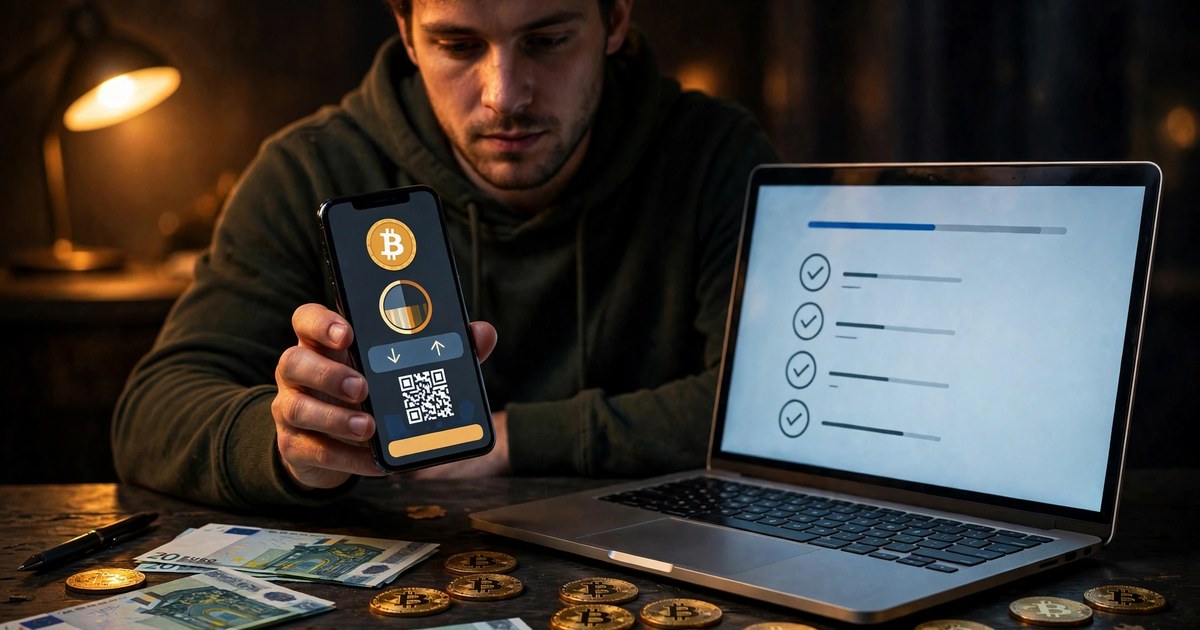
Cashing out $10,000 of Bitcoin can cost you $25 — or $1,500. The coins are identical, the bank account is identical, and the only thing that changes is the method you pick. With Bitcoin trading near $75,900, roughly 40% below its October 2025 all-time high of $126,080, and the Fear & Greed Index sitting at 25, more holders than usual are asking how to turn Bitcoin into cash without giving a fortune away.
This guide compares all five real ways to cash out Bitcoin in 2026 — a regulated exchange, a peer-to-peer marketplace, a Bitcoin ATM, a crypto debit card, and an OTC desk — with the actual fees, speeds and limits of each, plus the tax rules that now follow every sale and the seven mistakes that cost people the most money. If you are still deciding whether to sell at all, read our guide on how to store Bitcoin safely in 2026 first — the cheapest cash-out is worthless if the coins never reach the exchange.
The $10,000 Test: What Each Cash-Out Method Actually Costs
Here is the whole guide in one table — every figure is the all-in cost of turning $10,000 of Bitcoin into spendable money, not just the advertised headline rate.
| Method | All-in cost on $10,000 | Speed to spendable cash | Best for |
|---|---|---|---|
| Centralized exchange + bank transfer | About $25–$60 | 1–3 business days | Almost everyone |
| Peer-to-peer (P2P) marketplace | About $0–$50 | Minutes to hours | Local cash, flexible payment |
| Crypto debit card | About $50–$150 plus FX fees | Instant at checkout | Spending, not withdrawing |
| Bitcoin ATM (two-way machine) | About $500–$1,500, sometimes more | Minutes | Small, urgent cash only |
| OTC desk | Negotiated per trade | Same day | Very large amounts |
The gap is the story. The cheapest route costs roughly 0.25% of the sale; the most expensive routinely costs 12% to 17%, and regulators have alleged fees as high as 26% at some machines. On a $10,000 sale, that is the difference between $25 and $1,500, before tax. Everything below explains why, and how to pick the right lane for your amount, deadline and country.
Method 1: Centralized Exchange and Bank Transfer — the Cheapest Route for Almost Everyone
Selling on a regulated exchange and withdrawing the proceeds to your bank account is the default answer, and the numbers explain why. Spot trading fees on major exchanges typically land between 0.1% and 0.6%, and fiat withdrawals are usually flat rather than percentage-based. On a $10,000 sale, the all-in cost is often under $40, according to a 2026 off-ramp comparison.
The process is deliberately boring. Move your Bitcoin to your deposit address on the exchange, sell it for dollars or euros, then withdraw to your linked bank account. A standard ACH transfer in the US is typically free and arrives within one to three business days; SEPA in Europe works the same way. A wire lands faster, often the same day, but usually costs $15 to $25, and your bank may charge its own incoming wire fee.
Three details decide whether you actually pay $25 or $250. First, use the exchange's pro trading screen and place a limit order instead of the one-tap "sell" button: the instant screen on a major US exchange charges around 1.49% on a $2,000 trade, while the same platform's pro screen charges 0.25% or less. Second, check the withdrawal fee before you sell — some platforms charge nothing for ACH or SEPA and $25 for a wire, and that choice alone can double your cost. Third, keep your coins off the exchange until you are ready to sell, and move the fiat out promptly once the sale settles. Exchanges are businesses, not vaults: the $6.3 billion Binance hack in 2026 proved even the largest platforms can be hit, so our guide to the best crypto wallets in 2026 is worth reading before you move coins anywhere.
One warning applies to every method here: a real exchange takes its fees out of the money you withdraw. If any platform asks you to send new money to "release" your funds, pay a tax, or cover an unlock fee before you can withdraw, it is a scam — walk away and report it. The US Federal Trade Commission describes exactly this pattern.
Method 2: Peer-to-Peer Marketplaces — Cheap, Flexible, and Only as Safe as the Escrow
Peer-to-peer platforms connect you directly with a buyer and hold your Bitcoin in escrow until the buyer confirms payment. Fees are usually about 0.5% or less — often just a small escrow charge — which makes P2P one of the cheapest and most flexible ways to cash out: bank transfer, cash in person, gift cards and local payment apps are all on the table.
The trade-off is counterparty risk. You are trusting a stranger to pay you, and the escrow only protects you if you follow the platform's rules exactly: never release coins before payment has cleared, never accept payment outside the escrow, and never trade with a buyer who pressures you to move faster than the escrow allows. Check the buyer's history and completion rate first, and treat any offer far above the market rate as a trap — nobody pays a premium for Bitcoin out of generosity.
Privacy is another thing people get wrong about P2P. Most platforms now require identity verification, and the EU's DAC8 directive, live since 1 January 2026, requires platforms to report EU users' transactions to tax authorities. A P2P sale is still a taxable sale, and the platform has a record of it. What remains is a legitimate, low-cost channel that works well for smaller amounts and for people whose banks do not play nicely with crypto exchanges.
Method 3: Bitcoin ATMs — the Fastest Cash, and by Far the Most Expensive
A two-way Bitcoin ATM lets you sell Bitcoin and walk away with physical banknotes in minutes: select "sell", scan the QR code, send the coins, and collect the cash once the network confirms. It is the fastest route to paper money — and the most expensive route to anything.
The fees are brutal, and mostly hidden in the exchange rate. Industry figures for 2026 put the total effective cost of selling at a machine at roughly 5% to 15%, with competitive markets landing at 12% to 17% once the operator fee and the rate markup are combined. Some operators charge far more: the District of Columbia's attorney general sued Athena Bitcoin alleging undisclosed fees of up to 26%, and Iowa's attorney general alleged a 23% cut at Bitcoin Depot machines and 21% at CoinFlip. California caps kiosk charges at 15% and Illinois at 18% — which tells you how high the uncapped numbers run. On a $10,000 sale, a 15% machine takes $1,500; the same sale on an exchange takes about $25. A detailed 2026 fee breakdown shows the same pattern across operators.
There are practical limits, too. Only about 40% of the roughly 38,000 Bitcoin ATMs listed worldwide support selling at all — the rest are buy-only — so check the operator's map before you drive there. Per-transaction and daily limits often cap a single sale at $2,000 to $5,000. And the regulatory map is tightening: Indiana banned crypto ATMs outright in March 2026, Tennessee followed on 1 July 2026, Minnesota followed after that, and North Carolina's 12% fee cap takes effect on 1 January 2027.
Then there is the scam problem. The FBI's 2025 Internet Crime Report recorded $389 million lost through crypto ATM and kiosk scams in 2025, up 58% in a single year, according to a 2026 cash-out guide tracking the FBI figures. The pattern is almost always the same: a stranger contacts you by text, social media or a dating app, shows you fake investment profits, then directs you to a Bitcoin ATM to "withdraw" money that never existed. We covered the full picture in Bitcoin ATMs took $389M from scam victims in 2025 — if someone you have never met in person tells you to use a Bitcoin ATM, assume it is a scam.
Use a Bitcoin ATM only when you need a small amount of physical cash urgently and no other method is available. For anything above a few hundred dollars, it is the most expensive option in this guide by a factor of twenty or more.
Method 4: Crypto Debit Cards — Spend the Bitcoin Without Selling It First
A crypto debit card lets you spend Bitcoin at any shop that takes Visa or Mastercard: the provider converts the coins to fiat at the moment of purchase. Conversion spreads typically run 0.5% to 1.5%, plus foreign-exchange fees and ATM charges if you take cash out. On $10,000 of spending that is roughly $50 to $150, plus the FX markup.
This method answers a different question from the others. It is not a cash-out at all — it is a way to spend Bitcoin directly without a separate sale and bank transfer. That makes it useful for everyday spending and bad for lump sums into a bank account: every purchase is a separate taxable sale in the US, and the spreads add up fast on large amounts. For "$10,000 in my bank account," use an exchange; for groceries, use a card.
Method 5: OTC Desks — for Amounts That Would Move the Market
Over-the-counter desks run by firms such as B2C2, Cumberland and Wintermute, plus the institutional arms of Coinbase Prime and Kraken OTC, absorb an entire order at one agreed price with no visible footprint on the public order book. The price is negotiated per trade, and settlement is usually the same day.
For ordinary holders this method is irrelevant — desks are built for trades large enough that selling on an open exchange would push the price against you. But for a six- or seven-figure position, an OTC desk is usually the cheapest route per dollar, because the negotiated price beats the exchange fees, slippage and market impact of selling the same amount in public. If that is your situation, compare quotes from two or three desks; if it is not, the exchange route in Method 1 is your answer.
What Most People Get Wrong About Cashing Out
Five myths cause most of the money lost in cash-outs.
- Myth 1: the fastest method is the cheapest. A Bitcoin ATM is the fastest way to hold cash, and the most expensive by a factor of twenty. Speed and cost point in opposite directions; the cheapest route takes one to three business days because it uses the banking system instead of a kiosk.
- Myth 2: if I never sell, there is no tax. That is true in the United States, where tax is triggered by the sale — but not everywhere. In the Netherlands, crypto sits in Box 3, which taxes the value of your holdings on 1 January each year whether you sold or not: a 6.00% deemed return taxed at 36%, about 2.16% of wealth above the €59,357 allowance. Our Netherlands crypto tax guide has the full picture, including the reform keeping crypto on annual taxation until 2030.
- Myth 3: peer-to-peer sales are anonymous. They used to be. Today most platforms require ID verification, and under the EU's DAC8 rules they must report EU users' transactions to tax authorities. Treat every sale as recorded, whatever the channel.
- Myth 4: the "sell" button price is the market price. Instant buy/sell screens bake a spread into the quoted price. The same exchange's pro screen, with a limit order, regularly costs a fifth as much for the identical sale. Compare the quoted price against the live market price before you confirm.
- Myth 5: a small test transaction is a waste of money. Sending a few dollars' worth first is the cheapest insurance in crypto: it confirms the address, the network and the destination before the full amount is at stake. The people who skip it are the ones who post about sending five figures to the wrong chain.
Taxes: the Bill That Arrives After the Cash Does
Cashing out is a taxable event in most countries, and in 2026 the reporting is largely automatic. In the United States, the IRS treats Bitcoin as property, so selling it triggers capital gains tax on the difference between what you paid and what you received. Since 1 January 2025, most brokers and exchanges have sent Form 1099-DA to both you and the IRS, and from the 2026 tax year they must also report your cost basis — so the IRS holds its own record of what you bought and sold, as this cash-out tax guide explains. Our full breakdown is in Crypto Tax in the US 2026: the IRS 1099-DA, the 0%/15%/20% rates.
In the European Union, the DAC8 directive has required crypto platforms to collect and report customer holdings and transactions to national tax authorities since 1 January 2026. The rules then depend on your country: Germany exempts gains after a one-year holding period, the Netherlands taxes wealth rather than gains, and Belgium ended its tax-free treatment with a 10% rule in 2026. Keep a record of every purchase — date, amount, price and fees — and your 1 January holdings value under a wealth-tax system. The most expensive cash-out mistake after the ATM fee is discovering, a year later, that you cannot prove what you originally paid.
7 Costly Mistakes to Avoid When You Cash Out Bitcoin
- Cashing out at a Bitcoin ATM without checking the rate. The fee hides in the quoted price, not on the screen. At 15% it costs $1,500 on $10,000; regulators have alleged up to 26%.
- Sending coins to the wrong address or network. Always send a small test amount first and double-check the first and last characters of the address. A wrong-network transfer is usually unrecoverable.
- Using the instant "sell" button instead of a limit order. The convenience screen can cost five times the pro screen's fee.
- Forgetting the tax bill. Every sale is reported now — 1099-DA in the US, DAC8 in the EU. Set aside the tax portion the day the cash lands.
- Paying a fee to unlock a withdrawal. No legitimate exchange charges an unlock, tax or release fee before letting you withdraw — any such demand is a scam.
- Selling everything at once in a panic. Bitcoin is 40% below its peak and fear is at 25 — the worst cash-outs happen on the worst days. If you need the money over weeks rather than today, consider selling in stages. This is not financial advice, only arithmetic: a staged sale averages your exit price instead of locking in the day's low.
- Leaving the fiat on the exchange after selling. Once the sale settles, withdraw to your bank. Exchange balances are not bank deposits and are not insured like them.
Frequently Asked Questions
How long does it take to cash out Bitcoin to a bank account?
On a regulated exchange, the sale takes seconds and the bank transfer typically takes one to three business days for ACH in the US or SEPA in Europe. Some platforms offer instant withdrawals to a debit card for a small fee. A Bitcoin ATM pays cash in minutes, but at a 5% to 15% cost. A wire is the fastest bank route, usually same-day, for $15 to $25.
What is the cheapest way to cash out Bitcoin?
Sell on a regulated exchange using its pro trading screen with a limit order, then withdraw by ACH or SEPA. All-in costs typically run 0.1% to 0.6% — about $25 to $60 on a $10,000 sale. Peer-to-peer platforms are comparably cheap at 0.5% or less, but carry more counterparty risk.
Can I cash out Bitcoin without an ID?
Almost never in 2026. Regulated exchanges require identity verification, P2P platforms mostly do too, and Bitcoin ATM operators must collect ID above low thresholds — FinCEN cut the reporting threshold for some operators from $10,000 to $250. Small in-person cash trades still exist on some P2P platforms, but they carry the highest scam risk in this guide.
Do I pay tax when I cash out Bitcoin?
In the United States, yes: selling Bitcoin is a taxable disposal of property, and exchanges now report proceeds — and from the 2026 tax year, cost basis — to the IRS on Form 1099-DA. In the EU, DAC8 reporting has applied since 1 January 2026. Some countries differ: the Netherlands taxes the value of holdings on 1 January rather than the gain itself. Keep records of every purchase.
Can I cash out Bitcoin at an ATM?
Yes, but only at two-way machines — about 40% of the roughly 38,000 Bitcoin ATMs worldwide support selling. Expect 5% to 15% in fees and daily limits often between $2,000 and $5,000, and check the quoted rate against the live market price before you send anything. Several US states banned or capped these machines in 2026.
Conclusion
Cashing out Bitcoin is not complicated — but the price of doing it badly is. The same $10,000 sale costs about $25 through a regulated exchange and up to $1,500 at a Bitcoin ATM, and the difference is nothing but the method you choose. For almost everyone, the right answer is the boring one: sell on a reputable exchange with a limit order, withdraw to your bank by ACH or SEPA, keep records for tax, and never pay anyone a fee to "unlock" your own money. Reserve the ATM for small, urgent cash, the debit card for spending, and the OTC desk for amounts large enough to move the market. And if you buy back in later, our guide on how to buy Bitcoin with a credit card in 2026 shows the same fee traps in reverse — the 3.99% fee and the cash-advance trap that catch first-time buyers.
This article is for educational purposes only and is not financial, investment, tax or legal advice. Fees, limits and tax rules change frequently — always confirm the current figures on the provider's own pages before you transact.