What Is a Satoshi? 1 Bitcoin = 100 Million Sats — What $100 Buys You at $77,000
One bitcoin splits into 100 million satoshis — so at $77,000 per BTC, just $100 buys you about 129,870 sats. Here's what a satoshi is, what your money buys in sats, and the 5 mistakes beginners make with Bitcoin's smallest unit.
One bitcoin splits into 100 million satoshis — so at Bitcoin's current price near $77,000, just $100 buys you roughly 129,870 sats, and a single satoshi costs about $0.00077. You do not need $77,000 to own Bitcoin. You need to understand its smallest unit, because almost every beginner mistake with Bitcoin — overpaying in fees, misreading an exchange balance, or thinking they "missed it" — comes from not understanding sats.
This guide explains what a satoshi is, where the name comes from, exactly what your money buys in sats at today's price, and how to stack sats without the five mistakes most beginners make.
What Is a Satoshi?
A satoshi — universally shortened to "sat" — is the smallest unit of bitcoin. Just as one dollar divides into 100 cents, one bitcoin divides into 100,000,000 satoshis. The unit is named after Satoshi Nakamoto, the pseudonymous creator of Bitcoin, whose 2008 whitepaper designed a currency that could be divided finely enough for everyday payments. You can read more about the mystery behind the name in our guide to who Satoshi Nakamoto really is.
Because Bitcoin's code defines the total supply as 21 million coins, the total number of satoshis that will ever exist is fixed too: 21 million times 100 million, or 2.1 quadrillion sats. No more can ever be created, and that hard cap is part of why many investors treat Bitcoin as digital gold. If you are new to the asset itself, start with our complete beginner's guide to what Bitcoin is and how it works.
How Many Satoshis Are in One Bitcoin?
The conversion is simple and never changes:
- 1 BTC = 100,000,000 sats
- 0.1 BTC = 10,000,000 sats
- 0.01 BTC = 1,000,000 sats
- 0.001 BTC = 100,000 sats
- 0.0001 BTC = 10,000 sats
- 0.00000001 BTC = 1 sat
Exchanges and wallets usually display your balance in BTC with eight decimal places — for example, 0.00254000 BTC. That is simply 254,000 sats. If the decimal places confuse you, switch your wallet's display unit to sats: many wallets 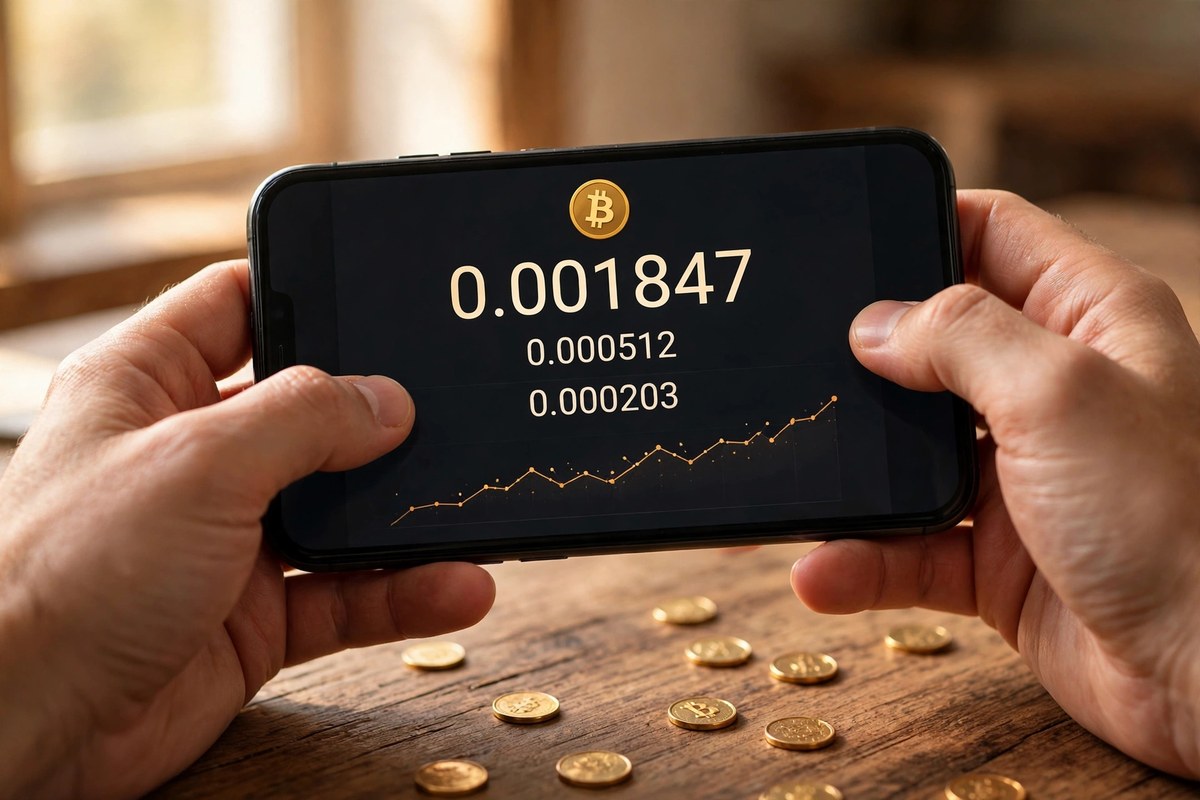 offer a "display in sats" setting, and it makes small balances instantly readable.
What $100 Buys You in Satoshis at $77,000
Here is the part most beginners get wrong: they look at Bitcoin's $77,000 price tag and conclude Bitcoin is "too expensive." But nobody has to buy a whole coin. At a price of $77,000 per BTC, one satoshi is worth $0.00077, and the math works out like this:
| You spend | Satoshis you get | Share of 1 BTC |
|---|---|---|
| $1 | ~1,299 sats | 0.00001299 BTC |
| $10 | ~12,987 sats | 0.00012987 BTC |
| $50 | ~64,935 sats | 0.00064935 BTC |
| $100 | ~129,870 sats | 0.00129870 BTC |
| $500 | ~649,351 sats | 0.00649351 BTC |
| $1,000 | ~1,298,701 sats | 0.01298701 BTC |
| $10,000 | ~12,987,013 sats | 0.12987013 BTC |
These figures are before exchange fees and spreads, so the sats credited to your account will be slightly fewer, and they move with the Bitcoin price — if BTC rises to $100,000, that same $100 buys only 100,000 sats. The calculation is always the same: divide your dollars by the BTC price, then multiply by 100 million. Price data in this article reflects CoinGecko's Bitcoin price near $77,000 on October 31, 2026.
Why Satoshis Matter More as Bitcoin Gets More Expensive
When Bitcoin traded at $100, a satoshi was worth a tenth of a cent and nobody talked about it. At $77,000, sats have become the practical unit of everyday Bitcoin. Three trends explain why:
First, psychology. Telling a friend you own "129,870 sats" feels achievable in a way that "0.0013 BTC" does not, and the "stacking sats" movement — regularly buying small amounts of Bitcoin — is built on exactly that framing. Our guide to dollar-cost averaging into Bitcoin and altcoins explains how small, regular purchases compound over time.
Second, micropayments. The Lightning Network, Bitcoin's fast payments layer, prices everything in sats. A coffee might cost 5,000 sats, a streaming tip 100 sats, a newsletter subscription 10,000 sats a month. Amounts that would be absurd to express in BTC — 0.00005 BTC for a coffee — are natural in sats.
Third, fees. Bitcoin transaction fees are quoted in satoshis per virtual byte (sat/vB). When the network is quiet, fees can be as low as 1 sat/vB for a low-priority transaction and 2 sat/vB for the fastest confirmation, according to mempool.space data — meaning a typical transaction can cost just a few hundred sats. When the network is congested, that rate can multiply many times over, and understanding sat/vB is the difference between paying $0.30 and $30 to move your coins.
Satoshis vs Millibitcoins, Bits and Other Units
Satoshis are not the only subdivision you will meet. Here is how the common units relate:
- 1 BTC = 100,000,000 sats
- 1 millibitcoin (mBTC) = 100,000 sats = 0.001 BTC
- 1 microbitcoin (μBTC or "bit") = 100 sats = 0.000001 BTC
- 1 satoshi (sat) = 0.00000001 BTC
Most wallets and exchanges default to BTC, some offer mBTC, and Lightning wallets almost always use sats. If you ever see a balance that looks impossibly large or small, check the unit first — a "100,000" balance is 100,000 sats (about $77 at today's price), not 100,000 bitcoins.
How to Buy Satoshis: 5 Steps
Buying sats is just buying Bitcoin in a small amount. The steps are identical whether you spend $10 or $10,000:
- Choose a reputable exchange. Compare fees, security and beginner-friendliness before you deposit anything, and avoid platforms promising guaranteed returns.
- Complete identity verification. Regulated exchanges require it, and it protects your account if you ever need to recover it.
- Deposit dollars, euros or your local currency by bank transfer or card — bank transfers usually carry the lowest fees.
- Place a market or limit order for BTC. Enter the amount in your currency (for example, $100) rather than in BTC; the exchange converts it automatically and shows you the sats you will receive.
- Move your Bitcoin to your own wallet. Leaving coins on an exchange means trusting that exchange with your money — a lesson the market relearned painfully this week, when the $6.3 billion Binance hack froze withdrawals across the world's largest exchange. Our step-by-step guide to buying your first Bitcoin walks through each step in detail, and our crypto wallet guide explains hot versus cold storage so you can choose where your sats live.
What Most People Get Wrong About Satoshis
Myth 1: "Bitcoin is too expensive now." Wrong. Bitcoin is divisible to eight decimal places. The price of one whole coin is irrelevant to whether you can afford to start — $10 buys you sats today, exactly as $10 bought you a fraction of a coin in 2015.
Myth 2: "Sats are a different cryptocurrency." Wrong. Sats are Bitcoin, the same asset, in a smaller unit — like cents to a dollar. There is no separate "satoshi coin" to buy, and anyone selling you one is running a scam.
Myth 3: "Small amounts aren't worth holding." Wrong, with a caveat. A few thousand sats will not make you rich, but regular small purchases — stacking sats weekly or monthly — are how most long-term holders built their positions. The caveat: tiny balances can be eaten by withdrawal fees, so accumulate on the exchange and withdraw in larger batches.
Myth 4: "You can send fractions of a satoshi." Wrong on the base chain. One sat is the smallest on-chain unit; you cannot send half a sat in a normal Bitcoin transaction. (Lightning invoices can technically price in millisatoshis, but those settle to whole sats.)
Myth 5: "Satoshi was a company or a team." Wrong. Satoshi Nakamoto is the pseudonym of Bitcoin's creator or creators, whose identity remains unproven eighteen years after the whitepaper's publication on October 31, 2008 — an anniversary the market marked this week, as covered in our piece on Bitcoin's whitepaper turning 18.
Stacking Sats Safely: A Checklist
- Buy on a schedule you can sustain, not on hype — weekly or monthly beats panic-buying a spike.
- Check the unit before every transaction: BTC, mBTC or sats.
- Set your fee in sat/vB manually when your wallet allows it, and avoid transacting during fee spikes unless urgent.
- Withdraw to your own wallet in batches to avoid paying a withdrawal fee on every small purchase.
- Back up your wallet's seed phrase offline, on paper or metal, never in a screenshot or cloud note.
- Never send sats to "double your Bitcoin" schemes — they are always scams.
- Keep records of every purchase for tax purposes; many countries tax crypto disposals even when you only sell a fraction of a coin.
How Satoshis Show Up in Your Wallet and on Exchanges
Open any Bitcoin wallet after a purchase and you will see one of three displays. Some wallets show BTC to eight decimals (0.00129870 BTC). Some show sats directly (129,870 sats). Some show a fiat estimate alongside ("≈ $100"). All three describe the same balance, and confusion between them causes more beginner panic than any market crash: a user who sees "129,870" and expects dollars, or "0.0012" and assumes they lost money, has simply misread the unit.
Exchanges add one more wrinkle: minimum order sizes and withdrawal minimums. A platform may let you buy $10 of Bitcoin but require a 0.001 BTC minimum withdrawal, which means small purchases must accumulate before they can move to your own wallet. Check both numbers before you buy — the minimum trade and the minimum withdrawal — so your sats do not sit stranded on an exchange, exposed to exactly the kind of platform risk that froze Binance withdrawals this week. When you do withdraw, confirm the destination address character by character: Bitcoin transactions are irreversible, and a single wrong character sends your sats to an address nobody controls.
Finally, remember that your wallet does not hold "coins" the way a physical wallet holds notes. It holds the keys to unspent transaction outputs on the blockchain, measured in sats. That is why your balance can arrive as several small outputs rather than one neat number, and why consolidating many tiny outputs during a low-fee period can save you money later. When fees are at 1 sat/vB, consolidation is nearly free; when fees spike, those same tiny outputs can cost more to spend than they are worth.
The Bigger Picture: Why Divisibility Is Bitcoin's Superpower
Bitcoin's divisibility is what lets a $1.55 trillion network serve both billion-dollar treasuries and a street vendor selling coffee. Gold cannot be split into a millionth of an ounce at the checkout; Bitcoin can, instantly and without permission. That is why the satoshi matters beyond trivia: it is the unit that makes Bitcoin usable as money rather than merely as an investment for the wealthy.
It also reframes the "too late" question. At $77,000, Bitcoin is about 39% below its all-time high near $126,000, set in October 2025 — and whether it recovers is a separate question from whether you can participate. Participation costs whatever you choose: $10, $100, or nothing at all. The unit of participation is the sat, and there are 100 million of them in every coin.
FAQs About Satoshis
How many satoshis are in one bitcoin?
Exactly 100,000,000. One bitcoin equals one hundred million satoshis, and this ratio is fixed by Bitcoin's code.
How much is 1 satoshi worth in dollars?
At a Bitcoin price of $77,000, one satoshi is worth about $0.00077. Divide the BTC price by 100 million to get the value of one sat at any price.
How many satoshis does $100 buy?
At $77,000 per BTC, $100 buys approximately 129,870 sats before exchange fees and spreads. At $100,000 per BTC, the same $100 would buy 100,000 sats.
Can I buy less than one bitcoin?
Yes. Every major exchange lets you buy a fraction of a bitcoin — in practice, you buy sats. Most platforms accept orders as small as $1 to $10.
Are satoshis the same as Bitcoin?
Yes. Satoshis are simply the smallest denomination of Bitcoin, like cents are to dollars. Holding 100 million sats is exactly the same as holding 1 BTC.
What is the smallest amount of Bitcoin I can send?
On the Bitcoin blockchain, the smallest transactable amount is 1 satoshi, though fees and dust limits mean practical minimums are higher. On the Lightning Network, amounts can be priced in thousandths of a sat (millisatoshis).
Conclusion
A satoshi is Bitcoin made accessible: 100 million sats per coin, $0.00077 each at $77,000, and $100 buys you nearly 130,000 of them. The investors who did best in Bitcoin's history were rarely the ones who bought a whole coin at the perfect moment — they were the ones who stacked sats steadily, kept them in their own wallets, and ignored the noise. Whether you start with $10 or $10,000, the unit is the same, the math is the same, and the first step is the same: buy sats, secure them, and let time do the rest.
Sources: CoinGecko Bitcoin price data, October 31, 2026; mempool.space fee data; the Bitcoin whitepaper. This article is for education only and is not financial advice.