EU Crypto Sanctions Task Force: Brussels Hunts the $102 Billion Ruble Stablecoin — 5 Things Every European Holder Must Know
Brussels just created a dedicated crypto task force after one ruble stablecoin moved $102 billion past sanctions — here are the 5 things every European crypto holder must check before the 22nd sanctions package lands.

One ruble-pegged stablecoin moved more than $102 billion through crypto markets in its first year — and on November 5, 2026, Brussels finally answered with a weapon of its own: a dedicated EU crypto sanctions task force. If you hold crypto anywhere in Europe, this is not a story about Russia. It is a story about your exchange account, your wallet, and the new checks that are about to land on both.
The European Commission announced the task force at the close of its tenth High-Level Expert Group meeting on sanctions in Brussels, chaired by Financial Services Commissioner Maria Luís Albuquerque. Sitting inside a brand-new sanctions office, the task force will spend an initial 12 months hunting the digital-asset networks that move money around EU sanctions — with help from experts in Ukraine and the United Kingdom. And the Commission is already working on a 22nd sanctions package that could turn the task force's findings into new bans. Here is what was announced, why the $102 billion A7A5 token forced the issue, and the five things every European holder should do now.
What Brussels Actually Announced on November 5
The announcement came in two parts, and both matter. First, the Commission is creating a dedicated sanctions office that will cover the entire life cycle of EU sanctions — policy design, implementation, enforcement support, and anti-circumvention work. Second, sitting inside that office, a specialised crypto task force will focus exclusively on digital assets used to dodge those sanctions.
The timing is deliberate. The meeting brought together senior sanctions officials from every EU member state and the European Anti-Fraud Office (OLAF). The message from the Commission's spokesperson, Siobhan McGarry, was unusually blunt: "We know that crypto is a tool that has been used to circumvent our sanctions."
According to the Kyiv Independent, an EU diplomat said the task force is initially envisaged to run for 12 months and will draw on expertise from Ukraine and the United Kingdom. The Commission has published no mandate, budget, staffing plan, or start date yet, and McGarry described the task force as an informal body combining national and EU expertise. For now it is a coordination decision, and its power will come from what member states do with its findings.
For the full announcement as reported from Brussels, see the Kyiv Independent's coverage of the new office and task force.
The $102 Billion Token That Forced Brussels' Hand
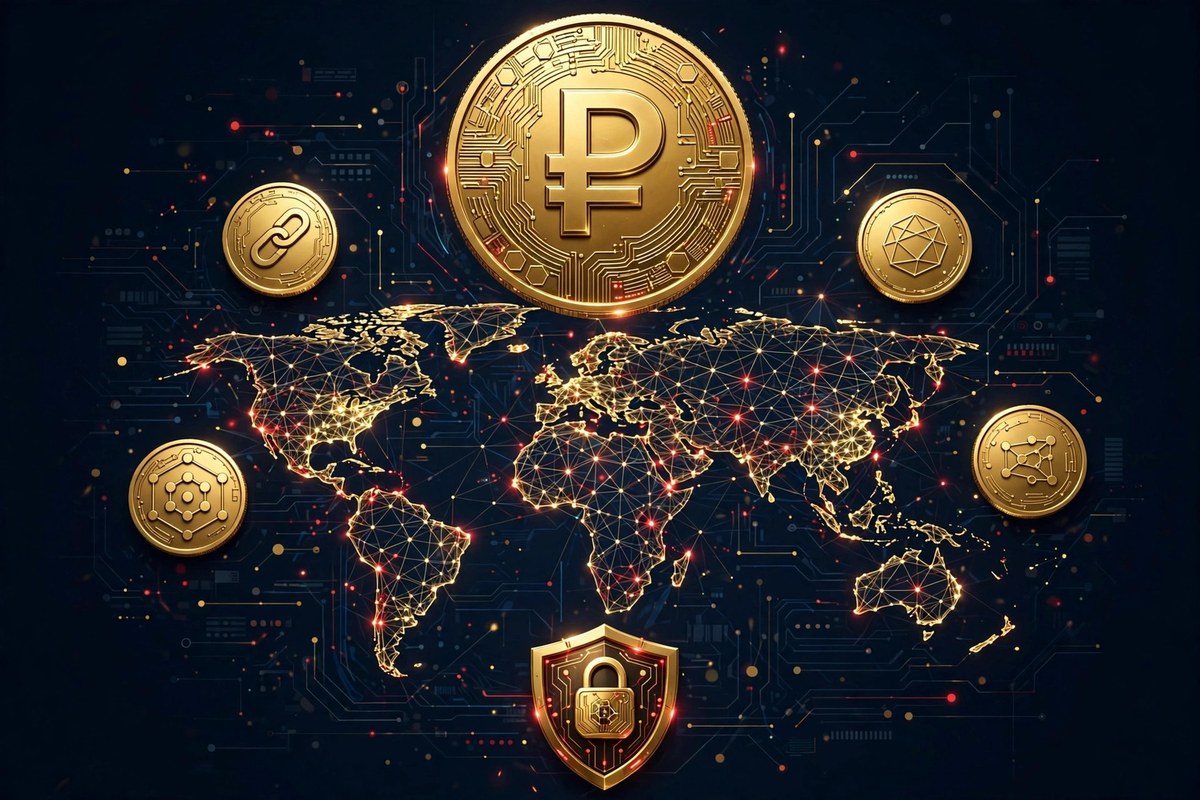
Every sanctions story in Brussels now has a name: A7A5. The token is a stablecoin pegged to the Russian ruble, launched in January 2025 and created by A7 LLC, a Russian firm specialising in cross-border payments for businesses trying to bypass Western sanctions. It is formally issued by Old Vector LLC, a company registered in Kyrgyzstan, and its main shareholders are Ilan Shor — a convicted fraudster sanctioned for interfering in Moldovan elections on behalf of Russia — and Promsvyazbank (PSB), a Russian state-owned bank sanctioned for serving the country's defence sector. It claims one-to-one backing by ruble deposits likely held at PSB.
For its first year, the scheme worked spectacularly. According to blockchain analytics firm Elliptic, A7A5 became the largest non-dollar stablecoin in the world, moving more than $102 billion across approximately 251,000 transactions. Russian importers and exporters, cut off from the Western banking system since 2022, increasingly settled cross-border payments in cryptocurrency — and A7A5 was built precisely for that job.

Then the coordinated response arrived. The A7A5 network was sanctioned in three waves by the United States, the United Kingdom, and the European Union over the second half of 2025. In March 2025, the US Secret Service, assisted by Elliptic, seized the USDT holdings of Garantex, the Moscow-based exchange that had been a key venue for moving money around restrictions. Grinex, which became A7A5's main trading venue, halted bank-card top-ups in April 2026 and reported a major security breach less than two weeks later.
The result is a case study in how sanctions can strangle a token without ever switching it off. By June 2026, A7A5's average daily transaction volumes had fallen to a low of $24.3 million — down 96% from the July 2025 peak — and its only significant exchange was offline. Elliptic's detailed account of the collapse is essential reading: The fall of A7A5: how sanctions strangled the ruble stablecoin.
Here is the twist: A7A5's smart contracts still run on the Ethereum and Tron blockchains, and no Western government can turn them off. Sanctions choked the token's on-ramps and exchanges — but the token itself survives. That is the gap the task force is meant to close: finding the next A7A5 before it moves another $100 billion, not after.
Timeline: How Crypto Sanctions Escalated to a Task Force
The task force did not appear out of nowhere. It is the latest step in a two-year escalation that has moved from individual designations to sector-wide bans — and now to a standing body whose only job is to keep finding the loopholes.
| Date | What happened | Why it mattered |
|---|---|---|
| 2022 | Sanctions cut Russian banks off from the Western financial system | Russian importers and exporters began settling cross-border payments in crypto |
| January 2025 | A7A5 ruble stablecoin launches | Becomes the largest non-dollar stablecoin, moving over $102 billion in year one |
| March 2025 | US Secret Service seizes Garantex's USDT holdings | A key Moscow exchange venue for sanctions evasion is taken down |
| Second half of 2025 | US, UK and EU sanction the A7A5 network in three waves | Daily A7A5 volumes begin their 96% collapse from the July 2025 peak |
| April 2026 | Grinex halts card top-ups, then reports a major breach | A7A5's main trading venue goes effectively offline |
| 2026 (20th package) | EU imposes a sector-wide ban on Russian crypto service providers and decentralised trading platforms | First time the EU targeted the whole Russian crypto ecosystem, not just named entities |
| 23 July 2026 (21st package) | EU bans operators from dealing with 14 crypto platforms in Georgia, Panama, the UAE, the Marshall Islands, Kyrgyzstan and Belarus | Introduces the power to ban entire crypto jurisdictions |
| 5–6 November 2026 | EU announces a dedicated sanctions office and a crypto task force, initially for 12 months | Enforcement moves from one-off packages to a standing hunt for the next loophole |
| 6 November 2026 | US Treasury's FinCEN cuts MEXC off from the American banking system | Washington shows the same week that exchange-level action is now the norm — see our coverage of the MEXC cut-off and its $16 billion in suspicious flows |
| Now in preparation | EU's 22nd sanctions package | Expected to convert the task force's early findings into new restrictions |
What the Task Force Can — and Cannot — Do
Before the headlines run away with this story, here is the honest version of what the task force actually is — and what most coverage is getting wrong.
What most people get wrong: this is not a new EU police force that can freeze your wallet. The task force is, in the Commission spokesperson's own words, an informal body. It has no published legal instrument, no budget, no staffing plan, and no power to investigate or penalise anyone on its own. Investigations and penalties remain with national authorities in each member state. Its job is coordination: spotting networks, sharing intelligence between capitals, and making sure the same rules are enforced consistently across the bloc.
What it can do: three things that genuinely matter. First, it pools blockchain analytics and intelligence from member states, OLAF, Ukraine, and the UK — the kind of cross-border picture no single regulator can build alone. Second, it feeds directly into the sanctions pipeline, which means the 22nd package — already in preparation — is likely to be the first one shaped by the task force's work. Third, it creates a permanent institutional memory: instead of rediscovering the same evasion tricks with every package, the EU now has a team whose entire job is to track them.
What it cannot do: it cannot switch off a token. A7A5 proved that — its smart contracts still run on Ethereum and Tron today. It cannot force an exchange outside the EU to comply, and it cannot move faster than the politics: every new ban still needs member-state agreement, and the Commission has not said when the task force will hold its first working session.
5 Things Every European Crypto Holder Must Do Now
The task force is aimed at sanctioned networks, not ordinary holders. But enforcement waves have a habit of catching innocent people in the net — frozen withdrawals, flagged transactions, closed accounts. The same week Brussels announced the task force, Binance told customers in France, Spain, Italy and Poland that their accounts will close on December 31, 2026, with monthly fees on leftover balances starting November 29. The compliance screws are tightening from every direction at once. Here is your checklist.
1. Check whether your exchange is actually licensed in the EU
MiCA requires crypto exchanges to be authorised in one EU member state before serving customers anywhere in the bloc. Binance still does not appear on the European Securities and Markets Authority's register of authorised crypto providers, after withdrawing its Greek licence application in June — and that is why accounts in four countries are now closing. If your exchange is not on the ESMA register, assume your account could be next. Our guide to buying Bitcoin in Europe on MiCA-licensed exchanges compares four authorised platforms and their fees.
2. Move funds off exchanges that are closing or restricting accounts
Deposits on the affected Binance accounts are already blocked, but crypto and fiat withdrawals remain open — for now. Binance says there is "no sudden freeze," but the fees start November 29 (0.025% of your remaining balance per month, or 10 USDC, whichever is higher) and the accounts close December 31. Do not wait for the deadline week, when withdrawal queues and support backlogs are at their worst. Read our full breakdown of the Binance France account closures, fees and deadlines before you move anything.
3. Audit your wallet history before you send anything to an exchange
Exchanges now run blockchain analytics on incoming deposits. If coins you received passed through a flagged mixer, a sanctioned platform, or a high-risk jurisdiction, your deposit can be frozen while compliance reviews it — even if you did nothing wrong. Before sending funds to a centralised exchange, check the history of the coins you are moving, and keep records of where they came from. If you hold privacy coins, read our guide on whether Zcash is banned in Europe — the rules are tightening there too, with a July 2027 deadline already on the books.
4. Keep your own keys for anything you do not trade
The lesson of every enforcement wave is the same: coins on an exchange are coins someone else controls. A hardware wallet costs less than a single month of Binance's dormant-account fee on a large balance, and it removes your holdings from any exchange freeze, closure, or compliance review entirely. Compare the options in our ranking of the best crypto wallets in 2026, updated after the $6.3 billion Binance hack.
5. Keep tax and transaction records from today, not from April
Sanctions enforcement and tax enforcement increasingly use the same data. If a future package or investigation ever asks you to prove the source of your funds, a clean record — exchange statements, wallet addresses, dates, and amounts — is the difference between a five-minute answer and a frozen account. Germany's one-year holding rule can make gains tax-free, but only if you can prove the holding period: see our Crypto Tax in Germany 2026 guide for the records that matter.
What Happens Next: The 22nd Package and the 12-Month Clock
The task force's first real test will be the 22nd sanctions package, which the Commission is already preparing. Commissioner Albuquerque's spokesperson has said that "in each and every sanctions package, of course, we're looking at ways we can close loopholes and tackle circumvention" — and the 22nd will be the first drafted with a dedicated crypto team feeding it targets.
Three things to watch. First, whether the 22nd package uses the 21st package's new power to ban entire crypto jurisdictions — the tool designed for countries that host evasion networks, like the Kyrgyzstan-registered issuer behind A7A5. Second, whether stablecoins come under direct pressure: A7A5 showed that a ruble-pegged token can move $102 billion, and the next one may not be ruble-pegged at all. Third, whether the task force's 12-month mandate gets extended — if it does, that tells you Brussels considers this a permanent fight, not a one-off project.
The other date on the clock is the task force's own lifespan. Twelve months from November 2026 takes it to November 2027 — past the July 2027 deadline already set for privacy-coin restrictions in Europe, and deep into the next cycle of sanctions packages. If the task force produces early wins, expect it to become permanent. If it produces only meetings, expect the criticism that it was announced without a mandate, a budget, or a start date to come back louder.
The Bigger Picture: Enforcement Is Now the EU's Crypto Strategy
Step back and the pattern of the last week is hard to miss. On November 5, the EU announced a crypto task force. On November 6, the US Treasury cut MEXC off from American banks over $16 billion in suspicious flows. On November 7, Binance confirmed it is closing accounts across four EU countries because it still has no MiCA licence. Three moves, three days, one direction: the era when crypto platforms could operate in Europe on a patchwork of old national registrations is over.
MiCA's transition period ended on July 1, 2026. Since then, the choice for every exchange has been simple: get authorised in an EU member state, or stop serving EU customers. Binance chose neither — it withdrew its Greek application in June, has not named another member state, and is now progressively restricting services. The exchanges that did get licensed are now the only game in town for European users.
For ordinary holders, the practical consequence is not that crypto is banned — it is that the middle ground is disappearing. Licensed exchanges, self-custody, and clean records are the safe side of the line. Unlicensed platforms, opaque stablecoins, and coins with murky histories are the other side — and the EU has just hired a team whose entire job is to watch that side.
Bitcoin, meanwhile, trades around $75,856 — down roughly 40% from its $126,080 all-time high, with the Fear & Greed Index at 25, in Extreme Fear. But the regulatory story unfolding in Brussels may matter more for European holders than any single price level: it decides which platforms you can use, which coins you can hold, and which transactions get flagged.
Frequently Asked Questions
What is the EU crypto sanctions task force?
It is a dedicated team announced by the European Commission on November 5–6, 2026, sitting inside a new sanctions office. Its job is to detect and act on crypto networks used to circumvent EU sanctions, particularly those linked to Russia. It is initially expected to run for 12 months, with expertise drawn from Ukraine and the United Kingdom.
Does the task force affect ordinary crypto holders in Europe?
Not directly — it targets sanctioned networks, not retail users. Indirectly, yes: exchanges will face more scrutiny, more transaction flagging, and more pressure to prove their customers' funds are clean. Holders who use licensed exchanges, keep their own keys for long-term holdings, and keep transaction records are the least exposed.
What was A7A5 and why does it matter?
A7A5 is a ruble-pegged stablecoin launched in January 2025 by the Russian firm A7 LLC and issued by Old Vector in Kyrgyzstan. According to Elliptic, it moved more than $102 billion in its first year. Coordinated US, UK, and EU sanctions cut its daily volumes by 96% from the July 2025 peak — but its smart contracts still run on Ethereum and Tron, which is why Brussels created a task force to find the next one earlier.
Can the EU ban an entire country's crypto services?
Yes — since the 21st sanctions package, adopted July 23, 2026, the EU can restrict crypto services from designated third-country jurisdictions. That package also imposed transaction bans on 14 crypto platforms based in Georgia, Panama, the UAE, the Marshall Islands, Kyrgyzstan, and Belarus.
Is Binance closing all accounts in Europe?
No — the closures affect accounts in countries where Binance previously ran locally registered businesses, notably France, Spain, Italy, and Poland. Affected accounts close December 31, 2026, with monthly fees on leftover balances starting November 29. Binance says it is still pursuing EU authorisation but has not named the member state where it plans to apply.
What should I do before the 22nd sanctions package?
Check that your exchange is MiCA-licensed via the ESMA register, move funds off any closing or unlicensed platform, audit your wallet history before depositing to an exchange, keep long-term holdings in self-custody, and keep clean tax and transaction records. The five-step checklist above walks through each one.
Conclusion
The EU's crypto task force is a small announcement with a large message: Brussels has stopped treating crypto sanctions evasion as a side issue and started treating it as a standing operation. One token moved $102 billion before anyone stopped it. The task force exists so the next one does not get the same head start.
For European holders, the practical takeaway is not fear — it is housekeeping. Use licensed exchanges, hold your own keys, know where your coins have been, and keep records. Do the five checks in this article this week, before the 22nd package lands — because the task force's first findings will not come with a warning, and by the time they are published, the accounts they affect will already be frozen.
Sources: Kyiv Independent; Elliptic; EU Perspectives; BlockchainReporter; CoinDesk. Market data as of November 8, 2026. This article is for information only and is not investment or legal advice.