US Government Shutdown Hits Day 38 — the Longest Ever — and 100+ Crypto ETFs Are Still Frozen: 5 Numbers That Decide What Launches First
Day 38: the longest shutdown in US history has frozen 100+ crypto ETF filings and the CLARITY Act — and Polymarket gives it a 60% chance of running past November 16. Here are the 5 numbers that decide what launches first when Washington reopens.
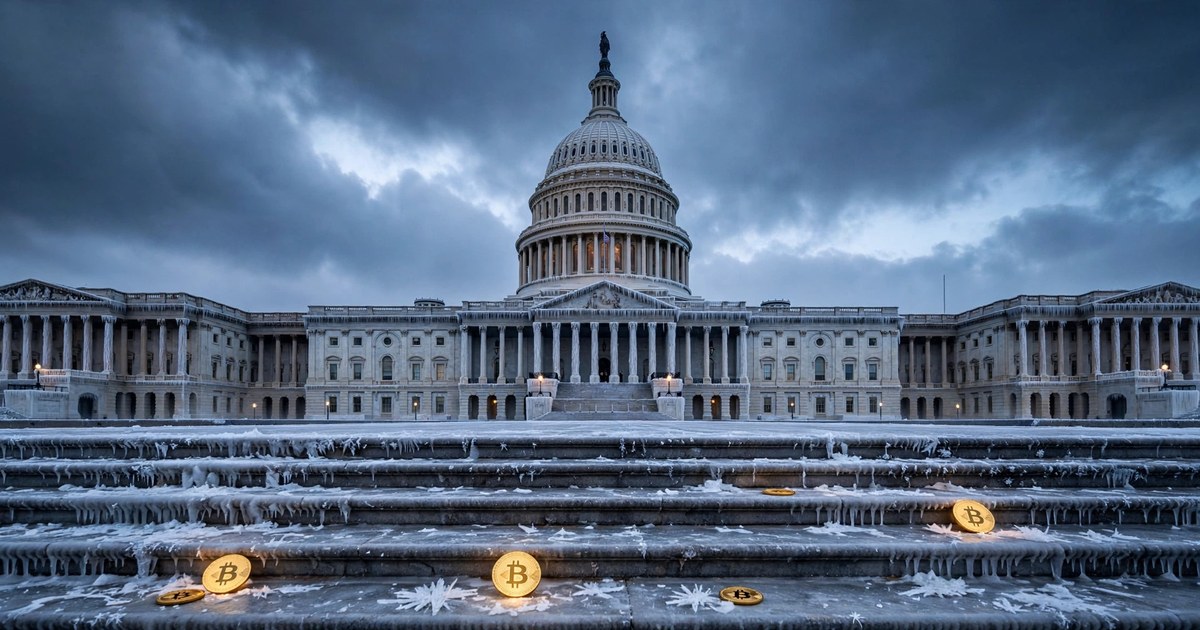
Day 38. The longest government shutdown in American history — and more than 100 crypto ETF applications are frozen inside it. The Senate is preparing to vote on a funding bill that could reopen Washington, but traders on Polymarket give the shutdown a nearly 60% chance of running past November 16. Every day it drags on, the "altcoin ETF floodgates" everyone expected to open in October stay shut — and the bill that was supposed to write crypto's rulebook is frozen with them.
This is not the shutdown story from three weeks ago. In mid-October, a Senate deal looked close enough that the shutdown was widely reported as ending. It did not end. The deal collapsed, the clock kept running, and on November 7 the shutdown passed 38 days — beating the 35-day record set in 2018–19. What was supposed to be crypto's biggest month of ETF launches has become a rain delay with no announced end date, and the market is paying for it: Bitcoin trades near $75,700, Ethereum near $2,240, and the total crypto market has shrunk to about $2.54 trillion.
Here are the five numbers that decide what happens next — and what launches first when Washington finally reopens.
5 Numbers That Explain the Freeze
| Number | What it means |
|---|---|
| 38 days | Length of the shutdown as of November 7, 2026 — the longest in US history, passing the 35-day record of 2018–19. |
| 100+ filings | Crypto-related ETF and registration filings frozen at the SEC, including more than 90 altcoin ETF applications. |
| 60% odds | Polymarket traders' probability that the shutdown continues beyond November 16. |
| 49–50 | The Senate procedural vote that killed the CLARITY Act on September 15 — before the shutdown froze even the fallback work. |
| 21 filings | Staking-focused crypto ETF applications from REX Shares and Osprey Funds, stuck in the same queue. |
The headline number is 38, but the number that matters most to investors is 100-plus. That is how many crypto filings are sitting in a queue that nobody in Washington is currently allowed to process.
What Exactly Is Frozen? The SEC's Own Shutdown Plan
The freeze is not an accident or a backlog — it is written policy. Under the SEC's "Operations Plan Under a Lapse in Appropriations & Government Shutdown," published in August, the agency says it "will not review and approve… new financial products," will not "accelerate the effectiveness of registration statements," and will not "provide non-emergency support to registrants" while funding is lapsed. In practice, that freezes every crypto filing that needs a human decision, including the S-1 effectiveness work issuers must complete before a spot product can launch.

Three things are stuck at once. First, the ETF queue itself: more than 90 applications for spot altcoin ETFs and digital-asset strategies, covering Solana, XRP, Litecoin, Hedera, Dogecoin, Cardano, Avalanche, Polkadot, Sui and more. Second, the staking ETF wave: 21 applications from REX Shares and Osprey Funds that would pay staking rewards inside an ETF wrapper, structured under the Investment Company Act of 1940 to bypass the slower Securities Act route. Third, the legislation: the CLARITY Act, the bipartisan market-structure bill meant to define how crypto and stablecoins are regulated, cannot move while Congress is shut down — and it was already in trouble before the shutdown began.
The Commodity Futures Trading Commission is running on minimal staff too, so the freeze extends beyond the SEC's building. For an industry that spent 2026 waiting on Washington, the shutdown has turned a regulatory calendar into a blank page.
Timeline: How Crypto's Biggest Month Became a Rain Delay
| Date | What happened |
|---|---|
| Sept 15, 2026 | CLARITY Act fails a Senate procedural vote 49–50. No new vote is scheduled. |
| Sept 17, 2026 | SEC adopts a generic listing standard for crypto exchange-traded products, removing the need for token-by-token 19b-4 filings. Bloomberg's Eric Balchunas says the move lifts altcoin ETF approval odds to 100% once the government is functioning. |
| Oct 1, 2026 | Government shutdown begins. SEC switches to essential personnel only; ETF reviews stop. |
| Oct 6–10, 2026 | The window when Solana spot ETFs were widely expected to be approved. Nothing is approved. |
| Oct 14, 2026 | Nasdaq withdraws the VanEck JitoSOL ETF listing proposal — America's first staking-ETF filing dies quietly, before its November 15 deadline. |
| Mid-October 2026 | A Senate funding deal is reported as close. The shutdown is widely described as ending. It does not end. |
| Nov 3–6, 2026 | Democrats sweep the midterm elections and win Congress. Analysts at TD Cowen call the CLARITY Act dead for two years; the bill has roughly eight weeks of life left in this Congress. |
| Nov 7, 2026 | Shutdown hits day 38 — the longest ever. Polymarket prices a ~60% chance it runs past November 16. The Senate prepares to vote on a funding bill. |
The cruel irony is that the regulatory plumbing was fixed just before the shutdown. The SEC's September 17 generic listing standard was designed to end the slow, token-by-token approval process. Issuers were reportedly even asked to withdraw old altcoin ETF filings so they could be re-approved through the faster standard process. Then the government closed, and the faster process has had nobody at the desk to run it. As Bloomberg ETF analyst James Seyffart put it, the situation is a "rain delay" — the framework is more favourable than ever, but the game cannot start until the rain stops.
What Most People Get Wrong About the Freeze
Myth one: the November 15 JitoSOL deadline still matters. It does not. The SEC's final deadline for the VanEck JitoSOL ETF — the first US fund whose reference asset would have been a liquid staking token — was November 15, 2026. But SEC records show Nasdaq withdrew the listing proposal on October 14, before the deadline arrived. The withdrawal is not a rejection, and the public docket states no reason, but the November 15 date is now moot. VanEck's existing Solana ETF, VSOL, is unaffected: it held 201,283 SOL worth $21.66 million as of October 13, with 75.01% of its SOL staked. The lesson is that deadlines only matter if the filing is still alive — and in a shutdown, filings die quietly.
Myth two: a shutdown rejection is coming. A review pause is not a denial. When the SEC suspends review because of an operational interruption, pending applications stay on file and keep their place in the queue. Nothing is rejected, withdrawn or advanced by the freeze itself. That is why ETF analysts sound almost relaxed about the delay: the filings are not damaged, they are parked. The risk is time, not substance — every week of delay is a week in which issuers cannot launch, gather assets, or earn fees.
Myth three: the CLARITY Act was about to pass anyway. It was not. The bill failed its Senate procedural vote 49–50 on September 15, weeks before the shutdown. Then the November midterms handed Congress to the Democrats, and TD Cowen now calls the bill dead for two years. The shutdown did not kill the CLARITY Act; it froze the corpse. What the shutdown did kill is the fallback: the SEC's own rulemaking and guidance work — including the broker-dealer rules that decide how exchanges hold customer coins in 2027 — which also needs a functioning agency.
The 3 Reopening Scenarios — and What Launches First in Each
| Scenario | Probability signal | What happens to crypto ETFs |
|---|---|---|
| Reopen this week | Senate funding vote passes; shutdown ends before November 16 | Fastest floodgate: Solana spot ETFs first (they were due October 6–10), then XRP, Litecoin and Hedera, which were already near auto-effectiveness before the shutdown. REX-Osprey staking ETFs follow within weeks under the generic standard. |
| Drag past November 16 | ~60% on Polymarket | Deadlines keep sliding; the 16 October ETF decisions already missed become a backlog the SEC clears in filing order. Issuers burn cash waiting; the first launches slip into December, and the "ETF December" narrative replaces "ETF Cryptober." |
| Drag into December | Lower odds, but the 38-day record shows this Congress can sustain a long standoff | Year-end launches largely slip to 2027. The generic listing standard still guarantees a wave eventually, but 2026's ETF story ends as a footnote — and the CLARITY Act's remaining eight weeks in this Congress expire with it. |
The scenario that matters most is the first one, because the pipeline is already built. Before the shutdown, the SEC had issued guidance allowing several high-profile crypto ETFs — Solana, Litecoin, Hedera and XRP — to go auto-effective through an 8-A filing and a listing certification from their exchanges. That mechanism does not disappear because the government closed; it waits. ETF analyst Nate Geraci of NovaDius Wealth put it bluntly on X: "Once the government shutdown ends, spot crypto ETF floodgates open." The queue is loaded. The only missing ingredient is a functioning SEC.
Which ETFs Are First in Line When the Floodgates Open
Solana spot ETFs lead the queue. The Solana cohort was first in line before the shutdown, with issuers expressing "high conviction" that approvals would land between October 6 and 10. Solana trades near $89–$95 after a brutal autumn — down more than 40% over the past year — but the ETF demand case survived the price crash: the network just shipped its fastest upgrade ever, and institutional interest in SOL has not gone away.

XRP, Litecoin and Hedera are next. XRP spot ETFs were approved in January 2026 and began trading January 10, establishing the regulatory pathway, but follow-on filings and new structures are still waiting. Litecoin's Canary Capital filing was delayed again with a request for public comments, and the SEC's decision calendar for Dogecoin and XRP funds runs into mid-2026. These are the filings closest to the finish line.
Staking ETFs are the real prize. The 21 REX-Osprey applications would be the first US ETFs to pass staking rewards to shareholders, covering ADA, AVAX, DOT, SUI and more. Best crypto staking platforms in 2026 shows why the demand exists: staking yields of 4–7% are available today, but only to investors willing to run validators or trust a platform — our ranking found Coinbase takes a 35% cut of rewards while Lido takes 10%. An ETF that keeps the yield and removes the plumbing is the product the market has been waiting for, and the shutdown is the only thing standing between it and launch. For the basics, see What Is Crypto Staking? How to Stake Crypto and Earn Rewards in 2026.
The index funds come last — but they are the biggest. The SEC has already approved a five-coin crypto ETF from Grayscale, and NYSE Arca filed in October to move the Bitwise 10 Crypto Index ETF onto the new generic listing standard, which allows up to 15% of a trust's net asset value in digital commodities that do not independently meet the core eligibility criteria. Read our breakdown in SEC Just Approved a 5-Coin Crypto ETF: Bitcoin, Ethereum, XRP, Solana and Cardano in One Fund and Bitwise Filed 11 Crypto ETFs in One Day. Once the generic standard is running at full staff, a single approval can open a dozen products at once.
What Crypto Holders Should Do While Washington Is Frozen
- Do not trade the shutdown headlines day to day. Funding votes fail and pass on hours' notice; Polymarket's 60% odds move with every Senate whisper. Position for the reopening, not for today's vote.
- Watch the SEC docket, not the news cycle. The first real signal will be an SEC notice, a Federal Register filing, or an 8-A effectiveness notice — not a politician's television appearance.
- Check which ETFs you already own are affected. Existing spot Bitcoin and Ethereum ETFs trade normally; the freeze hits new launches, not existing funds. But note the flows: Bitcoin ETFs lost $430.2 million on November 5 alone, and Ethereum ETFs shed $365.3 million in the week ending November 6.
- Revisit your staking setup now. If a staking ETF launches in December, direct stakers should compare its fee against what they pay today — see our staking platform ranking before deciding whether to switch.
- Do not confuse a frozen market with a dead one. Bitcoin is 40% below its peak and fear is elevated, but the ETF pipeline is the fullest it has ever been. Our guide Is Now a Good Time to Buy Crypto? runs five tests for deciding whether to buy, wait or walk away in this market.
Why the Market Is Falling Anyway
The shutdown is not the only weight on crypto. The latest leg down started with a stronger-than-expected US jobs report: the economy added 165,000 jobs in October, well above forecasts near 65,000, while unemployment fell to 4.1%. That pushed the probability of a 25-basis-point Federal Reserve rate increase at the December meeting toward 80%, and rate-hike odds are poison for risk assets. Bitcoin fell below $76,000 and tested its 50-week moving average near $75,733, with nearly $850 million in leveraged positions liquidated in 24 hours. Ethereum failed to reclaim its 200-day average near $2,310 and now sits near $2,240, down about 18% over 30 days, with support near $1,940 — roughly 13% below current prices.
Money is leaving the system, not just rotating within it. Stablecoin supply fell by about $5 billion in a single week to roughly $293.25 billion, according to DefiLlama, and Circle burned about $3.1 billion more USDC than it minted on Ethereum over the past month. When stablecoins shrink, there is less dry powder to buy dips — and that is why Ethereum has barely bounced even as its DeFi ecosystem still holds $43.51 billion of the $81.23 billion in total value locked across chains. For the full picture of the sell-off, see Why Is Crypto Down Today? 6 Reasons Bitcoin Fell to $75,000 — and What Happens Next.
The shutdown and the macro picture feed each other. A frozen SEC means no new ETF demand to absorb selling; a hawkish Fed means the selling keeps coming. That is the trap crypto is in this week — and it is also why the reopening matters so much. The day the government reopens, the most powerful buyer of 2026 — the ETF machine — switches back on.
Frequently Asked Questions
How long has the US government shutdown lasted?
As of November 7, 2026, the shutdown has lasted 38 days, making it the longest in American history — passing the 35-day record set in 2018–19. The Senate is preparing to vote on a funding bill, but Polymarket traders give the shutdown a nearly 60% chance of continuing beyond November 16.
How many crypto ETF filings are frozen by the shutdown?
More than 100 crypto-related filings are frozen, including over 90 applications for spot altcoin ETFs and digital-asset strategies, plus 21 staking-focused ETF applications from REX Shares and Osprey Funds. The SEC's shutdown operations plan states it will not review or approve new financial products while funding is lapsed.
Is the CLARITY Act dead?
Effectively, yes, in this Congress. The CLARITY Act failed a Senate procedural vote 49–50 on September 15, 2026, and after Democrats won Congress in the November midterms, analysts at TD Cowen called the bill dead for two years. The shutdown froze the SEC rulemaking that was supposed to substitute for legislation, including broker-dealer rules on how exchanges hold customer coins.
What happens to crypto ETFs when the shutdown ends?
ETF analysts expect a wave of approvals: the SEC adopted a generic listing standard on September 17 that removes token-by-token review, and several Solana, Litecoin, Hedera and XRP products were already near auto-effectiveness before the shutdown. As Nate Geraci of NovaDius Wealth put it, "once the government shutdown ends, spot crypto ETF floodgates open."
Does the shutdown affect Bitcoin and Ethereum ETFs that already trade?
No. Existing spot Bitcoin and Ethereum ETFs trade normally; the freeze hits new launches and new approvals, not existing funds. But flows into existing funds have turned negative — Bitcoin ETFs lost $430.2 million on November 5 alone, and Ethereum ETFs shed $365.3 million in the week ending November 6.
What was the VanEck JitoSOL ETF, and why does its November 15 deadline not matter?
The VanEck JitoSOL ETF would have been the first US fund holding a liquid staking token — JitoSOL, the largest liquid staking token on Solana, with roughly 8 million tokens in circulation worth about $1.1 billion. The SEC's final decision deadline was November 15, 2026, but Nasdaq withdrew the listing proposal on October 14, so there is no decision left to make. The withdrawal is not a rejection, and VanEck's existing Solana ETF (VSOL) is unaffected.
The Bottom Line
The longest shutdown in US history has done something nobody in crypto expected: it turned the industry's best regulatory setup ever — a generic listing standard, 100-plus filings, and a queue full of ready products — into a waiting room. The filings are not damaged. The demand is not gone. The only thing missing is a government that is open for business.
Watch three things this week: the Senate funding vote, the Polymarket odds on a shutdown past November 16, and the SEC docket for the first 8-A effectiveness notice. The day those three line up, the floodgates open — and the ETFs that launch first will be the ones that were ready in October. Solana first, the staking funds close behind, and the index products bringing up the rear. Until then, the freeze holds, the market drifts lower, and the 38-day clock keeps ticking.