Can Tether Freeze Your USDT? $1.567 Billion Frozen in 37 Minutes After the Binance Hack — 5 Checks for Stablecoin Holders
Tether froze $1.567 billion in USDT just 37 minutes after the Binance hack — while $3.33 billion escaped because Bitcoin can't be switched off. Here is how the stablecoin kill switch works, and the 5 checks every USDT holder should run this week.

Thirty-seven minutes. That is how long it took Tether to freeze $1.567 billion in USDT after stolen funds from the record $6.3 billion Binance hack landed in the attackers' main wallet. Circle followed three minutes later, blocking $823 million in USDC. If you hold stablecoins, here is the uncomfortable truth those freezes proved: your USDT and USDC can be switched off at the address level, by a company, without a court order, and without your permission. Your Bitcoin cannot. Understanding that difference — and the five checks at the end of this article — is now essential for anyone holding dollar-pegged crypto.
When Binance disclosed on October 29, 2026 that roughly $6.3 billion in crypto had been drained from its hot wallets, the largest exchange theft in history, the industry's fastest responders were not police or Binance itself. They were the companies that issue the stablecoins the hackers had stolen. Within hours, about $3 billion of the loot was frozen in place. But roughly $3.33 billion escaped the freeze entirely, because the attackers raced to convert freezable tokens into coins nobody can switch off. This article explains how the freeze race worked, why it stopped where it did, and what it means for your own holdings.
For the full story of the theft itself — how $6.3 billion left Binance's wallets in minutes and why Bitcoin crashed to $76,400 — read our Binance hack explainer. And for the mirror image of this story — why the hackers' Bitcoin sits in wallets nobody can touch — see why the Binance hacker's $1.4 billion in Bitcoin cannot be frozen.
What Happened: The $3 Billion Freeze Race
The attack began at 8:04 p.m. UTC on October 29, 2026, according to blockchain analytics firm Elliptic and reporting by CoinDesk. The hackers, linked by investigators to the same North Korean group behind the Bitget hack weeks earlier, did not crack a private key. Binance has said it found no evidence of private key compromise. Instead, the attackers exploited a signature-layer flaw: a transaction carrying 50 EIP-7702 authorizations tricked the exchange's signing pipeline into delegating control of a hot wallet to attacker code. Three minutes and twenty-four seconds later, 167,464 ETH plus 63 token transfers — including 1.615 billion USDT — left that wallet in a single transaction.
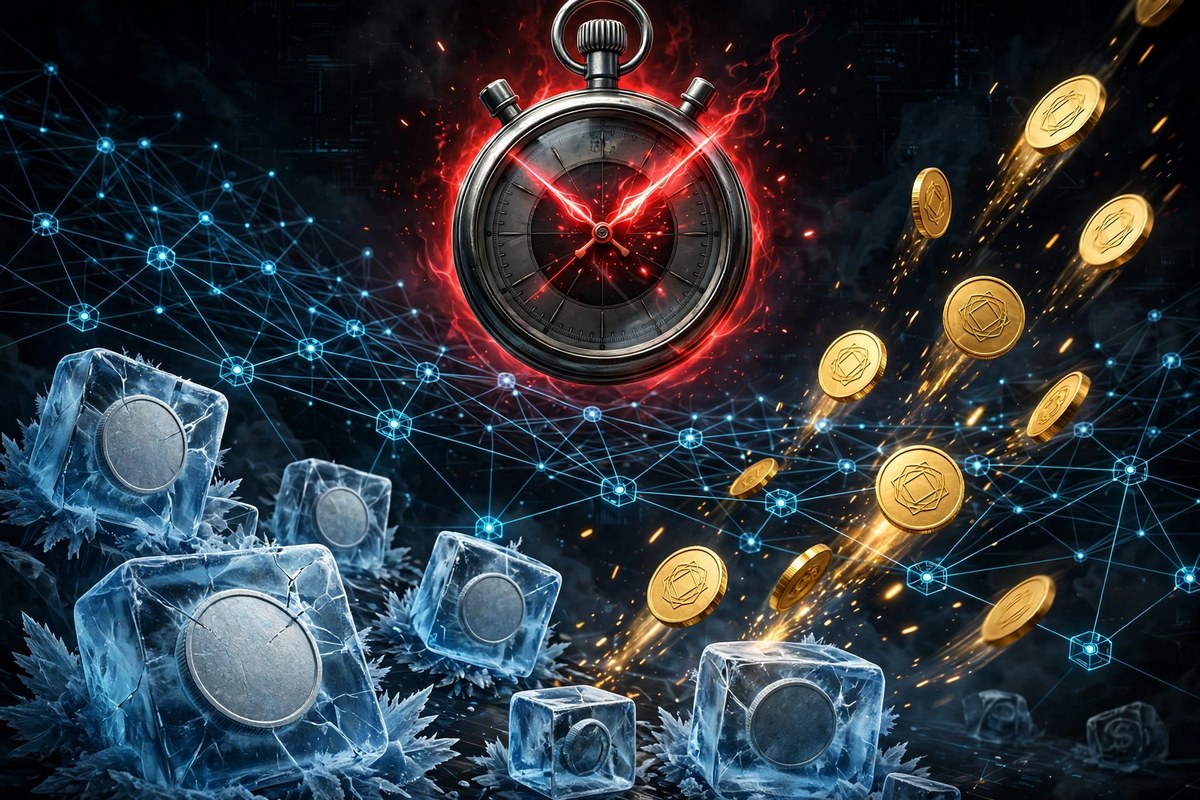
What followed was a race between two clocks. The hackers needed to convert stablecoins — tokens an issuer can blacklist — into Bitcoin, Ether, or TRON, which no issuer controls. The issuers needed to blacklist the attacker addresses before the conversions cleared. According to Elliptic, stablecoins made up 94% of the assets successfully frozen. But the attackers converted approximately $786 million in stablecoins into ETH and TRX before restrictions took effect, and another $500 million in USDT was traced by CertiK engineer Dickson Wu moving to a single address, with $325 million sold to market makers for ETH within an hour of the hack starting.
The freeze scoreboard, as verified by Elliptic as of 7:00 a.m. UTC on October 30, tells the story in numbers:
- Tether froze more than $1.567 billion in USDT, with its first major intervention landing just 37 minutes after the stolen tokens reached the attackers' principal Ethereum wallet. On-chain data compiled by TRM Labs put the confirmed total even higher, at roughly $1.773 billion across Ethereum, Tron, Avalanche, and Polygon.
- Circle froze approximately $823 million in USDC, about three minutes after Tether's first freeze, with $825 million confirmed on-chain including bridged funds from Avalanche.
- Ripple and World Liberty Financial also froze smaller amounts of their own tokens linked to the theft, and the Arbitrum Security Council moved to immobilize funds on its network.
- Binance reported roughly $3 billion frozen in total and has set aside more than $6.34 billion of its own reserves to cover customer losses, while withdrawals restart under new checks — see our 5 checks before you move crypto off Binance.
One detail matters enormously for ordinary holders: between 20:58 and 21:01 UTC on October 29, an attacker-linked wallet deposited about $60 million in USDT into Aave V3 on Ethereum and borrowed 19,762 wrapped Ether, worth roughly $44.6 million. The hackers were not just holding the loot — they were using DeFi lending markets to extract unfrozen value from frozen-adjacent collateral in real time. Speed, not just scale, decided what got saved.
How a Stablecoin Freeze Actually Works
USDT and USDC look like dollars on a blockchain, but legally and technically they are something else: claims issued by a company, with admin functions written directly into the token contract. That is the kill switch.
Tether's USDT contract includes an addBlackList function that blocks an address from sending or receiving USDT, and a destroyBlackFunds function that can wipe a blacklisted balance entirely so replacement tokens can later be issued to the rightful owner. Circle's USDC contract carries a blacklister role with the same effect: a blacklisted address cannot transfer, receive, mint, or burn USDC. In both cases the freeze is executed by the issuer, on-chain, in a single transaction — no bank, no court, no exchange needed.
Contrast that with Bitcoin and Ether. There is no issuer, no admin key, and no blacklist function in the protocol. As we detailed in our companion piece, the hackers' roughly 18,270 BTC and 458,770 ETH — about $3.27 billion at first-night prices — sit in wallets no administrator can touch. The same property that protects your Bitcoin from seizure also protects a thief's Bitcoin from recovery. Stablecoins invert that trade-off: they are recoverable precisely because they are controllable.
Here is the full comparison, because most holders have never seen it laid out:
| Asset | Can the issuer freeze it? | Who decides? | What happens to frozen funds? |
|---|---|---|---|
| USDT (Tether) | Yes — addBlackList | Tether, unilaterally | Balance blocked; can be destroyed and reissued to the proven owner |
| USDC (Circle) | Yes — blacklister role | Circle, in coordination with authorities | Balance blocked; return via a prescribed claims procedure |
| Bitcoin (BTC) | No — no issuer exists | Nobody | Nothing; only the private key holder can move it |
| Ether (ETH) | No — no issuer exists | Nobody | Nothing; same as Bitcoin at the protocol level |
| XRP / SOL / TRX | No — no issuer freeze | Nobody at protocol level | Exchanges can freeze accounts, but not the tokens themselves |
The distinction between freezing an account and freezing a token is crucial. An exchange can lock your account, but your coins still exist on-chain and can move if you hold the keys. An issuer blacklist locks the tokens themselves: even in your own self-custody wallet, blacklisted USDT cannot be sent anywhere. That is a power no Bitcoin holder has ever faced — and no stablecoin holder can opt out of.
The Double-Standard Debate: Why Not Every Victim Gets This Help
The freezes drew praise for their speed — and sharp criticism for their selectivity. CoinDesk reported that experts are now openly questioning a double standard: when $6.3 billion vanished from the world's largest exchange, issuers moved within the hour. When smaller victims lose funds, the same issuers are far slower, or do not act at all.
The policy history makes the tension concrete. Circle CEO Jeremy Allaire has said publicly that Circle freezes USDC only at law enforcement direction or under a court order. Tether took a similar position in 2022, saying it would not freeze Tornado Cash mixer addresses without government instruction. Yet after the Binance theft, Tether CEO Paolo Ardoino confirmed the $1.567 billion freeze on X, saying "protecting the industry and our partners is our main priority" — without saying whether law enforcement had instructed the action. Circle said its freeze was done "in coordination with authorities." The gap between the stated policy and the Binance response is exactly what critics are pointing at.
There are three honest ways to read this. The generous reading: Binance's scale made this a systemic event, and issuers acted to protect the whole ecosystem, not just one customer. The cynical reading: the biggest players get the fastest protection, and everyone else waits. The structural reading: freezing is a discretionary business decision dressed as a compliance process, and there is no published rulebook telling you which victims qualify. All three can be true at once — and none of them is reassuring if you are a small holder assuming your stablecoins carry the same protection.
The debate also exposes a second uncomfortable fact: freezing is not recovering. As Dubai lawyer Irina Heaver told CoinDesk, freezing "stops the hackers from moving the funds or concealing them, but doesn't automatically return them to Binance." Tether can destroy frozen USDT and issue replacements, and Circle has a procedure for returning USDC, but both require proof of ownership and legal grounds — and, as Heaver noted, it is not yet clear whether a court order will be required for Binance to get its funds back. Frozen is a pause button, not a refund.
Could Your USDT Be Frozen? The Honest Answer
Yes — technically, at any time, if Tether blacklists your address. Practically, the risk for an ordinary holder is low but not zero, and it clusters around specific triggers. Tether has historically frozen addresses linked to hacks, sanctions, scams, and law-enforcement requests. It does not routinely freeze random retail wallets. But the Binance case proves the trigger does not have to be a court order, and the decision does not have to be explained to you in advance.
The realistic scenarios where an everyday holder gets caught in a freeze are narrower than the headlines suggest, and worth naming precisely:
- Receiving tainted funds is the biggest real risk. If someone sends you USDT that passed through a hacked address, and that address is later blacklisted, your balance can be frozen even though you did nothing wrong. This is the same contamination logic that makes forced liquidations cascade through leveraged traders — one bad position drags down innocent counterparties.
- Sanctions exposure is the second risk. Addresses tied to sanctioned entities or mixers have been blacklisted before, and counterparties dealing with them can be swept up.
- Exchange and DeFi contagion is the third risk. Funds sitting in a hacked exchange's wallets, or supplied to a DeFi pool that received stolen tokens, can be frozen at the issuer level regardless of whose account they sit in.
None of this means you should dump all stablecoins. It means you should stop treating USDT and USDC as digital cash. They are corporate liabilities with an off switch, and your risk management should reflect that — just as you would not keep your life savings in a single bank account without understanding deposit insurance.
5 Checks Every Stablecoin Holder Should Run This Week
The Binance freeze race is a free lesson in stablecoin risk. Here is the checklist to apply to your own holdings before the next incident, not after it.
- Split your stablecoin exposure across issuers, not just wallets. Holding USDT on three wallets does not diversify issuer risk — one Tether blacklist decision hits all three. Split between USDT and USDC, and consider keeping part of your dollar exposure in tokenized Treasury products or fiat, so no single company's admin key controls all of it.
- Keep long-term savings in assets nobody can freeze. Bitcoin and Ether have no issuer kill switch — that is a feature, not a bug, for money you do not need to move quickly. If you are still fuzzy on Bitcoin's smallest unit and why it matters for self-custody, our guide What Is a Satoshi? 1 Bitcoin = 100 Million Sats explains the basics.
- Check where your USDT actually came from before accepting large payments. For over-the-counter trades, freelance payments, or peer-to-peer deals, use a block explorer to glance at the sending address history. Funds fresh from a mixer or a flagged hack address are the ones most likely to be frozen later.
- Do not park borrowed or leveraged positions in a single stablecoin. The Binance hackers borrowed $44.6 million in wrapped Ether against $60 million in USDT collateral in three minutes. In a freeze event, collateral can be immobilized while your loan keeps accruing — the same liquidation mechanics that wiped out 93,000 traders in 24 hours this week.
- Know your exit before you need it. If Tether or Circle ever froze your address, your recourse is a support ticket and a legal claim, not a private key. Decide now which exchange accounts, bank rails, and alternative stablecoins you would use, and keep a small buffer outside any single issuer so a freeze is an inconvenience, not a catastrophe.
What Most People Get Wrong About "Decentralized" Money
The Binance hack shattered a comforting myth: that crypto is either fully decentralized or fully corporate. In reality, the market is a hybrid, and the freeze race mapped the boundary precisely. Bitcoin, Ether, and the $3.33 billion the hackers still control sit on the decentralized side — censorship-resistant, unfreezable, and unrecoverable. USDT, USDC, and the $3 billion that was frozen sit on the corporate side — recoverable, controllable, and subject to a company's discretion. Most portfolios straddle both sides without realizing it.
That hybrid structure is also why the hack's market impact was contained. Bitcoin fell only about 3% on the Binance news, versus nearly 11% when Binance was last breached in 2018 — a sign, noted by market analysts this week, that the holder base is less leveraged and more structurally committed than in past shocks. The freeze mechanism itself may have helped: by immobilizing nearly half the loot within hours, issuers capped the amount of forced selling the hackers could do, which limited the downside for everyone else. The kill switch, for all its centralization, acted as a market stabilizer this time.
The question for holders is not whether stablecoin freezes are good or bad in the abstract. It is whether you have priced the off switch into your own plan. If your entire crypto net worth sits in one issuer's token, in one wallet, on one exchange, you have a single point of failure that no private key can fix. Diversify the issuer, diversify the asset, and keep your long-term holdings in coins nobody can switch off.
FAQs
Can Tether freeze USDT in my personal wallet?
Yes. Tether's contract allows it to blacklist any address, including a self-custody wallet, blocking that USDT from being transferred. The freeze applies to the tokens, not just to exchange accounts.
Can Circle freeze my USDC?
Yes, through the blacklister role in the USDC contract. Circle states it acts on law enforcement direction or court orders, though its Binance response was described as coordination with authorities.
Can anyone freeze my Bitcoin?
No. Bitcoin has no issuer, no admin key, and no blacklist function. An exchange can freeze your account, but nobody can freeze Bitcoin itself on-chain. The same applies to Ether at the protocol level.
Does a freeze mean the money is returned to victims?
Not automatically. Freezing stops movement; recovery requires proof of ownership and, potentially, a court order. Tether can destroy frozen USDT and reissue it, and Circle has a claims procedure, but neither is instant or guaranteed.
How much of the Binance loot was actually frozen?
About $3 billion of the estimated $6.3 billion, per Binance — including $1.567 billion in USDT frozen by Tether and $823 million in USDC frozen by Circle. Roughly $3.33 billion remains in wallets issuers cannot freeze, per Elliptic.
Should I stop using stablecoins?
No — but stop treating them as risk-free cash. Split across issuers, keep long-term savings in unfreezable assets like Bitcoin, and run the five checks above so a single issuer's decision can never lock up everything you own.
Conclusion
The Binance hack will be remembered for its size — $6.3 billion, the largest exchange theft ever. But its lasting lesson may be the 37 minutes. In 37 minutes, Tether proved that the world's most-used dollar token has an off switch, operated by a company, usable without a court order. In the same hour, the hackers proved the limit of that switch: convert to Bitcoin or Ether fast enough, and no one can stop you. Both facts are now permanent features of the market.
For ordinary holders, the takeaway is practical, not philosophical. Know which of your assets have a kill switch and which do not. Split your stablecoins across issuers. Keep your long-term wealth in coins nobody can freeze. And remember the number that started this story: $1.567 billion, frozen in 37 minutes, because someone else held the key to your money.
Sources: FinanceFeeds, CoinDesk, ForkLog, Dev.to analysis, CoinDesk markets.
This article is for informational purposes only and does not constitute financial advice. Crypto markets carry significant risk.