Why Crypto Companies Are Moving to Dubai: 60 Licensed, 23 Waiting — as the US Goes the Other Way
Dubai just licensed its 60th crypto company — 20 of them in 2026 alone, a record year — while Washington moves to hand the SEC more power over crypto. Here are the 5 numbers that explain the great crypto migration.

Dubai just licensed its 60th crypto company — 20 of them in 2026 alone, the busiest year on record — while Washington spent the same week moving to hand the SEC more power over the industry. The split could not be clearer: one government is handing out licences at a record pace, the other is writing rules that could push firms out. And the companies are voting with their headquarters.
According to an analysis of Dubai's Virtual Assets Regulatory Authority (VARA) public register by Regulatory Gate, published on November 9, 2026, the emirate now has 60 licensed virtual asset companies with active licences — and another 23 firms holding preliminary approval, waiting in line for full authorisation. This is not a press-release promise. It is a register you can check, name by name, and it tells a story the US crypto industry would love to be living right now.
So why are crypto companies moving to Dubai, what does a VARA licence actually buy them, and what does the great crypto migration mean for ordinary Bitcoin holders who will never set foot in the emirate? Here are the numbers — and the comparison with the United States that explains them.
The Number That Says It All: 60 Licences, and 2026 Is the Record Year
The headline figure is 60 active licences. But the trend inside that number is the real story. VARA has issued licences every year since it began operating in 2023, and the pace has accelerated in every single year:
| Year | New VARA licences issued | What happened |
|---|---|---|
| 2023 | 11 | VARA begins licensing; the first wave of exchanges and brokers gets regulated status |
| 2024 | 12 | Binance FZE secures its full VARA licence in April |
| 2025 | 17 | Steady growth as the framework matures |
| 2026 | 20 | Record year — already the most licences ever issued in a single year |
Twenty licences in 2026 alone, with almost two months of the year still to run when the data was published on November 9. The 60-company tally counts only firms holding active licences today — not every licence ever issued — so the real flow of companies through the system is even larger. And the pipeline behind it is fuller still: 23 companies currently hold In-Principle Approval (IPA), the intermediate step before a full licence. September alone produced seven preliminary approvals, the busiest month in the register's history.
Put another way: Dubai's regulated crypto sector has grown fivefold in three years, and the queue to join it has never been longer. That is what a regulatory regime that actually issues licences looks like. Compare it with the United States, where the defining crypto story of the last month is not a licence granted but a bill dying — more on that below.
Who Just Joined the Club: Bybit, Kraken, Rain — and a 170-Year-Old Bank
The names on the 2026 licence list matter, because they are not start-ups chasing a flag of convenience. They are the biggest players in the industry, plus one of the oldest banks in the world.
Bybit received its exchange licence on October 20, 2026, through Bybit Fintech FZE, covering spot trading in the emirate. The exchange has been headquartered in Dubai since 2022, but the licence converts a presence into a regulated business. Derivatives are the next step — Bybit has said it wants to expand into them, but that needs a separate approval, and it has not been granted yet.
Kraken, through Payward FZCO, was approved in October 2026 to provide broker-dealer and investment management services — a broader permission set than a simple exchange licence, and a sign of how the register is maturing from trading venues toward full-service crypto finance.
Rain MENA, the Gulf-built exchange, received licences for exchange and broker-dealer activities in October 2026, joining the register on October 5. Rain is licensed not only by VARA in Dubai but also by the FSRA in Abu Dhabi and the Central Bank of Bahrain — the kind of multi-jurisdiction stack that only exists where regulators actually answer the phone.
And then there is the name that should make traditional finance sit up: Standard Chartered Bank received a broker-dealer licence in August 2026. A bank founded in 1853 now holds a Dubai crypto licence. When the incumbents start joining the newcomers, a trend becomes a migration.
They join a register that already includes Binance FZE (licensed since April 2024), OKX (full VARA licence, with BTC/AED and ETH/AED pairs), and Crypto.com, operating as Foris DAX Middle East FZE with a full licence covering exchange, broker-dealer, lending and investment services — the only licensee authorised to let customers pay Dubai government fees in crypto.

The Queue Is Getting Longer: 23 Firms Waiting for Full Approval
If the 60 licensed firms are the story, the 23 waiting behind them are the sequel. These companies hold In-Principle Approval — VARA's formal signal that a firm is on the path to a licence, subject to meeting remaining requirements. Crucially, an IPA is not a licence: a firm holding one cannot offer regulated virtual asset services to customers in Dubai until VARA grants final approval.
Among the firms in the queue are Revolut Digital Assets and WhiteBIT (whose WB Fintech Development FZE received the most recent IPA, on September 30). Of the 23 IPA holders, 17 have applied to provide broker-dealer services and five have applied for exchange services. Broker-dealing dominates the market on both sides of the line: 44 of the 60 licensed companies — more than 70% — are authorised to provide broker-dealer services.
That concentration tells you what Dubai's crypto economy actually is. It is not a casino of token launches. It is a brokerage and trading hub: firms that connect buyers and sellers, hold client assets, and intermediate flows. The licences being issued are the boring, infrastructure kind — and boring infrastructure is exactly what institutional money needs before it arrives in size.
Why Dubai Is Winning the Race: 4 Reasons Companies Keep Choosing It
Licences do not issue themselves. Companies choose Dubai for a combination of reasons that, taken together, no other major jurisdiction currently offers in one place.
1. A regulator that exists — and answers. VARA was established in 2022 under Law No. 4 of 2022 as a dedicated virtual assets regulator. There is one door to knock on, one register to join, and one rulebook to follow. Contrast that with the United States, where a crypto firm can face the SEC, the CFTC, state regulators and banking supervisors simultaneously — and where, as of this week, nobody can say with confidence which agency will be in charge next year.
2. Speed with substance. Twenty licences in a year is fast for a financial regulator, but VARA's process is not a rubber stamp: the IPA stage exists precisely so firms must satisfy outstanding requirements before they can serve customers. The firms that pass get certainty; the firms that cannot, do not. That combination — quick decisions, real standards — is what companies mean when they say they want "regulatory clarity."
3. Zero personal income tax. The UAE charges no personal income tax, and our guide to how to buy Bitcoin in the UAE in 2026 sets out the 0% tax position, the AED payment rails and the five exchanges to compare. For founders, traders and crypto employees, the tax arithmetic of relocating is not subtle. It is the single biggest line item in the decision, and Dubai does not hide it.
4. A market, not just a mailbox. Dubai is not only a place to incorporate. It is a place where crypto is actually used: Crypto.com's licence allows customers to pay Dubai government fees in digital assets, and the emirate's exchanges offer AED pairs, local bank transfers and Arabic-language apps. Companies go where the customers are, and in Dubai the customers are already there.
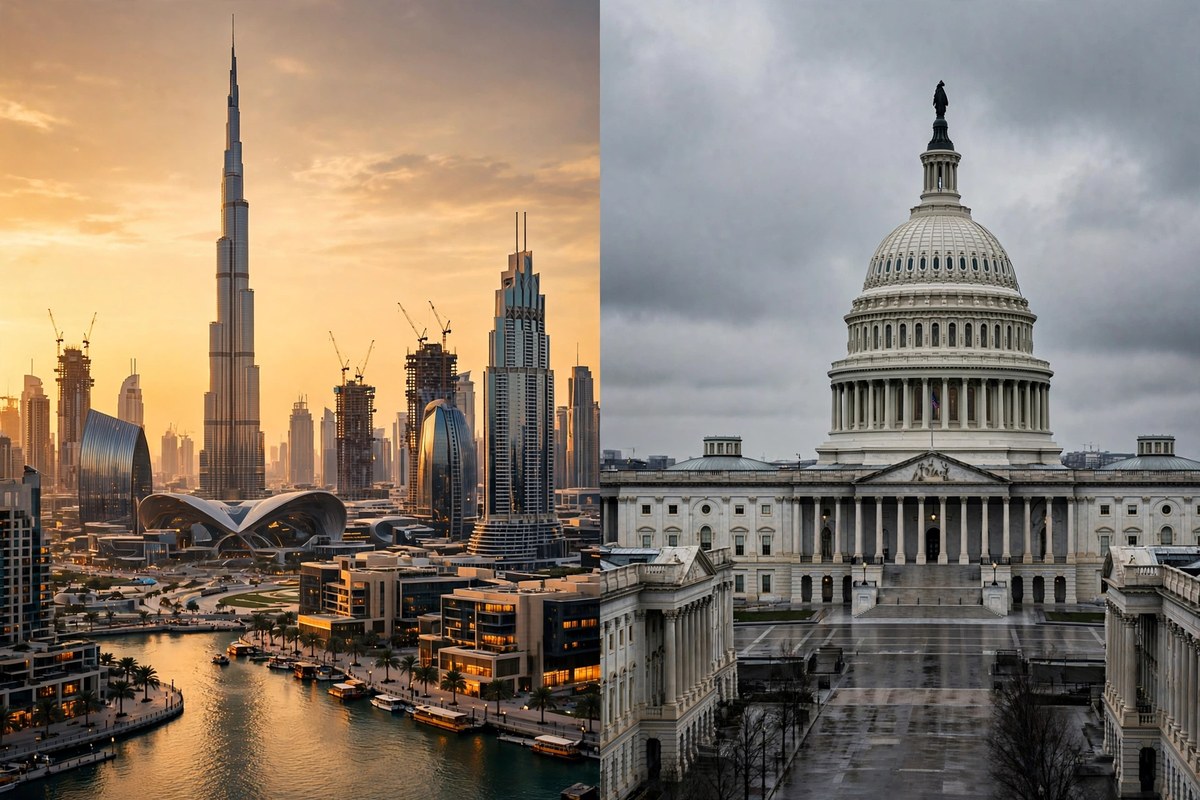
The Other Side of the Map: America Just Went the Other Way
Dubai's record year is landing at the worst possible moment for the American crypto industry. On November 3, 2026, Democrats won control of both the House and the Senate in the midterm elections — and the regulatory consequences arrived within days.
The House-passed CLARITY Act, the market-structure bill the industry had spent two years lobbying for, passed the House 294–134 in July 2025 but failed a Senate cloture vote 49–50 on September 15, 2026. It now dies when this Congress ends on January 3 unless the lame-duck session revives it — and House Democrats are instead discussing turning Rep. Maxine Waters' Crypto Investor and Consumer Bill of Rights into their own market-structure package for the next Congress, with a larger role for the SEC and a smaller one for the CFTC. That is the opposite of what the industry asked for.
Meanwhile the SEC has submitted a proposed crypto broker-dealer rule package to White House review — the filing reached the White House on November 3 — touching capital, customer protection and recordkeeping rules. The draft language has not been published, so nobody yet knows what it will require; the uncertainty itself is the problem. We covered the four rules that decide how exchanges will have to hold your coins in our report on the SEC broker-dealer rules reaching White House review.
The market has noticed. US spot Bitcoin ETFs recorded $1.28 billion in net outflows in the week of November 2–6, their largest weekly outflow since June, and Bitcoin was trading near $75,000 on November 10 — roughly 40% below its all-time high of $126,080 — as investors waited for the October CPI report. The contrast with Dubai could hardly be starker:
| Dubai (VARA) | United States | European Union (MiCA) | |
|---|---|---|---|
| Licences in 2026 | 20 — a record year | No federal crypto licensing regime exists | MiCA licences rolling out across member states |
| Regulator | One dedicated authority, est. 2022 | SEC vs CFTC turf war, unresolved | National regulators under one EU rulebook |
| Market-structure law | Law No. 4 of 2022, in force | CLARITY Act dead in the Senate; SEC-led package now favoured | MiCA in force since 2024 |
| Personal income tax on crypto | 0% | Up to 37% federal, plus state tax | Varies by country, up to ~45% |
| Big names arriving in 2026 | Bybit, Kraken, Standard Chartered, Rain | Coinbase won an OCC trust charter — but as a bank, not a crypto licence | Exchanges consolidating under MiCA licences |
Europe, for its part, sits in the middle: MiCA gives it a real rulebook, and our ranking of the best crypto exchanges in Europe in 2026 shows seven MiCA-licensed platforms competing on fees — but no European city is issuing licences at Dubai's pace, and none offers its tax rate.
What Most People Get Wrong About Dubai Crypto
The Dubai story is real, but three misconceptions keep circulating — and each one matters if you are thinking of moving money, or yourself, there.
Myth 1: "Dubai is an unregulated crypto free-for-all." Wrong, and in the opposite direction from the truth. Dubai has one of the most specific crypto rulebooks in the world: VARA licenses by activity — exchange, broker-dealer, custody, lending, investment management — and firms cannot serve customers until every requirement is met. The 23 firms stuck at IPA stage are the proof. An unregulated haven would not have a queue.
Myth 2: "A VARA licence means a company is safe." A licence means a company is supervised, not that it is solvent. The $6.3 billion Binance hack — the largest in crypto history — is a reminder that even the biggest names can be breached, licensed or not. If you hold coins on any exchange, the best crypto wallets in 2026, compared after the Binance hack, is the guide to moving them into your own custody, where no licence is needed at all.
Myth 3: "Moving to Dubai means paying no tax anywhere." The UAE charges no personal income tax, but your home country may still tax you — on exit, on worldwide income if you remain resident, or on gains realised before you leave. The 0% figure is real inside the UAE; it is not a magic shield against every other tax authority on earth. Get advice before you move, not after.
What This Means for You as a Bitcoin Holder: A 5-Point Checklist
You do not need to move to Dubai to benefit from the migration. But the shift changes the landscape every holder operates in. Use this checklist:
1. Check whether your exchange is licensed anywhere. Look for a VARA licence, a MiCA licence, or a US state money-transmitter regime. An exchange that holds no licence in any serious jurisdiction is a risk you are carrying for free.
2. Do not confuse an IPA with a licence. If a firm tells you it is "approved in Dubai," ask whether it holds a full VARA licence or only In-Principle Approval. The difference is the difference between being allowed to serve you and not being allowed to.
3. Watch the US rulebook, not the headlines. The SEC broker-dealer package now under White House review will decide how American exchanges hold your coins. If it lands hard, expect more US firms to follow Bybit and Kraken east — and expect the Dubai register to grow faster still.
4. Remember that licences do not replace custody. A regulated exchange is safer than an unregulated one, but the safest coins are the ones in a wallet you control. The Binance hack proved that even licensed giants can lose customer funds. Our honest guide to whether Bitcoin is a good investment in 2026 sets out the risks and the allocation thinking that should come before any exchange decision.
5. Watch the November 13 date. The first US ETF tracking Canton Coin, a tokenised-assets network token, has its registration statement going effective on November 13 — a reminder that even as Washington tightens, new crypto products keep reaching American investors through the ETF wrapper. For the mechanics of how those funds work, see our beginner's guide to what a Bitcoin ETF is and how spot ETFs work.
FAQs
How many crypto companies are licensed in Dubai?
Sixty companies hold active VARA licences as of November 9, 2026, according to an analysis of the regulator's public register by Regulatory Gate. Twenty of those licences were issued in 2026 — the most in any single year since licensing began in 2023. Another 23 companies hold In-Principle Approval and are waiting for full authorisation.
What is VARA?
VARA is Dubai's Virtual Assets Regulatory Authority, established in 2022 under Law No. 4 of 2022. It is a dedicated regulator for virtual assets, licensing firms by activity — exchange, broker-dealer, custody, lending, investment management and more. Firms must hold a full licence before they can offer regulated virtual asset services to customers in Dubai.
Which big crypto companies are licensed in Dubai?
Bybit (exchange licence, October 20, 2026), Kraken's Payward FZCO (broker-dealer and investment management, October 2026), Rain MENA (exchange and broker-dealer, October 2026), Standard Chartered Bank (broker-dealer, August 2026), Binance FZE (since April 2024), OKX and Crypto.com all hold VARA licences. Revolut Digital Assets and WhiteBIT are among the firms holding preliminary approval.
Is crypto tax-free in Dubai?
The UAE charges no personal income tax, which includes tax on crypto gains for individuals resident there. But that does not mean you owe nothing anywhere: your home country may tax you on exit, on worldwide income, or on gains realised before you leave. Professional tax advice is essential before relocating for tax reasons.
Why are crypto companies leaving the US for Dubai?
The US still has no federal crypto licensing regime, the CLARITY Act market-structure bill died in the Senate in September 2026, and House Democrats are now discussing a package that would give the SEC a larger role. Dubai offers the opposite: one dedicated regulator, licences issued at a record pace, and 0% personal income tax. Companies follow certainty.
Does a VARA licence mean my crypto is safe on that exchange?
No. A licence means the firm is supervised and must meet capital, custody and conduct requirements — but it does not guarantee solvency or protect against hacks. The largest exchange hack in history, the $6.3 billion Binance breach, happened to a licensed group. For large holdings, self-custody in a hardware wallet remains the safest option.
Conclusion
Dubai's 60 licences are not a marketing number. They are a register, updated on November 9, with names, dates and a queue of 23 more firms behind them — including Revolut and WhiteBIT — and a record 20 licences issued in a single year. Bybit, Kraken, Rain and Standard Chartered all joined in 2026, and the pipeline's busiest month ever was September.
The deeper story is the divergence. One jurisdiction built a dedicated regulator in 2022 and is now issuing licences faster than ever. The other spent the same week watching its market-structure bill die, its ETF flows turn negative to the tune of $1.28 billion, and its next rulebook disappear into White House review unpublished. Companies are not making an ideological choice. They are making a practical one — and the register shows which way they are going.
For holders, the lesson is simpler: use licensed exchanges, understand what the licence does and does not protect, and keep the coins you cannot afford to lose in a wallet you control. The great crypto migration is a story about where companies go. Your coins should live where only you can reach them.
Sources: CoinEdition, Arabian Business, Datawallet, Hokanews, PlainBTC, AInvest.