What Happens to Your Crypto If an Exchange Goes Bankrupt? FTX's 119% Payout Returned Just 0.19 BTC
FTX creditors got 119% back — and still lost 81% of their Bitcoin. If your exchange fails tomorrow, your balance becomes a court claim priced in dollars on the filing date. Here are the 5 checks that decide whether you get coins back, cash back, or nothing.

FTX creditors were promised 119% of their money back — and a customer who held one Bitcoin still ended up with roughly 0.19 BTC. That single paradox is the most important thing to understand about crypto exchanges: when an exchange fails, you do not automatically get your coins back. Your balance becomes a claim in a bankruptcy court, priced in dollars on the day of the filing, and paid out in rounds that can take years. After the $6.3 billion Binance hack, the question is no longer theoretical. Here is exactly what happens if your exchange goes bankrupt, what four real collapses paid back, and the five checks that decide whether you walk away with coins, cash, or nothing.
Binance said it has covered around 95% of the $6.3 billion stolen, and the FBI has formally attributed the theft to North Korea's TraderTraitor group, according to CoinDesk's November 2 markets report. Binance also processed $4.65 billion of withdrawals against $1.01 billion of deposits when it reopened, a net outflow of $3.64 billion. Binance survived. The exchanges below did not — and their customers' outcomes show why "my coins are on the exchange" is not the same as "my coins are mine."
What happens the day an exchange fails
The sequence is almost always the same, and it starts before any court filing. First, withdrawals freeze. In every major case, the freeze came first and the explanation came later: Celsius paused withdrawals in June 2022, Voyager froze trading and withdrawals on July 1, 2022, and FTX halted withdrawals days before its November 11, 2022 bankruptcy filing. Once a US Chapter 11 filing lands, an automatic stay freezes all customer withdrawals immediately — your staking position stops earning, you cannot unstake, and you cannot move anything.
Second, your account balance is converted into a legal claim. In most cases that claim is valued in US dollars at coin prices on the petition date — the day of the filing — not at the price when you eventually get paid. That is the mechanism behind the FTX paradox. Third, a court decides who actually owns the assets. Customers argued that FTX's own terms of service said title to their digital assets "shall at all times remain with you," but because customer funds had been misused and commingled, there were not enough coins on the books to repay everyone in kind, so customers were paid on petition-date dollar values.
Fourth, you wait. In all three of FTX, Mt. Gox and Celsius, more than a year and a half passed between the bankruptcy filing and the first distribution. FTX's plan only became effective on January 3, 2025, more than two years after filing. Patience is not optional; it is the process.

What four real collapses actually paid back
The headline recovery percentages you see in the news are misleading on their own, because they usually describe dollars, not coins. The table below puts the four best-documented cases side by side.
| Exchange | Failed | What went wrong | What customers got |
|---|---|---|---|
| FTX | November 2022 | About an $8 billion hole in customer accounts | About 119% of petition-date dollar claims; BTC valued at $16,871, so 1 BTC became roughly 0.19 BTC if payouts were used to buy Bitcoin back |
| Celsius | July 2022 | A $1.2 billion balance-sheet hole; customer crypto lent into illiquid positions | Earn accounts ruled property of the estate in January 2023; Earn customers recovered roughly 30 cents on the dollar in early distributions, with later rounds lifting cumulative recoveries |
| Voyager | July 2022 | Three Arrows Capital failed to repay loans of about $666 million | Initial plan expected customers to receive about 35.7%, with later recoveries raising the total |
| Mt. Gox | 2014 | About 850,000 BTC missing; 200,000 later found | Repayment in actual BTC — the opposite of FTX — but only a fraction of what was lost, spread over a decade, with a deadline moved to October 31, 2027 |
FTX is the positive outlier, and that is precisely why it misleads. The estate recovered $16 to $17 billion in assets, and more than $9.7 billion had been distributed across five rounds by July 2026. But because claims were locked at November 2022 prices, the "119%" figure measures dollars at the bottom of the market, not the Bitcoin customers actually held. One analysis of exchange bankruptcy claims calculates that an FTX.com customer claim for 1 BTC, with each payout used to buy BTC back, comes to only about 0.19 BTC. Genesis is the counter-example: it paid creditors back in actual coins, so they captured the price appreciation that dollar-based estates froze out.
Celsius is the warning. A court ruled in January 2023 that Earn account deposits were property of the bankruptcy estate, making Earn customers unsecured creditors rather than asset owners. That single legal classification — not the size of the hole — is what turned their deposits into a 30-cents-on-the-dollar outcome in early distributions. Voyager tells the same story from a different angle: its collapse was not a hack but a counterparty failure, when a hedge fund borrower defaulted and the broker had nothing left to pay with.
What most people get wrong about exchange custody
The biggest myth is that terms of service protect you. FTX's terms said title remained with customers, and it did not change the outcome once funds were gone. The second myth is that a big brand is a guarantee: FTX was the world's second-largest exchange when it failed, and Celsius and Voyager were household names in crypto. The third myth is that proof of reserves settles the question. A reserves snapshot shows assets at one moment; it does not show liabilities, it does not show whether customer assets were lent out, and it does not survive a hack or a fraud. Our own guide to Binance's proof of reserves lists five tests a report must pass before it means anything — and even a passing report is not insurance.
The fourth myth is that staked or yield-earning coins are safer because they are "working." They are riskier in a bankruptcy: staked funds are locked by the platform, they stop earning the moment proceedings begin, and their classification as estate property versus customer property is exactly what courts fight over. The fifth myth is that a hack and a bankruptcy are different problems. A $6.3 billion hack is how a solvent exchange becomes an insolvent one — and it is also why Binance's emergency fund matters so much. Binance spent roughly half of its SAFU emergency fund in one weekend, falling from 15,000 to 7,500 BTC, as we covered in our SAFU breakdown.
The 5 checks before you leave coins on an exchange
None of this means you must never use an exchange. It means you should treat an exchange balance as an exposure you actively manage, not a vault. Run these five checks tonight, while withdrawals are still open.
- Check the withdrawal test first. Move a small amount off the exchange and confirm it arrives. If withdrawals are slow, restricted, or suddenly require new verification, treat that as a signal, not an inconvenience — every failed exchange froze withdrawals before it filed.
- Check what the terms say about your assets. Look for whether customer assets are segregated, held in trust, or pooled with company funds, and whether the platform lends or rehypothecates deposits. Pooled and lent assets are the ones courts classify as estate property.
- Check the proof of reserves — and the liabilities. A reserves page without matching liabilities, auditor attestation, and cold-wallet evidence is marketing. South Korea's emergency checks after the Binance hack exposed a 19-point cold-wallet gap in how exchanges evidence their holdings, as detailed in our coverage of those checks.
- Check your own concentration. Never hold more on any single exchange than you can afford to lose access to for two years. The FTX timeline — filing in November 2022, first distributions in February 2025 — is the realistic worst case for getting anything back.
- Check your exit route before you need it. Set up self-custody now: a hardware wallet you control, a seed phrase stored offline, and a practiced withdrawal. Our guide to storing crypto safely walks through cold storage and seed phrases step by step, and our hardware wallet ranking compares eight options after the Binance hack. If you trade actively, our custody options ranking compares five places to hold coins, and our DEX guide explains the non-custodial alternative that just hit a record 23% of spot trading.
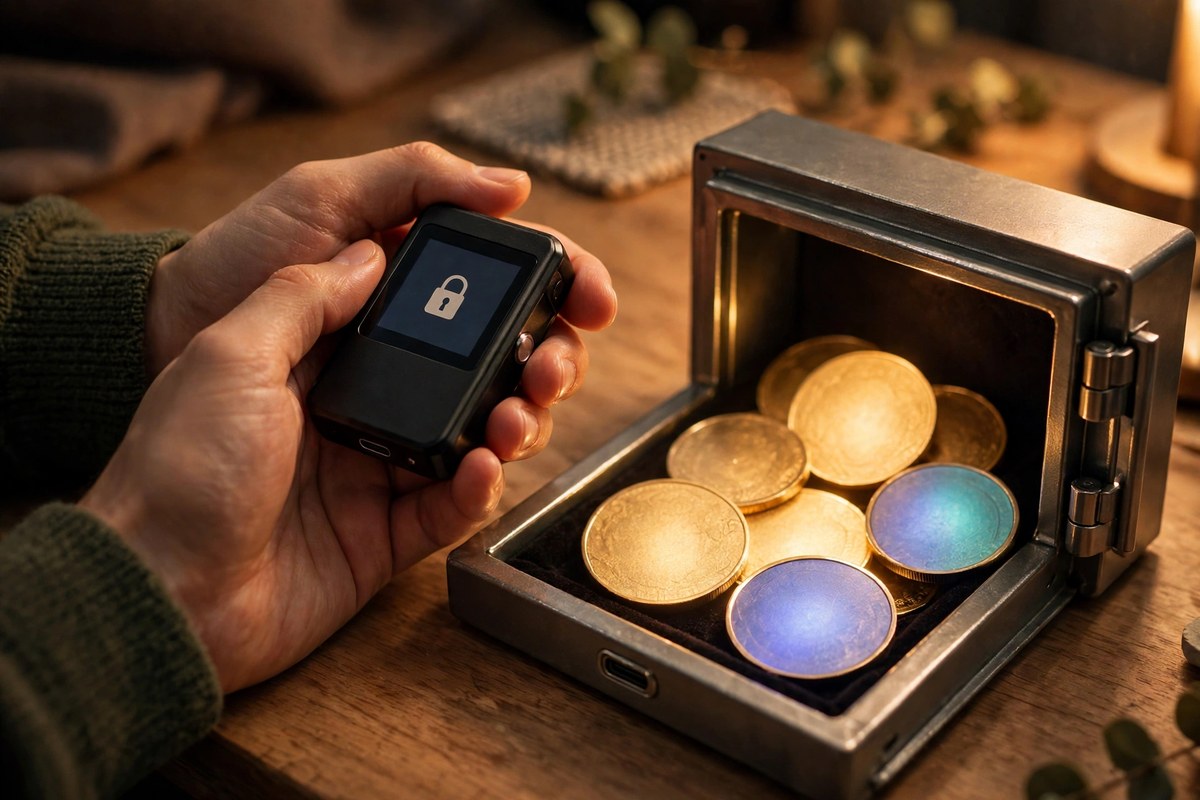
Exchange custody vs self-custody vs a DEX: the trade-off in one table
| Option | Who holds the keys | Bankruptcy risk | Main risk instead |
|---|---|---|---|
| Centralized exchange | The exchange | High — your balance becomes a court claim | Hack, fraud, freeze |
| Self-custody wallet | You | None — no counterparty to fail | Lost seed phrase, user error |
| Decentralized exchange | You, per trade | None for settled trades | Smart-contract bugs, slippage |
| Regulated ETF or trust | A custodian bank | Lower — segregated, regulated custody | Fees, no direct coin ownership |
The right mix depends on how you use crypto. Traders need some exchange balance for speed; long-term holders do not need any. A practical rule that survives every case above: keep trading funds on an exchange, keep savings in self-custody, and never let an exchange balance grow past the point where a two-year freeze would hurt you. Beginners starting from zero should read our complete guide to buying your first Bitcoin and our PayPal buying guide before choosing where to hold what they buy.
What to do if your exchange already froze withdrawals
Do not panic-sell, do not pay anyone who offers to "recover" your funds, and do not share your seed phrase or account credentials with anyone claiming to help — fake recovery scams target every major bankruptcy within days. Save screenshots of your balances, transaction history, and every announcement from the exchange. Watch for the official claims portal and court deadlines, not social media rumors; missing a claims deadline can reduce or void your recovery. Expect the process to take years, expect payment in dollars at filing-date prices unless the plan specifically pays in coins, and consult a lawyer before accepting any settlement if your balance is large. If the exchange later resumes withdrawals, as Binance did, withdraw first and ask questions later — a reopened exchange is not a proven-safe exchange.
FAQs
Do I get my exact coins back if an exchange goes bankrupt?
Usually no. Your balance becomes a claim, typically valued in dollars at filing-date prices, and paid in rounds after a court-approved plan. Mt. Gox and Genesis are exceptions that paid in coins; FTX, Celsius and Voyager paid in dollars or dollar-linked value.
How long does crypto bankruptcy repayment take?
Years. FTX filed in November 2022 and began distributions in February 2025; Celsius filed in July 2022 and began distributions in early 2024; Mt. Gox has run for over a decade. Plan on at least 18 months before any first payment.
Are staked coins safe if an exchange fails?
No — they are typically less safe. Staking locks your coins with the platform, earnings stop when proceedings begin, and courts may classify staked or yield-account deposits as estate property, as happened with Celsius Earn accounts.
Does proof of reserves protect my funds?
Not by itself. It shows assets at a snapshot in time, not liabilities, lending, or fraud. Treat it as one check among five, not as insurance, and always combine it with a small test withdrawal.
Is self-custody always better than an exchange?
For long-term holdings, yes — it removes bankruptcy and hack risk entirely. But it replaces them with personal responsibility: a lost seed phrase is unrecoverable. Use a hardware wallet, store the phrase offline, and practice a small recovery before moving large amounts.
What is the safest way to hold crypto after the Binance hack?
Split it: trading funds on a reputable exchange, savings in a hardware wallet you control, and nothing on any single platform that you cannot afford to lose access to for two years. That split would have protected customers in every collapse covered here.
Conclusion
The Binance hack did not make exchanges unsafe overnight — it reminded everyone that they never were vaults. FTX's 119% payout sounds like a happy ending until you convert it back to Bitcoin and find 0.19 BTC. Celsius's 30 cents on the dollar and Voyager's 35.7% first recovery are the more honest medians. The lesson is not to fear crypto; it is to stop lending your coins to a company and calling it storage. Run the five checks, move what you do not trade into self-custody, and make sure that if your exchange ever becomes the next headline, you are a former customer — not a creditor.
This article is educational and is not legal or financial advice. Bankruptcy recoveries, deadlines and classifications change as cases progress; for a specific claim, rely on the official claims portal and court documents and consult a qualified lawyer.