Is Your Crypto Safe on an Exchange After the $6.3B Binance Hack? South Korea's Emergency Checks Expose a 19-Point Cold-Wallet Gap
South Korea just ordered emergency inspections of its crypto exchanges after the $6.3B Binance hack — and the cold-wallet scores range from over 99% offline at Upbit to barely above the 80% legal floor elsewhere. Here are the 5 checks to run on your exchange today.

South Korea just ordered emergency inspections of every major crypto exchange in the country — and the first numbers out of that review expose a gap most users never see. Upbit keeps more than 99% of customer crypto offline in cold wallets. Bithumb sits near 94%. Coinone is around 85%. Two other platforms sit just above the 80% legal minimum. That is a 19-point spread between the safest and the barely-legal, and after a $6.3 billion hack at Binance, that spread is no longer a footnote. It is the single most useful number for deciding whether your coins should stay where they are.
The trigger was the largest exchange theft on record. On or about October 29, 2026, attackers drained roughly $6.3 billion from Binance hot wallets. The FBI has publicly attributed the theft to North Korea's TraderTraitor group, and Binance says it has covered around 95% of the stolen funds and frozen roughly $3 billion with help from issuers and other exchanges. But regulators outside the United States did not wait for the dust to settle. Within days, South Korea's Financial Services Commission (FSC) was in a room with Upbit, Bithumb and Coinone, and Abu Dhabi's financial regulator was pressing Binance's Gulf operations for answers. This article explains what those checks found, what a cold-wallet ratio actually means for your money, and the five checks you should run on any exchange today — before the next headline forces the question.
What South Korea actually ordered
South Korea's FSC held an emergency meeting on Monday, November 2, 2026, chaired by Digital Finance Policy Officer Yoo Young-jun, together with the Financial Supervisory Service, the Korea Financial Security Institute, the Digital Asset Exchange Association (DAXA) and major domestic operators. The agenda was blunt: review the impact of the Binance hack on the domestic market and inspect how Korean exchanges manage the wallets that hackers actually target.
The inspection focused on three things that matter more than any marketing claim about security. First, access controls on computer systems and hot wallets — who can approve a withdrawal, and how many signatures it takes. Second, the management of administrator privileges — the exact attack surface the Binance incident exposed, since investigators believe the breach began with access through an employee's work laptop rather than a broken blockchain. Third, the proportion of customer assets held offline, and whether exchanges hold additional reserves to absorb a loss.
The FSC's instructions to exchanges were specific: increase the cold-wallet ratio, monitor deposits and withdrawals continuously, add response personnel, run a rapid reporting system for abnormal access attempts, and accumulate additional reserves. A broader security review spanning the financial sector is scheduled for November 5 in South Korea. In other words, this was not a press release — it was the start of a supervisory process with a follow-up date already on the calendar.
The cold-wallet scores: a 19-point gap hiding in plain sight
Under South Korea's Virtual Asset User Protection Act, exchanges must keep more than 80% of users' virtual assets in cold wallets — wallets disconnected from the internet — and hold customer deposits at banks. They must also buy insurance or mutual-aid coverage, or accumulate reserves of at least 3 billion won (for won-denominated exchanges) to prepare for incidents. That 80% floor is the law. What the emergency review revealed is how differently exchanges clear it.
| Exchange | Share of customer crypto in cold wallets | Distance above the 80% legal floor |
|---|---|---|
| Upbit | Over 99% | 19+ points |
| Bithumb | About 94% | About 14 points |
| Coinone | About 85% | About 5 points |
| Digital X and Gopax | Slightly above 80% | Barely above the floor |
Read that table the way a regulator would. At Upbit, less than 1% of customer crypto sits in internet-connected hot wallets at any moment — the wallets a hacker can reach remotely. At an exchange sitting just above 80%, roughly one dollar in five is in hot storage. If a hot-wallet breach drained even a fraction of that exposed share, the loss would be an order of magnitude larger. The law treats both as compliant. Your risk does not.
There is a second number worth noting: the meeting explicitly considered raising offline storage above the current floor. That means the 80% minimum itself may move. Exchanges already operating near 99% would barely notice. Exchanges hugging the floor would have to restructure their wallet operations — or explain why they cannot.
Abu Dhabi is asking the same questions, for a different reason
While Seoul inspected wallets, Abu Dhabi's Financial Services Regulatory Authority (FSRA) of Abu Dhabi Global Market said it was engaging closely with Binance following the attack. The scrutiny lands differently there because Binance's Gulf footprint is institutional, not just retail: the exchange operates three ADGM-regulated entities, and Abu Dhabi technology investor MGX committed $2 billion to Binance in March 2025, becoming its first institutional investor.
The FSRA's engagement is a reminder that the Binance hack is not only a story about one exchange's security. It is a test of every jurisdiction that licensed, invested in, or built a crypto hub around the world's largest exchange. Binance has pledged to cover customer losses from company funds and says roughly $3 billion of the stolen assets have been frozen in cooperation with issuers and counterparties. But roughly $3.3 billion remained unrecovered according to one report cited in the days after the attack, and the stolen funds keep moving: the attacker moved all 233.46 million stolen XRP, worth about $293 million, into six new wallets after the coins sat untouched for roughly 80 hours, and separate movements of 80 million XRP (about $100.9 million) and 120 million TRX were also reported. Freezing is a race, and every hour the funds sit in wallets that exchanges have not blacklisted is an hour the trail gets harder to follow.
Washington is using the hack to push for legislation
In the United States, the political response arrived within days. CFTC Chair Michael Selig told CNBC that the hack vindicated the agency's October 5 proposed framework for crypto markets, calling Binance an unregulated offshore exchange. Senator Cynthia Lummis argued that the stalled Clarity Act would have let firms freeze suspicious transactions. The Digital Chamber pressed Congress for a bill giving the CFTC authority over crypto exchanges. President Donald Trump said at a Friday press conference that he was looking into the hack.
Whether legislation follows is genuinely uncertain — the Clarity Act has stalled before, and a midterm election on November 3, 2026 could reshuffle the committees that would write it. But the direction of travel is clear: the largest hack in crypto history is now the central exhibit in every argument for exchange oversight, and it arrived at the exact moment when more than 100 crypto ETF filings were already frozen by the US government shutdown. Regulation is no longer an abstract debate for traders. It is the mechanism that decides whether an exchange can be forced to hold more offline, prove its reserves, or freeze stolen funds faster next time.
What a cold-wallet ratio actually means for your money
A cold wallet is a wallet whose private keys have never touched an internet-connected device. A hot wallet is connected, because an exchange needs it to process withdrawals quickly. No exchange can run on 100% cold storage — withdrawals would take hours — so every exchange balances speed against exposure. The ratio is that balance, expressed as a number.
Here is why it matters more than the exchange's size. The Binance breach did not break Bitcoin, Ethereum, or any blockchain. It exploited internal systems and withdrawal approvals — the plumbing between the exchange's employees and its hot wallets. Attackers do not need to defeat cryptography when they can defeat process. A high cold-wallet ratio limits what that kind of attack can reach in a single incident, because most customer funds simply are not in the wallets the compromised process can move. That is also why South Korea's inspectors spent their time on access controls and administrator privileges rather than on blockchain code: the weakest link was operational, not cryptographic.
It also explains why Binance's own response — covering losses from company funds — is both reassuring and incomplete as a safety model. It worked because Binance is enormous and profitable enough to absorb a $6.3 billion hit. A smaller exchange facing a proportional loss might not be. Insurance, reserves, and a high cold-wallet ratio are the things that protect users when the exchange itself cannot simply write a cheque. South Korea's 3-billion-won reserve requirement is modest against a multi-billion-dollar theft, which is exactly why the FSC is pushing reserves higher alongside the cold-wallet ratio.
The 5 checks to run on your exchange today
You cannot audit an exchange the way the FSC can. But you can check five public, verifiable things in under an hour, and the answers separate exchanges that take custody seriously from exchanges that only talk about it.
Check 1: Does it publish a cold-wallet ratio, or just the word "secure"?
An exchange that discloses a specific cold-wallet percentage — and updates it — is giving you a testable claim. An exchange that only says "funds are kept safe" is giving you marketing. If your exchange does not publish a ratio, treat that as information: it has chosen not to be measured. Ask support for the figure in writing, and note whether the answer is a number or a paragraph.
Check 2: Has it published a proof of reserves, and does anyone verify it?
Proof of reserves is supposed to show that the exchange holds the assets it owes customers. A self-published snapshot with no independent verification is weaker than an attestation by a reputable auditor, and both are weaker than liabilities being disclosed alongside assets — reserves without liabilities can hide a shortfall. Binance's own proof-of-reserves process is under fresh scrutiny after the hack, with a new check due around November 3, 2026. Read the methodology, not just the headline.
Check 3: How fast did it freeze stolen funds last time — and does it have a blacklist process?
After the Binance hack, exchanges and issuers froze roughly $3 billion, but the attacker still moved hundreds of millions in XRP and TRX days later. Ask whether your exchange participates in industry blocklists, how quickly it can freeze deposits from flagged addresses, and whether it has ever done so publicly. Speed here is measured in hours, not press releases.
Check 4: What happens to your coins if the exchange itself fails?
Read the terms on segregation: are customer assets held separately from the company's own funds, and in which jurisdiction would a bankruptcy play out? An exchange licensed in a jurisdiction with strong customer-asset rules — the kind of regime South Korea and Abu Dhabi are now tightening — is a different risk from an offshore entity with no such obligation. If you cannot find a clear answer, that is the answer.
Check 5: How much do you actually need to keep on the exchange?
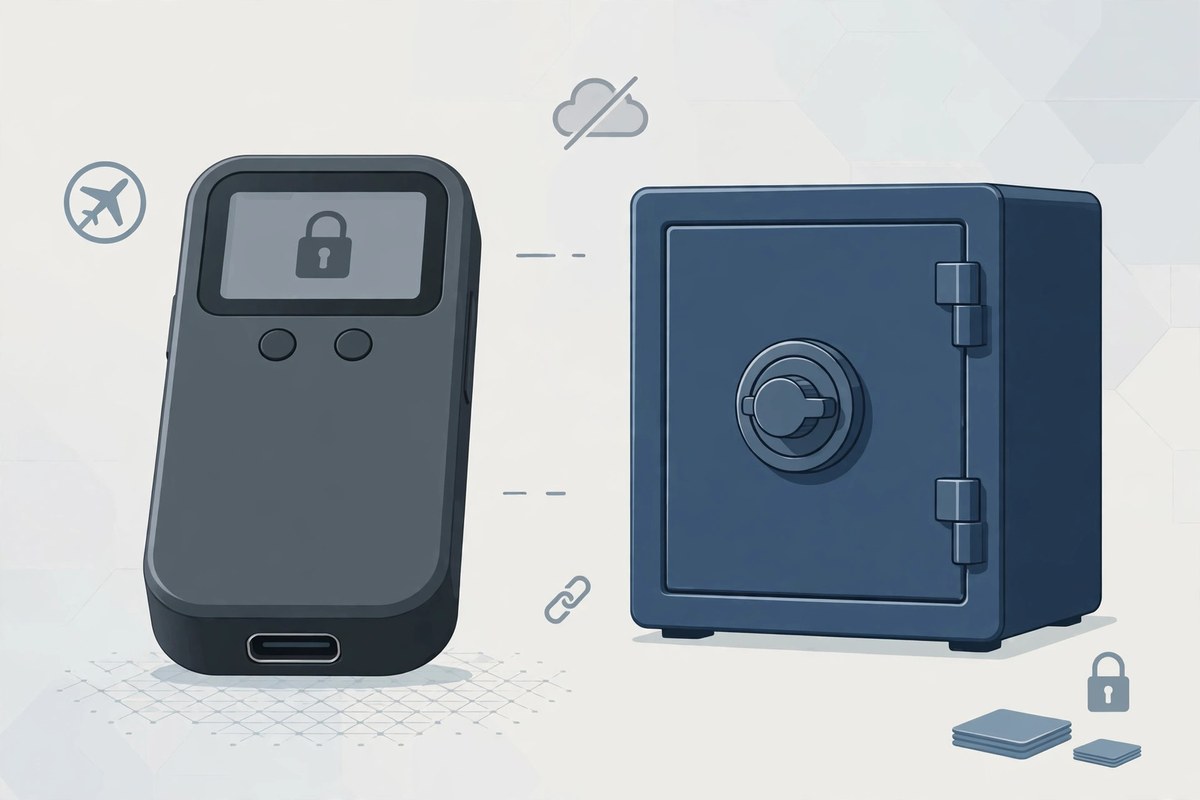
The most effective check costs nothing: move what you are not actively trading into self-custody. A hardware wallet takes your coins out of every exchange's hot wallet entirely, which makes their cold-wallet ratio irrelevant to those funds. For a refresher on how wallets work, see our beginner guide What Is a Crypto Wallet?, and for the post-hack buying checklist, see How to Buy Bitcoin Safely After the $6.3B Binance Hack: 10 Checks Before You Send a Dollar. Keeping only trading capital on an exchange is not paranoia after a $6.3 billion theft — it is the lesson the theft taught.
What most people get wrong about exchange safety after a hack
The most common mistake is treating a hack as a verdict on a coin rather than on a custodian. Bitcoin did not fail on October 29. Neither did Ethereum, XRP, or TRX — the assets that were stolen were moved through compromised exchange systems, and the blockchains themselves kept processing transactions normally. Bitcoin traded around $78,000 in the days after the hack, down roughly 4% from its pre-disclosure high, and even posted a third consecutive day of gains by November 2. The market's verdict was on Binance's operations, not on crypto itself.
The second mistake is assuming that a big exchange is automatically a safe one. Size helps with loss absorption — Binance could cover its losses — but size also makes an exchange a bigger target, and a single compromised laptop can authorize withdrawals at any scale. The Korean numbers prove the point from the other direction: the safest ratio in the review belongs to the country's largest exchange, but the smallest ones sit nearest the legal floor. Safety correlates with process, not with size alone.
The third mistake is waiting for regulators to fix it. South Korea's review is welcome, and the November 5 sector-wide check may raise standards further. But regulation moves in months and the next attack will not wait. The five checks above are things you can do this week, with no regulator required.

What happens next: three dates to watch
Three near-term milestones will show whether this regulatory moment turns into lasting change. First, Binance's proof-of-reserves check due around November 3, 2026 — watch whether it discloses liabilities as well as assets, and whether an independent party verifies it. Second, South Korea's financial-sector security review on November 5 — watch whether the 80% cold-wallet floor is raised, and whether exchanges near the floor are named. Third, the US midterm election on November 3 and its aftermath — watch whether the Clarity Act or a CFTC-authority bill gains momentum, or whether the hack fades into campaign rhetoric. For the full attribution story so far, see FBI Names North Korea in $6.3B Binance Hack: 600+ Addresses Blacklisted, $3B Frozen, and for a ranked view of where to keep crypto instead, see Where Is Crypto Safe After the Binance Hack? Custody Options Ranked.
The deeper question is whether cold-wallet disclosure becomes standard everywhere, the way proof of reserves became standard after FTX. If South Korea raises its floor, other regulators will cite it. If Abu Dhabi imposes new conditions on Binance's Gulf entities, other hubs will watch. And if the United States finally passes exchange legislation, the global baseline moves. The hack was a crime. The response is a policy experiment, and its results will decide how much of your crypto sits within a hacker's reach next time.
Frequently asked questions
Is my crypto safe on Binance after the hack?
Binance says it has covered around 95% of the stolen funds, frozen roughly $3 billion, and restored withdrawals in phases from November 1, with customers pulling a net $3.64 billion in the first phase. That is a strong institutional response. It does not change the underlying lesson: funds left on any exchange sit partly in hot wallets, and the safest posture is to keep only what you actively trade on an exchange. See our ranked exchange guide at Best Crypto Exchanges After the Binance Hack, Ranked.
What is a cold wallet, in plain terms?
A cold wallet stores private keys offline, disconnected from the internet, so a remote hacker cannot reach them. A hot wallet is connected so withdrawals can be processed quickly. Exchanges keep a small share hot for liquidity and the rest cold for safety — the ratio between them is the number South Korea just inspected.
Is 80% cold storage enough?
It is the legal minimum in South Korea, but the review itself suggests regulators think it may not be: they discussed raising it. An exchange at 99% leaves under 1% exposed; an exchange just above 80% leaves nearly 20% exposed. Both pass the law. Only one gives you a wide margin.
Does the Binance hack mean Bitcoin itself is unsafe?
No. The theft exploited exchange systems and withdrawal approvals, not the Bitcoin network. Bitcoin's price fell about 4% on the news and recovered toward $78,000 within days. The risk was custodial — who holds your coins — not cryptographic.
Will South Korea's checks affect users outside Korea?
Directly, no — the FSC regulates Korean exchanges. Indirectly, yes: if Seoul raises its cold-wallet floor or names laggards, other regulators cite that precedent, and global exchanges tend to standardize their strongest compliance posture across markets rather than run different systems per country.
What should I do this week?
Run the five checks above, starting with the simplest: reduce your exchange balance to trading capital only, move the rest to self-custody, and confirm your exchange publishes a cold-wallet ratio and a verified proof of reserves. If it publishes neither, consider that a finding, not a gap in your research.
Conclusion
The most important number to come out of the Binance hack's aftermath is not $6.3 billion. It is 19 — the percentage-point gap between the Korean exchange that keeps more than 99% of customer crypto offline and the ones sitting just above the 80% legal floor. Regulators in Seoul and Abu Dhabi are now treating that gap as a supervisory issue, and Washington is treating the hack as a legislative one. Both processes will take months. Your five checks take an hour. Do them before the next emergency inspection, not after it.
Sources: South Korea's FSC emergency review as reported by EconoTimes and MoneyToday; Abu Dhabi regulatory engagement as reported by Finance Middle East; Binance withdrawal resumption and market reaction as reported by CoinDesk; US legislative response as reported by Blockchain Academics. This article is for information only and is not investment advice.