How to Buy Bitcoin in Switzerland in 2026: 5 FINMA-Regulated Exchanges Compared — Fees, CHF Deposits and the 0% Capital Gains Tax
Switzerland charges 0% capital gains tax on Bitcoin for private investors — but the wrong exchange still costs you CHF 195 on a CHF 10,000 buy. We compared 5 FINMA-regulated platforms: Kraken Pro's 0.40% fee, Swissquote's 1% plus 0.95% currency conversion, and Relai's self-custody advantage.
Switzerland charges private investors 0% capital gains tax on Bitcoin — buy at CHF 20,000, sell at CHF 70,000, and the CHF 50,000 gain is tax-free. But the wrong exchange can still quietly cost you CHF 195 on a CHF 10,000 purchase, and one popular Swiss bank does not even let you trade in francs. This guide compares the five best FINMA-regulated ways to buy Bitcoin in Switzerland in 2026, with real fees, real CHF deposit routes, and the three tax traps that catch newcomers.
Timing matters too. Bitcoin is trading near $76,000 on 6 November 2026, roughly 40% below its $126,080 all-time high, after a tech-led sell-off wiped out $1.24 billion in leveraged positions in 24 hours. For Swiss buyers, that drawdown is exactly why the choice of exchange matters: every franc saved on fees and currency conversion is a franc that stays invested. If you are new to Bitcoin itself, start with our complete beginner's guide to how BTC works before you buy.
Is Bitcoin Legal in Switzerland?
Yes. Bitcoin is fully legal in Switzerland, and the country has one of the clearest crypto frameworks in the world. There is no single dedicated crypto law; instead, existing financial-market statutes govern the sector, supervised mainly by the Swiss Financial Market Supervisory Authority (FINMA). FINMA's 2018 ICO guidelines classify Bitcoin and Ether as payment tokens, not securities, and the DLT Act in force since 2021 created the legal framework for crypto-securities and tokenisation. The pillars are the Anti-Money Laundering Act (AMLA), the Banking Act, the Financial Market Infrastructure Act and the DLT package.
What that means in practice: Swiss residents buy through FINMA-authorised or self-regulatory-organisation (SRO) affiliated providers, complete identity verification (KYC), and deposit Swiss francs. FINMA also published Guidance 01/2026 on crypto custody in January 2026, and the Federal Council is consulting on two new licence categories — payment-instrument institutions and crypto-institutions — expected to take effect toward 2027. For the full regulatory picture, see the 2026 Switzerland crypto regulation guide and Mintarex's FINMA and tax overview.
The 0% Capital Gains Tax — and the 3 Catches
Switzerland's tax treatment is the single biggest reason crypto wealth concentrates in cantons like Zug and Schwyz. The Federal Tax Administration (FTA) treats cryptocurrencies as movable private assets, like shares. For private investors, capital gains are generally tax-free — but three catches decide whether that 0% rate actually applies to you.
Catch 1: the wealth tax. Crypto held at year-end is subject to annual cantonal and communal wealth tax, valued at fair market price on 31 December. Rates range from 0.3% to 1.0% depending on the canton, with Zug and Schwyz the lowest. Each canton provides a wealth-tax exempt allowance, typically around CHF 100,000 per individual. The FTA publishes official year-end tax values in its Kursliste — for 31 December 2025, Bitcoin was valued at CHF 69,571.99 and Ether at CHF 2,364.08.
Catch 2: the professional-trader test. The 0% rate disappears if the tax authority classifies you as a professional trader — then gains become income taxed at up to roughly 40% combined federal, cantonal and municipal rates. Under the FTA's Circular 36 safe harbour, you stay a private investor only if all five criteria are met: assets held for at least six months, annual trading volume below five times the portfolio's value on 1 January, gains below half of total income, no debt-financed purchases, and derivatives used only to hedge. Frequent leveraged trading is the fastest way to fail this test.
Catch 3: income is still taxed, and reporting is coming. Staking and mining rewards are taxed as income at fair market value when received, and crypto-to-crypto swaps count as sales (tax-free for private investors, but still reportable). Buying and selling payment tokens is VAT-exempt. And the privacy era is ending: Switzerland's automatic exchange of crypto-asset information (CARF) with 74 partner countries goes live in 2027 at the earliest, after the Federal Council suspended its crypto provisions for 2026. Declare your holdings — the 0% rate rewards honest private investors, not hidden ones. Full detail is in the Swiss crypto tax documentation and Rue's Switzerland crypto tax guide.
5 Best Exchanges to Buy Bitcoin in Switzerland in 2026 — Compared
Here is the short version. The table below compares the five platforms Swiss buyers actually use, ranked by total cost on a typical purchase. Fees change, so treat these as the November 2026 figures from published fee schedules.
| Exchange | Bitcoin fee | CHF deposit | Custody | Best for |
|---|---|---|---|---|
| Kraken Pro | 0.40% maker / 0.80% taker | Free via SIC (Bank Frick) | Exchange wallet; withdraw anytime | Lowest cost for regular buyers |
| Relai | ~1% (0.9% with referral) | Free bank transfer; cards +3% | Self-custody from day one | Beginners who want to own their coins |
| Bitpanda | 0.99% on Bitcoin | Bank transfer, cards, Apple Pay | Exchange wallet | Simple app with Swiss parent company |
| Bitcoin Suisse | From ~0.75% execution | Swiss bank transfer | Custody and staking included | Large amounts and premium service |
| Swissquote | 1% + 0.95% FX conversion | CHF account, but crypto trades in USD/EUR | Quarterly custody fee from CHF 20 | Bank-level security for long-term holders |
Two names deliberately missing from the top five: Bybit (0.10% spot fees, but no CHF bank funding — Swiss accounts use the global platform, not the EU one) and Binance (0.10% spot, but no CHF bank transfer for Swiss residents; francs enter through cards or P2P only). Both are cheap to trade on and awkward to fund from a Swiss bank account.
Kraken: The Cheapest Way to Buy Bitcoin in Switzerland
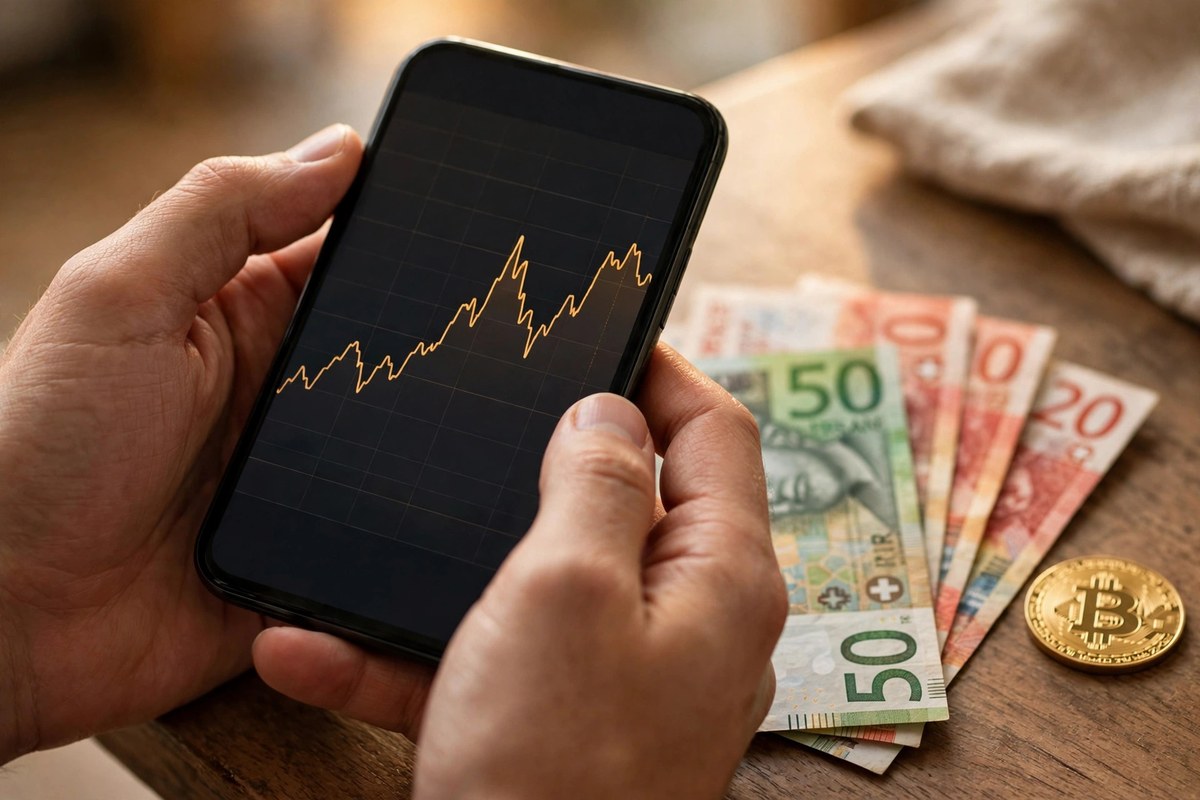
Kraken takes first place on cost, and the reason is a plumbing detail no other exchange in this list offers: a connection to the Swiss Interbank Clearing (SIC) system. Its funding provider, Bank Frick in Liechtenstein, accepts CHF transfers over SIC from Swiss bank accounts — listed as free, with a 1 CHF minimum and same-day settlement.
After a 2026 pricing restructure, Kraken Pro starts at 0.40% for makers and 0.80% for takers when monthly trading is under $2,500, falling to 0.22% and 0.38% above $10,000. The standard Instant Buy costs around 1.5%, so always use Kraken Pro for the same account. Kraken lists 600+ coins, offers free Lightning withdrawals, and publishes proof of reserves. One warning for beginners: Kraken Pro's order-book interface looks intimidating the first time. Place a limit order near the current market price, and the 0.40% maker fee applies. Full comparison data is in Datawallet's best Swiss exchanges ranking.
Relai: The Swiss Bitcoin-Only App With Self-Custody Built In
Relai, founded in Zurich in 2020, is the only platform on this list that never holds your Bitcoin at all. Every purchase settles directly into a wallet only you control, so there is no exchange balance to remember to withdraw — the step most beginners skip is the one Relai will not let you skip. It now serves more than 85,000 users across Switzerland and the Eurozone, is a member of the Swiss self-regulatory organisation VQF, and is registered as a MiCA crypto-asset service provider with the French regulator AMF.
Fees are about 1% per buy (0.9% with a referral code), with zero-fee monthly auto-invest on purchases up to CHF 100. Bank transfers are free; cards, Apple Pay and Google Pay cost around 3% extra. The minimum purchase is 10 CHF/EUR, and you can set up a weekly or monthly savings plan from as little as 50 CHF. One change newcomers miss: Relai used to allow light KYC up to 1,000 CHF a day, but MiCA rules now require full identity verification for all users. See the full Relai review for the current fee breakdown.
Swissquote: A Real Swiss Bank — With a Hidden Currency Cost
Swissquote Bank Ltd holds a FINMA banking licence and began offering crypto trading in 2017, before any other Swiss bank. Clients can buy, hold, stake and transfer 55 coins from the same account used for shares and a Swiss IBAN. That bank-level integration is the attraction — and the fee schedule is the catch.
Customers with less than USD 6,000 in crypto trades over the previous 30 days pay 1% as either maker or taker, and the maker rate does not reach 0.50% until monthly volume hits USD 600,000. Worse, crypto trades settle in dollars or euros, not francs: Swiss investors must convert francs at the bank's 0.95% rate or transfer euros in first, and an order placed without an available USD or EUR balance accrues debit interest. On top of that, Swissquote charges a quarterly custody fee starting at CHF 20 per quarter for accounts below CHF 50,000, rising to CHF 50 above CHF 150,000, plus 8.1% VAT. It also accepts incoming coins only from Bitpanda, Bitstamp, Coinbase, Gemini, Kraken and Revolut. Swissquote earned CHF 14.6 million in crypto income in the first half of 2026, down 66% — a sign its high-fee model is losing share. The detailed cost breakdown is in Datawallet's Swissquote guide.
Bitcoin Suisse and Bitpanda: The Swiss-Native Alternatives
Bitcoin Suisse, founded in 2013, is the veteran Swiss crypto broker: execution typically starts around 0.75%, with custody and staking services under FINMA oversight. It suits larger buyers who want a named Swiss counterparty and a phone call rather than an app. Bitpanda, whose holding company Bitpanda Group AG is registered in Zurich, has accepted Swiss customers and CHF deposits since 2018. Its standard fee is 0.99% for Bitcoin and 1.49% for most other coins (2.49% for tokens under €100 million market cap), with the order-book interface Bitpanda Fusion starting at 0.25%. Bitpanda also offers savings plans, stocks and precious metals in the same app — convenient, but the 0.99% Bitcoin fee is roughly ten times an order-book rate at Bybit or Binance.
What a CHF 10,000 Bitcoin Buy Really Costs on Each Platform
Fees look small as percentages. On a real purchase they are not. Here is the all-in cost of buying CHF 10,000 of Bitcoin on each platform, using November 2026 published fees:
| Platform | Trading fee | Currency conversion | Deposit | Total cost |
|---|---|---|---|---|
| Kraken Pro (limit order) | CHF 40 (0.40%) | CHF 0 | Free via SIC | CHF 40 |
| Kraken Pro (market order) | CHF 80 (0.80%) | CHF 0 | Free via SIC | CHF 80 |
| Bitcoin Suisse | ~CHF 75 (0.75%) | CHF 0 | Free | ~CHF 75 |
| Relai (bank transfer) | CHF 100 (1%) | CHF 0 | Free | CHF 100 |
| Bitpanda | CHF 99 (0.99%) | CHF 0 | Free | CHF 99 |
| Swissquote | CHF 100 (1%) | CHF 95 (0.95%) | Free | CHF 195 |
The gap between the cheapest and the most expensive route is CHF 155 on a single CHF 10,000 buy — and Swissquote then adds CHF 80 a year in custody fees on top. For a monthly buyer investing CHF 500 a month, that difference compounds to more than CHF 900 over five years. Our honest guide to whether Bitcoin is a good investment in 2026 explains how to think about those long-term numbers before committing.
How to Buy Bitcoin in Switzerland: Step-by-Step Checklist
Buying your first Bitcoin in Switzerland takes about 15 minutes once your account is verified. Follow this checklist in order:
- Pick your platform by your goal: Kraken Pro for the lowest fees, Relai for automatic self-custody, Swissquote if you want everything inside your Swiss bank.
- Complete identity verification first: have your Swiss ID or passport and a proof of address ready — full KYC is now required on every regulated platform, including Relai.
- Deposit Swiss francs the cheap way: use a free SIC bank transfer to Kraken, or a free bank transfer to Relai. Avoid card deposits unless you accept the ~3% surcharge.
- Use a limit order on an exchange: on Kraken Pro a limit order near the market price costs 0.40% instead of 0.80% for a market order.
- Move your Bitcoin to your own wallet: exchange balances are not your coins. Set up a hardware wallet before your first large purchase — see our hardware vs software wallet comparison and the beginner's wallet guide.
- Keep dated trade records with franc values: every platform must export them, and you need them for your cantonal wealth and income tax declaration on 31 December values.
- Declare your holdings every year: report the 31 December value in your tax return even though the gains themselves are tax-free.
What Most People Get Wrong About Buying Bitcoin in Switzerland
Switzerland's reputation as a crypto paradise creates confident misunderstandings. These are the five we see most often:
"0% capital gains tax means I don't have to report anything." Wrong. The gains are tax-free, but the holdings must still be declared for wealth tax, and staking or mining income is taxable. CARF information exchange with 74 countries starts in 2027 — undeclared holdings will surface.
"Swissquote lets me trade Bitcoin in Swiss francs." Wrong. Swissquote crypto trades settle in USD or EUR only. Every CHF purchase carries the bank's 0.95% conversion fee before the 1% trading fee even applies.
"Relai is anonymous because it's Swiss and Bitcoin-only." Wrong since MiCA. Relai now requires full KYC for all users, whatever the amount. The old 1,000 CHF-a-day light-KYC window is gone.
"Any big global exchange accepts CHF bank transfers." Wrong. Binance offers Swiss residents no CHF bank transfer — francs enter through cards or P2P. Kraken is the only major exchange in this guide with free CHF deposits via the SIC system.
"Buying the dip at $76,000 guarantees a profit." Wrong, and dangerous. Bitcoin is 40% below its $126,080 peak and just lost $1.24 billion in leveraged longs in a day — prices can fall further, and the professional-trader test means frequent dip-trading can cost you the 0% tax rate. Buy a plan, not a price. For the wider market picture, read our complete beginner's guide to buying crypto and how crypto staking works before deciding how much risk to take.
Bitcoin in Switzerland vs Germany and France
Switzerland's tax edge is real, but it is worth seeing it next to its neighbours. In Germany, private investors pay 0% capital gains tax only if they hold Bitcoin for more than one year — sell earlier and the gain is taxed as income. France applies a flat 30% tax on crypto gains (12.8% income tax plus 17.2% social charges). Switzerland asks for no holding period at all for private investors, and no capital gains tax at any holding length — the trade-off is the annual wealth tax and the professional-trader test. That combination is why Switzerland remains the most attractive of the three for long-term holders. Compare the details in our guides to buying Bitcoin in Germany and buying Bitcoin in France.
Frequently Asked Questions
What is the cheapest way to buy Bitcoin in Switzerland?
Kraken Pro with a limit order: 0.40% trading fee and free CHF deposits via the SIC system through Bank Frick. On a CHF 10,000 purchase that is CHF 40 all-in, against CHF 195 at Swissquote once its 0.95% currency conversion is included.
Do I pay tax on Bitcoin gains in Switzerland?
Private investors generally pay 0% capital gains tax on Bitcoin. You still pay cantonal wealth tax of 0.3–1.0% a year on holdings above the roughly CHF 100,000 exempt allowance, and income tax on staking or mining rewards. If you are classified as a professional trader, gains are taxed as income at up to about 40%.
Can I buy Bitcoin with TWINT in Switzerland?
TWINT is available on some peer-to-peer apps such as Peach Bitcoin, where you buy directly from another person with coins held in multisig escrow (around 2% fee, up to roughly 1,000 CHF a day). The major regulated exchanges in this guide fund by bank transfer, card, Apple Pay or Google Pay instead.
Is Swissquote or Kraken better for Swiss Bitcoin buyers?
Kraken is cheaper: 0.40–0.80% with free CHF deposits and no custody fee. Swissquote offers bank-level security and everything inside one Swiss bank account, but charges 1% per trade plus a 0.95% currency conversion and a quarterly custody fee from CHF 20. Use Swissquote for large long-term holdings where bank integration matters most; use Kraken for regular buying.
How much Bitcoin can I buy in Switzerland without ID?
Effectively none on regulated platforms any more. Full KYC is required on Kraken, Swissquote, Relai, Bitcoin Suisse and Bitpanda. Peer-to-peer apps like Peach Bitcoin still allow small purchases up to roughly 1,000 CHF a day without an account, with coins held in escrow.
When does Switzerland start sharing crypto data with other countries?
Automatic exchange of crypto-asset information (CARF) with 74 partner countries was due to start in January 2026, but the Federal Council suspended its crypto provisions for this year — exchange now begins in 2027 at the earliest. Declare holdings in the meantime; the 0% capital gains rate is for honest private investors.
Conclusion
Switzerland gives Bitcoin buyers something no large European country matches: 0% capital gains tax for private investors, a FINMA-regulated market, and free franc deposits through the SIC system. But the tax advantage is wasted if the exchange takes it back in fees. On a CHF 10,000 buy, Kraken Pro costs CHF 40, Relai CHF 100 with self-custody included, and Swissquote CHF 195 once currency conversion is counted — a CHF 155 gap on a single trade.
For most Swiss buyers the right setup is simple: buy on Kraken Pro with limit orders, or use Relai if you want coins in your own wallet from the first minute, and move larger holdings to a hardware wallet. Declare the 31 December value every year, keep your holding period above six months and your volume below the professional-trader thresholds, and the 0% rate stays yours. Bitcoin at $76,000 — 40% below its peak — is a test of patience, not a guarantee. Buy the plan, keep the fees low, and let Switzerland's tax rules do the rest.