How to Buy Bitcoin in Italy in 2026: 5 Exchanges Compared — Fees, SEPA and the 33% Tax That Starts Now
Bitcoin is 40% below its peak — but in Italy the 33% tax decides your profit. 5 licensed exchanges compared, the €1,000 fee test, and the new DAC8 reporting rules.
Bitcoin is trading at roughly $75,800 today — about 40% below its $126,080 all-time high — and if you are buying from Italy, the price on the screen is not the number that decides your profit. The tax is. Since 1 January 2026, Italy taxes crypto gains at 33%, up from 26%, and the old €2,000 tax-free allowance is gone entirely. Every euro of profit is now taxable, from the first euro. This guide compares the five best exchanges for Italian buyers, shows you exactly what a €1,000 purchase costs on each one, and explains the new tax rules in plain language — so the dip you buy does not turn into a surprise bill from the Agenzia delle Entrate.
Italy is one of the best-regulated places in Europe to buy Bitcoin in 2026, but it is also one of the most expensive to sell it in. The EU's MiCA regulation is fully in force, supervised in Italy by CONSOB and the Bank of Italy, and every platform serving Italian residents must now be licensed. At the same time, automatic reporting under the EU's DAC8 directive means your exchange sends your balances and transactions to the Italian tax authority whether you declare them or not. Buying Bitcoin in Italy is easy; doing it cheaply — and legally — takes five minutes of reading first.
The 33% Tax Rule in 5 Numbers
The single most important fact for any Italian Bitcoin buyer is the 2026 Budget Law (Law 199/2025). It reclassified crypto gains among the most heavily taxed speculative income in the country. Here is what changed, in numbers:
| Rule | 2025 | 2026 |
|---|---|---|
| Capital gains tax on crypto | 26% | 33% |
| Tax-free allowance | €2,000 per year | €0 — abolished |
| MiCA euro stablecoins (EMTs) | 26% | 26% (unchanged) |
| Annual wealth tax on foreign-held crypto (IVCA) | 0.2% | 0.2% |
| Reporting | Self-declared | DAC8 automatic reporting |
What does 33% actually mean in euros? Buy €5,000 of Bitcoin and sell it later for €8,000, and your €3,000 gain costs €990 in tax. Under the old 26% rate it would have cost €780. The seven-point rise takes an extra €210 from the same trade — and because the €2,000 exemption is gone, even a €500 gain now produces a €165 tax bill. Gains realised in 2025 are still taxed at the old 26% rate; only gains realised from 1 January 2026 use 33%, and they are declared in your 2027 filing. The full Italy crypto tax guide for 2026 confirms the same figures, including the 0.2% IVCA wealth tax.
Three details most guides skip: first, swapping one crypto for another with the same characteristics — Bitcoin for Ether, for example — is not a taxable event in Italy, so rebalancing between coins does not trigger the tax. Second, euro-denominated stablecoins that qualify as MiCA e-money tokens, such as EURC, stay at 26%. Third, crypto held on foreign platforms or in private wallets must be declared on Form RW (Quadro RW) and is subject to the 0.2% annual IVCA wealth tax on its 31 December value — while crypto held with an Italian intermediary that handles the tax for you is generally exempt from that charge. Selling crypto for euros, or spending it on goods and services, is a taxable disposal, and the gain is calculated using the LIFO method.
Is It Legal to Buy Bitcoin in Italy?
Yes — buying, holding and selling Bitcoin is fully legal in Italy, and the framework got stricter, not looser, in 2026. MiCA is in force across the EU, and in Italy it is supervised by CONSOB together with the Bank of Italy. The old OAM register of crypto operators has closed: providers that had applied for MiCA authorisation could keep operating only until 30 June 2026, and eight Italian companies received CONSOB authorisation.
The practical consequence is simple: only use a platform that holds a MiCA licence (from any EU country) or a CONSOB authorisation. Unlicensed platforms can freeze your account or disappear with no regulator to complain to. Every exchange in the comparison below meets that test. And remember that since January 2026, under DAC8, registered exchanges automatically transmit Italian residents' balances and transactions to the Agenzia delle Entrate — so "the tax office won't know" is no longer a plan.
5 Exchanges Compared: Fees, SEPA and Safety
The five platforms below are the strongest options for Italian residents in 2026, ranked on fees, euro payment rails, licensing and Italian-language support. Independent comparisons of crypto exchanges in Italy reach the same shortlist, with Kraken first on safety and OKX first on fees. The cheapest way to fund any of them is a SEPA bank transfer — free or €1 on most platforms, and instant with SEPA Instant on several. Paying by card is instant but costs up to 4% extra, which is why the card column matters more than the trading fee for most first-time buyers.
| Exchange | Spot trading fee | SEPA deposit | Card buy fee | Licence | Best for |
|---|---|---|---|---|---|
| Kraken | 0.25% maker / 0.40% taker (Pro) | Free, SEPA Instant | ~3.75% | MiCA (Ireland) | Best overall |
| Coinbase | 0.25% limit / 0.50% market (EU) | Free | ~3.99% | MiCA (Luxembourg) | Beginners |
| OKX EU | 0.08% maker / 0.10% taker | Free, SEPA Instant | ~2–3% | MiCA (Malta) | Lowest fees |
| Bitstamp | ~0.20% maker / 0.30% taker | Free | ~3–4% | MiCA (EU) | EU-regulated safety |
| Young Platform | 1.89% retail / 0.20% Pro | Free, SEPA Instant | ~2–3% | CONSOB-authorised | Italian support + tax report |
1. Kraken — Best Overall
Kraken has operated since 2011 and has never lost customer funds to a hack — a record no other large exchange can match. Its EU company is licensed under MiCA by the Central Bank of Ireland. Italian users get free SEPA Instant deposits (transfers from banks like Intesa Sanpaolo arrive in seconds), 450-plus cryptocurrencies, and Kraken Pro, where fees start at 0.25% maker and 0.40% taker. Kraken also publishes proof-of-reserves reports, so you can verify it actually holds the Bitcoin it sells you.
2. Coinbase — Best for Beginners
Coinbase is the easiest on-ramp in Italy and the most transparent: as a Nasdaq-listed company it files quarterly reports with the US Securities and Exchange Commission. It serves the EU through Coinbase Luxembourg S.A., which holds a MiCA licence from Luxembourg's CSSF. You can fund it by SEPA, card or PayPal and cash out by SEPA to an Italian bank. The trade-off is price: spot trading costs EU customers 0.25% on limit orders and 0.50% on market orders, and the simple-buy card route runs to about 3.99%. Use Coinbase for your first purchase, then move to its Advanced trading view — or to Kraken Pro — once you know what you are doing.
3. OKX EU — Lowest Fees
OKX EU, run by OKX Europe Limited under a MiCA licence from the Malta Financial Services Authority, is the cheapest of the five for active buyers: 0.08% maker and 0.10% taker on spot, across roughly 300 coins. Deposits work through SEPA, SEPA Instant, cards, Apple Pay and Google Pay, and withdrawals go out by SEPA or crypto. The app is more complex than Coinbase's, so it suits buyers who have made their first purchase already and now care about every tenth of a percent.
4. Bitstamp — Best for EU-Regulated Safety
Founded in 2011 and based in Luxembourg, Bitstamp is the longest-operating crypto exchange in the world and a favourite of cautious European buyers. It is MiCA-licensed, supports free SEPA euro deposits, and charges around 0.20% maker and 0.30% taker. If your priority is a boring, regulated European institution, Bitstamp is the pick.
5. Young Platform — Best Italian Option
Young Platform is Italy's homegrown exchange and the only domestic platform in this ranking. For Italian residents that delivers two concrete advantages no international rival can match: support in Italian, and a built-in tax-record feature that tracks your transactions specifically for Italian tax reporting — which became far more important on 1 January 2026, when the rate rose to 33%. It is CONSOB-authorised, supports SEPA, SEPA Instant, cards and even Satispay, and offers a Young Card for spending. Retail fees are high at 1.89%, so use its Pro mode (0.20%) for anything beyond a first small buy.
How to Buy Bitcoin in Italy, Step by Step
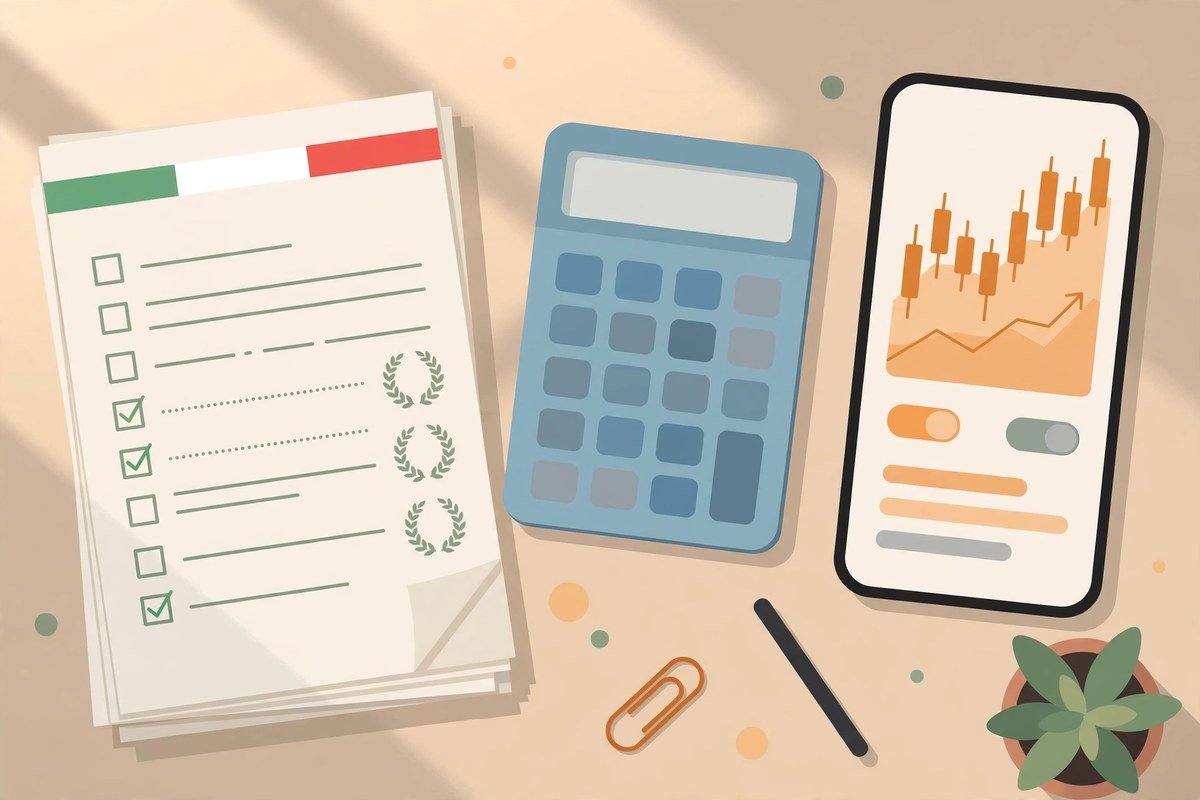
The whole process takes about 15 minutes if your documents are ready. Follow this checklist in order — skipping the verification step is the most common reason first purchases fail.
- Choose a MiCA-licensed or CONSOB-authorised exchange from the table above. Check the licence on the exchange's own legal page before you deposit anything.
- Create your account and complete identity verification (KYC). You will need a valid ID (carta d'identità or passport), your codice fiscale, and a selfie. Verification usually takes minutes, occasionally up to a day.
- Deposit euros by SEPA transfer, not by card. A SEPA transfer from your Italian bank is free on Kraken, OKX and Bitstamp and arrives instantly with SEPA Instant; a card deposit costs 3–4% and can be coded as a cash advance by your bank, adding interest from day one.
- Buy Bitcoin with a limit order, not a market order. On Kraken Pro and Coinbase Advanced, a limit order costs roughly half the fee of a market order — on Kraken, 0.25% versus 0.40%.
- Move your Bitcoin to your own wallet for amounts you plan to hold. Exchanges are for buying, not for long-term storage — the $6.3 billion Binance hack in October 2026 was a reminder that even the largest platforms can be breached. A hardware wallet costs €50–€150 and removes the exchange from your risk entirely.
- Save every receipt and export your transaction history. You will need the purchase price, date and fees for your tax return — and since DAC8 reporting is now automatic, your records should match what the exchange sends to the tax office.
What a €1,000 Bitcoin Purchase Really Costs
Fees look small as percentages and large as euros. Here is the same €1,000 SEPA-funded purchase on each platform, using taker/market-order fees — the price a first-time buyer actually pays:
| Exchange | Trading fee on €1,000 | SEPA deposit | Total cost | Bitcoin received* |
|---|---|---|---|---|
| OKX EU | €1.00 (0.10%) | €0 | €1.00 | ~€999 |
| Bitstamp | €3.00 (0.30%) | €0 | €3.00 | ~€997 |
| Kraken Pro | €4.00 (0.40%) | €0 | €4.00 | ~€996 |
| Coinbase (market) | €5.00 (0.50%) | €0 | €5.00 | ~€995 |
| Young Platform (retail) | €18.90 (1.89%) | €0 | €18.90 | ~€981 |
*Before the Bitcoin network withdrawal fee (usually under €1) and any spread. The gap between the cheapest and the most expensive retail route is almost €18 on every €1,000 — before the card trap. Pay the same €1,000 by credit card on Coinbase and the ~3.99% card fee adds another €39.90, taking the total to nearly €45. On a €1,000 buy, the funding method matters nine times more than the choice of exchange. Fund by SEPA, always.
5 Mistakes That Cost Italian Buyers Money
Paying by card when SEPA is free. The most expensive mistake in this guide. A card buy stacks a 3–4% processing fee on top of the trading fee, and some Italian banks code crypto purchases as cash advances, which means interest from day one at rates that can exceed 25% a year, with no grace period. A SEPA transfer costs nothing and, with SEPA Instant, arrives in seconds.
Using a market order on the simple-buy screen. The one-click buy button is the most expensive way to trade on every platform in this ranking. A limit order on the same exchange costs roughly half as much — on Kraken Pro, 0.25% instead of 0.40%.
Leaving Bitcoin on the exchange. Exchanges get hacked, freeze withdrawals, and go bankrupt. The October 2026 Binance breach — $6.3 billion — happened to the world's largest exchange. If you are holding for months, move your coins to a wallet you control. Our guide to what a crypto wallet is explains hot versus cold storage, and our best crypto wallets for beginners ranking compares the safest options.
Forgetting the 33% tax until filing day. Because the €2,000 exemption is gone, every gain counts. Set aside a third of every profit the moment you sell — and remember that DAC8 means the Agenzia delle Entrate already has your exchange data. If you sell regularly, consider a platform with Italian tax reporting, like Young Platform, or a crypto tax tool that exports Form RT-ready records.
Buying the dip with borrowed money. Bitcoin fell 5.5% in a single day this week, to about $75,800, and more than $1.24 billion in leveraged positions were liquidated in 24 hours, after the Nasdaq suffered its worst session since April 2025. Buying a dip with a credit card or a loan turns a 5% drop into a margin call. If you cannot afford to watch your purchase fall 40% — as Bitcoin has from its $126,080 peak — you are buying too much. Our honest guide to whether Bitcoin is a good investment in 2026 covers position sizing and risk in detail.
What Most People Get Wrong About Buying Bitcoin in Italy
"Crypto is unregulated in Italy, so anything goes." Wrong. MiCA is fully in force, CONSOB and the Bank of Italy supervise the market, the OAM register has closed, and a Permanent Supervisory Committee now coordinates enforcement. Only licensed platforms may serve Italian residents.
"The tax office can't see my crypto." Wrong since January 2026. DAC8 obliges exchanges to report Italian residents' balances and transactions automatically to the Agenzia delle Entrate, and crypto now enters the ISEE calculation used for social benefits — omitting it can cost you entitlements as well as a fine.
"Swapping Bitcoin for Ethereum is tax-free, so selling for euros must be too." Half right. Crypto-to-crypto swaps between assets with the same characteristics are not taxable events. Selling for euros — or spending crypto on goods — is a taxable disposal at 33% on the gain.
"The cheapest exchange is always the best choice." Not for a first-time buyer. OKX wins on fees, but a beginner who values Italian-language support and automatic Italian tax records may save more money with Young Platform's tax feature than with OKX's 0.30% fee advantage. Match the platform to your needs, not just to the fee table.
"Now is a bad time because Bitcoin crashed." Nobody knows. Bitcoin is 40% below its October 2025 peak, which is either a discount or the start of a deeper fall — the honest answer is that both are possible, and the Bitcoin price prediction for 2027 shows just how wide the range of professional forecasts is. What you can control is the price you pay to buy in: SEPA instead of card, limit order instead of market order, and a licensed exchange instead of an unlicensed one. Before your first purchase, read what Bitcoin actually is — and when you eventually sell, our guide to selling Bitcoin safely walks through cashing out without the usual mistakes. Elsewhere in Europe the same SEPA and MiCA rules apply — see our guide to buying Bitcoin in Germany and our Bitcoin versus gold comparison.
Frequently Asked Questions
How can I buy Bitcoin in Italy in 2026?
Open an account with a MiCA-licensed or CONSOB-authorised exchange such as Kraken, Coinbase, OKX EU, Bitstamp or Young Platform, complete identity verification with your ID and codice fiscale, deposit euros by free SEPA transfer, and buy with a limit order. Avoid card deposits — they cost 3–4% extra.
How much tax do I pay on Bitcoin in Italy?
Gains realised from 1 January 2026 are taxed at a flat 33% substitute tax, with no tax-free allowance. Gains realised in 2025 used the old 26% rate. Crypto held on foreign platforms or in private wallets must be declared on Form RW and is subject to a 0.2% annual IVCA wealth tax. Euro-denominated MiCA stablecoins stay at 26%.
Which is the cheapest exchange to buy Bitcoin in Italy?
OKX EU, at 0.08% maker and 0.10% taker — a €1,000 purchase costs about €1 in trading fees. Kraken Pro (0.25%/0.40%) and Bitstamp (~0.20%/0.30%) are close behind. But the funding method matters more than the exchange: a card deposit adds up to €40 per €1,000, while SEPA is free.
Can I buy Bitcoin with euros by bank transfer?
Yes. Every major exchange serving Italy accepts SEPA transfers, and SEPA Instant deposits are free on Kraken, OKX EU and Young Platform, arriving in seconds from Italian banks such as Intesa Sanpaolo. SEPA withdrawals back to your Italian bank are also free on most platforms.
Do I need to declare Bitcoin to the Italian tax office?
Yes. Crypto held abroad or in private wallets goes on Form RW, gains go on Form RT of the Modello Redditi PF (or the equivalent section of Modello 730), and since 2026 exchanges report your data automatically under DAC8. Crypto also counts in the ISEE means test for social benefits.
Is Binance available in Italy?
Availability of global platforms in Italy changed during the 2026 MiCA transition, and the OAM register has closed. Before depositing with any exchange — Binance included — check its current licensing status on its legal page and confirm it accepts Italian residents. The five platforms compared above are confirmed licensed for Italian users in 2026.
Conclusion
Buying Bitcoin in Italy in 2026 is straightforward: pick a licensed exchange, fund it by SEPA, buy with a limit order, and move your coins to your own wallet. The hard part is not the purchase — it is the 33% tax. With the €2,000 exemption gone and DAC8 reporting automatic, the taxman now takes a third of your gain and already knows about the trade. Kraken is the best all-rounder, OKX is the cheapest, Coinbase is the easiest first step, Bitstamp is the safest European bet, and Young Platform is the only one that speaks Italian tax fluently. Whichever you choose, two rules save real money: never pay by card when SEPA is free, and set aside 33% of every gain the day you sell.