How to Buy Bitcoin in Slovenia in 2026: 5 MiCA-Licensed Exchanges Compared — Fees, Euro SEPA Payments and the 0% Tax Rule That Survived
Slovenia still taxes private crypto gains at 0% in 2026 — the 25% tax bill was never passed. Here's how to buy Bitcoin with 5 MiCA-licensed exchanges, SEPA fees from €0, and the Bitstamp home advantage.
Slovenia Still Taxes Private Crypto Gains at 0% — and That Changes Everything About Buying Bitcoin Here
Here is the fact most Slovenia guides get wrong: private individuals in Slovenia still pay 0% tax on crypto gains in 2026. The much-reported 25% crypto tax was never passed into law. The government adopted the bill on 17 July 2025, then pulled it from the National Assembly agenda in December 2025, and it was never voted on. With elections due in 2026, the earliest a crypto tax could realistically start is 2027. That makes Slovenia one of the last genuinely tax-free places in the EU to buy Bitcoin. Bitcoin itself trades near $75,850 on 8 November 2026, heading for a fifth straight losing week while US spot ETFs bled $1.28 billion in the week to 6 November, the worst week since June. The mechanics of buying in Slovenia, though, have never been simpler: five MiCA-licensed exchanges serve Slovenian residents, SEPA euro deposits are free on most of them, and the cheapest route charges just €0.80 in trading fees on a €1,000 buy.
This guide compares those five exchanges on real fees, walks through the exact steps to buy your first Bitcoin, explains the tax rule that survived, and flags the five mistakes that cost Slovenian buyers money. Our guide to what a Bitcoin ETF is and whether to buy one explains the alternative to owning coins directly.
Is Bitcoin Legal in Slovenia?
Yes. Buying, holding and trading Bitcoin is fully legal in Slovenia, regulated under the EU's Markets in Crypto-Assets (MiCA) framework, with the Securities Market Agency — Agencija za trg vrednostnih papirjev, or ATVP — as the national authority. Any exchange holding a MiCA licence in any EU country can passport its services into Slovenia, so a licence from Malta, Luxembourg, Ireland, the Netherlands or Austria counts exactly the same as a Slovenian one. That is the single most important check before you deposit a euro: without a MiCA licence, none of MiCA's investor protections apply to your money.
Slovenia's crypto footprint is outsized for a country of two million people. Bitstamp, one of the world's oldest major exchanges, was founded in Slovenia in 2011 by Nejc Kodrič and Damijan Merlak and still runs a Slovenian office; NiceHash, the global mining marketplace, is another Slovenian-born name. One new rule does apply in 2026: under the EU's DAC8 directive, crypto service providers must report user and transaction data to tax authorities from 1 January 2026. Buying Bitcoin is still legal and still tax-free for private individuals, but it is no longer invisible — keep records of every purchase, because the Financial Administration of the Republic of Slovenia (FURS) can now see exchange data.
The 0% Tax Rule That Survived — and the 25% Bill That Didn't
Slovenia's tax story is a case study in why you should never trust a headline. In April 2025, the Ministry of Finance proposed a dedicated Law on the Tax on Profit from the Disposal of Crypto Assets: a flat 25% tax on profits when residents convert crypto into fiat currency or use it to pay for goods and services. Crypto-to-crypto swaps and transfers between your own wallets would have stayed exempt, taxable profit would have been disposals minus acquisitions in the year, and a step-up basis at the 1 January 2026 price would have wiped pre-2026 gains clean. Finance Minister Klemen Boštjančič argued it was illogical for one of the most speculative asset classes to stay untaxed, and the government estimated €20–25 million a year in revenue. Dozens of outlets reported the 25% tax as a done deal starting 1 January 2026.
It never happened. The government adopted the bill in July 2025, but it was pulled from the parliamentary agenda in December 2025 and never put to a vote. As of November 2026, personal crypto trading remains tax-free for non-business individuals under FURS practice, with no crypto deadlines — no wallet snapshot, no annual return. With elections in 2026, the earliest realistic start for any crypto tax is 2027. The lesson: the 0% window is real but political, not permanent — keep every receipt, because a future law could set a step-up date that rewards people who can prove what they paid and when.
Three caveats. First, the exemption covers private individuals trading outside a business activity — trade as a business and FURS can tax the income. Second, tokens with the characteristics of securities or derivatives, such as tokenised stocks, are not tax-free crypto; they are taxed as financial instruments. Third, the separate D-IFI flat 25% tax on financial instruments applies from 1 January 2026, so the line between "crypto" and "financial instrument" matters more than ever. This is general information, not tax advice — if your holdings are large, a Slovenian tax adviser is money well spent. For comparison, see our Crypto Tax in Germany 2026 guide.
5 MiCA-Licensed Exchanges Compared for Slovenia
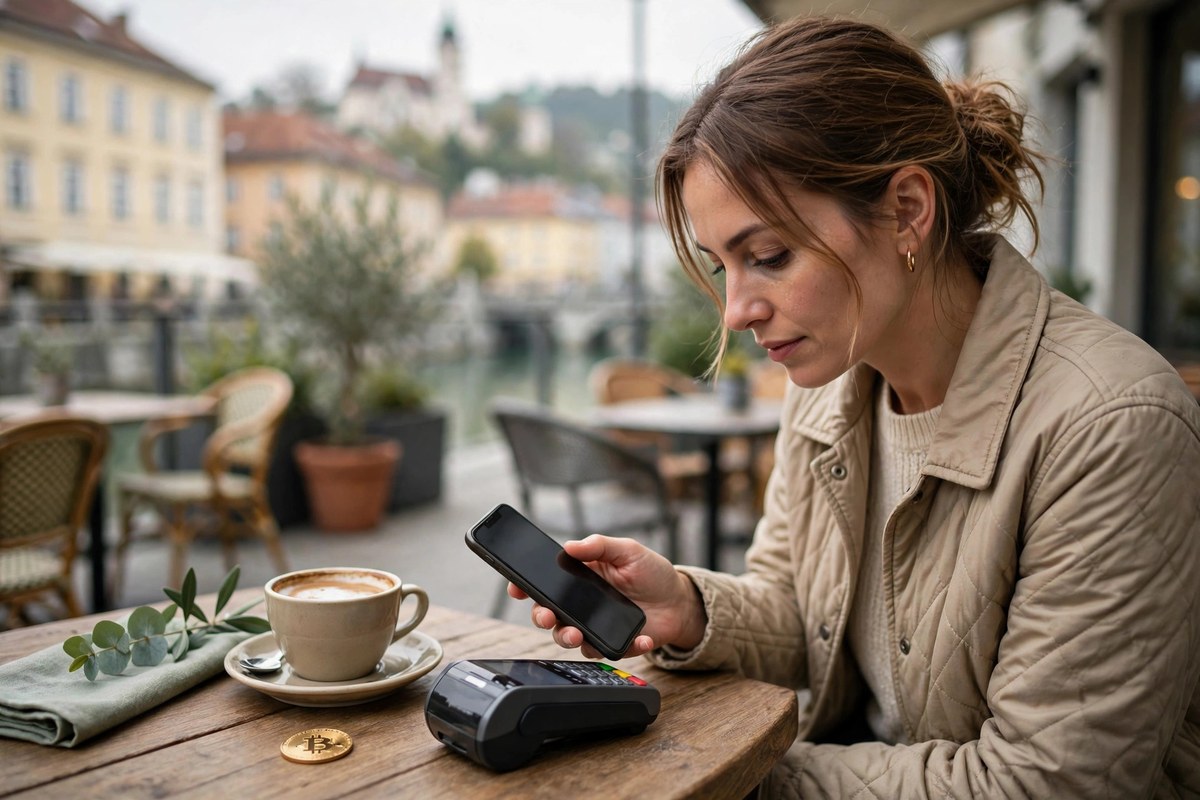
Every exchange below holds a MiCA licence from an EU regulator and accepts Slovenian residents with euro SEPA deposits. Fees shown are standard spot taker fees — the price you actually pay on a simple market buy. Always confirm the current fee schedule before trading, because exchanges change fees without notice.
| Exchange | Spot taker fee | SEPA deposit | Coins | MiCA licence | Best for |
|---|---|---|---|---|---|
| Bitstamp | 0.30% | Free | 100+ | Luxembourg (CSSF), first issued May 2025 | Slovenian buyers — Slovene interface, local office |
| Kraken | 0.40% | Free | 640+ | Ireland (Central Bank of Ireland) | Widest coin choice, proof of reserves |
| OKX EU | 0.08% | Free | 300+ | Malta (MFSA) | Lowest fees, active traders |
| Coinbase | 0.40% | Free | 250+ | Luxembourg (CSSF) | Beginners, PayPal deposits |
| Bitvavo | 0.25% | Free | 425+ | Netherlands, since June 2025 | Low fees, EUR pairs, proof of reserves |
Bitstamp is the sentimental favourite and a genuinely strong one: founded in Slovenia, still operating a Slovenian office, the only platform here with a Slovene-language interface, and supervised by the ATVP as a MiFID investment firm while its crypto services run under a Luxembourg MiCA licence. Its 0.30% taker fee is mid-range, and it supports SEPA, cards, Apple Pay, Google Pay and PayPal. Kraken lists more coins than anyone else here — over 640 — and holds the rare trading-platform permission from the Central Bank of Ireland, but its standard 0.40% taker fee is the joint-highest; its Pro interface is cheaper. OKX EU is the fee champion at 0.08% taker under a Maltese MiCA licence, with a self-custody wallet — but USDT cannot be traded on OKX EU, so stablecoin movers need euros or another coin instead. Coinbase is the name most first-time buyers already know, runs under a Luxembourg MiCA licence, and accepts PayPal and SEPA Instant, but its standard 0.40% fee is high. Bitvavo is the quiet value pick: 0.25% taker, most of its 425 coins trade directly against EUR, free SEPA deposits, and published proof of reserves under a Dutch MiCA licence. Bybit EU deserves an honourable mention at 0.10% flat spot fees under an Austrian FMA MiCA licence. Whichever you choose, verify the MiCA licence, check the fee on the exact order type you will use, and never leave large balances on any exchange longer than necessary. Independent comparisons for Slovenian users are available at Datawallet's Slovenia exchange guide and CryptoWinRate's Slovenia ranking.
What €1,000 of Bitcoin Really Costs on Each Exchange
On a €1,000 market buy, using each platform's standard spot taker fee and a free SEPA deposit, the trading fee alone is:
| Exchange | Taker fee | Fee on €1,000 | SEPA deposit | Total cost to buy |
|---|---|---|---|---|
| OKX EU | 0.08% | €0.80 | €0 | €0.80 |
| Bitvavo | 0.25% | €2.50 | €0 | €2.50 |
| Bitstamp | 0.30% | €3.00 | €0 | €3.00 |
| Kraken | 0.40% | €4.00 | €0 | €4.00 |
| Coinbase | 0.40% | €4.00 | €0 | €4.00 |
The gap between cheapest and most expensive is €3.20 per €1,000 — small once, but €320 per €100,000, before spreads. The real trap is the payment method: buying with a debit or credit card can add around 3.99% on some platforms, turning a €1,000 buy into a €39.90 fee. SEPA bank transfer is almost always the cheapest way to fund an account in Slovenia, usually arriving the same day or next business day. Also watch the spread — the gap between the buy and sell price on simple "instant buy" screens — a hidden fee that never appears in the fee table. Buying on the spot market or the advanced interface almost always gives a tighter spread than the one-tap buy button.
How to Buy Bitcoin in Slovenia: 7 Steps
Step 1 — Pick a MiCA-licensed exchange. Beginners who want a Slovenian-language interface should start with Bitstamp; fee-sensitive buyers should look at OKX EU or Bitvavo; anyone who wants the widest coin choice should look at Kraken. Open the exchange's official site — never click an exchange link from a social media ad.
Step 2 — Create your account and verify your identity. Sign up with your email, then complete verification: a government ID and a face check. Under EU anti-money-laundering rules every licensed exchange must do this before you can deposit or trade. It usually takes minutes, occasionally up to a day.
Step 3 — Deposit euros by SEPA. From your Slovenian bank account, send euros to the deposit details the exchange shows you, using the exact reference code it gives you — or the deposit can be delayed. SEPA deposits are free on all five exchanges in this guide.
Step 4 — Buy Bitcoin on the spot market. Go to the BTC/EUR pair, enter the euro amount, and place a market or limit order rather than using the one-tap instant buy screen. Double-check the fee shown before confirming.
Step 5 — Check what you actually received. Confirm the BTC credited, the fee charged, and the effective price. Save a screenshot or export the transaction record — this is the cost-basis evidence FURS would want if the tax rules change.
Step 6 — Move it to your own wallet. For any amount you would not want to lose, withdraw your Bitcoin to a wallet you control. Exchange wallets are convenient and risky: the $6.43 billion Binance hack of 2026 was a reminder that even the largest platforms can be breached. Our best crypto wallets for beginners guide compares hot and cold wallets in plain English.
Step 7 — Record everything. Keep a simple log: date, exchange, euros spent, BTC received, fee paid, and the wallet address you sent it to. Under DAC8 your exchange reports to the tax authority anyway — your records are what let you prove your side of the story.
What Most People Get Wrong About Buying Bitcoin in Slovenia
"The 25% crypto tax started on 1 January 2026." False — the most expensive misconception in Slovenian crypto. The bill was proposed, widely reported as certain, adopted by the government, then quietly pulled from parliament in December 2025. Private crypto gains remain tax-free in 2026, but the idea could return after the 2026 elections — treat the 0% window as a gift with an unknown expiry date, not a permanent right.
"Any big exchange is fine." Wrong. Only a MiCA-licensed exchange gives you EU investor protections, and the licence must be real — check it on the regulator's register, not the exchange's marketing page. Unlicensed platforms can freeze withdrawals, disappear, or operate from jurisdictions where you have no recourse.
"The cheapest fee is always the best deal." Not quite. A 0.08% fee with a wide spread can cost more than a 0.30% fee with a tight spread, and a platform that charges for withdrawals can eat the saving on the way out. Compare the full round trip: deposit, trade, spread and withdrawal.
"Bitcoin on an exchange is my Bitcoin." Legally and practically, no. Coins on an exchange are an IOU from the exchange; if it is hacked, frozen or bankrupted, your claim is unsecured. Withdrawal to self-custody is the only way the coins are unambiguously yours — and the step most beginners skip.
"Slovenia is a tax haven, so I don't need records." The opposite. DAC8 reporting started on 1 January 2026, which means exchanges now report your activity to FURS automatically. A tax-free regime with full reporting is the worst combination for sloppy record-keeping: the authority can see the transactions, and only your records prove what you paid.
5 Mistakes That Cost Slovenian Bitcoin Buyers Money
- Buying with a card instead of SEPA. Card purchases can cost around 3.99% versus €0 for a SEPA transfer — roughly €200 thrown away on a €5,000 buy for the sake of a few hours.
- Using the one-tap buy button. Instant-buy screens hide a spread on top of the fee. Use the spot market or advanced trading interface and you will see the real price before you commit.
- Leaving coins on the exchange. Every week coins sit on an exchange is a week of counterparty risk you are not being paid for. Withdraw to a wallet you control — see our hardware vs software wallet comparison if you are deciding which type to buy.
- Trusting a headline about the tax. The 25% tax was reported as law by major outlets months before it died in parliament. Before any tax decision, check the current position on the FURS website — a future government can revive the bill. Full background: the Slovenia Tax Guide 2026.
- Buying in a fear cycle without a plan. Bitcoin is down about 40% from its $126,080 all-time high, ETFs just posted their worst outflow week since June, and the Fear & Greed Index reads 26. That can be an opportunity or the start of a deeper fall — the CPI report due on 10 November could move the price either way. Decide your amount, horizon and exit rules before you buy, and never invest money you need within a year. For yield on holdings rather than price speculation, our best crypto staking platforms ranking shows what the major platforms actually pay after their cuts.
Storing Your Bitcoin Safely After You Buy
Buying is the easy half; custody decides whether you keep the money. For small amounts, a reputable mobile or desktop wallet is fine. For larger holdings, a hardware wallet — a physical device that keeps your private keys offline — is the standard recommendation, and it costs less than the card fee on a single €5,000 purchase. Write your recovery phrase on paper, store it physically separate from the device, and never photograph it, email it, or type it into any website. No exchange, wallet company or "support agent" will ever legitimately ask for it — if someone does, it is a scam. Comparing Slovenia with its neighbours? Our How to Buy Bitcoin in Croatia in 2026 guide covers the same MiCA framework with different local tax rules.
Frequently Asked Questions
Is Bitcoin legal in Slovenia in 2026?
Yes. Buying, holding and trading Bitcoin is legal, regulated under the EU's MiCA framework, with the Securities Market Agency (ATVP) as the national authority. Any exchange with a MiCA licence from any EU country can serve Slovenian residents.
Do I pay tax on Bitcoin gains in Slovenia?
For private individuals trading outside a business activity, crypto gains remain tax-free in Slovenia in 2026. The proposed 25% tax was never enacted — it was pulled from parliament in December 2025. Business income and security-like tokens are taxed differently, and the rules could change after the 2026 elections, so keep full records of every transaction.
Which is the best exchange to buy Bitcoin in Slovenia?
There is no single best choice. Bitstamp is the most local option — founded in Slovenia, with a Slovene interface and a local office. OKX EU has the lowest standard fee at 0.08%, Bitvavo is the low-fee all-rounder at 0.25% taker, Kraken has the widest coin selection, and Coinbase is the most beginner-friendly.
Can I buy Bitcoin with euros by SEPA transfer?
Yes — SEPA is the cheapest funding method in Slovenia. All five exchanges compared in this guide accept free SEPA euro deposits from Slovenian banks, usually arriving the same day or the next business day. Avoid card purchases, which can cost around 3.99%.
What is the minimum amount of Bitcoin I can buy in Slovenia?
Most exchanges let you start with as little as €10. There is no legal minimum, but check the minimum order size and withdrawal fee — on a very small purchase, a fixed withdrawal fee can eat a large share of your coins.
Should I buy Bitcoin now or wait?
Bitcoin trades near $75,850, roughly 40% below its all-time high, with ETF outflows at their worst since June and the Fear & Greed Index at 26. That is either a buying opportunity or the early stage of a deeper correction — the CPI data on 10 November is the next big test. Decide your budget, horizon and risk tolerance first, consider spreading purchases over time instead of buying everything at once, and never invest money you cannot afford to lose. For the latest market picture, see the live Bitcoin news and price levels for today.
Conclusion
Slovenia is, quietly, one of the best places in Europe to buy Bitcoin in 2026 — and not for the reason most guides claim. The 25% tax that dominated headlines never became law, so private gains remain tax-free while the window lasts. Bitstamp, the exchange founded in Ljubljana in 2011, gives Slovenian buyers a home team with a Slovene interface. And MiCA means five licensed exchanges now compete for your business with free SEPA deposits and fees from 0.08%. The winning move is boring but effective: pick a licensed exchange, fund it by SEPA, buy on the spot market, withdraw to your own wallet, and keep records as if the taxman is already watching — because under DAC8, he is. Do that, and the only question left is the market: whether $75,000 holds, or the fifth losing week becomes a sixth. Either way, you will have bought cheaply, legally, and — for now — tax-free.