How to Buy Bitcoin in Croatia in 2026: 5 MiCA-Licensed Exchanges Compared — Fees, Euro SEPA Payments and the 2-Year 0% Tax Rule
Hold Bitcoin 2 years in Croatia and the tax is 0% — sell a day earlier and it's 12%. Five MiCA-licensed exchanges compared: the cheapest charges €1.50 per €1,000, the priciest €24.90.
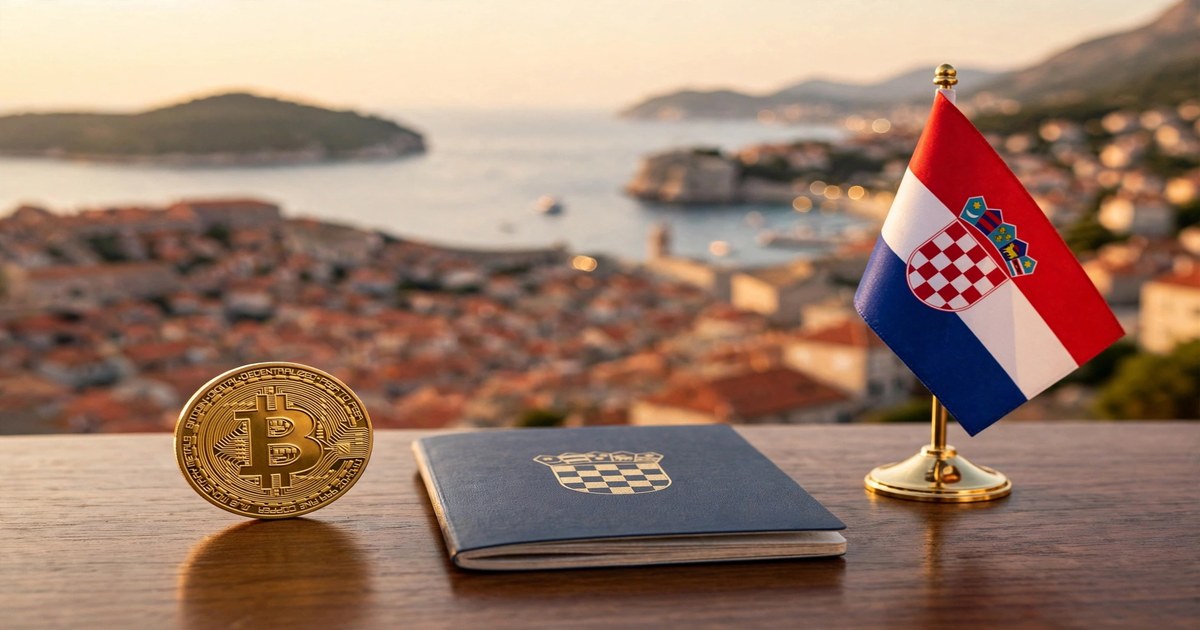
Hold your Bitcoin for two years in Croatia and the tax on your profit is 0%. Sell it one day earlier and you owe 12%. That single rule — plus the fact that Croatia now runs on the euro and every major exchange is MiCA-licensed — makes buying Bitcoin from Zagreb, Split or Rijeka one of the cheapest, simplest setups in Europe. This guide compares five MiCA-licensed exchanges, works out exactly what a €1,000 buy costs on each, and walks you through the purchase, the storage and the tax form.
Bitcoin trades near €68,000 (about $75,900) as of 8 November 2026, roughly 40% below its all-time high of $126,156 — and Croatia is quietly one of the friendliest places in the EU to buy the dip. The country adopted the euro in January 2023, the EU's MiCA crypto rulebook has applied since 30 December 2024, and the Croatian regulator HANFA now supervises crypto-asset service providers. An estimated 50,500 Croatians — about 1.3% of the population — already own crypto. Here is how to join them without overpaying.
Is Bitcoin Legal in Croatia in 2026?
Yes. Buying, holding and selling Bitcoin is fully legal in Croatia. As an EU and eurozone member, Croatia falls under the Markets in Crypto-Assets Regulation (MiCA, Regulation (EU) 2023/1114), which became directly applicable across the EU on 30 December 2024. HANFA — the Croatian Financial Services Supervisory Agency — is the competent authority that authorises and supervises crypto-asset service providers under Croatia's MiCA Implementation Act, while the Croatian National Bank (HNB) supervises issuers of asset-referenced and e-money tokens.
The practical consequence matters more than the acronyms: after the 18-month transitional period for legacy providers ended on 1 July 2026, any exchange serving Croatian customers must hold a full MiCA authorisation from an EU regulator. A licence from any EU country passports across the whole bloc, so a Dutch, Irish, Austrian or Maltese licence covers you in Croatia. Exchanges without a MiCA licence are not supervised by any EU regulator, and MiCA's investor protections do not apply if you use them. Before you open an account, check that the operating company appears in HANFA's registers or the ESMA record — that one check is the single most important safety step in this guide. A full overview of Croatia's crypto regulation under MiCA and HANFA confirms the framework and the 1 July 2026 cut-off for legacy providers.
Local names still exist alongside the global platforms: Electrocoin and Bitcoin mjenjačnica are Croatian crypto companies that give buyers a domestic route and a local euro benchmark. They are useful for comparison, but for most buyers the global MiCA-licensed exchanges below win on fees and liquidity.
5 MiCA-Licensed Exchanges Compared for Croatia
Fees are where Croatian buyers lose the most money — and where the gap between the cheapest and the priciest option is widest. The table below compares the five platforms that best combine a MiCA licence, euro SEPA funding and service to Croatian residents. All figures are base-tier spot fees as published in November 2026; independent comparisons of the best exchanges in Croatia and Datawallet's Croatia exchange ranking reach the same shortlist.
| Exchange | MiCA licence | Spot fee (maker / taker) | EUR funding | Best for |
|---|---|---|---|---|
| Kraken | Central Bank of Ireland | 0.25% / 0.40% (Kraken Pro) | SEPA, SEPA Instant, card | Security-first buyers; 450+ coins |
| Bitvavo | Dutch regulator (AFM) | 0.15% maker | Free SEPA deposits | Lowest euro spot fees |
| OKX EU | Malta (MFSA) | 0.10% / 0.20% | SEPA, card, Apple Pay, Google Pay, PayPal | Low fees, wide coin range |
| Coinbase | Luxembourg (CSSF) | 0.40% / 0.60% (Advanced) | SEPA, SEPA Instant, PayPal, card | Beginners, audited US-listed company |
| Bitpanda | Austria (FMA) + Germany (BaFin) | 0.99%–2.49% standard; ~0.25% on Fusion | SEPA, card, Apple Pay, Google Pay | One account for crypto, stocks and ETFs |
Kraken earns the top overall recommendation for most Croatian buyers: operating since 2011 without a major loss of client funds, it pairs a MiCA authorisation from the Central Bank of Ireland with an Irish e-money licence, so both the crypto and the fiat side of a Croatian account sit under EU supervision. It also publishes proof of reserves and offers deep euro markets on the BTC/EUR pair.
Bitvavo is the cheapest euro route on paper — the largest euro spot exchange in the world, with free euro deposits and a 0.15% maker fee. OKX EU matches it closely at 0.10% maker / 0.20% taker and adds PayPal funding. Binance also serves Croatian customers from 0.10% spot, and Bybit EU (FMA MiCA licence, Austria) charges 0.10% flat. Bitpanda is the convenience pick — crypto, stocks, ETFs and metals in one Austrian-regulated account — but its standard prices embed a premium of 0.99% to 2.49%, so it suits occasional buyers, not active traders; its Fusion interface cuts active traders to about 0.25%.
What a €1,000 Bitcoin Buy Actually Costs on Each Exchange
Fee percentages look small until you multiply them. On a €1,000 market buy of Bitcoin, the trading fee alone is roughly:
- Bitvavo at 0.15% costs about €1.50 — the cheapest of the five in this comparison.
- OKX EU at 0.20% taker costs about €2.00 for an instant market order, or €1.00 with a limit order.
- Kraken Pro at 0.40% taker costs about €4.00 — or €2.50 if your order waits on the book as a maker.
- Coinbase Advanced at 0.60% taker costs about €6.00, and the simple one-tap buy screen costs considerably more.
- Bitpanda standard pricing costs €9.90 to €24.90 on the same €1,000, depending on the coin and the size of the order.
That is a 16-fold difference between the cheapest and the priciest way to buy the exact same Bitcoin. Two habits protect you: fund with a SEPA transfer from your Erste, OTP banka, Zagrebačka banka or Revolut account instead of a card — card purchases add processor fees and wider spreads — and buy on the exchange's standard or advanced spot interface with a limit order, never the instant-buy widget, where the markup is hidden in the displayed price. SEPA transfers in euros are cheap and settle quickly, which is why they are the default rail for Croatian buyers.
How to Buy Bitcoin in Croatia: Step by Step
The whole process takes under an hour the first time, and minutes after that.
Step 1: Choose a MiCA-licensed exchange
Pick from the table above. For a first purchase, Kraken or Bitvavo are the simplest balance of safety and cost; Coinbase is the easiest interface if you have never traded before; OKX EU is the pick if you want the lowest fees and the widest coin selection. Confirm the MiCA licence before you register.
Step 2: Create and verify your account
Register with your email, set a strong unique password and turn on two-factor authentication with an authenticator app (not SMS). Verification requires a Croatian ID card or passport and proof of address — a utility bill or bank statement. Most exchanges verify within minutes to a few hours. This is also the moment to check whether you actually need a full exchange account at all: if you only want Bitcoin and nothing else, the Bitcoin-only app Relai lets you buy from about 1% per purchase by SEPA, with no trading interface to learn.
Step 3: Deposit euros by SEPA
Send euros from your Croatian bank account via SEPA transfer. Ordinary SEPA transfers are usually free or cost a few cents from Croatian banks, and SEPA Instant settles in seconds where supported. Never deposit from someone else's account — exchanges reject third-party deposits and can freeze the funds. Revolut is a popular funding route for Croatians because its euro transfers are fast and free, but a direct transfer from your bank works just as well.
Step 4: Buy Bitcoin on the spot market
Go to the BTC/EUR pair on the exchange's trading screen — not the instant-buy button. Place a limit order slightly below the current price if you are patient, or a market order if you want it filled immediately. Double-check the pair: buying BTC/USDT on an EU platform can be restricted, and euro pairs keep your accounting simple for tax time.
Step 5: Move it to your own wallet
Leaving Bitcoin on an exchange means trusting the exchange's security forever. For any amount you would mind losing, withdraw to a wallet you control. Our guide to the best crypto wallets for beginners in 2026 explains hot versus cold wallets; a hardware wallet is the standard choice for holdings above a few hundred euros. Test the withdrawal with a small amount first, confirm it arrives, then move the rest.
Croatia Crypto Tax 2026: the 12% Rule and the 2-Year 0% Exemption
Croatia has one of the most holder-friendly crypto tax regimes in the EU — and the rule is simple enough to fit in one sentence. Profit from selling cryptocurrency is treated as income from capital for individuals. If you sell within two years of buying, the gain is taxed at a flat 12%. If you sell more than two years after buying, the gain is completely exempt — 0% tax. The municipal surtax (prirez) that used to sit on top was abolished from 1 January 2024, so 12% is the whole bill, and the tax is final: it is not part of your annual income tax return. The Croatia crypto tax guide for 2026 and the Croatian Tax Administration's published guidance both confirm the 12% rate and the two-year exemption.
Three details catch people out. First, the holding period is calculated from the date of acquisition to the date of disposal using FIFO (first-in, first-out) across multiple trades, so keep a record of every purchase date and price. Second, swapping one cryptocurrency for another is not a taxable event — tax only arises when you convert crypto to fiat euros or spend crypto on goods and services. Third, gains are reported on the JOPPD form and the tax is calculated and paid by the last day of February of the following year — for gains made in 2026, the deadline is the end of February 2027. Note that Porezna uprava has published JOPPD examples reminding filers that a filing may still be required even when a gain is not taxable because the asset was held for more than two years.
A worked example: you buy €2,000 of Bitcoin in November 2026 and sell it for €3,000 in June 2027 — seven months later. Your €1,000 gain is taxed at 12%, so you owe €120, reported on the JOPPD by the end of February 2028. Sell the same Bitcoin in December 2028 instead, more than two years after purchase, and the €1,000 gain is tax-free. That €120 difference is the entire incentive structure of Croatian crypto tax: it rewards patience and punishes churn. Since 2026 the EU's DAC8 rules also mean authorised exchanges report client transaction data to EU tax authorities, so undeclared gains are far easier for Porezna uprava to detect than they used to be.
One warning: if your trading is frequent and organised enough to be reclassified as a business activity, it can be taxed as self-employment income at progressive rates instead. There is no published threshold for that reclassification, so very active traders should talk to a Croatian tax adviser. This article is general information, not tax advice.
5 Mistakes Croatian Bitcoin Buyers Make
- Paying card and instant-buy markups: a card-funded instant purchase can cost 3.99% or more once processor fees and spreads are counted, against 0.15% on a SEPA-funded limit order. On €1,000 that is roughly €40 versus €1.50.
- Using an unlicensed exchange after the MiCA cut-off: since 1 July 2026, platforms without full MiCA authorisation operate outside EU supervision in Croatia. If it goes wrong, MiCA's protections do not apply.
- Selling just before the two-year mark: selling at 23 months costs 12% of the gain; waiting one more month can make the same gain tax-free. Check the acquisition date before every sale.
- Leaving large amounts on an exchange: exchanges are convenient for buying, not for storing. Withdraw to your own wallet, back up the seed phrase offline, and never photograph it or store it in the cloud.
- Ignoring the JOPPD deadline: gains must be reported by the end of February of the following year. The 2025 deadline fell on 2 March 2026 because 28 February was a Saturday — check the calendar each year and file on time.
Bitcoin in Croatia: What Most People Get Wrong
The biggest misconception is that crypto is unregulated in Croatia. It is not: MiCA applies in full, HANFA supervises providers, and the tax administration has published specific guidance on crypto gains since 2018. The second misconception is that the 12% tax applies to everything. It does not — it applies only to gains on assets sold within two years, only when converting to fiat or spending, and never to crypto-to-crypto swaps. The third is that buying Bitcoin requires a foreign bank account or a kuna conversion. Croatia has used the euro since January 2023, so a SEPA transfer from any Croatian bank lands as euros with no conversion at all. And the fourth: that you need a lot of money to start. Every exchange above lets you buy a fraction of a Bitcoin — €50 buys about 0.0007 BTC at current prices — so the minimum is your budget, not the price of a whole coin.
If you are still deciding whether Bitcoin deserves a place in your portfolio at all, read our honest guide Is Bitcoin a Good Investment in 2026? before you buy. And if you already hold Bitcoin on an exchange elsewhere in Europe, the same MiCA rules and the same 2-year exemption apply — our Bulgaria buying guide shows how another eurozone country compares, including its own 10% tax treatment.
FAQs: Buying Bitcoin in Croatia
Is it legal to buy Bitcoin in Croatia?
Yes. Bitcoin is fully legal in Croatia. The EU's MiCA regulation applies since 30 December 2024, HANFA supervises crypto-asset service providers, and licensed exchanges serve Croatian residents with euro SEPA funding. Buying from a MiCA-licensed platform is the compliant route.
How much tax do I pay on Bitcoin in Croatia?
Capital gains on Bitcoin sold within two years of purchase are taxed at a flat 12% as income from capital, with no surtax since 2024. Gains on Bitcoin held for more than two years are completely exempt. Crypto-to-crypto swaps are not taxable; tax arises when you convert to euros or spend crypto. Report gains on the JOPPD form by the end of February of the following year.
Which exchange is cheapest for Croatians?
On trading fees alone, Bitvavo (0.15% maker) and OKX EU (0.10% maker / 0.20% taker) are cheapest, with Binance and Bybit EU also at 0.10%. Kraken Pro (0.25% / 0.40%) costs a little more but is widely rated the strongest on security and euro liquidity. Bitpanda's standard pricing (0.99%–2.49%) is the most expensive of the five compared here. Always fund by SEPA, not by card.
Can I buy Bitcoin with a Croatian bank account?
Yes. Send euros by SEPA transfer from Erste, OTP banka, Zagrebačka banka, PBZ or Revolut to your exchange account. SEPA transfers are cheap and fast because Croatia uses the euro. Card purchases also work on most exchanges but cost more in fees and spreads.
Do I need to report Bitcoin to Porezna uprava?
Taxable gains must be reported on the JOPPD form by the end of February of the year after the sale, and Porezna uprava notes a filing may still be required even for exempt gains held over two years. From 2026, DAC8 means authorised exchanges share transaction data with EU tax authorities. Keep records of every purchase date, price and sale.
Should I keep Bitcoin on the exchange or move it to a wallet?
Move it to a wallet you control for any amount you would mind losing — a hardware wallet for larger holdings. Exchanges are for buying and selling, not long-term storage. If you want yield on other coins while you hold, our crypto staking guide explains how staking rewards work and what the risks are. If you ever pay by card instead of SEPA, read our credit-card buying guide first — the 3.99% fee and the cash-advance trap catch a lot of first-time buyers.
Conclusion
Croatia in November 2026 is one of the easiest places in Europe to buy Bitcoin properly: euro SEPA funding with no conversion, five MiCA-licensed exchanges competing on fees as low as 0.10%, and a tax rule that makes patience pay — 12% if you sell within two years, 0% if you wait. The formula is simple: pick a licensed exchange, fund it by SEPA, buy on the spot market with a limit order, move the coins to your own wallet, and note the purchase date so the two-year clock starts ticking. On a €1,000 buy, the difference between the cheapest and the priciest route is more than €20 in fees alone — and the difference between selling at 23 months and 25 months can be the entire 12% tax bill. In Croatia, the cheapest Bitcoin is the Bitcoin you buy carefully and hold patiently.