How to Buy Bitcoin in Israel in 2026: 5 Exchanges Compared — Fees, ILS Payments and the 25% Tax Rule
Bitcoin is legal in Israel — but your bank may still refuse the money, and the taxman takes 25% of every shekel of profit. 5 exchanges compared, ILS fees checked, and the 10-year exemption new immigrants miss.
Buying Bitcoin in Israel is legal — but it is not simple. Your bank may refuse to accept the money when you sell, the tax authority takes 25% of every shekel of profit, and the cheapest exchange is not always the one that will actually let your shekels in. This guide compares 5 exchanges that work for Israeli buyers in 2026, checks their ILS fees and payment methods, and explains the 25% tax rule — including the 10-year exemption most new immigrants never hear about.
Bitcoin trades around $75,900 on November 8, 2026, after a brutal month that took it 40% below its October 2025 peak. That pullback is exactly why timing and fees matter: buying through the wrong route can cost you more in spreads and bank charges than a week of price movement. Here is the route that costs least, and the paperwork that keeps you out of trouble.
Is Bitcoin Legal in Israel in 2026?
Yes. Israelis can legally buy, hold and sell Bitcoin. But Bitcoin is not legal tender and the Bank of Israel has repeatedly warned it carries consumer, volatility and operational risks. The Israel Tax Authority (ITA) classifies cryptocurrency as a taxable asset — property, not currency — under Circular 5/2018, which is why every sale is a taxable event.
Regulation is split across several bodies, and Israel is not an EU member state, so the EU's MiCA framework does not apply. The Capital Market, Insurance and Savings Authority (CMA) is the primary licensing body for crypto service providers under the 2016 Supervision of Financial Services Law; nine firms held CMA licences by June 2026, five of them approved that year. The Israel Securities Authority (ISA) decides whether tokens qualify as securities and regulates digital-asset investment advice. The Bank of Israel supervises the banks and their handling of crypto-sourced funds, while the Israel Money Laundering and Terror Financing Prohibition Authority (IMPA) enforces anti-money-laundering rules, including the Travel Rule at a threshold of ILS 5,000. For a full country-by-country regulatory overview, see Blockspot's Israel profile.
That fragmented setup is the reason Israeli buyers face a quirk almost no other developed market has: the exchange may be perfectly legal, and your bank may still refuse the deposit. More on that below — it shapes which exchange you should pick.
5 Exchanges Compared: Fees, ILS Payments and Who Each One Suits
These are the five routes Israeli buyers actually use in 2026 — two local, three global. Fees change, so treat the figures as the typical range at the time of writing and check the live fee page before you buy.
| Exchange | Typical fee | ILS payments | Best for |
|---|---|---|---|
| Bit2C (local) | Volume-tiered trading fees | ILS bank transfer, NIS balance | Regular buyers who want shekels in and out |
| Bits of Gold (local) | 1.20%–1.95% | ILS bank transfer | Beginners who want a licensed local broker |
| Binance (global) | From ~0.1% spot | Card, P2P (ILS bank transfer via P2P) | Lowest trading fees, widest coin choice |
| Kraken (global) | From ~0.25% (Pro) | Card, bank transfer (USD/EUR) | Security-first buyers, larger orders |
| eToro (global) | ~1% on crypto | Card, bank transfer | First-timers who want a simple app |
Bit2C is Israel's oldest exchange, founded in July 2012, and trades several digital assets directly against the shekel. Its fees are volume-tiered, so frequent traders pay less. Bits of Gold is Israel's largest crypto brokerage and received a Capital Markets Authority licence in 2022 — a milestone that matters because licensed local firms have the smoothest relationships with Israeli banks. Its fees run 1.20%–1.95%, higher than a global exchange, but many buyers pay the premium for Hebrew support and paperwork that Israeli banks and the tax authority understand. A detailed local comparison is available at Newhedge's Israel exchange guide.
Binance remains the cheapest way to trade, with spot fees from around 0.1%, but it does not take direct ILS bank transfers — Israelis usually fund it by card or through its peer-to-peer market, where another user takes your ILS bank transfer. Kraken is the security-first choice and suits larger orders, while eToro is the simplest app for a first purchase, at roughly 1% per trade. If you are still deciding whether Bitcoin belongs in your portfolio at all, read our honest guide: Is Bitcoin a Good Investment in 2026?
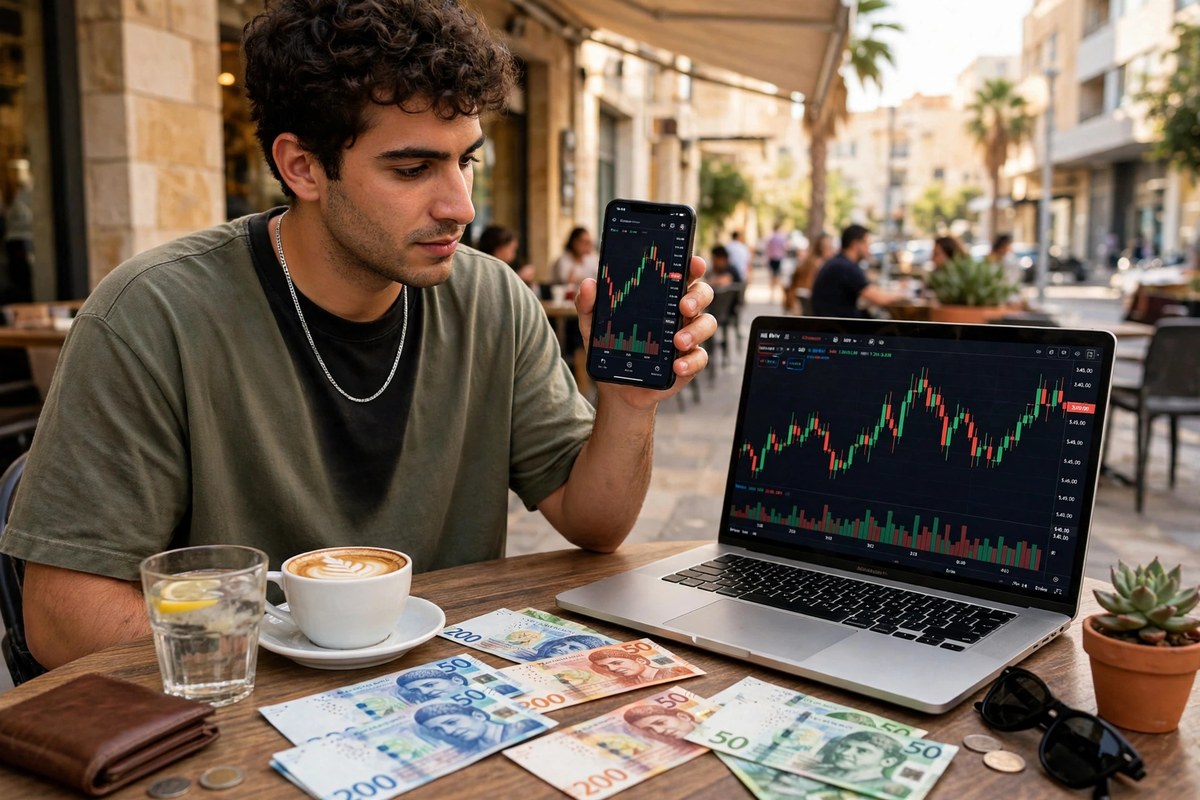
How to Buy Bitcoin in Israel — Step by Step
Step 1: Pick your route. If you want shekels in and shekels out with minimum bank friction, start local — Bit2C or Bits of Gold. If you want the lowest fees and the widest choice of coins, use Binance or Kraken and accept card or P2P funding. Beginners who want the simplest possible first purchase can use eToro.
Step 2: Verify your identity. Every reputable platform runs KYC identity checks — passport or Israeli ID, proof of address, and sometimes proof of source of funds. Budget a day for approval; local platforms are usually faster for Israeli documents.
Step 3: Fund your account in shekels. On Bit2C or Bits of Gold, send an ILS bank transfer from your own Israeli bank account — never from a third party's account, or the bank may freeze the transfer. On global exchanges, pay by card or use P2P. Keep the transfer receipt: you will need it twice, once for the bank and once for your tax records.
Step 4: Place the order. A market order buys instantly at the current price; a limit order buys only at the price you set. For a first purchase under ILS 10,000, a market order is fine. For larger amounts, a limit order avoids buying at a bad moment during a volatile hour.
Step 5: Move your Bitcoin off the exchange. Exchanges get hacked — the $6.3 billion Binance hack in October 2026 is the latest reminder. For any amount you would not want to lose, withdraw to your own wallet. Our comparison explains the options: Best Crypto Wallets in 2026: 7 Compared After the $6.3B Binance Hack.
Step 6: Record everything. Save the trade confirmation, the deposit receipt, the wallet address and the shekel amount. Israel's tax filing requires it, and your bank will ask for it when the money comes back.
Paying in Shekels: ILS Payment Methods Compared
ILS bank transfer is the cheapest and most reliable method, and it only works properly on the two local platforms. Transfers from your own Israeli account to Bit2C or Bits of Gold are straightforward, and the paper trail is exactly what your bank wants to see later. Credit and debit cards work on Binance, Kraken and eToro, but card purchases typically carry higher fees — and buying crypto with a card can be treated as a cash advance by some issuers, with extra charges. Our guide to the trap is here: How to Buy Bitcoin With a Credit Card in 2026: The 3.99% Fee, the Cash-Advance Trap — and 5 Cheaper Ways to Pay.
Peer-to-peer (P2P) lets you pay another user by ILS bank transfer on Binance's P2P market. It is the only way to get shekels onto the biggest global exchange, but it carries counterparty risk: only trade inside the platform's escrow system, never pay outside it, and never accept a "discount" price from a stranger in a chat app. Cash is not a sensible route in Israel — unlicensed cash deals leave no paper trail, which is precisely what banks and the tax authority will demand later.
The Bank Problem: Why Israeli Banks Still Say No
This is the part most guides skip, and it is the part that costs Israeli buyers the most time. Israeli banks have historically been cautious — the regulatory data classifies banking access for crypto in Israel as "difficult" — and many buyers have had deposits refused or accounts questioned when crypto money arrives. The Bank of Israel's Proper Conduct of Banking Business Directive No. 411 governs how banks treat crypto-sourced funds, and banks have applied it with blanket refusals and automatic source-of-funds checks on transfers over ILS 100,000.
That is changing. In July 2026 the Bank of Israel published a draft amendment to Directive 411 that would bar blanket refusals and drop the automatic ILS 100,000 source-of-funds check. The amendment is not yet final, but the direction is clear: banks are being pushed toward judging each case on its own paperwork rather than refusing all crypto money outright.
Until the new rules bite, protect yourself with three habits. First, keep a clean paper trail from the first shekel: every deposit receipt, every trade confirmation, every wallet address. Second, use a licensed local platform for the fiat legs of the journey — money that arrives from a CMA-licensed broker is far easier for a bank to accept than money from an anonymous overseas wallet. Third, tell your bank before a large withdrawal lands, not after: a five-minute call with your branch, with your records ready, prevents most freezes. When you eventually sell, the exit matters as much as the entry — see How to Sell Bitcoin in 2026: A Complete Beginner's Guide to Cashing Out Safely.
The 25% Tax Rule: What Every Israeli Buyer Owes
Israel taxes crypto as an asset, not as a currency. For individual investors, capital gains on Bitcoin are taxed at a flat 25%. The rate rises to 30% for significant shareholders and is 23% for corporations — while anyone whose trading is classified as a business can be taxed at marginal income-tax rates of up to 50%. That classification is the single most expensive surprise in Israeli crypto tax: passive investors pay 25%, but day-traders, miners and DeFi yield farmers face scrutiny under the business-income rules.
Three details soften the 25% rate. First, your cost basis is index-linked: the Israeli CPI from purchase to sale is used to uplift your original cost, which shrinks the taxable gain in an inflationary economy. Second, every disposal is a taxable event — including swapping Bitcoin for Ethereum, which the ITA treats as selling BTC at its shekel value on the trade date. Third, all disposals must be reported on Form 1322 by April 30 of the following year, extended to May 31 if you file online. The Israel Crypto Capital Gains Tax Calculator explains the index-linked cost base in detail, and Taxxy's Israel Crypto Tax Guide 2026 covers the filing rules.
There is one genuine exemption, and it is generous: new immigrants (olim chadashim) and returning residents are exempt from Israeli tax for 10 years on capital gains from foreign assets acquired before becoming Israeli tax residents — which can include cryptocurrency held on foreign exchanges before making aliyah. If you moved to Israel holding Bitcoin bought abroad, do not sell before checking whether that exemption covers you; it is the difference between 25% and 0%. The November 2024 draft legislation from the Finance Ministry and the ITA would formally codify the 25% rate and the source rules tied to tax residency at the date of acquisition, and it remained in legislative progress as of mid-2026.
This is general information, not tax advice. Israeli crypto tax is genuinely complicated — the interaction of the 25% rate, the index-linked basis, the business-income test and the oleh exemption is exactly the kind of thing worth one paid hour with an Israeli crypto-savvy accountant before a large sale.
What's New in Israel in 2026: Stablecoins, Custody Rules and a Political Row
Israel spent 2026 writing crypto rules rather than banning crypto. In April 2026 the CMA approved BILS, a shekel-pegged stablecoin issued by Bits of Gold, after a pilot lasting about two years. In June the Finance Ministry published a draft stablecoin law for comment, and in July the CMA issued binding custody rules — Circular 2026-10-2, with segregated trust accounts and multi-party approval of transfers — that take effect around January 2027. The Bank of Israel published a preliminary digital shekel design in March 2025 but has not decided to issue one. A full timeline of the 2026 rule-making is tracked at 4Pillars' Israel Crypto Regulation (2026).
The most public crypto moment of the year was political. On October 23, Prime Minister Benjamin Netanyahu told Channel 10 that Israel might need a "bypass economy" using crypto and blockchain if international banking sanctions were ever imposed. The next day the Bank of Israel publicly rejected the idea, saying cryptocurrencies "cannot be used as a route for bypassing sanctions" and telling the government to focus on preserving ties with its main trading partners. No bill, budget or timetable for any such plan exists. The episode is a useful reminder of the limits of crypto as a sanctions workaround — traceable blockchains and regulated exchanges make it a poor tool for the job, as the Bank of Israel's statement and the coverage at Crypto News Flash and Crypto Times both explain.
Storing Your Bitcoin Safely
Buying is only half the job. If you leave Bitcoin on an exchange, you are trusting that exchange's security, solvency and honesty — and October 2026 showed even the biggest can be breached. For holdings you plan to keep for months or years, a hardware wallet is the standard answer: your keys live offline, and the exchange cannot lose them. For smaller amounts you trade often, a reputable mobile wallet is fine. Never keep your recovery phrase in a photo, an email or a cloud note; write it on paper and store it somewhere safe. If you move coins between platforms, read How to Transfer Crypto Between Exchanges first — a wrong-network transfer is the most common way beginners lose coins forever.
5 Mistakes That Cost Israeli Buyers Money
- Buying by card without checking the fee: card purchases can cost 3.99% plus cash-advance charges — an ILS bank transfer to a local platform is almost always cheaper.
- Leaving coins on the exchange: the $6.3 billion Binance hack is the latest proof that "I'll withdraw later" is a risk, not a plan.
- Ignoring the bank on the way out: selling is easy; getting the shekels into your Israeli bank account is the hard part. Keep records from day one and warn your branch before a large deposit lands.
- Forgetting crypto-to-crypto swaps are taxable: trading BTC for ETH is a disposal at 25%, even though no shekels ever touched your account.
- Selling as a new immigrant without checking the 10-year exemption: crypto bought before aliyah may be entirely exempt for a decade — check before you sell, not after.
FAQs
Is it legal to buy Bitcoin in Israel?
Yes. Bitcoin is legal to buy, hold and sell in Israel, but it is classified as a taxable asset rather than currency, and it is not legal tender. The CMA licenses crypto service providers, the ISA oversees securities questions, and the Bank of Israel supervises how banks handle crypto-sourced funds.
Which is the best exchange to buy Bitcoin in Israel?
For shekel bank transfers and the smoothest bank relationship, Bit2C or Bits of Gold — the latter holds a CMA licence. For the lowest trading fees, Binance (from ~0.1% spot) via card or P2P. For security-first larger orders, Kraken. For the simplest first purchase, eToro at around 1%.
How much tax do I pay on Bitcoin in Israel?
Individual investors pay 25% capital gains tax on profits, with the cost basis uplifted for inflation (index-linked). The rate is 30% for significant shareholders and 23% for corporations, while active traders classified as a business can pay marginal rates up to 50%. Report disposals on Form 1322 by April 30 (May 31 online).
Can I pay for Bitcoin with shekels (ILS)?
Yes — via ILS bank transfer on Bit2C and Bits of Gold, by card on global exchanges, or through P2P on Binance. Bank transfer is the cheapest and leaves the cleanest paper trail for your bank and the tax authority.
Will my Israeli bank accept money from selling Bitcoin?
Often, but not always. Banks have historically refused some crypto-sourced deposits under Directive 411. A July 2026 draft amendment would bar blanket refusals, and money arriving from a CMA-licensed local platform with full records is far easier for a bank to accept. Keep every receipt and warn your branch before large deposits.
Do new immigrants to Israel pay tax on Bitcoin?
New immigrants and returning residents are exempt from Israeli tax for 10 years on capital gains from foreign assets — including cryptocurrency — acquired before becoming Israeli tax residents. Check the exemption with a tax adviser before selling.
Conclusion
Israel is one of the more demanding places to buy Bitcoin, but not one of the hardest — the rules are written down, the tax rate is a flat 25%, and the local industry is maturing fast, with nine licensed firms, a shekel stablecoin and new custody rules landing in 2026. The winning formula for most Israeli buyers is simple: buy through a local licensed platform with an ILS bank transfer, keep immaculate records, move the coins to your own wallet, and check the 10-year oleh exemption before your first sale. Bitcoin is around $75,900 today — 40% below its peak and sitting almost exactly on the short-term holder cost basis. Whether that is a buying opportunity or a warning is a separate question, and our take is here: Is Now a Good Time to Buy Crypto? Bitcoin Is 40% Below Its Peak and Fear Is at 25 — 5 Tests That Decide Buy, Wait or Walk Away. Either way, buy it the cheap, documented way — the fees and the paperwork are the parts you control.