France Voted 150–44 to Force €100,000 Self-Custody Crypto Declarations — €10,000 Fine, and 2 Dates That Decide It
France voted 150–44 to force holders of self-custodied crypto worth €100,000+ to declare it — with fines up to €10,000. But the rule isn't law yet: November 17 and November 20 decide whether it survives.

France's National Assembly voted 150–44 on November 3, 2026 to require taxpayers to declare self-custodied crypto holdings worth at least €100,000 — with fines of up to €10,000 for failing to do so. If you hold Bitcoin or other crypto in a hardware wallet or a wallet you control yourself, this vote is aimed directly at you. But here is the twist most headlines skip: the rule is not law yet, and two dates — November 17 and November 20 — decide whether it ever becomes one.
Amendment I-2701, tabled by deputy Charles de Courson and six co-sponsors, would add a new paragraph to Article 1649 bis C of France's General Tax Code. It targets wallets "not held with a crypto-asset service provider" — in plain language, coins you hold yourself rather than on an exchange. The threshold is assessed on December 31 of the relevant tax year, which makes the year-end snapshot, not your trading activity, the thing that counts.
This article explains exactly what passed, who it hits, what the €10,000 fine really is, the full timeline to law, and the checklist to run before December 31. If you are a French taxpayer with crypto in self-custody, this is the one vote you cannot afford to misunderstand.
What France Actually Voted On
On Tuesday, November 3, 2026, during the second sitting of the day, France's National Assembly adopted Amendment I-2701 to the 2027 Finance Bill in public vote no. 9636. The result was decisive: 150 votes in favor, 44 against, and 8 abstentions, according to the Assembly's official voting record. The amendment was filed by Charles de Courson and six co-sponsors from the Libertés, Indépendants, Outre-mer et Territoires group.
The measure adds a reporting obligation to Article 1649 bis C of the General Tax Code. That article already requires French residents to declare accounts held abroad — including foreign crypto accounts, which residents already report via form 3916-bis. The new paragraph extends the logic one step further: wallets held directly, without any regulated crypto-asset service provider in the middle, would also have to be declared once their total value reaches €100,000 (about $112,000).
The threshold includes holdings valued at exactly €100,000, and it is measured on December 31 of the relevant tax year. That single detail shapes everything about how the rule would work in practice: it is a snapshot test, not a test of how much you traded, earned, or moved during the year.
It is also worth noting what the amendment does not do. It does not create a new tax on holding crypto. It does not ban self-custody. And it does not, by itself, give the tax authorities your wallet addresses or transaction history. It creates a declaration obligation — a duty to tell the authorities that qualifying wallets exist and what they are worth at year-end.

Who the Rule Hits — and Who It Does Not
The rule targets one specific group: French taxpayers who hold crypto in wallets they control themselves. That means hardware wallets such as Ledger and Trezor, and self-custody software wallets where you alone hold the private keys or seed phrase. If your coins sit on a regulated exchange or with a licensed crypto-asset service provider, those holdings are already visible to the authorities through existing reporting channels — the new amendment is not aimed at them.
The practical dividing line is custody, not coin. Bitcoin in your own hardware wallet counts toward the €100,000. The same Bitcoin sitting on a regulated exchange account does not trigger this particular declaration, because it is not self-custodied. That is why the amendment matters most to long-term holders who moved their coins off exchanges after the security scares of recent weeks — the very people who did the "responsible" thing and took self-custody are the ones now facing a new declaration duty.
There is also a threshold question that catches many people out. The €100,000 applies to the total value of your directly held crypto, not to each wallet individually. Spreading coins across five wallets does not dodge the obligation if the combined year-end value crosses the line. The amendment's explanatory statement frames the test around the taxpayer's directly held portfolio, and the December 31 valuation date means a portfolio that crosses €100,000 on a price spike at year-end is caught even if it spent most of the year below the line.
Finally, the rule covers French tax residents, not tourists — though it is a strong signal of where European reporting is heading, as we explain below.
The €10,000 Fine: What It Is and What It Is Not
The amendment's explanatory statement describes a sanction mechanism reaching €10,000 for failure to declare. That figure has dominated the headlines, so it deserves precision. The €10,000 is a proposed penalty ceiling — the maximum fine for not filing the declaration — not a charge automatically imposed on everyone above the threshold. Declaring correctly costs nothing. The fine only enters the picture if you are obliged to declare and do not.
That distinction is important for two reasons. First, it means the rational response to the amendment is compliance, not panic selling. A holder with €120,000 in a hardware wallet faces no penalty for holding it, provided the declaration is made. Second, it means the real risk is administrative: forgetting, misunderstanding the threshold, or assuming that self-custody means invisibility. The French Bitcoin advocacy group Institut National de Bitcoin opposed the proposal in an October 28 analysis, arguing in part that the amendment does not specify the contents of the declaration — what exactly must be reported, and in what form, is still undefined.
That vagueness is itself a risk. A declaration obligation without a defined form leaves taxpayers guessing about what "declare" means in practice: wallet addresses, aggregate values, or something else entirely. Until the implementing details appear, the safest reading is the conservative one — assume aggregate year-end value across all directly held wallets, and keep records that let you prove it.
The Timeline: 2 Dates That Decide Everything
The amendment's journey is far from over, and its history already includes one false start. The same proposal was adopted in committee on October 9 under a different number, but it was nullified when the finance committee rejected the budget's overall revenue section — a procedural step that voids attached amendments. The November 3 vote revived it. Whether it survives this time depends on the rest of the budget process.
| Date | What happens | Why it matters |
|---|---|---|
| October 9, 2026 | Adopted in committee, then nullified | Shows the amendment can die on procedure even after winning a vote |
| November 3, 2026 | Adopted by the National Assembly, 150–44 | The vote that put self-custody reporting on the agenda |
| November 17, 2026 | Assembly must complete its first reading | The deadline for the bill's first-reading passage |
| November 20, 2026 | Senate debate scheduled to begin | The Senate can amend or drop the provision |
| December 31, 2026 | First valuation snapshot, if enacted | The date your holdings would be measured against €100,000 |
The most important caveat comes from the budget process itself. The National Assembly has twice postponed the vote on the revenue provisions, originally set for October 20. Faustine Fleuret, Global Public Affairs Lead at the lending protocol Morpho, has stated that the revenue provisions "are likely to be rejected," which could result in the entire bill being defeated in the National Assembly — including the previously approved amendments. In other words, the self-custody reporting rule could still fall with the whole budget, even after winning its own vote by a wide margin.
That is why the honest summary is this: France has voted for self-custody reporting, but France has not yet enacted it. Anyone telling you the rule is already in force is getting ahead of the legislation. Anyone telling you it is dead is also wrong. It sits in the middle — adopted by one chamber, awaiting the rest of the process.
What Most People Get Wrong About Self-Custody Reporting
The vote has produced a wave of confident claims, and several of them are wrong. Here are the myths that could cost holders real money.
Myth 1: "Self-custody means the tax office cannot see my coins." Self-custody means no exchange reports your balance for you. It never meant invisibility. France already requires residents to declare foreign-held crypto accounts via form 3916-bis, and blockchain transactions are public by design. The new amendment closes the gap between "no intermediary reports it" and "nobody has to report it." The privacy of self-custody was always about control of your keys, not secrecy from your tax authority.
Myth 2: "The rule is already law, so I must file now." Wrong. The amendment is part of the 2027 Finance Bill, which still requires full Assembly passage and Senate approval before taking effect. Filing obligations, forms, and deadlines will only exist once the final law is published. Acting now means preparing records, not filing a form that does not yet exist.
Myth 3: "Splitting coins across wallets keeps me under €100,000." The threshold applies to your total directly held portfolio, not per wallet. Five wallets holding €25,000 each add up to €125,000 — above the line. Structuring holdings to evade a reporting threshold is also exactly the kind of behavior tax authorities treat as aggravating, not clever.
Myth 4: "The €10,000 fine applies to everyone over €100,000." No. The fine is the ceiling for failing to declare. Declare, and there is no fine. The amendment creates paperwork, not a wealth tax — though France's separate 31.4% tax on crypto-to-stablecoin swaps is a different matter that holders should understand alongside it.
Myth 5: "This only affects the French, so I can ignore it." Even if you are not French, the direction of travel matters. Hong Kong has already passed a crypto tax reporting law with 2027 data collection, and the global CARF reporting framework is pulling self-custody into the same net worldwide. France is the latest, not the last, jurisdiction to target directly held wallets. Holders everywhere should read this vote as a preview.
Your Checklist Before December 31
Whether or not the amendment survives the Senate, the December 31 snapshot date makes preparation cheap and regret expensive. Run through this checklist now, while prices and records are easy to reconstruct.
- List every wallet you control directly: hardware wallets, software wallets, and any wallet where you alone hold the keys. Include wallets you have forgotten about — old phones, old seed phrases, test wallets with dust balances.
- Record a December 31 valuation method: decide in advance how you will price each asset at year-end, and screenshot or export balances on the day. A consistent method beats a perfect one.
- Separate exchange holdings from self-custody: keep a clear record of which coins sit with a regulated provider and which sit in wallets you control, because the amendment only targets the second group.
- Check your total, not each wallet: add up all directly held crypto. If the combined figure is near €100,000, assume you are in scope and prepare accordingly.
- Keep your seed phrases offline and private: a declaration obligation is not a reason to share keys with anyone. No legitimate tax form will ever ask for your seed phrase — treat any request for one as a scam.
- Watch November 17 and November 20: the Assembly's first-reading deadline and the start of Senate debate are the two moments that decide whether this becomes law. Set a reminder for both.
- Talk to a French tax adviser if you are near the line: the declaration's contents are still undefined, and professional advice is cheaper than a €10,000 penalty for guessing wrong.
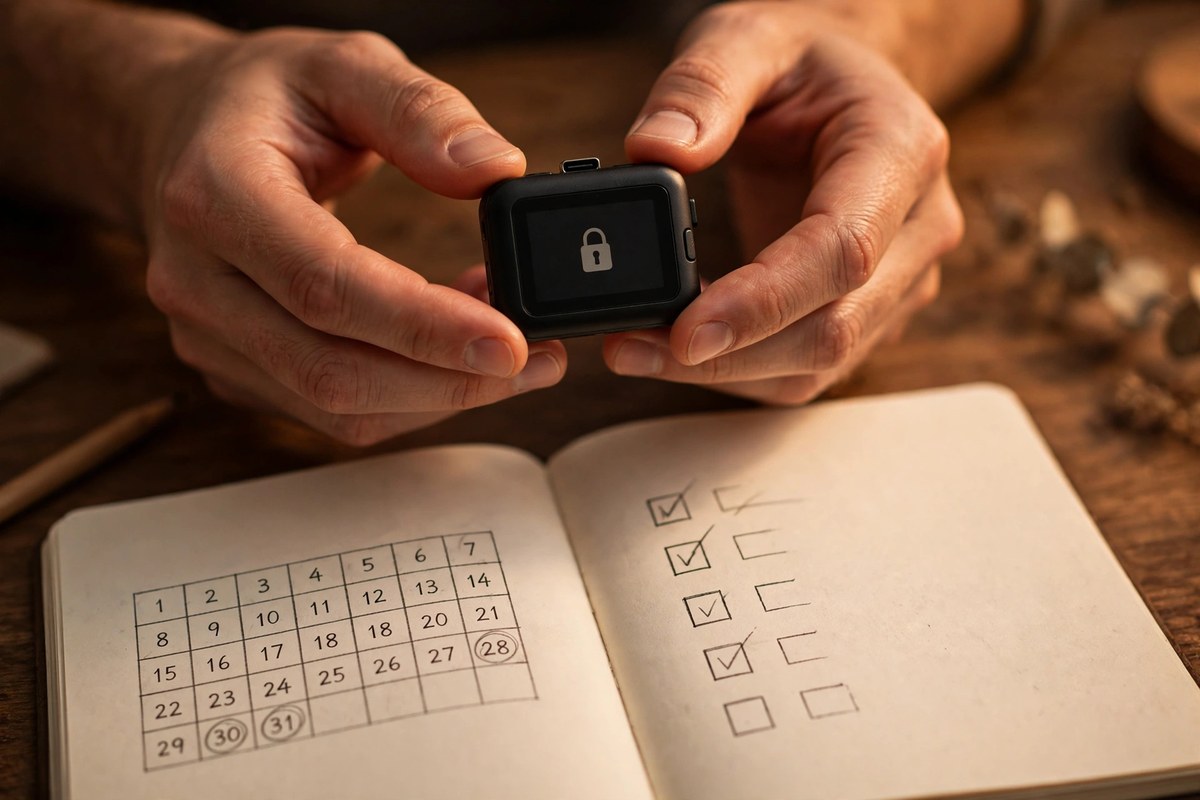
One more practical point: if you are rethinking where to hold your coins in light of this vote, our comparison of the best crypto wallets in 2026 covers the security trade-offs between hardware and software wallets — and our guide to buying Bitcoin in Europe explains which exchanges operate under MiCA licensing. Custody decisions should be driven by security first and reporting second, not the other way around.
How France Fits the Global Reporting Wave
France is not acting in isolation. The amendment lands in a year when crypto reporting has tightened on every continent. Hong Kong's new tax reporting law requires exchanges to report trades abroad, with data collection starting in 2027 and six-year record retention. The United States has spent 2026 arguing over the CLARITY Act and the division of crypto oversight between the SEC and CFTC. And the OECD's Crypto-Asset Reporting Framework is steadily pulling more jurisdictions into automatic exchange of crypto tax information.
What makes the French move distinctive is its target. Most reporting regimes so far have leaned on intermediaries — exchanges and custodians file the reports, and holders are passive. France's amendment flips that logic for self-custody: when there is no intermediary, the holder files. That is a philosophical shift as much as a bureaucratic one, because it treats direct ownership as a reporting category of its own rather than a gap in the system.
For holders, the practical consequence is convergence. The era when moving coins off an exchange also moved them off the reporting radar is ending. Exchange balances are reported by the exchange. Self-custodied balances, under rules like France's, are reported by the holder. The choice between custody options is increasingly a choice about who files the paperwork, not whether paperwork exists. That is also why year-end planning matters beyond France: our crypto tax-loss harvesting guide for 2026 explains how the same December 31 date can work in your favor if you plan before it arrives.
What Happens Next
Three scenarios are now open. In the first, the 2027 Finance Bill passes with Amendment I-2701 intact, the Senate keeps the provision, and the first December 31 snapshot lands at the end of 2026 — meaning French holders above €100,000 in self-custody would face their first declaration in early 2027. In the second, the Senate amends or drops the provision, and self-custody reporting returns as a future proposal rather than a 2027 obligation. In the third, the budget's revenue provisions are rejected outright, the whole bill falls, and the amendment dies with it — exactly as its October committee version did.
The base case, given the 150–44 margin and the political appetite for closing reporting gaps, is that some version of self-custody disclosure survives — but the form it takes, and what exactly must be declared, is genuinely uncertain. The Institut National de Bitcoin's criticism that the amendment does not specify the declaration's contents is not a footnote; it is the main open question. A rule that requires declaring "holdings" without defining whether that means addresses, values, or both will need implementing guidance before anyone can comply with confidence.
For now, the smart position is preparation without panic: inventory your wallets, record your year-end values, watch November 17 and November 20, and do not let anyone — exchange, adviser, or stranger online — talk you into sharing keys or paying a "declaration fee." The French state does not charge a fee to declare, and it never asks for your seed phrase.
FAQs
Is France's €100,000 self-custody crypto reporting rule already law?
No. Amendment I-2701 was adopted by the National Assembly on November 3, 2026, but it is part of the 2027 Finance Bill, which still needs full Assembly passage and Senate approval. The Assembly faces a November 17 deadline to complete its first reading, and Senate debate begins November 20. Until the final law is published, there is no filing obligation.
Does the €100,000 threshold apply per wallet or in total?
In total. The amendment targets directly held crypto portfolios worth at least €100,000, assessed on December 31 of the tax year. Splitting coins across multiple self-custodied wallets does not keep you below the threshold if the combined value crosses it.
What happens if I do not declare?
The amendment's explanatory statement describes a sanction mechanism reaching €10,000 for failure to declare. That is a proposed maximum penalty for non-declaration, not an automatic charge on holders above the threshold. Declaring correctly avoids the fine entirely.
Does the rule cover crypto held on exchanges?
No. It covers wallets "not held with a crypto-asset service provider" — hardware wallets and self-custody software wallets where you control the keys. Exchange-held crypto is already covered by existing reporting channels, including France's form 3916-bis for foreign-held accounts.
What counts as self-custodied crypto?
Any crypto you hold directly without a regulated intermediary: hardware wallets, non-custodial software wallets, and any wallet where you alone hold the private keys or seed phrase. If a company holds the keys on your behalf, the wallet is generally not self-custodied for this purpose.
Should non-French holders care about this vote?
Yes, as a signal. Hong Kong has already passed its own crypto tax reporting law, global CARF reporting is expanding, and France's move shows regulators are now targeting self-custody directly rather than only exchanges. Even if the amendment never touches you, it previews the reporting regime other countries are likely to copy.
Conclusion
France's 150–44 vote is the clearest signal yet that self-custody is entering the tax-reporting era. A €100,000 threshold, a December 31 snapshot, and a fine of up to €10,000 for silence add up to a simple message: holding your own keys no longer means holding them invisibly. But the vote is not the law, and the next two dates — November 17 in the Assembly and November 20 in the Senate — will decide whether this becomes a 2027 obligation or another amendment that dies with its budget.
The holders who come out best are the ones who prepare now: inventory every wallet you control, record your year-end values, and keep your keys private while you do it. Self-custody was always about control, not concealment — and France just made that distinction official. Sources for this article include Cointelegraph's report on the vote, CoinMarketCap Academy's analysis of the threshold, and KuCoin's coverage of the amendment.