14 Companies Sold $8.08 Billion of Bitcoin in 2026: MARA and Riot Lead — What Happens Next Before the Fed's December 9 Decision
Fourteen public companies sold 108,247 BTC worth $8.08 billion in 2026 — MARA alone sold 40,581 coins at $74,446 each. Here is who sold, why miners are pivoting to AI data centers, and the 5 signals that decide whether Bitcoin holds $72,700 or falls to $70,000 before the Fed's December 9 decision.

Fourteen public companies sold 108,247 Bitcoin worth $8.08 billion in 2026 — and two miners, MARA and Riot, were responsible for 56% of it. MARA alone sold 40,581 BTC at an average price of $74,446, almost exactly where Bitcoin trades today. The selling has not stopped: Bitcoin sits at $73,700, down 41% from its peak, with the Federal Reserve's December 9 decision now priced as an 86.3% chance of a rate hike. This is not a story about companies losing faith in Bitcoin. It is a story about miners quietly becoming AI companies — and what that means for Bitcoin's supply, and your portfolio, before December 9.
Lookonchain's tally, published on November 10, 2026, is the clearest picture yet of how the corporate Bitcoin trade has flipped. In 2025, public companies were net buyers, racing to build treasuries. In 2026, the miners — the companies that actually produce Bitcoin — became its biggest sellers. The question for every holder now is simple: is the selling done, or is the worst still ahead? The answer lies in who sold, why they sold, and the five signals that decide whether Bitcoin holds $72,700 or breaks toward $70,000.
The $8.08 Billion Sell-Off, Ranked
The headline numbers come from on-chain analytics firm Lookonchain, which tracked wallet movements and corporate disclosures through November 10, 2026. Fourteen listed companies sold a combined 108,247 BTC. Here is the ranking that matters:
| Rank | Company | BTC sold | Value | Average price | Stated reason |
|---|---|---|---|---|---|
| 1 | MARA Holdings | 40,581 | $3.03 billion | $74,446 | Debt repayment, AI data centers |
| 2 | Riot Platforms | 20,264 | $1.51 billion | $73,231 | Data center expansion |
| 3 | Bitdeer Technologies | 10,553 | $787 million | — | Estimated outflows |
| 4 | Cango | 7,001 | $522 million | — | Operations funding |
| 5 | CleanSpark | 5,715 | $426 million | — | Operations funding |
| 6 | Core Scientific | 3,374 | $252 million | — | Restructuring, AI pivot |
| — | 8 other companies | 24,133 | ~$1.55 billion | — | Mixed |
The concentration is the story. The top five sellers account for 84,114 BTC — nearly 78% of the total. MARA and Riot alone sold 60,845 coins. And the timing is not random: MARA's third-quarter shareholder letter, published November 9, disclosed that the company sold about 26,984 BTC for $1.9 billion in the first nine months of 2026, then sold more in October to reach the 40,581 total. Riot's quarterly filing confirms 20,264 BTC sold in the nine months ended September 30, mainly to finance data center development.
For context on scale: 108,247 BTC is roughly 0.5% of all Bitcoin that will ever exist, sold by just fourteen companies in less than eleven months. It is also more than the entire annual issuance of new Bitcoin. When sellers of that size move, price feels it — Bitcoin has fallen from around $79,000 to below $73,000 in the past week alone, with $723 million in leveraged positions liquidated in 24 hours after the hot October inflation report.
Why the Miners Are Selling Now
The miners are not selling because they think Bitcoin is going to zero. They are selling because their business model is changing underneath them — and Bitcoin is the funding source for the pivot.
Debt comes first. MARA used $750 million of its sale proceeds to repay loans that were backed by its Bitcoin holdings, releasing 17,477 BTC previously pledged as collateral. That is a company choosing balance-sheet safety over holding coins through a downturn. With Bitcoin down 41% from its peak and borrowing costs rising, debt secured against a falling asset is a risk no CFO wants to carry into 2027.
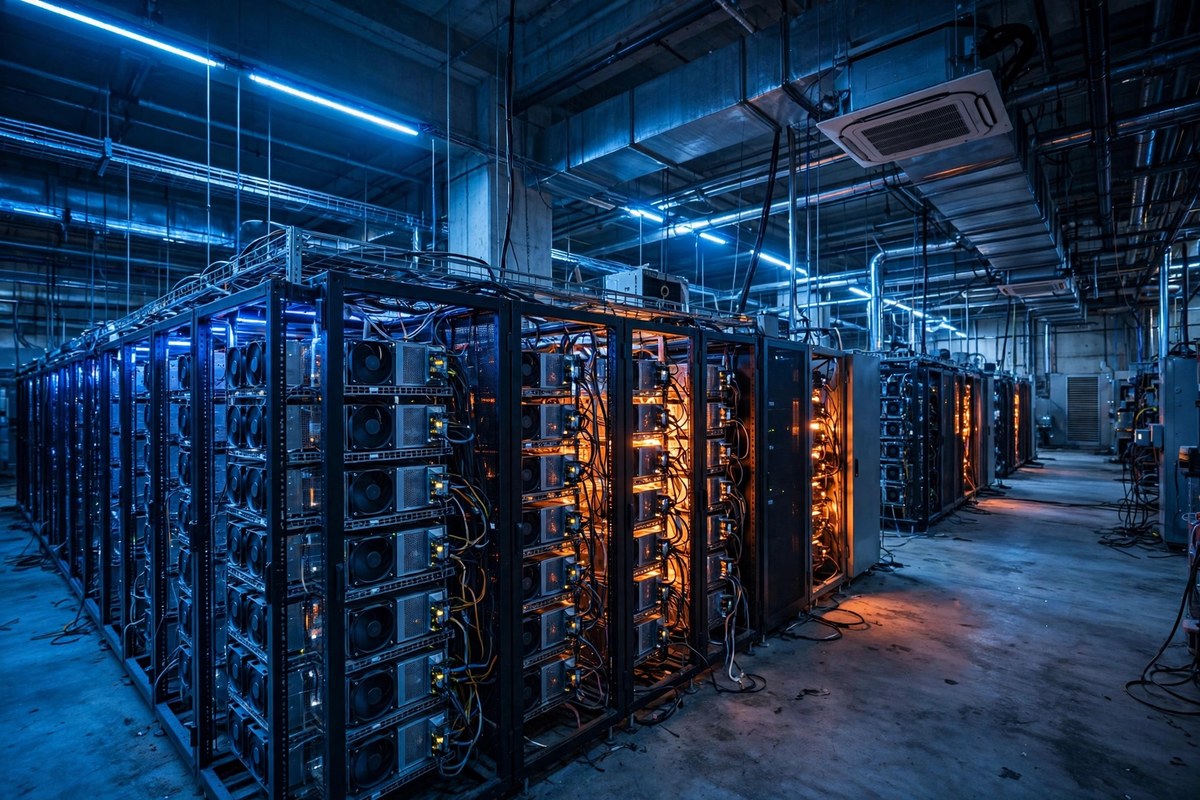
The AI pivot is the bigger driver. The same companies that spent years building power-hungry mining operations now sit on exactly what the AI boom needs: cheap power, industrial-scale facilities, and grid connections. Riot is selling Bitcoin to finance data center development. Core Scientific has been restructuring around AI hosting. The miners are not abandoning crypto — they are converting Bitcoin into the infrastructure of a different boom. As our Future of Bitcoin Mining in 2027 analysis showed, hashprice has fallen to $32.86 and the hashrate is in its longest slump ever, which squeezes mining margins and makes selling coins the rational move.
Falling prices force the hand. A miner that mines a coin at $73,700 and watches it slide toward $70,000 faces a simple choice: sell now and fund operations, or hold and risk selling lower later. When the short-term holder cost basis sits at $75,877 — above the current price — every coin sold below that level locks in a loss for recent buyers. The miners, with coins mined at far lower costs, can sell profitably at prices that hurt everyone else.
The Caveat: Not Every "Sale" Was a Sale
Before concluding that $8.08 billion of Bitcoin was dumped on the open market, read the fine print. Lookonchain's methodology combines on-chain wallet movements with corporate disclosures — and some of the counted outflows are estimated, not confirmed sales. Bitdeer's 10,553 BTC, for example, is identified as estimated January-to-September outflows. An outflow from a company wallet can be a sale, but it can equally be coins moved to a custodian, collateral posted for a loan, or a hedge being set up through options and basis trades.
The distinction matters for price. A coin moved to a custodian does not hit the order book. A coin sold to repay a loan does. The honest reading of the $8.08 billion figure is that it measures the scale of corporate Bitcoin leaving company wallets in 2026 — the upper bound of selling pressure, not a precise count of coins sold on exchanges. That does not make the number meaningless. It makes it a warning: even at the lower bound, confirmed disclosures alone show MARA and Riot selling more than $4.5 billion of Bitcoin between them.
There is a second caveat. The tally leaves out the largest corporate holder entirely. Strategy — the biggest public Bitcoin holder — is not in Lookonchain's list, even though its own SEC filings show it sold small amounts in 2026: 32 BTC between May 26 and 31, 3,588 BTC between June 29 and July 5, and 1,638 BTC between July 27 and August 2. Strategy's selling was tiny relative to its holdings, but its exclusion means the true corporate total is higher than $8.08 billion.
The Other Side of the Trade: Somebody Is Still Buying
Every seller needs a buyer, and the buyers have not disappeared. Strategy added 1,036 BTC during November 2–8, the same week the selling tally was compiled. Sovereign wealth funds have put $2.3 billion into Bitcoin, with $13 trillion in funds watching the asset. The demand side of the corporate trade is splitting in two: miners selling to fund AI, and long-horizon allocators buying the dip they created.
The ETF picture is more complicated. U.S. spot Bitcoin ETFs recorded net outflows of $201 million on November 9 alone, marking a third consecutive session of outflows for both Bitcoin and Ethereum funds, and the bleeding continued into a fourth day. That is the near-term headwind: institutional flows have turned negative at exactly the moment miners are selling and the Fed is about to hike. But ETF outflows of a few hundred million dollars a day are small next to the $8.08 billion corporate total — and small next to the $94 billion still sitting in Bitcoin funds. The question is not whether ETFs are selling today. It is whether they start buying again once the December 9 decision is behind us.
Whales are sending the same mixed signal. Analyst Ali Martinez reported that large Bitcoin holders reduced their balances by more than 34,000 BTC over the preceding week, worth almost $2.6 billion, as Bitcoin fell from $79,000 to below $73,000. Yet the Crypto Fear and Greed Index sits at 29 — Fear — a level that has historically marked moments when patient buyers, not sellers, were rewarded. If you are wondering whether Bitcoin is still a sensible long-term holding through this, our guide Is Bitcoin a Good Investment in 2026? walks through the risks and the case honestly.
What Happens Next: 3 Scenarios for Bitcoin Before December 9
The next four weeks are dominated by one date: December 9, when the Federal Reserve meets with markets pricing an 86.3% probability of a 25-basis-point rate hike, taking the target range to 4%–4.25%. October CPI came in hot at 0.4% month over month against a 0.3% forecast, core CPI rose 0.3% for a third straight month, and Governor Christopher Waller has already said he supports a December increase. Bitcoin has lost its 50-week moving average near $76,100 after seven weeks above it. Here are the three scenarios, labelled as predictions, not certainties:
| Scenario | Trigger | Price path | Probability |
|---|---|---|---|
| Bull case | Fed signals a pause after December; miner selling slows; ETF flows turn positive | Reclaims $75,000, then $79,500 resistance | 25% |
| Base case | Fed hikes 25bp as expected; selling continues at a slower pace; support holds | Range-bound $72,700–$75,200 into year-end | 45% |
| Bear case | Fed sounds hawkish for 2027; miners accelerate sales; $72,700 breaks | Slides toward $70,000, then $68,000 | 30% |
The base case is the most likely because the market has already priced the hike. A 25-basis-point increase that everyone expects rarely crashes a market by itself — the damage comes from what the Fed says about 2027. If the statement hints at more hikes, the bear case takes over quickly, because leveraged longs are already fragile: retail accounts are 74.7% long, and $723 million in liquidations showed how fast a hot data print cascades. If the Fed hints the December hike is the last one, the bull case opens, because the miner-selling story is finite — MARA and Riot cannot sell the same coins twice, and their AI data centers will eventually be funded.
Our full outlook, Bitcoin Price Prediction 2027 After the Fed's December Rate Hike, puts the same levels in a longer frame, and Will Crypto Recover in 2027? maps the three recovery paths from $73,700. The short version: the selling is real, the buyers are real, and December 9 decides which side sets the price into 2027.

5 Signals That Decide $70,000 or $75,000
Watch these five signals, in order, before December 9. They will tell you whether the corporate sell-off is ending or accelerating.
Signal 1: the $72,700 support level. Bitcoin's immediate support sits at $72,700–$73,000, with a recent hourly swing low at $72,689. A daily close below $72,700 opens the door to $70,000. Holding it keeps the base case alive.
Signal 2: ETF flows. Four straight days of outflows is a trend, not noise. A single day of strong inflows — especially above $200 million — would signal that institutions see $73,000 as a buying level, not an exit.
Signal 3: Fed speakers before December 9. Every Waller-style comment moves the hike odds. If more governors join the hawkish camp, the 86.3% probability climbs toward certainty and the bear case gains weight.
Signal 4: the miner selling pace. MARA's Q3 letter showed selling accelerating after September. If November disclosures show miners slowing sales — because data centers are funded or debt is repaid — the largest source of supply pressure fades.
Signal 5: whale wallets. The 34,000 BTC sold by whales last week is the fastest whale distribution in months. If whale balances stabilize, the bottom is forming. If they keep falling, the market has further to go.
What Most People Get Wrong About the Corporate Sell-Off
Wrong idea 1: "Companies are dumping because Bitcoin is dead." The sellers are miners funding AI data centers and repaying debt — business decisions, not verdicts on Bitcoin. Strategy and sovereign funds are buying the same coins.
Wrong idea 2: "$8.08 billion was all dumped on exchanges." Lookonchain's tally includes estimated outflows, collateral moves, and options deliveries. Confirmed spot sales are a large share of it, but not all of it.
Wrong idea 3: "The selling means the top is in." Corporate selling peaked in previous cycles before rallies, not only before crashes. Miners sell when they need cash — and they need cash most when prices are high enough to make selling attractive, and when they are building something else.
Wrong idea 4: "Retail should copy the miners." Miners sell coins they produced at a fraction of the current price. A retail holder who bought at $90,000 is in a completely different position. Copying a miner's trade without a miner's cost basis is how portfolios get destroyed.
Investor Checklist: 5 Moves Before December 9
- Check your cost basis against $75,877. That is the short-term holder cost basis. If you bought above it, you are underwater with the crowd — and crowd capitulation is what creates bottoms, not what you should join.
- Decide your $72,700 line in advance. Write down what you will do if Bitcoin closes below $72,700, and what you will do if it reclaims $75,000. Decisions made in advance beat decisions made in panic.
- Move coins you will not sell off exchanges. If you are holding through December 9, self-custody removes the temptation to panic-sell and the risk of an exchange issue. Our ranking of the best crypto wallets in 2027 covers the options after the $116 million Coldcard hack.
- Do not use leverage into the Fed meeting. With $723 million liquidated in a single day and retail 74.7% long, leverage is the fastest way to turn a dip into a total loss.
- Plan your 2027 allocation now, not in January. If you are new to crypto, start with How to Invest in Crypto: A Beginner's Guide — buying, storing, and growing a position without the mistakes that cost beginners the most.
Frequently Asked Questions
How much Bitcoin did public companies sell in 2026?
Fourteen publicly traded companies sold a combined 108,247 BTC worth approximately $8.08 billion in 2026 through November 10, according to on-chain analytics firm Lookonchain. MARA Holdings led with 40,581 BTC ($3.03 billion), followed by Riot Platforms with 20,264 BTC ($1.51 billion) and Bitdeer with 10,553 BTC ($787 million).
Why are Bitcoin miners selling their Bitcoin?
Mainly to repay debt and fund AI data center expansion. MARA used $750 million of proceeds to repay loans backed by its Bitcoin, releasing 17,477 BTC from collateral. Riot sold Bitcoin to finance data center development. Falling hashprice and mining margins make selling coins the rational way to fund operations.
Is the $8.08 billion figure all confirmed spot sales?
No. Lookonchain's tally combines confirmed disclosures with estimated on-chain outflows, and some outflows may be collateral moves, custodian transfers, or options-related deliveries rather than spot sales. The confirmed disclosures from MARA and Riot alone still total more than $4.5 billion of selling.
Will the Fed raise rates on December 9, 2026?
Markets price an 86.3% probability of a 25-basis-point hike on December 9, taking the target range to 4%–4.25%, after hot October CPI data (0.4% vs 0.3% expected) and hawkish comments from Fed Governor Christopher Waller. This is a market-implied probability, not a guarantee.
What price levels matter for Bitcoin now?
Support sits at $72,700–$73,000, with a recent swing low at $72,689. Resistance is $75,000, then $79,500. A daily close below $72,700 opens a move toward $70,000; reclaiming $75,000 would signal the start of a recovery.
Should I buy Bitcoin while companies are selling?
That depends on your time horizon and risk tolerance, not on the miners' trades. Miners sell coins produced at low cost to fund businesses; long-horizon buyers like Strategy and sovereign wealth funds are buying the same dip. Never invest money you cannot afford to lose, and never use leverage into a Fed decision. This article is not financial advice.
Conclusion
The $8.08 billion corporate sell-off is the most important Bitcoin supply story of 2026 — and the most misunderstood. It is not a vote of no confidence in Bitcoin. It is miners converting coins into debt repayment and AI data centers, at prices near $74,000, while Strategy and sovereign wealth funds buy the other side of the trade. The selling is finite: MARA and Riot cannot sell the same coins twice, and every coin they sell is one less coin they can sell tomorrow.
What happens next is decided by December 9. If the Fed hikes and hints at a pause, the base case holds — a $72,700–$75,200 range into year-end, then a cleaner setup for 2027. If the Fed sounds hawkish about 2027, $70,000 comes into view fast. Either way, the five signals above will tell you which way the market is leaning before the price does. Watch $72,700, watch the ETF flows, and do not let a miner's business decision become your panic decision.