Bitcoin eCash Fork: Every BTC Holder Just Got Free ECX Tokens Worth $29 — How to Claim Them Without Losing Your Bitcoin
If you held Bitcoin on October 29, you now own the same amount of ECX — worth about $29 a coin. But moving your BTC first can hand your free tokens to someone else. Here's the safe way to claim them.
If you controlled your own Bitcoin private keys on October 29, 2026, you just received free money — the same amount of a brand-new token called ECX, worth about $29 per coin. But here is the catch most holders will miss: move your Bitcoin first, and you could hand those free tokens to someone else forever. This guide shows you exactly what happened, what your ECX is worth, and the safe order for claiming it.
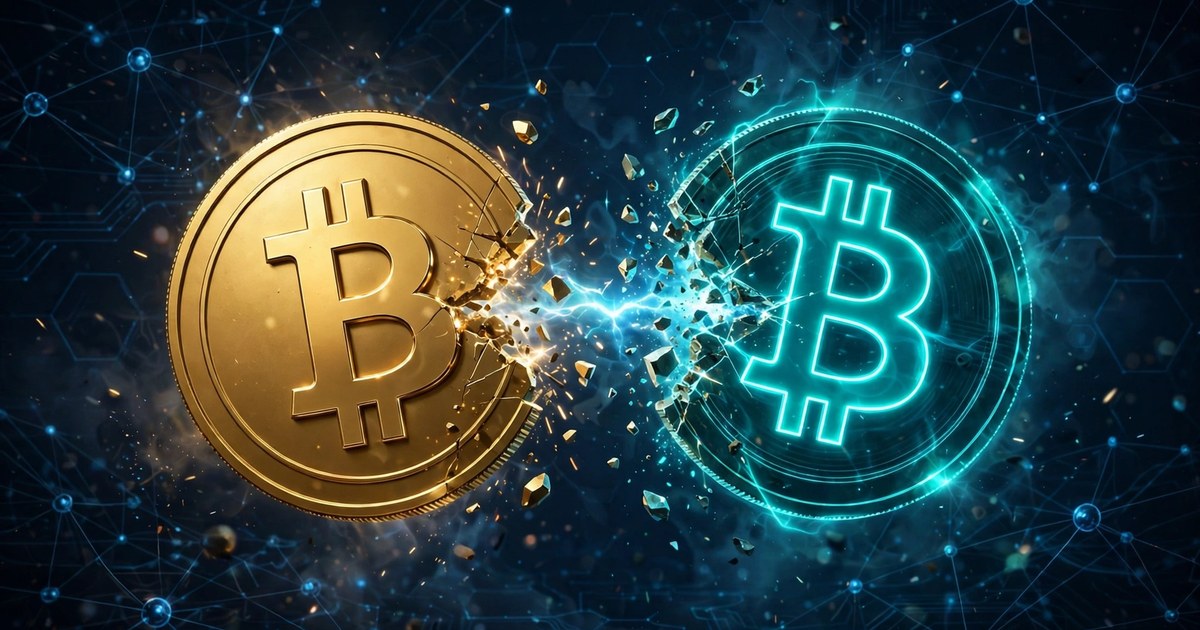
On October 29, at Bitcoin block 973,728, developer Paul Sztorc and his company LayerTwo Labs launched eCash — a hard fork of Bitcoin built to add payments, privacy features and sidechains through a technology called drivechains. The fork copied Bitcoin's entire transaction history at that block. That means every address that held Bitcoin at the snapshot now holds the identical balance in ECX on the new chain. Held 0.5 BTC in your own wallet? You now own 0.5 ECX as well — and your Bitcoin never moved, was never locked, and was never converted.
Your Bitcoin is completely unaffected. It still trades near $75,000, and the fork changes nothing about the Bitcoin network itself. The new asset is the thing to understand — because it is free, it is thinly traded, and claiming it wrong carries a real risk to the Bitcoin you already own.
What Is the eCash Fork, and Who Is Behind It?
eCash is the work of Paul Sztorc, the developer behind the Bitcoin drivechain proposals known as BIP300 and BIP301. Sztorc announced the project on April 24, 2026, at the Bitcoin 2026 conference in Las Vegas. The first launch target was August 21, near block 964,000, but the fork ultimately went live on October 29 at block 973,728. Cointelegraph's full report on the launch covers how the snapshot worked and what holders received.
The idea behind eCash is frustration. Sztorc has argued publicly that Bitcoin's development has grown cautious and that promising ideas — private payments, new applications, experimental sidechains — have nowhere to live on Bitcoin itself. Drivechains are his answer: sidechains that plug into a parent chain and let developers build new features without changing Bitcoin's core rules. eCash is the first live network built on that model, a separate blockchain forked from Bitcoin's code and history.
That framing matters, because it tells you what ECX is and is not. It is not an airdrop from a marketing team, and it is not a token you had to sign up for. There is no registration, no form, and no claim website. The coins already exist at your old addresses. The only question is whether you can reach them — and whether reaching them is worth the risk.
How Much Is Your ECX Actually Worth?
Here is where the excitement meets reality. ECX trades, but barely. Data providers disagree on the exact numbers, which itself tells you how thin this market is:
- Price: CoinMarketCap listed ECX at $32.63 on November 5, and around $29 on November 7. CryptoRank recorded a peak of $45.21 on November 4.
- Volume: daily trading volume was about $355,000 on November 5, but fell to roughly $35,000–$38,000 by November 7 — almost all of it on one decentralized exchange.
- Coverage: CoinGecko lists ECX only as a preview listing with no tracked price, and data provider Kaiko does not track the token at all.
Do the math on your own holding. One whole Bitcoin at the snapshot means one ECX, worth roughly $29 at current prices. A holder with 0.1 BTC has about $2.90 of ECX. A holder with 10 BTC has about $290. The token is real money, but for most holders it is small money — and the market is so shallow that a sale of any size could move the price against you. Early trading saw ECX swing between $40 and $50 before settling lower, and with daily volume in the tens of thousands of dollars, there is no guarantee you can sell at the quoted price. BTC Peers' breakdown of the fork tracks the same thin-volume picture.
There is also a supply quirk worth knowing. About 1.1 million BTC are linked to Bitcoin's creator Satoshi Nakamoto through the so-called Patoshi pattern. On the eCash chain, roughly 600,000 ECX sit at those same addresses — coins that will almost certainly never move. Another roughly 500,000 ECX went to early investors and development funding. That leaves the freely circulating supply far smaller than the headline numbers suggest.
ECX vs XEC vs Bitcoin Cash: Do Not Confuse the Three
The single most common mistake holders are already making is confusing the new ECX with an older coin that shares the eCash name. They have nothing to do with each other. Here is the difference in one table:
| Token | What it is | Origin | Relationship to your BTC |
|---|---|---|---|
| ECX (new) | Native token of Paul Sztorc's eCash fork | Bitcoin hard fork, block 973,728, Oct 29, 2026 | 1:1 with BTC you held at the snapshot |
| XEC (old) | The older "eCash" coin | Forked from the Bitcoin Cash family years ago | None — you received nothing |
| BCH | Bitcoin Cash | Bitcoin fork from 2017 | None from this event |
If a wallet, exchange or website offers you "eCash" and shows the ticker XEC, that is the old coin, not your fork tokens. If someone tells you to send Bitcoin to "activate" your ECX, that is a scam — the real ECX already sits at your addresses and no payment unlocks it. If you want background on how an earlier Bitcoin fork works, read our guide on What Is Bitcoin Cash (BCH)? — the mechanics of a snapshot fork are the same, even though this fork is a different network.
Did You Actually Get ECX? It Depends Where Your Bitcoin Was
Eligibility is simple, but access is not. The rule is: whoever controlled the private keys at block 973,728 controls the ECX.
If you held Bitcoin in your own wallet — a hardware wallet, or a software wallet where you hold the seed phrase — you control the ECX. The same keys that secure your Bitcoin secure the same addresses on the eCash chain. Nothing to register, nothing to apply for.
If you held Bitcoin on a centralized exchange — Binance, Coinbase, Kraken or any other platform — the exchange holds the keys, so the exchange holds your ECX. You are, in the words of the reporting on this fork, "at their mercy" over distribution. Some platforms have moved: NeoxEX opened native ECX deposits, withdrawals and trading on October 29, and CoinW has announced plans to distribute ECX to eligible holders, with deposits and trading to follow. If your exchange has said nothing, check its announcements before assuming anything — and do not move coins around hoping to trigger a distribution that may never come.
That distinction is also a reminder of why self-custody matters. Our guide How to Store Bitcoin Safely in 2026 walks through the setup that would have put you on the right side of this snapshot automatically — and the same setup protects you in the next one.
How to Claim ECX Without Risking Your Bitcoin: The 7-Step Checklist
This is the part that matters most, because the fork carries a genuine technical trap. Bitcoin and eCash share transaction history and address formats. That means a transaction broadcast on one chain can, in some circumstances, be replayed on the other — copied across and executed there too. LayerTwo Labs warns explicitly: never move your BTC first. An ordinary, unprotected Bitcoin spend can be replayed on the eCash network, and if you send Bitcoin to an exchange, the exchange may receive your ECX for free as well. If you send it to a merchant or to a new address of your own, the ECX can end up somewhere you may never reach.
Follow this checklist in order, and do not skip steps:
- Do nothing in a hurry. Your ECX is not going anywhere. There is no deadline, and the token's thin market means rushing to sell gains you almost nothing.
- Move ECX first, Bitcoin second. This is the golden rule from LayerTwo Labs. Separate the two holdings by spending the ECX before you ever move the BTC again.
- Use a wallet that supports eCash. Claiming means signing with the same keys that secure your Bitcoin, using a wallet that can handle the eCash chain and set the nLockTime field freely. Do not improvise with a wallet you have not verified.
- Use replay protection. The project's documentation describes a marker in a transaction's nLockTime field: a value of 499999998 with at least one non-final input. eCash nodes accept such a transaction; Bitcoin nodes reject it. That is what makes a transaction valid on one chain only.
- Test with a tiny amount first. Move a small fraction of ECX, confirm it arrived where you expected, and only then handle the rest.
- Never enter your seed phrase or private key on a website. The project itself is explicit about this. Any site, tool or "claim portal" asking for your recovery phrase is stealing your Bitcoin. Real claiming happens in a wallet you control, never in a browser form.
- Check your exchange before moving anything. If your coins were on an exchange at the snapshot, confirm whether it supports ECX distribution before you move Bitcoin off the platform — moving first can forfeit the distribution.
The process is called coin splitting, and it is deliberately slow and careful. If any step feels unclear, the safe choice is to wait. Your Bitcoin is worth far more than the ECX attached to it, and no amount of free tokens justifies risking the principal. CoinStats' step-by-step claiming guide walks through the same split process with the same warning: move ECX first, and never share your recovery phrase.
Where Can You Actually Sell ECX?
Access is not the same as liquidity. Even if you successfully split your coins, selling them means finding a buyer — and right now there are very few venues:
- NeoxEX opened native ECX trading on October 29, with ECX/USDT, ECX/USDC and ECX/BTC pairs.
- Orca, a decentralized exchange on Solana, lets users swap USDC for wrapped ECX (wECX) through a liquidity pool — but wrapped tokens add a second layer of trust and complexity.
- CoinW has announced plans to distribute ECX to eligible holders, with deposits, withdrawals and trading still to be announced.
No major exchange has listed ECX, and CoinGecko does not yet track a price. That means no deep order book, no reliable price discovery, and no guarantee your sell order fills anywhere near the quoted price. For most holders, the honest answer is that the ECX is a small, illiquid bonus — interesting, but not life-changing, and not worth paying high fees or taking risks to realize immediately.
3 Scenarios: What Happens to ECX Next
| Scenario | What would have to happen | What ECX does |
|---|---|---|
| Breakout | A major exchange lists ECX and drivechain apps attract real users | Price climbs back toward the $45 peak and beyond; volume grows from thousands to millions daily |
| Slow fade (base case) | No major listing; a niche community keeps building while most holders ignore it | ECX drifts between $15 and $35 on thin volume, mostly a curiosity for Bitcoin historians |
| Collapse | Replay incidents, scams or a critical bug erode trust; exchanges delist | Price falls toward single digits and liquidity dries up; ECX becomes untradeable for practical purposes |
The base case is the most likely. Fork coins have a long history of fading: they launch with excitement, trade thinly, and only survive if developers build something people actually use. eCash's pitch — drivechains that bring payments, privacy and new applications to a Bitcoin-derived network — is genuinely ambitious. But ambition is not adoption, and as of today there is no proven demand for ECX beyond speculation. Bitcoin itself, meanwhile, is dealing with its own pressures: U.S. spot Bitcoin ETFs have just recorded $1.28 billion of outflows in a week, and the price sits near $75,000. If you want to understand those flows before deciding anything about your holdings, read How to Read Bitcoin ETF Flows and our beginner's guide What Is a Bitcoin ETF?

5 Things Most People Get Wrong About the eCash Fork
1. "I need to claim ECX before a deadline." There is no deadline. The coins exist at your addresses and will still be there next month. Scammers invent deadlines; the protocol does not.
2. "My Bitcoin doubled." No. You received a new, separate token worth about $29 per coin — roughly 0.04% of a Bitcoin's value. Your Bitcoin is unchanged.
3. "ECX is the same as eCash (XEC)." No. XEC is an older coin from the Bitcoin Cash family. ECX is the new fork token. Different networks, different prices, different wallets.
4. "I can claim ECX on any website that asks for my wallet." No. Any site asking for your seed phrase or private key is a theft attempt. Claiming happens only in a wallet you control.
5. "Satoshi just got rich again." About 600,000 ECX sit at addresses linked to Bitcoin's creator through the Patoshi pattern — but those coins have never moved on Bitcoin, and there is no reason to expect them to move on eCash. If you want the full story of the mystery holder, read Who Is Satoshi Nakamoto?
Is eCash a Scam? The Honest Verdict
eCash is not a scam in the way most crypto scams work. It is a real network, launched by a known developer with a decade-long public record, built on published proposals, with no token sale and no one asking you to send money. The fork is technically genuine: the chain exists, the snapshot happened, and the coins are where the project says they are.
But "not a scam" is not the same as "a good investment." ECX has no proven demand, trades on a handful of small venues, has a market so thin that a single sale can move the price, and depends entirely on whether drivechains attract builders and users over the next year. The honest verdict: treat ECX as a small free bonus, not as a position to chase. Claim it carefully if you self-custody, sell it if you can do so cheaply and safely, and never risk your Bitcoin — or your seed phrase — to get it. The scams around this fork are real even though the fork itself is not one: fake claim sites are already circulating, and they are the actual threat.
What About Tax?
Fork tokens can have tax consequences that differ by jurisdiction, and the rules are genuinely unsettled in many countries. Some tax authorities treat forked coins as income at the time you gain control of them; others only tax you when you sell. The reporting on this fork notes that readers should check local rules before filing. If your ECX is worth only a few dollars, the practical impact is small — but if you held a large Bitcoin balance at the snapshot, talk to a tax professional before you sell, and keep records of the price on the day you claim or sell. For U.S. holders, our guide How to Invest in Bitcoin in 2026 includes the basics of tracking cost basis for new holdings.
Frequently Asked Questions
What is the Bitcoin eCash fork?
eCash is a hard fork of Bitcoin launched on October 29, 2026, at block 973,728 by developer Paul Sztorc's LayerTwo Labs. It copies Bitcoin's transaction history and gives every holder at the snapshot an equal balance of a new token, ECX. Its goal is to add payments, privacy and sidechain applications through drivechain technology.
How do I know if I received ECX?
If you controlled your own Bitcoin private keys — a hardware wallet or a self-custody software wallet — at block 973,728 on October 29, you hold the same amount of ECX. If your Bitcoin was on a centralized exchange, the exchange controls your ECX and decides whether to distribute it.
How much is ECX worth?
CoinMarketCap listed ECX at about $32.63 on November 5 and around $29 on November 7, with a peak of $45.21 on November 4. Daily volume is very thin — roughly $35,000 to $355,000 — so the quoted price may not reflect what you can actually sell for.
Can claiming ECX put my Bitcoin at risk?
Yes, if done wrong. Because Bitcoin and eCash share history and address formats, an unprotected Bitcoin transaction can be replayed on the eCash chain. Always move your ECX first, use replay protection, and never enter your seed phrase on any website.
Is ECX the same as eCash (XEC)?
No. XEC is an older coin from the Bitcoin Cash family and has nothing to do with this fork. The new token is ECX, from Paul Sztorc's eCash network. Confusing the two is the most common mistake holders are making right now.
Where can I sell ECX?
NeoxEX offers native ECX trading pairs, Orca on Solana offers wrapped ECX, and CoinW has announced distribution plans. No major exchange has listed ECX yet, and CoinGecko does not track a price, so liquidity is very limited.
Conclusion
The eCash fork is one of those rare crypto events that is genuinely free money with a genuine catch. If you held your own keys on October 29, you own ECX worth about $29 per Bitcoin — a small windfall that cost you nothing. But the same fork that created that windfall also created a replay risk that can cost you your Bitcoin if you move coins in the wrong order, and a wave of fake claim sites designed to steal seed phrases from holders who rush.
The right move is boring, and that is the point: do nothing in a hurry, move ECX before BTC, use replay protection, never type your seed phrase anywhere, and treat the tokens as a small bonus rather than a reason to trade. The fork will still be there tomorrow. Your Bitcoin should be too.