What Is Tokenomics? Supply, Unlocks and Burns Explained — 5 Checks Before You Buy Any Altcoin in November 2026
Cronos burned $92,000 of CRO on October 30 — then scheduled a $58 million release for November 16, about 670 times bigger. Tokenomics is the supply math behind moves like that, and these 5 checks show how to read it before you buy.

Cronos burned 1.79 million CRO on October 30, worth about $92,000 — and then scheduled a reserve release of roughly 1.17 billion CRO for November 16, worth around $58 million or more. That is about 670 times bigger than the burn. If you only watched the burn headline, you thought supply was shrinking. If you read the supply schedule, you knew the opposite was coming. That gap — between the headline and the schedule — is tokenomics, and in November 2026 it is moving more altcoin prices than almost any other single factor.
Tokenomics is simply the economics of a crypto token: how many coins exist, how many can ever exist, who holds them, when new ones are released, and what people actually use them for. Bitcoin trades near $76,500 on November 3, down about 2% in 24 hours, while the wider market has lost nearly 2% in a day. But beneath that market-wide move, individual coins are being pushed around by their own supply calendars. More than $879 million of tokens were scheduled for release in the first week of November alone, and the month's biggest single release — Monad's MON on November 24 — is valued at roughly $278 million to $324 million depending on the source. This guide explains tokenomics in plain language, shows what November's unlock wave really means, and gives you a 5-check list to run before buying any altcoin.
What Tokenomics Actually Means
The word is a blend of "token" and "economics," and it covers every rule that controls a token's supply and demand. Think of it as the monetary policy of a crypto project, except that instead of a central bank committee meeting eight times a year, the rules are usually written into code and published in advance. Four pillars matter most.
First, supply: how many tokens exist now (circulating supply), how many exist in total including locked ones (total supply), and how many can ever exist (maximum supply). Second, distribution: who got the tokens at launch — the team, early investors, the community, or the public — and how much each group holds. Third, issuance: how new tokens enter circulation, whether through mining, staking rewards, or scheduled releases, and whether that flow speeds up, slows down, or stops. Fourth, utility and demand: what the token is actually used for — paying fees, staking, voting, or nothing at all — because supply only matters relative to demand.
A coin can have brilliant technology and still be a bad buy if its supply schedule floods the market. Conversely, a modest project with tight, transparent supply can hold up surprisingly well. That is why experienced traders read the unlock calendar before the price chart. If you are new to the basics, start with our What Is Bitcoin guide and our What Is Ethereum guide — the two coins whose supply models every other project is measured against.
The Four Supply Numbers That Decide a Coin's Price
Before buying any token, find these four numbers. They are usually listed on the project's documentation page or on a token-data site, and any project that hides them is telling you something.
Maximum supply is the hard cap. Bitcoin's is 21 million, and no more can ever be created. A capped supply does not guarantee rising prices — demand still has to show up — but it removes one entire source of selling pressure: the project cannot print its way out of trouble.
Circulating supply is what is actually trading today. This is the number market capitalization is calculated from, and it is the number that changes when unlocks hit. A coin can look cheap by market cap and still be expensive once you count the locked tokens waiting to enter.
Issuance rate is how fast new supply arrives. Bitcoin's issuance halves roughly every four years. Zcash is cutting its block reward to one-third in its November 5 NU7 upgrade — while also cutting block times from 75 seconds to 25 seconds, so daily issuance stays roughly unchanged. The headline ("reward cut!") and the reality ("same daily issuance, faster blocks") are different stories, and only the schedule tells you which is true.
Unlock schedule is the calendar of locked tokens becoming available: team allocations, investor allocations, ecosystem funds, and reserves. Unlocks do not automatically mean selling — holders may keep their tokens — but they do mean selling becomes possible, and markets price in that possibility in advance.
| Coin | Supply model | November 2026 event |
|---|---|---|
| Bitcoin (BTC) | Capped at 21 million; issuance halves about every 4 years | No major unlock; price driven by ETFs and macro |
| Ethereum (ETH) | No hard cap; part of fees are burned, offsetting issuance | Staking and ETF flows dominate, not unlocks |
| Solana (SOL) | Inflationary with a declining issuance schedule | Small monthly stake-lock releases on Nov 11 and Nov 28 |
| Zcash (ZEC) | Capped-style issuance; NU7 upgrade changes block timing | NU7 activates Nov 5; 22,309 ZEC (~$28M) sits in the retiring Sprout pool |
| Monad (MON) | Large team and investor allocations under lock | Nov 24: one-year cliff unlock, ~$278M–$324M |
November's Unlock Wave, in Plain Numbers
November 2026 is an unusually busy month for token releases, which makes it a perfect live case study. The first week alone was scheduled to release more than $879 million of tokens across the market, according to data reported by BeInCrypto and KuCoin. Here are the dates that matter most.
On November 2, Bitway (BTW) unlocked 101.63 million tokens worth about $109.66 million, or 3.37% of its released supply. On November 3 — today — Kite (KITE) unlocked 640 million tokens in its first team and investor release since its November 2025 launch, ending a 12-month cliff. Estimates of its value range from about $78 million to about $132 million depending on the price and data source used, and it represents roughly 17% to 46% of circulating supply by different measures — a reminder to treat any single unlock figure as an estimate, not a fact. On November 5, Ethena (ENA) releases 93.8 million tokens in a monthly team unlock worth about $16 million.
On November 6, Hyperliquid (HYPE) provides the month's best lesson in reading the fine print: the projected schedule listed 9.92 million HYPE, but the team committed to releasing only 180,000 HYPE, worth about $15.72 million. On November 16, Cronos releases roughly 1.17 billion CRO from its strategic reserve, worth about $58.6 million by one tracker and up to $73 million by others. On November 21, the AI token Akedo faces a 2.1 billion token unlock after already falling 33% in a single day earlier — a position we covered in our AI tokens crash analysis. And on November 24, Monad's one-year team and investor cliff unlock releases roughly 15.6 to 16.61 billion MON, valued at about $278 million to $324 million — more than 130% of its reported market capitalization by some measures, because so much of its supply has been locked until now.
Two warnings apply to every number in that list. First, trackers disagree: the same unlock is often reported at different dollar values because prices move and because some figures are still marked as pending verification. Second, an unlock is availability, not a sale. Tokens that become available can be held, staked, or sold — and the market's job is to guess which one happens.
An Unlock Is Not a Sale — but the Market Prices It Like a Risk
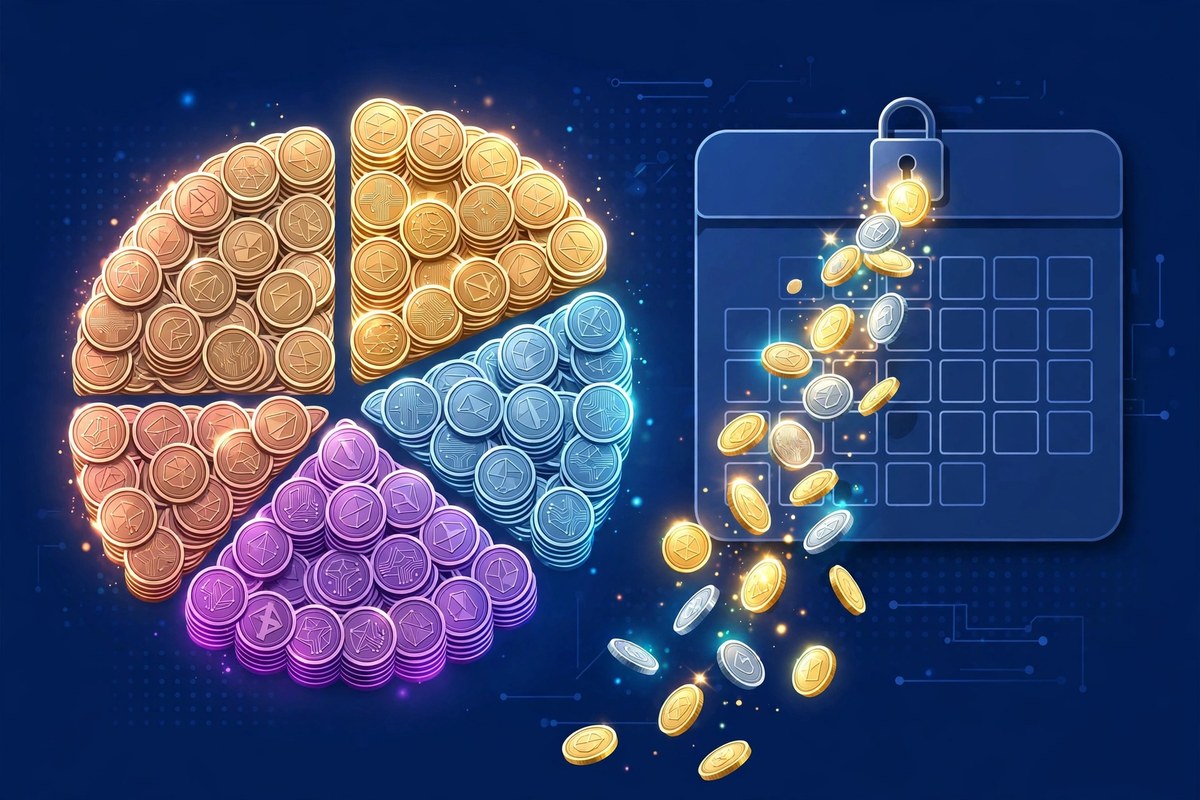
The most common beginner mistake is treating every unlock as an automatic crash. It is not. What actually happens depends on who receives the tokens and what they need the money for. Team members who still work on the project usually hold. Early investors who have waited a year through a cliff often sell at least part — they have been locked up precisely because the market did not want them selling earlier.
Hyperliquid's November 6 release is the cleanest example of the difference. A schedule showing 9.92 million HYPE sounds like a flood; a team commitment to release only 180,000 HYPE is a trickle. Traders who read only the schedule would have positioned for a dump that was never coming. The same logic applies in reverse: a project that quietly accelerates its releases, or that unlocks tokens to a group with no reason to hold, deserves skepticism even if the headline number looks small.
The practical rule: judge an unlock by the percentage of circulating supply it represents, not by its dollar value. A $100 million unlock is noise for a $50 billion coin and an earthquake for a $300 million one. Kite's unlock matters because it is a double-digit percentage of its circulating supply. Monad's matters because it more than doubles the coins available to trade. Always convert dollars into percentages before deciding whether to care.
A Burn Is Not a Miracle — the Cronos Lesson
Token burns are the mirror image of unlocks: instead of releasing supply, the project permanently destroys tokens, usually by sending them to an address nobody controls. Burns are marketed as bullish, and sometimes they are. But the Cronos example shows why the size of the burn relative to the schedule is everything.
Cronos burned 1,791,534 CRO on October 30 in its first monthly buyback, worth about $92,000 — just 0.0035% of circulating supply. Seventeen days later, about 1.17 billion CRO leaves the strategic reserve under its release schedule. The burn was real, and it was roughly 670 times smaller than the release that followed it. A trader who bought the burn headline bought into a supply increase, not a decrease.
Burns matter when they are large, recurring, and funded by real revenue — Ethereum's fee burn is the standard example, because it scales with network usage rather than with marketing announcements. One-off burns that are tiny next to upcoming unlocks are publicity, not policy. Before celebrating any burn, compare it with the next three months of scheduled releases. If the releases dwarf the burn, the burn is not the story.
5 Tokenomics Myths Most Buyers Get Wrong
Myth 1: Low price means cheap. A coin at $0.01 with 100 billion tokens in circulation is not cheaper than a coin at $50,000 with 19 million coins. Price per token means nothing without supply. Market capitalization — price times circulating supply — is the starting point, and fully diluted valuation — price times total supply — is the reality check.
Myth 2: A big unlock always crashes the price. Sometimes the market has priced the unlock in for months, and the event itself is a non-event or even a relief rally. The damage usually happens in the weeks before the unlock, as traders sell ahead of it, not on the day itself.
Myth 3: Burns always push prices up. As Cronos shows, a burn can be trivially small next to the release schedule. Demand has to meet the remaining supply; destroying 0.0035% of it changes nothing.
Myth 4: Team and investor holdings do not matter if the technology is good. They matter more than the technology in the short term, because they are the supply overhang. A project where insiders hold 60% of tokens that unlock over the next year is a different investment from one where insiders hold 10%, whatever the whitepaper says.
Myth 5: Fixed supply means the price can only go up. Bitcoin's cap is real, but demand is not guaranteed. A capped coin with no users still falls. Scarcity amplifies demand; it does not replace it.
The 5-Check Tokenomics Checklist Before You Buy
Run these five checks on any altcoin before you put money in. If you cannot answer one of them, that is itself an answer.
Check 1: What percentage of total supply is already circulating? Below 50% means most supply is still to come. Above 80% means the unlock risk is mostly behind the project. Monad, before its November 24 cliff, is the extreme low end of this scale.
Check 2: What unlocks in the next 90 days, and who receives them? Use a token-data tracker and write down the dates, amounts, and recipients. Team and investor unlocks deserve more caution than ecosystem or community releases, which are often spent slowly on grants and incentives.
Check 3: Is issuance rising, falling, or flat? Declining issuance (Bitcoin's halvings, Solana's schedule) is a tailwind. Rising issuance — staking rewards that outpace fee burns, for example — is a headwind that demand must overcome every single day.
Check 4: Do burns or buybacks actually move the needle? Compare the last burn with the next unlock. If the burn is less than 1% of the upcoming release, ignore it. If burns are funded by real revenue and recur monthly, they count.
Check 5: What is the token actually used for? Fee payment, staking, and governance give a token a reason to be held. A token with no use beyond speculation depends entirely on new buyers arriving — the weakest demand story in crypto. For the staking side of this question, see our crypto staking explainer and our crypto wallet guide before moving any coins to a new project.
Why Tokenomics Matters More in a Falling Market
In a rising market, sloppy supply barely matters — new buyers absorb every unlock and every emission. In a falling market, it matters enormously, because there are fewer new buyers and every release competes for their money. That is exactly the market of early November 2026: Bitcoin has fallen about 11% over 30 days, spot Bitcoin ETFs recorded $643 million of outflows on October 30 and another $399 million on November 2, and about $363 million of leveraged positions were liquidated in 24 hours, with longs making up nearly 90% of them, according to crypto.news and CoinGlass data.
When liquidity is thin, supply events decide which coins fall hardest. Zcash fell about 11% in a day to around $1,140, underperforming even a falling Bitcoin, as leveraged longs were forced out ahead of its NU7 upgrade — a supply-and-governance story layered on top of a market-wide selloff. Meanwhile, coins with no unlock overhang tend to fall less, simply because nobody is forced to absorb new supply. Tokenomics does not predict the market. It tells you which coins carry extra weight when the market turns against them.
Frequently Asked Questions
What is tokenomics in simple terms?
Tokenomics is the set of rules governing a crypto token's supply and demand: how many tokens exist, how many can ever exist, who holds them, when locked tokens are released, and what the token is used for. It is the closest thing crypto has to a central bank's monetary policy, except the rules are usually public and written in advance.
Do token unlocks always make the price fall?
No. Unlocks make selling possible, not certain. Prices often fall before an unlock as traders position ahead of it, and sometimes rise after it if holders keep their tokens. The risk depends on the size of the unlock relative to circulating supply and on who receives the tokens.
What is the difference between circulating supply and total supply?
Circulating supply is the number of tokens trading today. Total supply includes locked, reserved, and not-yet-released tokens. Fully diluted valuation multiplies the price by total supply, and it is the honest measure of what a project is worth if every token eventually circulates.
Are token burns good for the price?
Only if they are big enough to matter. A burn removes supply permanently, which helps if demand stays constant. But a small burn next to large upcoming unlocks — like Cronos burning $92,000 of CRO ahead of a $58 million-plus release — is marketing, not a supply squeeze.
How do I check a coin's unlock schedule?
Use a token-data tracker such as Tokenomist and cross-check the project's own documentation. Note the date, the number of tokens, the percentage of circulating supply, and the recipient group. Treat any single source's dollar figure as an estimate, because trackers disagree and prices move.
Is Bitcoin's tokenomics better than other coins?
Bitcoin's model — a fixed 21 million cap with issuance that halves about every four years — is the most predictable in crypto, and that predictability is part of its appeal. But predictability is not a guarantee of returns: demand, regulation, and macroeconomic conditions still decide the price, as the current pullback below $77,000 shows.
Conclusion
Tokenomics is not a niche topic for analysts. It is the supply schedule that decides whether your coin faces a flood or a drought in the months after you buy it. November 2026 proves the point in real time: a $92,000 burn followed by a $58 million release, a first team unlock worth up to $132 million, a $15.7 million release that was supposed to be far larger, and a $278 million-plus cliff still to come on November 24.
Before your next altcoin purchase, run the five checks: circulating percentage, the 90-day unlock calendar, the direction of issuance, the real size of any burns, and the token's actual use. Five minutes with the supply schedule will save you from more losses than five hours of chart-watching. The market rewards traders who read the schedule before the headline — and in November, the schedule is the headline.
Disclaimer: This article is for education only and is not financial advice. Token unlock figures are estimates from public trackers and vary by source; verify the schedule for any specific coin before investing.