What Is the Lightning Network? Bitcoin's $1 Billion-a-Month Payments Layer — Explained in Plain English
Lightning now moves over $1 billion of Bitcoin a month in payments that settle in under a second for less than a cent — yet public capacity fell 19% in a single quarter. Here's how it works, what it costs, and the 5 myths that trip up new users.

Bitcoin can now move more than $1 billion a month in payments that settle in under a second and cost less than a cent — and most Bitcoin holders have never used the network that makes it possible. That network is called the Lightning Network, and in 2026 it sits at a strange crossroads: payment volume is at record highs while the publicly visible capacity that powers it has been shrinking for months.
Before going further, one fact frames everything else: Bitcoin's base layer was never built for buying coffee. It settles a block roughly every 10 minutes, every transaction competes for limited space, and fees rise whenever the network gets busy. Lightning is the workaround — a second layer of payment channels that sits on top of Bitcoin and lets people transact off-chain, instantly, almost for free, while still settling back to Bitcoin's security when it matters.
What the Lightning Network Actually Is
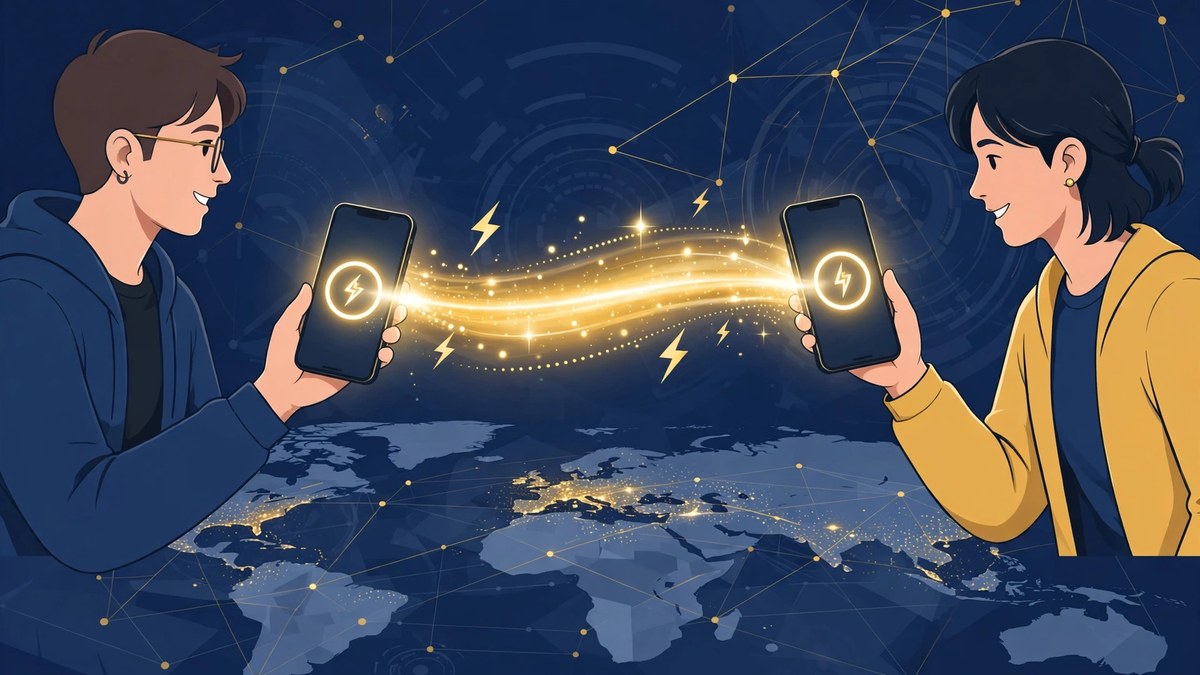
The Lightning Network is a network of payment channels built on top of Bitcoin. Two people open a channel by locking some bitcoin into a shared on-chain transaction. Once it is open, they can send bitcoin back and forth as many times as they like, instantly, without touching the blockchain. Only when they close the channel does the final balance get written back to Bitcoin's base layer. Think of it like opening a tab at a bar: you put down a card once, order as many drinks as you want, and settle a single bill at the end of the night.
The clever part is that channels connect to each other. You do not need a direct channel with the person you want to pay: if you have a channel with Alice and Alice has a channel with Bob, you can pay Bob through Alice — and nobody needs to trust anybody, because the payment uses a cryptographic trick called a Hashed Timelock Contract (HTLC). The money can only move forward if the recipient proves they received it, and if anything fails, everyone gets their money back automatically.
That design is why Lightning is called a Layer 2. Bitcoin's base layer — Layer 1 — stays slow, expensive and extremely secure, doing what it does best: final settlement. Lightning — Layer 2 — handles the everyday traffic that would choke the base layer. The idea was first proposed in a 2016 white paper by Joseph Poon and Thaddeus Dryja, and it has been running on Bitcoin's main network since 2018. Eight years later, it is no longer an experiment — it is infrastructure that exchanges, fintech apps and merchants actually use.
Lightning in Numbers: The 2026 Snapshot
Lightning is hard to measure, because most of what happens on it is private by design. Public trackers can only see channels that nodes choose to announce, and private channels — used by mobile wallets, exchanges and businesses — never appear in the public data at all. Researchers estimate they hold at least twice as much capacity as the visible network, which is why different sources report very different numbers for the same month. If you are new to Bitcoin, start with our complete beginner's guide to how Bitcoin works — Lightning only makes sense once you understand the base layer. And if the word "blockchain" still feels fuzzy, our plain-English blockchain explainer covers the ledger that all of this sits on. The figures below come from Blockonomi's 2026 Lightning statistics roundup, Spark's state-of-the-network research and River's 2026 Adoption Report:
| Metric | Figure | Source and date |
|---|---|---|
| Record public capacity | About 5,637 BTC | Amboss, December 2025 |
| Public capacity, end of Q3 2026 | About 3,767 BTC (about $310 million) | Glassnode, September 30, 2026 |
| Public nodes | About 17,400 (early 2026); about 13,800 by late 2026 | mempool.space / Glassnode |
| Public channels | About 41,000 (early 2026); about 36,800 by late 2026 | mempool.space / Glassnode |
| Monthly payment volume | About $1.17 billion | River, November 2025 |
| Volume growth, year over year | About 300% | River 2026 Bitcoin Adoption Report |
| Monthly volume first crossed $1 billion | February 2026 | River, via Bitcoin Magazine |
| Typical Lightning payment | About $62 | Glassnode Q3 2026 reporting |
| Node count vs 2022 peak | Down from about 20,700 | mempool.space |
Two facts in that table deserve a second look, because they point in opposite directions. First, payment volume is booming: River estimates Lightning processed about $1.17 billion in November 2025, roughly four times the $286.5 million estimated a year earlier, and monthly volume crossed $1 billion for the first time in February 2026. Second, public capacity is shrinking: Glassnode measured a 19.3% fall in a single quarter, and different trackers put current public capacity anywhere from about 2,270 BTC to about 3,767 BTC depending on what they count.
That contradiction is the real story of Lightning in 2026. The network is processing more money through fewer, bigger, more professional channels. Node counts have fallen from the 2022 peak of about 20,700 as hobbyist operators dropped out and capacity consolidated into professional routing operations run by companies like Lightning Labs, ACINQ, River, Kraken and Lightspark, which together account for more than half of the network's capacity. Lightning is becoming less of a hobbyist mesh and more of a payments backbone — smaller on the surface, busier underneath.
How a Lightning Payment Works, Step by Step
The mechanics sound complicated, but the user experience is simple. Here is what actually happens when you pay for something with Lightning:
- Open a channel (once): your wallet locks a small amount of bitcoin into a channel with a well-connected node. This is the only step that touches Bitcoin's blockchain and pays an on-chain fee.
- Scan or paste an invoice: the person or merchant you are paying gives you a Lightning invoice — a short string of characters that encodes the amount and a secret payment hash.
- Your wallet finds a route: it looks for a path of connected channels from you to the recipient, splitting the payment across several routes if one channel cannot carry the full amount.
- The payment hops along the path: each node forwards the payment to the next, earning a tiny routing fee — usually a fraction of a cent. The cryptographic lock means no middleman can steal the funds in transit.
- The recipient claims it in under a second: they reveal the secret that unlocks the payment, the lock releases along the whole path, and every channel balance updates. Done. No block confirmation, no waiting.
- Close the channel (whenever you like): the final balances are written back to Bitcoin's blockchain in a single transaction. Until then, you can make unlimited payments through the same channel.
The whole process feels like tapping a card. The difference is what happens underneath: no bank, no card network, no 2–3% merchant fee, and no 2–5 business days for a cross-border transfer to clear. A Lightning payment from New York to Lagos settles in the same second as one from New York to New Jersey, for the same sub-cent fee.
Lightning vs On-Chain Bitcoin vs Visa: The Comparison That Matters
| Bitcoin on-chain | Lightning Network | Visa / card networks | |
|---|---|---|---|
| Settlement time | About 10 minutes per block; 6 confirmations often recommended | Under 1 second | Authorisation in seconds; final settlement in 1–3 days |
| Typical fee | Varies with congestion; can spike to dollars in busy periods | Less than 1 cent in most cases | About 2–3% for merchants |
| Best for | Large transfers, long-term storage, final settlement | Everyday payments, micropayments, remittances | Everyday card payments |
| Smallest practical payment | A few dollars (fees make smaller payments pointless) | A fraction of a cent (1 satoshi) | A few cents (fees make micropayments uneconomic) |
| Who controls it | No one; decentralised miners and nodes | No one; decentralised nodes and channels | Private companies and banks |
The trade-off is clear. Lightning is not a replacement for Bitcoin's base layer — it is a complement. You would not buy a house over Lightning, and you would not buy a coffee on-chain. And against Visa, Lightning's advantage is not speed at the checkout — cards are already fast — it is cost, finality and access: no percentage cut, no chargebacks, no bank account required, and the same rails work anywhere on Earth.
5 Myths About Lightning That Cost People Money
Most of what goes wrong with Lightning comes from believing one of these five myths. They are the most expensive misunderstandings in Bitcoin's second layer.
Myth 1: Lightning is a separate cryptocurrency
It is not. Lightning moves real bitcoin — the same BTC you already own. There is no "Lightning coin" to buy, and anyone selling you one is running a scam. A Lightning payment is a bitcoin payment that happens off-chain and settles on-chain later.
Myth 2: Lightning payments are free
They are close to free, but not free. Routing nodes charge tiny fees, usually a fraction of a cent, and opening or closing a channel costs a normal on-chain Bitcoin fee. If you run your own node, you pay for hardware, electricity and your time; if you use a custodial wallet, you pay in trust — the company holds your keys. Free is a myth; nearly free is the reality.
Myth 3: Lightning is only for tiny payments
This was true in 2019. It is not true in 2026. The typical Lightning payment is now about $62, according to Glassnode's Q3 2026 reporting, and the network processed about $1.17 billion in a single month. Exchanges route large withdrawals over Lightning, and merchants settle real invoices through it. That said, very large payments can still fail: a single channel can only carry as much as its balance allows. Lightning's sweet spot is everyday money — from cents to thousands of dollars — not life savings in one hop.
Myth 4: Lightning is private and untraceable
Lightning is more private than Bitcoin's base layer, but it is not anonymous. Intermediate routing nodes only see the previous and next hop, not the sender or the final destination — that is real privacy. But your channel partner can see your channel balance, custodial wallets know exactly who you are, and a determined observer can analyse the public channel graph. If you need strong privacy, Lightning helps; if you need invisibility, it does not.
Myth 5: Lightning is dying because capacity is falling
Public capacity fell about 19% in Q3 2026, and node counts are down from their 2022 peak — and yet monthly payment volume is at record highs. Capacity measures how much bitcoin is locked in public channels, not how much the network is used. The decline reflects consolidation: fewer, larger, professional channels doing more work, plus a shift toward private channels that trackers cannot see at all. A shrinking public number with growing volume is a network maturing, not a network dying — though it does mean Lightning is becoming more centralised at the routing layer, which is a genuine concern worth watching.
The Risks Nobody Mentions
Lightning is genuinely useful, and it is genuinely not risk-free. The honest version of this guide has to include the downsides that promotional articles skip.
Routing can fail. A payment only succeeds if a path of channels with enough liquidity exists between you and the recipient. Large payments fail more often, and payments can fail at busy times. Wallets now split big payments across several routes automatically, but failure is still a normal part of using Lightning — not a sign that your money is gone. Failed payments return to you.
Channels need managing. A channel has a balance on each side. If you only ever spend, your side empties and you cannot pay until you refill it. If you only ever receive, the other side empties and you cannot receive more. Non-custodial users have to think about this; custodial users pay a company to think about it for them.
Your funds are hot. Bitcoin in a Lightning channel is online by design, so it is more exposed than bitcoin in cold storage. Keep spending money on Lightning and savings in cold storage — never the other way around.
The network is concentrating. Research cited in 2026 puts the node-capacity Gini coefficient at about 0.97 — comparable to the most unequal real-world wealth distributions. A small number of large routing hubs now carry most of the traffic, which makes the network efficient but also more dependent on a handful of professional operators than the early vision promised.
Watchtowers and downtime matter. If you run your own node and it goes offline, a dishonest channel partner could theoretically try to close a channel with an old balance. Watchtower services exist to prevent this, but it is one more moving part to understand — another reason beginners are better off starting with a reputable custodial or managed wallet.
What Happens Next: Stablecoins, Square and the Second Act
The most consequential Lightning development of 2026 has nothing to do with Bitcoin payments at all. It is stablecoins. Lightning Labs shipped Taproot Assets v0.6 in June 2025, enabling multi-asset Lightning for the first time on mainnet, and Tether announced USDT support on Bitcoin and Lightning in January 2025, with the integration going live in March 2026. If dollar stablecoins become routine on Lightning, the network stops being only a way to spend bitcoin and becomes a way to send dollars anywhere, instantly, for less than a cent — a direct competitor to the remittance industry that still charges 5–7% and takes days. Blockready's 2026 Lightning overview and CryptoNews' look at Lightning's instant-payment push both flag stablecoins and merchant adoption as the forces to watch.
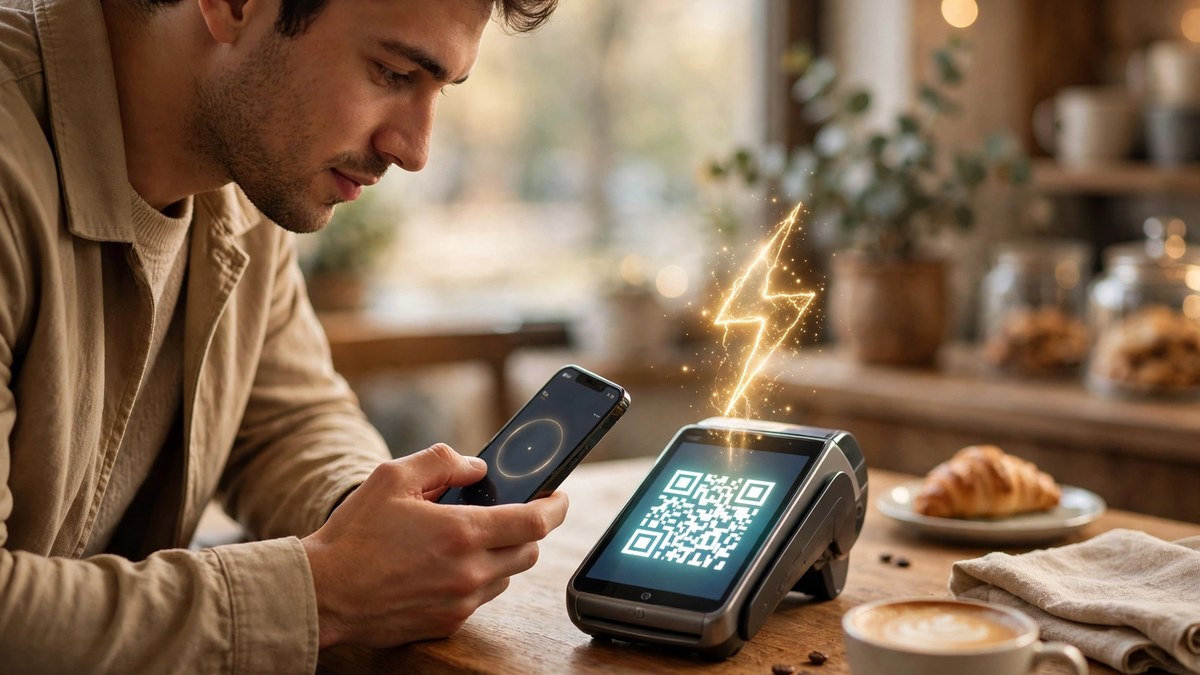
The merchant side is moving too. Square — now Block — began rolling out Lightning-powered Bitcoin payments to merchants in mid-2025, with full availability targeted for 2026. SoFi adopted Lightning for cross-border remittances in August 2025, targeting corridors where traditional wires eat 5–7% in fees. And Coinbase completed its Lightning integration via Lightspark in mid-2024; by mid-2025, more than 15% of Bitcoin withdrawals from Coinbase used Lightning.
The honest outlook is mixed. Lightning's volume is at record highs, its biggest use cases — remittances, merchant payments, stablecoins — are only just starting, and the technology keeps improving: BOLT12, merged into the Lightning specification in September 2024, brings reusable payment offers that work like a static QR code. At the same time, public capacity is falling and the network is consolidating into fewer professional hands. Lightning in 2026 is not the triumphant story its earliest fans promised, and it is not the failure its critics claim. It is a working payments layer with real users, real volume and real problems — and for the first time, the volume numbers are big enough that the problems are worth solving.
Frequently Asked Questions
Is the Lightning Network safe to use?
For everyday amounts, yes — with the right setup. Payments are secured by Bitcoin's cryptography, failed payments return your money, and the protocol has operated on mainnet since 2018 without a catastrophic failure. The main risks are custodial (trusting a company with your keys), operational (channel management, node downtime) and financial (keeping too much in a hot wallet). Keep spending money on Lightning and savings in cold storage.
How much does a Lightning transaction cost?
Usually less than one cent. Routing fees are fractions of a cent per hop, and most wallets charge nothing extra for small payments. The real costs are opening and closing channels, which pay normal on-chain Bitcoin fees — so open a channel once and use it many times.
Can I lose money on the Lightning Network?
You can lose money the same ways you can lose money anywhere in crypto: sending to the wrong invoice, trusting a custodial wallet that fails, or keeping large sums in a hot wallet that gets compromised. You cannot lose money simply because a payment fails — failed payments return to the sender. The protocol itself has no history of losing user funds at scale, but the companies and apps around it can still fail.
How do I start using Lightning?
Download a Lightning wallet such as Phoenix, Breez or Wallet of Satoshi, buy a small amount of Bitcoin — our buying guide walks through it — move it into the wallet and make a tiny test payment first. Keep only spending money in the wallet; savings belong in cold storage, as our storage guide explains.
What is the difference between Lightning and the Bitcoin blockchain?
The blockchain is Bitcoin's base layer: slow, expensive, extremely secure, and the final record of who owns what. Lightning is a layer on top of it: fast, nearly free, and built for everyday payments, with final balances settled back to the blockchain when channels close. If Bitcoin is the vault, Lightning is the wallet in your pocket. For the full picture, read our Bitcoin beginner's guide and our crypto wallet guide — and our satoshi explainer shows what $100 buys at current prices.
Conclusion
The Lightning Network is Bitcoin's answer to its oldest criticism — that it is too slow and too expensive to use as money. In 2026 it moves over $1 billion a month, settles payments in under a second for less than a cent, and is being adopted by Coinbase, Square, SoFi and the world's largest stablecoin issuer. It is also shrinking on the surface and consolidating into fewer professional hands.
Both stories are true at the same time. Lightning is not a magic solution and it is not a dead end. It is a working piece of financial infrastructure that gets more useful every year — and for anyone who holds Bitcoin, understanding it is now as basic as understanding the wallet that holds it. Start small, use a wallet you trust, make a test payment, and see for yourself: the first time a payment lands in under a second, the abstract idea of a second layer becomes very concrete, very fast.
Not financial advice. Figures are drawn from River's 2026 Bitcoin Adoption Report, mempool.space, Glassnode, Amboss and Bitcoin Magazine reporting; Lightning statistics vary by tracker because private channels are not publicly visible.