SEC Just Approved a 5-Coin Crypto ETF: Bitcoin, Ethereum, XRP, Solana and Cardano in One Fund — 5 Numbers That Decide If It's Worth Buying
The SEC just approved a single ETF holding Bitcoin, Ethereum, XRP, Solana and Cardano — $775 million of crypto in one ticker, 80% of it Bitcoin. Here are the 5 numbers that decide whether the basket beats buying the coins yourself.
The SEC Just Approved a Five-Coin Crypto ETF — and 80% of It Is Bitcoin
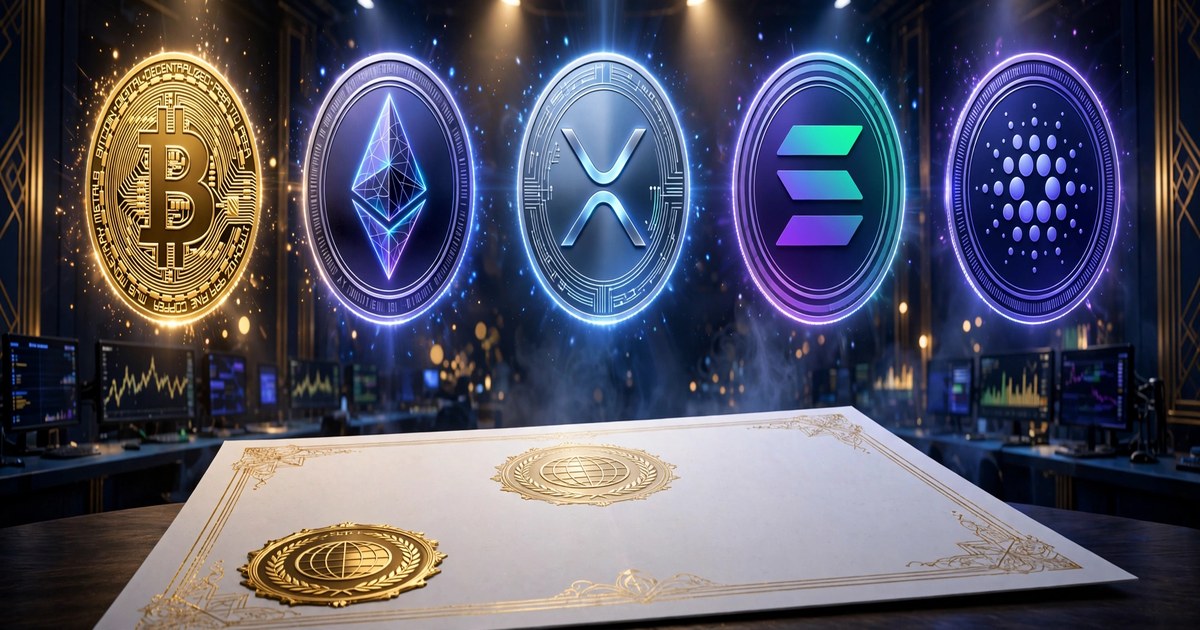
The U.S. Securities and Exchange Commission has approved the conversion of the Grayscale Digital Large Cap Fund into a spot crypto ETF, putting Bitcoin, Ethereum, XRP, Solana and Cardano into a single ticker for the first time. The fund holds roughly $775 million in assets — and about 80 cents of every dollar in it is Bitcoin. If you have ever wanted one-click exposure to the whole large-cap crypto market without opening five wallets, this is now the closest Wall Street has ever come to offering it. But the basket is far more lopsided than the "five-coin ETF" headline suggests, and whether it is worth buying depends on five numbers most coverage is skipping.
The approval, issued as an accelerated order on November 7, 2026 and first reported by CryptoSlate, lands in the middle of one of the roughest weeks crypto has had in months: U.S. spot crypto ETFs lost more than $540 million in a single Thursday session, over $1 billion in leveraged positions were liquidated, and Bitcoin fell 5.6% in a day. This is not a victory lap for a bull market — it is the SEC opening the index-ETF door while the market is still bleeding.
What the SEC Actually Approved
The order converts the Grayscale Digital Large Cap Fund — ticker GDLC — from an over-the-counter trust into a fully listed exchange-traded fund on NYSE Arca. The fund first launched in 2018 and has traded on OTC Markets under the GDLC ticker since 2019. The conversion completes a process Grayscale started with a July 1 filing, and it amends NYSE Arca Rule 8.500-E to permit trust units issued by limited-liability companies and to recognize index-based portfolios.
The SEC's order states that the exchange's surveillance capabilities and the fund's asset-quality thresholds meet the requirements of Section 6(b)(5) of the Exchange Act — the standard designed to deter fraud and manipulation. That language matters because it is the same test every future basket fund will have to pass. Once operational details are finalized, GDLC will transition to continuous trading with on-exchange creation and redemption, the mechanism that keeps an ETF's market price close to the value of the assets it holds.
Why does this matter beyond one fund? Because the approval opens the door for every other crypto basket fund waiting in line. Bitwise filed a Form 19b-4 in November to uplist its $1.3 billion Bitwise 10 Crypto Index Fund (BITW) as an exchange-traded product. Hashdex has asked the SEC to broaden its Nasdaq Crypto Index US ETF to include seven additional altcoins. Franklin Templeton submitted paperwork in February to launch its own crypto index ETF. GDLC is the first domino — and the SEC's reasoning in this order is now the template the rest will be judged against. For the full background on how spot crypto ETFs work and why the structure matters, see our guide What Is a Bitcoin ETF? How Spot Bitcoin ETFs Work in 2026.
The Basket, Coin by Coin: What You Actually Own
Here is the part the headlines gloss over. The ETF tracks a basket of the five largest cryptocurrencies by market capitalization — but the weights are anything but equal. At approval, the portfolio was approximately 80% Bitcoin, 11% Ethereum, 4.8% XRP, 2.8% Solana and 0.8% Cardano.
Put $1,000 into GDLC and roughly $800 of it buys Bitcoin. Ethereum gets about $110. XRP gets $48. Solana gets $28. Cardano gets $8. That is not a diversified crypto portfolio in any meaningful sense — it is a Bitcoin fund with a garnish of altcoins.
The weights are not arbitrary. They track market capitalization, which is why Bitcoin dominates: BTC's market cap sits near $1.52 trillion, dwarfing everything else. The weights will drift as prices move and be rebalanced periodically — but Bitcoin's dominance is structural, not a one-day quirk.
| Coin | Weight in GDLC | Price on Nov 7, 2026 | What it adds to the basket |
|---|---|---|---|
| Bitcoin (BTC) | ~80% | ~$75,900 | Digital gold; the market's anchor |
| Ethereum (ETH) | ~11% | ~$2,239 | Smart contracts; largest programmable chain |
| XRP | ~4.8% | ~$1.18 | Payments; zero ETF outflows on the worst day |
| Solana (SOL) | ~2.8% | ~$90.19 | High-speed transactions; fast-growing DeFi |
| Cardano (ADA) | ~0.8% | — | Research-led blockchain; smallest weight |
Each coin plays a different role. Our beginner guides cover all five before you decide: What Is Bitcoin?, What Is Ethereum?, What Is XRP?, What Is Solana? and What Is Cardano?.
GDLC vs Buying the Coins Yourself vs a Spot Bitcoin ETF
The honest question is not whether GDLC is good in the abstract — it is whether it beats the two obvious alternatives. Here is the comparison that actually decides it.
| GDLC (5-coin ETF) | Buying 5 coins yourself | Spot Bitcoin ETF (e.g. IBIT) | |
|---|---|---|---|
| Coins held | BTC, ETH, XRP, SOL, ADA | Any coins you choose | Bitcoin only |
| Bitcoin weight | ~80% | You decide | 100% |
| Custody | Fund custodian; no keys to manage | You hold the keys (or an exchange does) | Fund custodian |
| Trading | NYSE Arca, stock-market hours | 24/7 on crypto exchanges | NYSE Arca, stock-market hours |
| Staking rewards | No (at launch) | Yes — ETH, SOL and ADA can be staked | No |
| Tax reporting | One brokerage 1099 | Every trade is a taxable event you must track | One brokerage 1099 |
| Fees | Fund expense ratio (to be confirmed) | Exchange fees per trade | Typically 0.12%–0.25% |
| Best for | One-ticker exposure to the large-cap market | Control, staking and 24/7 access | Bitcoin-only exposure |
The table exposes the real trade-off. GDLC wins on simplicity and tax reporting: one ticker, one brokerage statement, no seed phrases, no exchange accounts. It loses on control and yield. Buy the coins yourself and you can stake Ethereum, Solana and Cardano and earn rewards the ETF does not pass through — at least not at launch. You can also weight the coins however you like instead of accepting an 80% Bitcoin allocation, and trade at 3 a.m. on a Sunday, when crypto moves and the stock market is closed.
Against a spot Bitcoin ETF, GDLC's pitch is diversification — but with 80% in Bitcoin, the diversification is thin. The main thing the extra 20% buys you is upside if an altcoin season arrives, and downside protection of exactly zero if Bitcoin falls, since Bitcoin drives the basket. The comparison that matters most for most buyers is the one we have covered before: Bitcoin vs Ethereum: Which Is the Better Investment in 2026? — because the 80/11 split between those two coins is where almost all of GDLC's performance will come from.
Why This Approval Matters Right Now
The approval did not arrive in a vacuum. It landed the day after one of the worst sessions of the year. On Thursday, November 6, the Nasdaq shed 5.5% in its worst day since April 2025, the Philadelphia Semiconductor Index plunged 12%, and Bitcoin fell 5.6% to just under $76,000. Ether dropped 7.8%, XRP and Solana each fell roughly 5.5%, and more than $1 billion in leveraged crypto positions were liquidated — the worst wipeout since late October, according to CoinGlass data reported by CoinDesk.
Read together, the two stories — a landmark approval and a $540 million exit — tell you where the market actually stands. Institutional demand for crypto exposure is not dead; it is selective. Money left Bitcoin and Ethereum funds on the worst day, stood still on XRP, and the SEC approved the first basket fund the same week. The approval is a structural event, not a price catalyst. Nobody should buy GDLC because the SEC approved it — the approval changes access, not value. What it changes is who can buy: financial advisers, retirement accounts and institutions that could not hold five separate coins can now hold one ticker.
There is also a political backdrop. Democrats are projected to win control of both the House and the Senate in this week's U.S. midterm elections, and House Democrats are reportedly planning a broader crypto market structure bill for the next Congress that would expand SEC oversight and limit the CFTC's role. The CLARITY Act itself has been stalled since a Senate procedural vote fell short in September. GDLC's approval shows the SEC is moving on crypto products through its existing authority regardless of what Congress does next. We covered the election's crypto implications in Democrats Won Congress: What It Means for Crypto — 5 Rules That Change and the CLARITY Act.
5 Numbers That Decide If the 5-Coin ETF Is Worth Buying
1. 80% — the Bitcoin weight. This is the number that decides almost everything. GDLC is a Bitcoin fund with altcoin seasoning. If you believe Bitcoin outperforms the rest of the market, the basket is fine. If you believe altcoins are about to outperform, GDLC gives you only 20% exposure to that thesis — and 0.8% to Cardano. Before buying, ask whether you would buy an 80% Bitcoin fund on purpose. If yes, GDLC is efficient. If no, buy the coins separately and set your own weights.
2. $775 million — the assets under management. That is the fund's size as of June 30, and it is small next to the giants: BlackRock's IBIT alone manages tens of billions. Size matters because it drives liquidity and bid-ask spreads. $775 million is large enough to be viable, but small enough that early trading could be choppy. Watch the first weeks of trading volume before placing a large order.
3. $540 million — the one-day ETF outflow. That is what left U.S. spot crypto ETFs on Thursday, the session before the approval, according to SoSoValue data reported by KuCoin. It is a reminder that ETF flows are not a one-way street: the same vehicles that carried billions in during the rally can bleed hundreds of millions in a day when stocks sell off. GDLC will inherit that flow sensitivity, and with Bitcoin at 80% of the basket, its flows will track Bitcoin sentiment almost exactly.
4. $0 — XRP's net flows on the worst day. While Bitcoin and Ethereum funds lost $530 million combined, XRP products recorded zero net flows. XRP also has the freshest ETF story of the five: spot XRP ETFs were approved in January 2026 and have accumulated $1.81 billion in cumulative net inflows. XRP's 4.8% weight in GDLC is small, but its flow resilience is the most interesting data point in the basket. Our earlier analysis asked the same question: XRP Is the Only Crypto ETF Still Taking Money In.
5. 90+ — the ETF pipeline still waiting. More than 90 crypto ETF applications were frozen by an SEC funding freeze earlier this year, and Bitwise alone filed 11 new crypto ETFs in a single day this week — AAVE, ZEC, TAO, HYPE and seven more. GDLC is the first basket through the door, but it will not be the last, and it will not be the cheapest or the most diversified for long. See our ranking of the new filings: Bitwise Filed 11 Crypto ETFs in One Day: AAVE, ZEC, TAO, HYPE and 7 More Ranked.
What Most People Get Wrong About the 5-Coin ETF
"It's diversified, so it's safer than Bitcoin." Wrong in the way that matters. Diversification only reduces risk when the assets move independently. Bitcoin, Ethereum, XRP, Solana and Cardano are highly correlated — on Thursday they all fell 5% to 8% together. A basket of five assets that fall together is not safer than one asset; it is the same risk with more moving parts. GDLC reduces single-coin risk (if Cardano collapses, you lose 0.8%), but it does not reduce market risk at all.
"Now Solana and Cardano have spot ETFs." Not quite. They have exposure inside a basket fund. A single-asset spot Solana ETF — rumored to be close to trading this week — is a different product with different flows, and it is still waiting. GDLC gives you Solana exposure at 2.8%; it does not give you a Solana ETF.
5 Checks Before You Buy GDLC
Use this checklist before placing an order — it takes five minutes and it is the difference between buying a product you understand and buying a headline.
Check 1: Read the expense ratio. Grayscale's funds have historically charged more than BlackRock's and Fidelity's. The fee was not in the approval order; confirm it at listing and compare it with IBIT's 0.25% and FBTC's 0.25%. On a $10,000 holding, every 0.25% costs you $25 a year, every year.
Check 2: Watch the first two weeks of trading volume. A $775 million fund converting from OTC to NYSE Arca should trade well, but early spreads can be wide. If daily volume is thin, use limit orders, never market orders.
Check 3: Decide your Bitcoin view first. With 80% in Bitcoin, GDLC is a Bitcoin call with a 20% altcoin kicker. If you are bearish on Bitcoin, no basket weight will save you. If you are bullish on altcoins specifically, buy them directly instead.
Check 4: Compare it with the staking you give up. Ethereum, Solana and Cardano all pay staking rewards to direct holders — currently in the low single digits annually. GDLC does not pass those through at launch. Our explainer covers the mechanics: What Is Crypto Staking? How to Stake Crypto and Earn Rewards in 2026.
Check 5: Check whether your account can even hold it. Some retirement accounts and adviser platforms restrict crypto ETFs, and some allow spot Bitcoin ETFs but have not yet whitelisted basket funds. Confirm GDLC is available on your platform before assuming the approval means access for you.
What Happens Next
The immediate next step is operational: Grayscale must finalize the transition to continuous trading and on-exchange creation and redemption on NYSE Arca. The first real test will be the first week of live trading — volume, spreads and whether the market price tracks the basket's value tightly.
The second test is competitive. Bitwise's $1.3 billion BITW uplisting is the most direct rival: ten coins instead of five, and a much larger asset base. If any rival launches with a lower fee or a staking feature, GDLC's first-mover advantage narrows fast. And the third test is the single-asset pipeline: rumors put the first spot Solana ETF close to trading, and the SEC's willingness to approve a basket containing Solana, XRP and Cardano strengthens the case for the individual funds. If spot SOL and spot ADA ETFs launch, the argument for holding them inside an 80%-Bitcoin basket weakens.
And the fourth test is the market itself. Bitcoin is trading near $75,900, down about 40% from its peak, with the Federal Reserve's December decision looming and rate-hike odds at 79%. GDLC launches into a market where the biggest question is not which coins to hold but whether the sell-off is over. A basket fund does not answer that question. It just makes it easier to act on your answer.
FAQs
What is the Grayscale 5-coin crypto ETF?
It is the Grayscale Digital Large Cap Fund (GDLC), converted by the SEC into a spot ETF listed on NYSE Arca. It holds Bitcoin (~80%), Ethereum (~11%), XRP (~4.8%), Solana (~2.8%) and Cardano (~0.8%) — the five largest cryptocurrencies by market capitalization — in a single ticker.
When can I buy GDLC?
The SEC approved the conversion on November 7, 2026. Trading on NYSE Arca begins once Grayscale finalizes operational details for continuous trading and on-exchange creation and redemption. The fund has traded on OTC Markets under the same GDLC ticker since 2019.
Is GDLC better than buying Bitcoin alone?
It depends on your view. GDLC is 80% Bitcoin, so its performance will track Bitcoin closely. It adds 20% exposure to four altcoins, which helps only if altcoins outperform Bitcoin. If you only want Bitcoin, a spot Bitcoin ETF is cheaper and simpler. If you want the whole large-cap market in one ticker, GDLC is the simplest route.
Does GDLC pay staking rewards?
Not at launch. Ethereum, Solana and Cardano can all be staked by direct holders, but the ETF does not currently pass staking rewards through to shareholders. That is one of the costs of the ETF wrapper versus holding the coins yourself.
How much does GDLC cost?
The expense ratio was not disclosed in the approval order and should be confirmed at listing. Grayscale's crypto funds have historically charged higher fees than BlackRock's IBIT (0.25%) and Fidelity's FBTC (0.25%), so compare before buying.
Is the 5-coin ETF safe?
No crypto investment is safe in the sense of guaranteed returns. GDLC reduces single-coin risk — one coin collapsing costs you only its weight — but it does not reduce market risk: all five coins fell 5% to 8% together on November 6. The fund is regulated and listed, which reduces custody and fraud risk versus holding coins on an unregulated exchange, but the price can still fall sharply.
Conclusion
The SEC's approval of the Grayscale five-coin ETF is the most important structural crypto event of the week — and it is not a buy signal. It is an access event. For the first time, an ordinary brokerage account can hold Bitcoin, Ethereum, XRP, Solana and Cardano in a single ticker, with regulated custody and a single tax statement. That matters enormously for advisers, retirement accounts and investors who never wanted to manage five wallets.
But the basket is 80% Bitcoin, it pays no staking rewards, its fee is unconfirmed, and it launches into a market that just lost $540 million of ETF money in a day. If you would buy an 80% Bitcoin fund on purpose, GDLC is the easiest way to do it. If you would not, the approval changes nothing about what you should own. The SEC opened a door. Walking through it is still your call — and it should be made with the checklist above, not with the headline.
Disclaimer: This article is for informational purposes only and does not constitute financial or investment advice. Cryptocurrency prices are highly volatile. Always do your own research before making any investment decision.