Pay With Bitcoin at 4 Million Shops: Square's November 10 Switch, 0% Fees — and Why Almost Nobody Spends It Yet
Square flips Bitcoin payments on by default for ~4 million US sellers on November 10, 2026, with 0% fees through year-end — yet Spiral's October report says spending is still scarce. Here's what changes, what it costs from January, and the 7 checks before you pay or accept.
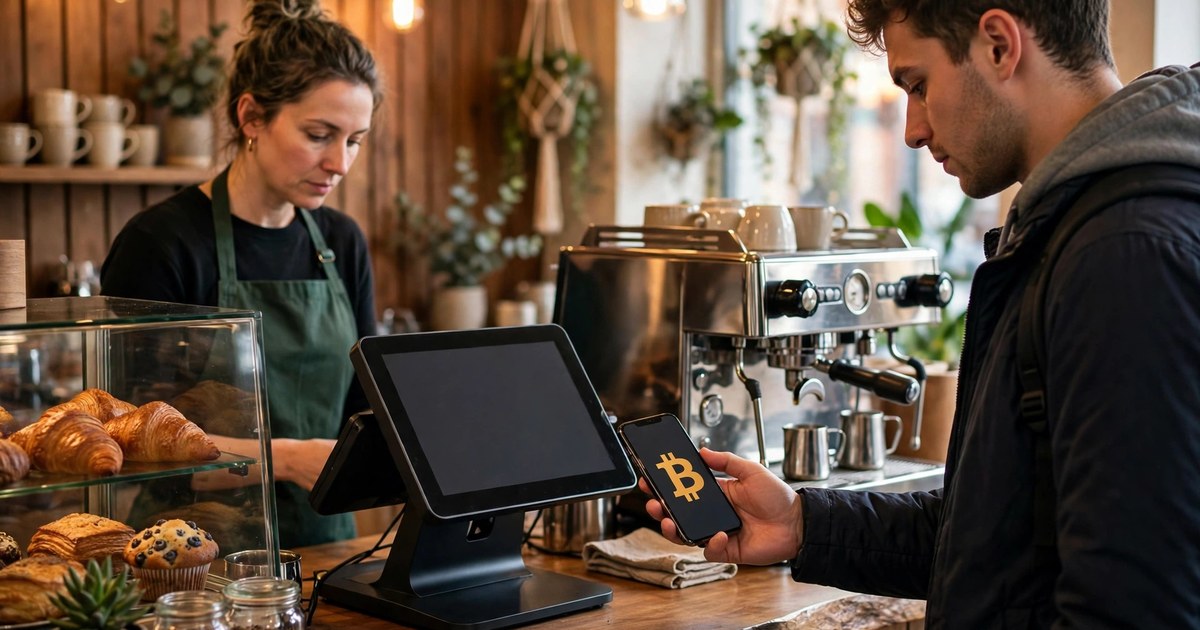
Square is about to switch on Bitcoin payments by default for roughly 4 million American sellers — and on November 10, 2026, paying with Bitcoin at an ordinary shop counter stops being an experiment. The catch, spelled out by the very developers who built much of the payment software, is that almost nobody is actually spending Bitcoin yet, even where it is already accepted. This article explains what flips on November 10, what it costs merchants and customers, and the checks to run before you pay with Bitcoin or leave the feature switched on.
Block's Square began auto-enabling Bitcoin payments for eligible sellers in the United States on March 30, 2026, and the rollout reaches full availability across its network by November 10, 2026. Customers pay with Bitcoin, usually over the Lightning Network, and merchants receive US dollars by default unless they change the setting. Square is waiving all processing fees on Bitcoin payments through the end of 2026, then charges a flat 1% from January 2027. That is the headline. The harder question is whether a default setting creates real spending — and the early evidence says not yet.
What actually flips on November 10
Until now, a Square seller had to opt in to Bitcoin payments. From the March 30 rollout onward, eligible sellers have been getting Bitcoin acceptance switched on automatically, and November 10 is the date the rollout reaches full availability for eligible users. No new hardware is needed and no separate setup is required: Bitcoin acceptance sits inside the existing Square checkout, and a customer can pay by scanning a code or using a Lightning wallet.
Three design choices matter more than the switch itself. First, settlement defaults to dollars. When a customer pays in Bitcoin, Square converts the payment and the merchant receives dollars in their Square balance, in the same way card revenue lands. Second, the merchant can choose to keep some of the takings in Bitcoin — reports describe sellers being able to keep up to 50% of eligible daily revenue in BTC — but that is an opt-in choice, not the default. Third, a seller who does not want Bitcoin payments can switch the feature off. The default changes the starting point; it does not remove the choice.

There are eligibility limits. The feature is for eligible sellers in the United States who meet Square's verification requirements, and businesses based in New York are excluded, a nod to that state's BitLicense regime. Other states named in early coverage of the rollout include Georgia, Hawaii and Wyoming as exclusions in some reports, so sellers should check their own dashboard rather than assume they are included. If the option has not appeared yet, that is most likely a rollout queue, not a rejection.
The numbers that decide whether this matters
Square's own framing is scale: roughly 4 million sellers in the United States use Square, against roughly 1 million who accepted Bitcoin before the switch, according to coverage of the rollout. Spiral, the Block-backed developer group behind much of the Lightning payment software, puts the already-live figure more conservatively at more than 1 million sellers who can accept Bitcoin through Square. Either way, the merchant count describes the option, not the sale — a point Spiral makes explicitly in its October 27 report, The Long Road to Bitcoin Payments.
That distinction is the story. Seven years of easier Lightning tools have expanded the places Bitcoin could be used without giving most holders a reason to use it there, Spiral argues. A seller can display a Bitcoin option and still take no Bitcoin payments all day. Square can remove the merchant's exposure to Bitcoin's price by converting receipts to dollars, but it cannot decide which money a customer is willing to part with. The report calls the gap mainly a demand problem, and it publishes no transaction count or repeat-purchase series to accompany the million-seller figure.
Context matters here too. Bitcoin was trading near $77,450 on November 4, 2026, with Ether near $2,275 and the Fear and Greed Index at 34, in fear territory, according to KuCoin's daily market report. In a fearful market, holders tend to hoard the asset they expect to rise and spend the money they expect to hold its value — which is exactly the wrong psychology for everyday Bitcoin spending. A payment default does not change that incentive on its own.
Square Bitcoin vs card payments: the fee comparison
For merchants, the immediate attraction is price. Standard in-person card processing on Square costs roughly 2.6% plus 10 cents per tap, according to guides to the rollout. Bitcoin payments cost nothing through the end of 2026, then 1% from January 2027. On a $100 sale, that is roughly $2.70 saved against a card payment in 2026, and roughly $1.70 saved from January 2027 onward — before any other costs, taxes or bookkeeping are counted.
| Payment method | Merchant fee in 2026 | Merchant fee from January 2027 | What the merchant receives |
|---|---|---|---|
| Square Bitcoin payment | 0% | 1% flat | US dollars by default; optional Bitcoin share if switched on |
| Standard in-person card | About 2.6% + 10 cents | About 2.6% + 10 cents | US dollars |
| Cash | No processing fee, but handling and banking costs | Same | US dollars |
The table flatters Bitcoin slightly, because it leaves out the costs that do not appear in a fee schedule: bookkeeping for Bitcoin-originated sales, staff time explaining the option to customers, and the tax reporting that comes with it. Square reports payment volume to the IRS on Form 1099-K, the same form it already sends for card sales, with Bitcoin-originated sales included in the gross total. Merchants should confirm with their accountant how those sales are treated in their own books, especially if they switch on the option to keep part of the revenue in Bitcoin — at that point they are holding an asset, not just receiving dollars.
Why customers are not spending it yet
There are five honest reasons, and none of them is that the technology fails at the till. Lightning payments settle near-instantly, which solves the old complaint that Bitcoin was too slow for a coffee. The blockers are economic and psychological instead.
First, spending Bitcoin feels like spending an investment. When Bitcoin is down roughly 39% from its October 2025 all-time high near $126,000, as market data showed in early November 2026, holders anchor on the price they paid, not the price today. Parting with coins that might recover feels like a loss, even when the coffee costs the same in dollars either way.
Second, tax friction is real in the United States. Spending Bitcoin is generally treated as disposing of property, which can create a taxable event, whereas spending dollars does not. That alone is enough to keep most holders reaching for a card, and it is a reason the tax treatment of each payment deserves a check before a customer makes Bitcoin their everyday money.
Third, most customers have no reason to prefer Bitcoin at the till. Cards give rewards, chargeback protection and a familiar refund path. Bitcoin over Lightning gives speed and, for the merchant, lower fees — benefits that mostly accrue to the seller, not the buyer. Until buyers get something back — a discount, a reward, or a purchase they cannot make another way — the rational choice at the counter is usually the card.
Fourth, the places that accept Bitcoin and the people who hold it do not always overlap. A neighbourhood café on Square may now accept Bitcoin, but its regulars may hold no Bitcoin at all, while the holders live elsewhere. Merchant count is a supply measure; spending needs demand in the same postcode.
Fifth, stablecoins have eaten part of the use case. Spiral notes that Block added Lightning support to the x402 payment protocol in September 2026, while reported activity on that protocol has largely used dollar stablecoins. If the goal is fast, cheap digital payment without price swings, a dollar stablecoin does that job without asking anyone to spend their Bitcoin.
What most people get wrong about Square's switch
The most common misunderstanding is that Square is forcing shops to take Bitcoin and hold a volatile asset. It is not. The default is dollar settlement, the merchant can opt out, and the Bitcoin-holding option is a separate choice. A second misunderstanding runs the other way: that 4 million sellers accepting Bitcoin means 4 million sellers will receive Bitcoin. Most will receive dollars, exactly as before, with a cheaper fee. A third misunderstanding is that zero fees last forever. They do not — the waiver ends at the end of 2026, and the January 2027 price of 1% is the number merchants should budget on, not 0%.
A fourth misunderstanding is subtler: that a Lightning payment is automatically a Bitcoin payment in the economic sense. If a customer pays dollars carried over Lightning rails, or a merchant receives dollars converted at checkout, the rails are Bitcoin-linked infrastructure, but no customer decision to spend Bitcoin and no merchant decision to hold it has necessarily happened. Counting rails as spending overstates adoption, and Spiral's report is careful to separate the two.
Merchant checklist: 7 checks before November 10
- Check your dashboard first: confirm whether Bitcoin payments are enabled for your account, and whether your state and verification status make you eligible.
- Decide the settlement setting deliberately: leave dollar settlement on unless you have a written reason to hold Bitcoin, and record that decision.
- Budget on the January fee, not the waiver: plan for 1% from January 2027, and compare it honestly with your current card costs including handling time.
- Brief your staff in one minute: a customer paying with Bitcoin should get the same receipt, refund explanation and queue time as a card customer.
- Ask your accountant one question: how Bitcoin-originated sales appear in your books and on Form 1099-K, and what changes if you keep any revenue in Bitcoin.
- Set a review date in December: revisit the fee change, the volume of Bitcoin payments actually received, and whether to keep the feature on.
- Do not promise what you cannot refund: agree your refund process for Bitcoin-originated sales before the first one arrives, not after.

Customer checklist: 7 checks before you pay with Bitcoin
- Check the tax position first: understand that spending Bitcoin can be a taxable disposal in the United States, and keep records of what you spent and when.
- Use a wallet you can afford to lose from: pay from a spending wallet with a small balance, not from long-term cold storage — see our guide to choosing a crypto wallet for beginners.
- Confirm the price before you tap: check the dollar amount the merchant will receive and the Bitcoin amount leaving your wallet, including any network fee.
- Keep the receipt like a card receipt: save it until any refund window closes, and note that refund mechanics may differ from card payments.
- Never spend your whole stack at the till: decide in advance what share, if any, of your Bitcoin is for spending, and keep the rest untouched.
- Learn the basics before your first payment: if you are new to Bitcoin, start with what Bitcoin is and how it works and how to buy Bitcoin as a beginner before paying with it.
- Store the rest safely offline: anything you are not planning to spend belongs in proper storage — see how to store crypto safely with cold storage and seed phrases.
Dated timeline: how Square got here
Late 2025: Square introduces Bitcoin payments as an opt-in feature for sellers who actively enable it. Adoption requires the merchant to act, so uptake is limited to sellers who already want it. October 8, 2025: Square's Bitcoin product lead frames the goal publicly as making Bitcoin everyday money. March 30, 2026: Square begins auto-enabling Bitcoin payments for eligible United States sellers, flipping the model from opt-in to opt-out, with dollar settlement by default and fees waived through the end of 2026. October 27, 2026: Spiral publishes its frank assessment that spending remains scarce despite more than a million sellers being able to accept Bitcoin. November 10, 2026: the rollout reaches full availability across Square's network for eligible sellers. January 2027: the fee waiver ends and a flat 1% fee applies to Bitcoin payments.
That timeline explains why November 10 matters even though the switch started in March: it is the moment the default becomes the norm rather than a phased test, and the moment merchants who have ignored the setting so far have to make an active decision — keep it, switch it off, or start holding some Bitcoin.
What happens next: three scenarios
Scenario one, the slow burn, is the most likely on current evidence: merchant numbers stay high, spending stays low, and Bitcoin payments become a cheap rails option that mostly settles in dollars. Merchants save on fees, customers barely notice, and the headline number keeps growing while transaction counts stay unpublished. Scenario two, the incentive break, is what Spiral is effectively calling for: a discount, reward or product that gives buyers a reason to spend Bitcoin, or five-year payment experiments that test whether incentives change repeat use. If a major seller offers a visible Bitcoin discount, spending could follow quickly because the infrastructure is already in place. Scenario three, the pullback, happens if tax, bookkeeping or refund friction outweighs the fee saving for enough sellers that opt-outs rise after the January fee change — at which point the merchant count, the headline metric, would start falling and the story would reverse.
For readers deciding what to do this week, the scenarios point to the same practical stance: merchants should keep the feature under review rather than treating it as a verdict on Bitcoin, and customers should treat their first Bitcoin payment as a small, deliberate test, not a lifestyle switch. The infrastructure is real, the fee saving is real, and the spending gap is real too — all three can be true at once.
Frequently asked questions
Can I pay with Bitcoin at any shop that uses Square?
No. Only eligible sellers in the United States who meet Square's verification requirements, and not sellers based in New York, are included, and any seller can opt out. The November 10 date is full availability of the rollout, not a guarantee that every Square terminal accepts Bitcoin.
Does the shop receive Bitcoin when I pay with Bitcoin?
By default, no. Square converts the payment and the merchant receives US dollars. The merchant can separately choose to keep up to 50% of eligible daily revenue in Bitcoin, but that is an opt-in setting.
How much does a Square Bitcoin payment cost the merchant?
Nothing through the end of 2026, then a flat 1% from January 2027. Compare that with roughly 2.6% plus 10 cents for a standard in-person card payment, but remember bookkeeping and tax-reporting time are extra costs.
Is paying with Bitcoin taxable?
In the United States, spending Bitcoin is generally treated as disposing of property and can create a taxable event, unlike spending dollars. Keep records of every payment and check your own position with a tax professional; this article is not tax advice.
Do I need a special wallet to pay at a Square terminal?
You need a wallet that can pay over the Lightning Network or present the payment method the terminal shows. Use a small spending wallet for till payments, and keep long-term holdings in separate, secure storage.
Will Square's switch push the Bitcoin price up?
There is no evidence in the rollout coverage that merchant acceptance alone moves the price. Payment acceptance changes how Bitcoin can be used; price is driven by much larger forces, including ETF flows, macroeconomic data and market sentiment. Treat any claim that November 10 guarantees a price rise as speculation, not a fact.
Conclusion
Square's November 10 switch is genuinely significant and genuinely oversold at the same time. Significant, because roughly 4 million sellers getting Bitcoin acceptance by default, with dollar settlement and a fee cheaper than cards, is the largest everyday-payment distribution Bitcoin has ever had. Oversold, because a default setting is not demand: Spiral's own report says spending is still scarce, no transaction count backs the merchant headline, and the buyers' incentives — tax, rewards, and the reluctance to spend an asset they expect to rise — have not changed. Merchants should use the fee window, decide the settlement setting deliberately, and review the feature in December before the 1% fee lands. Customers should try it small, keep records, and keep the bulk of their Bitcoin where it belongs: in secure storage, not in a spending wallet. If incentives arrive, the rails are ready. Until then, November 10 is best read as the day Bitcoin became easy to accept — not yet the day it became normal to spend.
Sources for the figures in this article include Square rollout coverage and Spiral's October 2026 payments report, KuCoin's November 4, 2026 daily market report for Bitcoin, Ether and sentiment levels, and guides to Square's fee schedule and tax reporting. For related reading on fees and safety, see our comparison of the cheapest ways to buy Bitcoin in 2026 and our safety checks published after the Binance hack, how to buy Bitcoin safely after the $6.3B Binance hack. External sources: Square Bitcoin payments guide, why people are not spending Bitcoin, Square enables Bitcoin payments for US merchants, and KuCoin crypto daily market report, November 4, 2026.