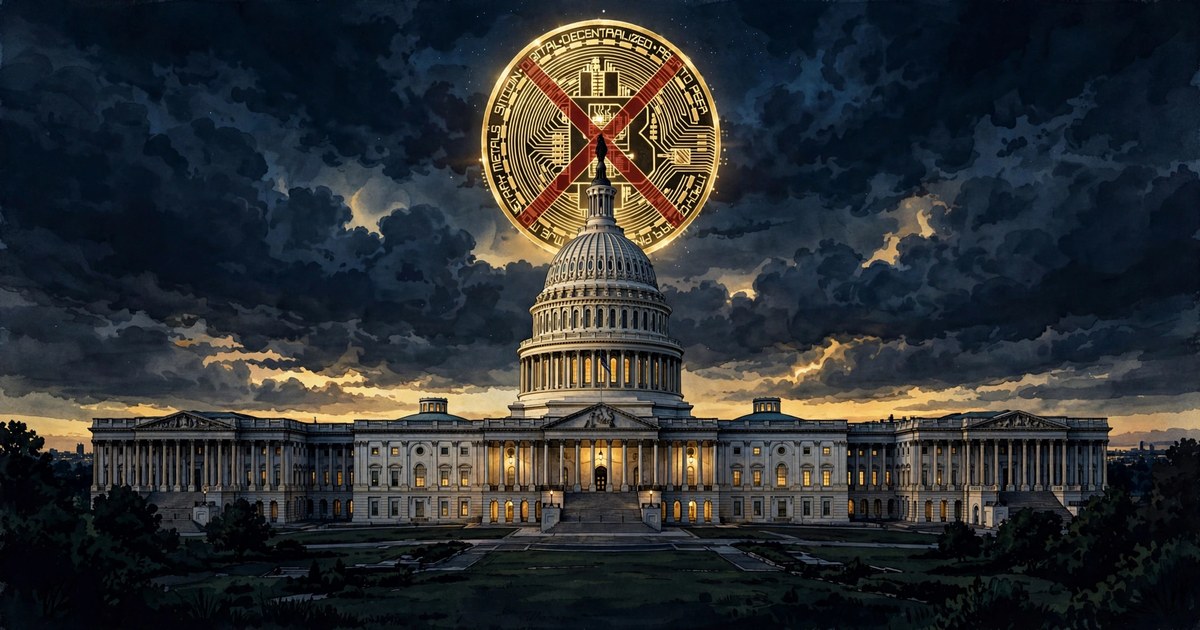
SEC Just Redefined 'Decentralized' in 3 New Crypto Rules — What It Means for Your Tokens
The SEC's 3 new FAQ answers (Nov 2) say shared DAO voting doesn't make you a controlling group — but 1 unilateral power, like freezing a wallet, still means central control. Run these 5 checks on any token you hold.

On November 2, 2026, the U.S. Securities and Exchange Commission quietly answered the question that has haunted crypto for a decade: when is a token network actually decentralized? The answer, buried in three new FAQ entries numbered 1.4, 1.5 and 1.6, is that shared governance does not automatically mean centralized control — but a single person who can freeze your wallet, reverse your transaction or rewrite the voting rules still does. If you hold governance tokens, stake through a DAO, or invest in any project that calls itself decentralized, these three answers change how your tokens are classified — and what happens to them next.
This is not a new law. The SEC's Division of Corporation Finance was explicit: the FAQ is staff guidance, it carries no legal force, and the Commission has neither approved nor disapproved it. But it is the clearest map the agency has ever published of the line between a digital commodity and a security — and it arrives days before the U.S. midterm elections, while Congress is still debating the CLARITY Act that would settle the question in statute. Here is what the three new answers actually say, what most people are getting wrong about them, and the five checks you can run on any token you hold.
What the SEC actually published on November 2
The Division of Corporation Finance added questions 1.4 through 1.6 to its crypto asset FAQ, expanding on the agency's March 2026 interpretation of federal securities laws. That March framework, effective March 23, 2026, sorts crypto assets into five categories: digital commodities, digital collectibles, digital tools, stablecoins and digital securities. Crucially, it separates a token's classification from whether a particular sale of that token creates an investment contract — a token can be one thing while a transaction involving it is another.
The November additions answer the governance questions the March framework left open. Journalist Eleanor Terrett flagged the update the same evening, describing it as an effort to answer some of the decentralization questions the CLARITY Act would address in law. Crypto lawyer Miles Jennings welcomed it, saying it clarifies how systems can maintain decentralized governance while using legal entities such as DUNAs — decentralized unincorporated nonprofit associations. The FAQ itself does not name DUNAs or approve any particular organization, but the direction is unmistakable.
Three themes run through all three answers: coordination matters more than participation, unilateral power matters more than titles, and working software is not the same thing as a decentralized network. Each answer deserves a closer look.
Question 1.4: Voting together does not make you a controlling group
The first new answer tackles the fear that has kept many token holders away from governance: if thousands of strangers vote on a protocol's future, does the SEC treat them as a single controlling group? The staff's answer is no — with conditions.
Participants generally will not be considered a central-party group if they are unaffiliated and have no separate agreement or understanding to act together outside their participation in governance. Formal arrangements, informal coordination and delegation all fall within that assessment — so a voting bloc that coordinates off-chain, or a set of delegates who always vote together under a private deal, could still count as a group. But ordinary, independent participation in an open governance process does not.
The same approach applies when governance sits inside an organization, association or foundation, and when participation depends on holding the system's native token. Even where participants do qualify as a group, the staff says they must possess operational, economic or voting control to meet the central-party definition. Being a group is not enough; the group must actually be able to run the thing.
A footnote adds the quality test: qualifying governance must be transparent and rules-based, with diverse stakeholders independently contributing to decisions. Proposals, deliberations, voting and implementation must be publicly accessible, and decision-making authority cannot be concentrated through affiliated participants or delegation. In other words, a DAO whose votes are public, whose participants are genuinely independent, and whose power is not quietly funnelled through a handful of delegates passes this test. A DAO that is a rubber stamp for an insider circle does not — no matter what its website claims.

Question 1.5: The one power that still means central control
The second answer is the sharpest, and the one with the most immediate consequences for token holders. It explains what it means for a central party to oversee participation — at the protocol level, the validator level and the user level.
The staff lists the powers that count: granting or limiting access, changing voting procedures, deciding who validates transactions, modifying code, reversing transactions, or revoking access. Each example concerns a power a central party can exercise unilaterally. If one person or one coordinated group can freeze your account, roll back your trade, pick the validators, or rewrite the rules without going through governance, that is central oversight — and the network is not decentralized in the SEC's eyes, whatever its marketing says.
By contrast, the answer describes circumstances where material operations run automatically through rules-based code without anyone exercising discretion. Where discretion remains, it can be exercised solely through the system's governance process — provided the participants themselves do not constitute a central party under question 1.4. The two answers work as a pair: governance is legitimate only if the governors are independent, and automation is legitimate only if no one holds a unilateral override.
There is a sting in a separate footnote: an association or foundation could still control another crypto system, including by setting operating parameters for applications deployed on the underlying network. A foundation that claims to be hands-off while quietly setting the parameters for every app built on its chain is still a central party. This is the detail that should worry investors in projects where a foundation controls the front door, the validator set, or the upgrade keys.

Question 1.6: A working product is not a decentralized network
The third answer corrects one of the most common confusions in crypto. Functionality and decentralization answer different questions. A system is functional when its native asset can be used in accordance with its programmed utility — the token does what it was designed to do. Decentralization concerns autonomous operation without a person, entity or coordinated group holding operational, economic or voting control.
A token can therefore be fully functional and still centralized. A slick app, millions of users and a token that works exactly as advertised prove nothing about who controls the network. The staff says functional systems associated with digital commodities have characteristics of decentralization, although the degree depends on their circumstances — a deliberately qualified statement, not a blanket clearance.
This distinction matters for anyone evaluating a project by its product. A working product is evidence of execution, not of decentralization. The decentralization question is always about control: who can change the rules, who can stop the system, and who can override the users.
Old test vs. new test: what changed
| Question | Before November 2 | After the new FAQ answers |
|---|---|---|
| Does voting in a DAO make you a controlling group? | Unclear — governance participation itself raised central-party risk | No, if participants are unaffiliated with no separate agreement to act together |
| Does a foundation or association kill decentralization? | Feared to — legal entities looked like central parties | Not automatically — but a foundation that sets app parameters can still be one |
| What proves central control? | Vague "efforts of others" analysis | Specific unilateral powers: freeze, reverse, pick validators, rewrite voting rules |
| Does a working product prove decentralization? | Often assumed so in project marketing | No — functionality and decentralization are separate questions |
| Is this the law? | — | No — staff guidance only; a future SEC can rewrite it, and Congress can override it |
5 myths traders get wrong about the new SEC guidance
Myth 1: "The SEC just declared my token a commodity." Wrong. The FAQ gives a framework for analysis, not a verdict on any token. Question 1.4 is expressly limited to digital-commodity classification under Section III of the March interpretation; it does not apply to other securities-law provisions addressing groups, including the Exchange Act definition of an exchange. No token was cleared by this update.
Myth 2: "DAOs are now safe from securities law." Wrong. The guidance helps DAOs whose governance is genuinely open and independent. A DAO controlled by an affiliated insider group, or one whose foundation holds unilateral override powers, fails the same test it always failed — now with the failure spelled out in the staff's own examples.
Myth 3: "An FAQ is as good as a law." Wrong, and the SEC says so itself. The FAQ represents staff views, creates no new obligations, and can be rewritten by a future SEC. Commentator Avi Lev made exactly this point in reaction to the update, questioning whether it reduces or increases pressure on lawmakers to pass the CLARITY Act. Guidance is a weather vane, not a foundation.
Myth 4: "This only matters to lawyers and founders." Wrong. Classification decides whether a token can list on U.S. exchanges, whether ETFs can hold it, and whether platforms can offer it to retail users. The SEC's parallel moves — Regulation Crypto Assets, proposed in August 2026, and the freeze affecting 90-plus crypto ETF applications — show that classification is the gate through which every token's U.S. market access passes.
Myth 5: "Decentralization is a yes-or-no label." Wrong. The staff repeatedly frames decentralization as a matter of degree depending on circumstances. A network can be decentralized in its validation but centralized in its upgrade keys, or open in governance but closed in access. The right question is never "is it decentralized?" but "decentralized in which decisions, and who holds the override?"
Why this landed now: Circle, CLARITY and the midterm clock
The timing is not accidental. Circle, the stablecoin issuer, submitted comments to the SEC on October 20 urging the agency to protect permissionless institutional networks — including its own Arc Network, which uses a permissioned set of known validators — and to keep Regulation Crypto Assets consistent with the GENIUS Act, the first federal stablecoin statute. Circle asked the SEC to cut the 2% broker-dealer haircut on GENIUS-compliant payment stablecoins to zero and to clarify that technical services performed after a network becomes functional do not constitute essential managerial efforts. The November FAQ answers the governance half of that argument: a permissioned validator set is not automatically a central party, but unilateral control over who validates is.
Meanwhile, the legislative clock is ticking. The CLARITY Act would settle token classification in statute, but it has not passed. As one Washington analysis put it this week, crypto's Washington playbook has delivered real wins — GENIUS, the repeal of the broker rule, bipartisan votes on market structure — but without a definitive framework from Congress, regulators are filling the void, and for the next two years the SEC, CFTC and other agencies will carry most of the crypto agenda. The November 2 FAQ is the SEC carrying that agenda in public.
And the midterm elections on November 3 could change who writes the next chapter. A shift in Congress changes the odds for CLARITY; a shift in the White House eventually changes who runs the SEC. Guidance issued days before an election is guidance that can be revisited after it.
5 checks to run on any token you hold
Use the SEC's own logic as a checklist before you buy, stake or vote:
- Who can freeze or reverse? If any single party can freeze wallets, reverse transactions or revoke access unilaterally, the network fails question 1.5 — regardless of its "decentralized" branding. Check the project's docs for admin keys, pause functions and multisig thresholds.
- Who picks the validators? A permissioned validator set is not fatal, but unilateral power to add or remove validators is a central-control flag. Look for transparent, rules-based validator selection.
- Are governors genuinely independent? Under question 1.4, check whether top delegates are affiliated, whether voting power concentrates through delegation, and whether proposals and deliberations are publicly accessible. A DAO where three wallets decide everything is a company with extra steps.
- Does the foundation set the rules for apps? The footnote trap: a foundation that controls operating parameters for applications on its network can itself be the central party, even if the base chain looks open.
- Is "working" being sold as "decentralized"? Under question 1.6, separate the two. A great product with a centralized kill switch is a great product — and a centralized network. Price the centralization risk accordingly, and keep self-custody in mind: our guide to best crypto wallets in 2026 explains how hardware wallets limit what any central party can do to your holdings.
The same logic applies across the ecosystem. If you stake, read crypto staking explained to see how validator selection and lockups interact with control. If you use decentralized exchanges, our guide to DEXs shows why on-chain trading venues became the fallback after the $6.3B Binance hack. And if you are new to the whole space, What Is DeFi? explains the governance models the SEC is now grading.
What happens next: 6 dates that decide this story
- November 3, 2026 — U.S. midterms. Results reshape the odds for the CLARITY Act and future SEC leadership.
- November 5, 2026 — Zcash NU7 upgrade. A live test of how a privacy network's governance handles a major upgrade under the new lens.
- November 12, 2026 — USDC becomes Europe's first "significant" stablecoin. The EU's 60% reserve rule takes effect, a parallel classification regime to watch.
- November 15, 2026 — Solana ETF deadline. Classification questions feed directly into which ETFs the SEC lets through its current freeze.
- Late 2026 — Regulation Crypto Assets finalization. The proposed rule's 60-day comment period closed October 20; the final rule will convert guidance like this FAQ into binding requirements.
- 2027 — CLARITY Act window. If Congress does not legislate, the SEC's staff guidance remains the de facto rulebook — and a future SEC can rewrite it at will.
FAQs
Did the SEC declare any specific token a commodity on November 2?
No. The update adds three staff FAQ answers about governance and decentralization under the March 2026 interpretation. It clears no token and creates no new legal obligations. Classification remains case-by-case.
Does voting in a DAO now make me part of a controlling group?
Generally no, if you are unaffiliated with other voters and have no separate agreement to act together. But coordinated voting blocs, affiliated delegates and private vote-swapping deals can still constitute a group — and the group must also hold operational, economic or voting control to count as a central party.
What is the single biggest red flag for centralization?
Unilateral override power: the ability of one party to freeze accounts, reverse transactions, pick validators, change voting procedures or modify code without going through governance. That is the staff's clearest test in question 1.5.
Is the FAQ legally binding?
No. It is staff guidance from the Division of Corporation Finance. The Commission has neither approved nor disapproved it, and a future SEC can revise it. Only Congress, through legislation like the CLARITY Act, or a formal SEC rule can settle the question permanently.
How does this affect stablecoins like USDC?
Indirectly but importantly. Circle's October 20 comments asked the SEC to align Regulation Crypto Assets with the GENIUS Act and to treat GENIUS-compliant payment stablecoins as settlement assets. The FAQ's governance logic — permissioned validators are not automatically central parties — supports that argument, but the final rule will decide it.
Should I sell tokens that look centralized under this test?
Not on this guidance alone. Centralization is a risk factor, not a verdict: it affects listing prospects, ETF eligibility and regulatory exposure, but many centralized projects continue to operate and trade. Use the five checks above to price the risk, diversify, and keep assets you cannot afford to lose in self-custody.
Conclusion
The SEC's three new answers do something rare in crypto regulation: they give ordinary holders a usable test. Independent voters are not a controlling group. Unilateral freeze-and-reverse power is central control. A working product is not a decentralized network. Those three sentences are the whole update — and they are enough to grade almost any project in the market.
But the update's limits matter as much as its content. It is guidance, not law; it clears no token; and it arrives days before an election that could change the people writing the next version. Treat it as the clearest map available, not as the destination. The projects that pass its tests — open governance, no unilateral overrides, genuinely independent participants — are the ones built to survive whatever Congress and the next SEC decide. The ones that fail it were never as decentralized as their marketing claimed; now the SEC has said so in writing. Sources: Crypto.news on the SEC FAQ update, PYMNTS on Circle's SEC comments, CoinDesk on crypto's Washington playbook.