US Digital Dollar Banned Until 2031: How a Housing Bill Killed the Fed's CBDC — and Why Stablecoins Won
The Fed may not issue a digital dollar through December 31, 2030 — a ban buried in a housing bill that left private stablecoins untouched. Here are the 5 differences between a CBDC, a stablecoin and cash, plus the 2027 and 2028 GENIUS Act deadlines that decide your money.
The Answer in Three Lines
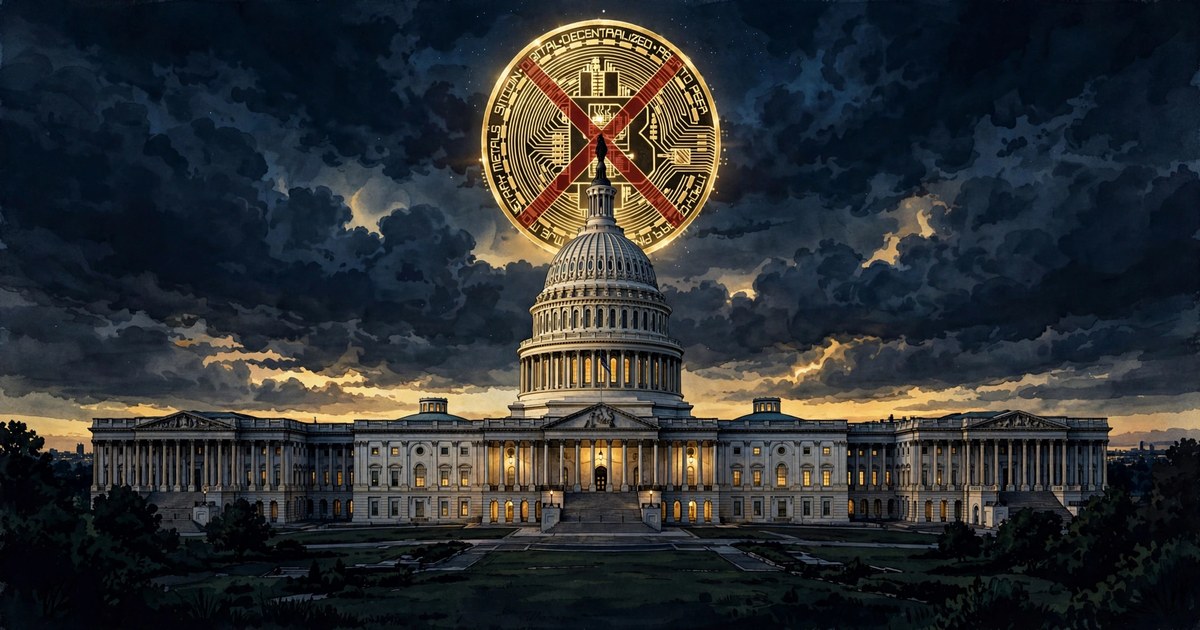
The United States will not get a government-issued digital dollar until at least 2031. A law enacted in July 2026 bars the Federal Reserve from issuing a central bank digital currency (CBDC) through December 31, 2030 — and the ban was buried inside a housing bill, not a crypto bill. Private stablecoins were explicitly left out of the ban, which is why the real winner of America's digital-money fight is not the Fed, but companies like Circle and Tether operating under the new GENIUS Act.
If you hold crypto, use stablecoins, or just wonder whether your dollars will one day live in a Fed app, this is the law that answers the question — and the deadlines around it matter more than the headlines suggest.
How a Housing Bill Killed the Digital Dollar
The story starts with an unlikely vehicle: the 21st Century ROAD to Housing Act, a 300-page bill about housing and financial matters. Near the end of the bill, Title XI added Section 423 to Title 12 of the U.S. Code, creating the first statutory prohibition on a Federal Reserve digital dollar. The provision advanced on an overwhelming 84–6 procedural vote in the Senate and became law in July 2026, according to reporting on the legislation.
The language is blunt. The Board of Governors of the Federal Reserve System and the Federal Reserve Banks "may not issue or create a central bank digital currency or any digital asset that is substantially similar to a central bank digital currency directly or indirectly through a financial institution or other intermediary." In other words, the Fed cannot launch a retail digital dollar itself, and it cannot quietly do it through a bank middleman either.
This was not the first attempt. A standalone Senate bill, the "No CBDC Act" (S. 464), introduced by Senator Mike Lee in February 2025, stalled. The House passed its own version, the "Anti-CBDC Surveillance State Act" (H.R. 1919), by 219 votes to 210 on July 17, 2025, but it never cleared the Senate. The housing bill succeeded where standalone crypto bills failed, precisely because the CBDC language rode along with must-pass legislation. A January 2025 executive order had already prohibited federal agencies from establishing a CBDC; the July 2026 law turned that policy into statute.
The debate flared up again in late October 2026, when Senator Bill Hagerty of Tennessee — the author of the GENIUS Act stablecoin law — warned in an interview published on October 29 that a government-issued digital dollar could threaten financial freedom. His warning landed just as Washington was finalizing the rules for the private alternative: payment stablecoins issued by private companies under federal law.
What the Ban Actually Covers — and What It Does Not
The law is narrower than the slogans suggest, and the details decide what it means for your money. Under 12 U.S.C. § 423, a "covered CBDC" has four attributes: it is denominated in U.S. dollars, it constitutes U.S. currency, it is a direct liability of the Federal Reserve, and it is widely available to the general public. A retail digital dollar — an account or token every American could hold directly with the Fed — fits that definition exactly.
Three things the ban does not do matter just as much:
- It does not ban private stablecoins. The law explicitly preserves dollar-denominated currency that is "open, permissionless, and private." USDT, USDC and other private stablecoins are untouched — and, as explained below, that carve-out is the whole point.
- It does not ban wholesale experiments. The prohibition targets a retail, general-public CBDC. Research and interbank settlement work is a different question, and the Fed has long said it would not issue any CBDC without congressional approval anyway.
- It is not permanent. The prohibition sunsets on December 31, 2030. Its expiration would not automatically authorize a digital dollar on January 1, 2031 — Congress would still need to pass separate authorizing legislation. But after 2030, the legal door is no longer bolted shut, and one proposal already floated in Congress would make the ban permanent instead.
That sunset is the most misunderstood part of the story. Headlines that say "America banned the CBDC forever" are wrong. What Congress did was freeze the question for roughly four and a half years, handing the market to private issuers in the meantime.
CBDC vs Stablecoins vs Cash: 5 Differences That Decide Your Money
The comparison below is the fastest way to understand what changed. A CBDC and a stablecoin can look identical on a phone screen — both are digital dollars — but who issues them, what backs them, and who can see your transactions are completely different.
| Fed CBDC (now banned) | Private stablecoin (legal, regulated) | Physical cash | |
|---|---|---|---|
| Issuer | The Federal Reserve | Private company (e.g. Circle, Tether) | The U.S. Treasury / Fed |
| What backs it | Direct Fed liability | Reserves held by the issuer under GENIUS Act rules | Full faith and credit of the U.S. |
| Who holds your account | Potentially the central bank itself | A private issuer, exchange or wallet | You, in your pocket |
| Privacy | Transactions potentially visible to the issuer | Pseudonymous on-chain, but issuers can freeze tokens | Fully anonymous |
| Status in the U.S. | Banned for retail use through Dec. 31, 2030 | Legal under the GENIUS Act from Jan. 18, 2027 | Legal tender, always |
The privacy row is why the ban's supporters fought so hard. Critics of a CBDC, including the White House, have argued it could "pose significant threats to personal privacy and liberty" — a government ledger of every purchase, in the worst-case telling. Supporters of a CBDC answer that a well-designed digital dollar could include privacy protections, and that cash is already disappearing. Both arguments are about the same fact: whoever issues digital money can, in principle, see how it moves.
Banks had a second, quieter objection. A retail CBDC could pull deposits out of commercial banks and into the Fed, undermining banks' core business of taking deposits and lending them out. That argument, backed by banking groups, helped the ban win bipartisan support — the Senate procedural vote was 84–6, not a party-line fight.
Why Stablecoins Won Instead
While the CBDC door was closing, Congress opened a different one. The GENIUS Act, signed into law on July 18, 2025, created the first federal framework for payment stablecoins. The Senate passed it 68 to 30 on June 17, 2025, and the House followed 308 to 122 on July 17, 2025. If you want the full breakdown of how that law works, read our guide to the GENIUS Act stablecoin licensing rules.
The GENIUS Act takes effect on January 18, 2027, and the implementation machinery is now moving fast. On October 21, 2026, the Office of the Comptroller of the Currency (OCC) announced final implementation rules, published in the Federal Register on October 23. Then, on November 2, 2026, the Treasury Department proposed a rule implementing Section 3 of the GENIUS Act — the section that decides who may issue, offer and sell payment stablecoins in the United States.
The Treasury proposal is strict. Only a "permitted payment stablecoin issuer" (PPSI) may issue a payment stablecoin in the U.S., and knowing participation in a violation can draw a fine of up to $1 million per violation, imprisonment of up to five years, or both. Digital asset service providers will be barred from offering or selling a non-PPSI stablecoin to Americans from July 18, 2028, and foreign issuers must show they can comply with lawful orders and reciprocal arrangements once the Act takes effect on January 18, 2027. Limited safe harbors exist for de minimis volumes and unusual circumstances.
At the same time, the industry is lobbying for stablecoins to be treated even more like cash. Circle, the issuer of USDC, has formally asked the Securities and Exchange Commission to give qualifying payment stablecoins "cash treatment" under its proposed crypto-asset framework — including cutting the standard broker-dealer "haircut" deduction from 2% to zero for eligible stablecoins. The SEC has not adopted that request; it is a policy ask, not a rule. But it shows the direction of travel: stablecoins want to be treated as dollars, not as exotic assets.
Put together, the picture is a deliberate American choice: no government digital dollar, and a regulated private stablecoin market instead. Europe made the opposite bet with its digital euro project; America chose private issuance under  public rules.
What This Means for Your Crypto and Your Cash
For most holders, the practical consequences are straightforward:
- No Fed wallet is coming. You will not be offered a Federal Reserve account or a Fed digital-dollar app before 2031 at the earliest. Anyone claiming to sell you "FedCoin" or "the official U.S. digital dollar" is running a scam.
- Stablecoins are the regulated digital dollar. From January 18, 2027, only permitted issuers may issue payment stablecoins in the U.S., and from July 18, 2028, platforms may not offer non-compliant stablecoins to Americans. If you hold USDT or USDC, check that your issuer is on the permitted path — the compliance deadlines are now dated, not theoretical.
- Your bank may offer tokenized deposits instead. With a retail CBDC banned, banks are preparing tokenized deposit products — digital dollars that are bank liabilities, not Fed liabilities — as their answer to stablecoins. Expect that competition to intensify through 2027.
- Bitcoin's role is untouched. The ban is about a government digital currency, not about decentralized crypto. Bitcoin remains a private, decentralized asset, and nothing in the CBDC law changes how it works. If you are new to it, our beginner's guide to buying Bitcoin covers the basics.
- Watch the 2030 sunset, not just the 2027 deadlines. The GENIUS Act deadlines arrive first, but the CBDC ban's expiry on December 31, 2030 is the date that reopens the whole debate — in a different Congress, under a different president.
The Timeline: 5 Dates That Decide America's Digital Money
| Date | What happened / happens |
|---|---|
| January 2025 | Executive order prohibits federal agencies from establishing a CBDC. |
| July 17, 2025 | House passes the Anti-CBDC Surveillance State Act 219–210; GENIUS Act passes the House 308–122. |
| July 18, 2025 | GENIUS Act signed into law — the first federal stablecoin statute. |
| July 2026 | 21st Century ROAD to Housing Act becomes law, adding the statutory CBDC ban (12 U.S.C. § 423) through Dec. 31, 2030. |
| January 18, 2027 | GENIUS Act takes effect; Treasury's issuer rules bite; foreign stablecoin issuers face new conditions. |
| July 18, 2028 | Platforms barred from offering non-permitted stablecoins to Americans. |
| December 31, 2030 | CBDC ban sunsets — Congress would still need fresh authorization to launch a digital dollar. |
One more date belongs on every crypto holder's calendar, even though it is not a CBDC date: the broader market-structure bill, the CLARITY Act, failed a Senate procedural vote 49 to 50 on September 15, 2026, short of the 60 votes needed to advance. Any bill not enacted by January 3, 2027 dies with this Congress and must be reintroduced. That is why, for the next two years, agencies like the SEC and CFTC — not Congress — will carry most of the crypto agenda, filling the gap with rules like the Treasury's November 2 proposal.
What Could Still Change
The ban looks solid, but it is not the end of the argument. Three things could reopen it. First, a proposal floated in Congress would make the ban permanent, removing the 2030 sunset entirely — that would settle the question for good, if it passes. Second, the sunset itself guarantees a fresh fight in 2030, when a new Congress could extend the ban, let it lapse, or authorize a CBDC outright. Third, the courts and the agencies will spend years interpreting the edges: what counts as "substantially similar" to a CBDC, and whether a tokenized bank deposit crosses that line.
The politics also cut both ways. Crypto political spending topped $206 million in the 2026 midterms, with industry PACs fighting to preserve friendly lawmakers and revive stalled legislation. That money bought allies, but as the CLARITY Act's failure shows, it has not yet bought a law. And the midterm results themselves — decided on November 3, 2026 — will shape which committees write the next version of every crypto bill, including any future CBDC bill.
The honest summary is this: America has chosen private digital dollars over a government one, locked that choice in until 2031, and left the hardest questions — privacy, bank deposits, and who controls the rails — to regulators implementing the GENIUS Act. The digital dollar is dead. The dollar's digital future is just getting started.
Frequently Asked Questions
Will the US launch a CBDC?
Not before 2031. Federal law bars the Federal Reserve from issuing a retail CBDC through December 31, 2030, and even after the ban sunsets, Congress would need to pass separate authorizing legislation. No Fed digital dollar is in development for public use.
Is my USDT or USDC affected by the CBDC ban?
No — the ban explicitly exempts private, permissionless stablecoins. Your stablecoins are instead governed by the GENIUS Act, which takes effect on January 18, 2027, with platform restrictions on non-permitted stablecoins following on July 18, 2028.
What is the difference between a CBDC and a stablecoin?
A CBDC is issued by a central bank and is a direct liability of that bank; a stablecoin is issued by a private company and backed by reserves it holds. Both can be digital dollars, but the issuer, the privacy implications and the legal framework are entirely different.
Did the CBDC ban kill the digital euro or other countries' CBDCs?
No. The U.S. law binds only the Federal Reserve. Other central banks, including the European Central Bank with its digital euro project, make their own decisions.
Could Congress make the CBDC ban permanent?
Yes — proposals to remove the 2030 sunset have been floated, including an amendment associated with Senator Ted Cruz. None has passed so far, so the current law expires on December 31, 2030 unless Congress acts.
Should I move my money because of the CBDC ban?
No action is required by the ban itself. It does not change your bank account, your cash, or your crypto holdings. The dates that matter for holders are the GENIUS Act deadlines in 2027 and 2028, which affect which stablecoins platforms may offer — not whether your dollars still work.
Conclusion
The United States answered its digital-dollar question in the most American way possible: by hiding the answer in a housing bill. The Federal Reserve may not issue a retail CBDC through December 31, 2030, private stablecoins were carved out and handed a federal rulebook instead, and the Treasury's November 2, 2026 proposal is now filling in who gets to issue America's digital dollars. The ban is real, it is dated — not permanent — and it makes stablecoins, not the Fed, the default digital dollar for the rest of the decade.
Watch January 18, 2027 for the GENIUS Act taking effect, July 18, 2028 for the platform crackdown on non-permitted stablecoins, and December 31, 2030 for the day the CBDC question comes back. Until then, the digital dollar youctually use will be a private one — regulated, reserve-backed, and deliberately not issued by your government.
Sources: KuCoin's analysis of the U.S. CBDC ban and Senator Hagerty's October 2026 warning; CoinTelegraph's reporting on the Senate housing-bill provision; Davis Polk's client update on the Treasury's November 2, 2026 GENIUS Act Section 3 proposal; CoinDesk's November 2, 2026 analysis of crypto's Washington agenda; and MEXC's midterm-election regulation overview. This article is for information only and is not financial or legal advice.