How to Buy Bitcoin in South Korea in 2026: 5 FIU-Registered Exchanges Compared — Fees, KRW Deposits and the Tax Delay to 2029
South Korea just delayed its 22% crypto tax to 2029 — and Upbit still controls ~64% of all won trading at a flat 0.05% fee. Here are the 5 licensed exchanges where you can legally buy Bitcoin in won, what each one costs, and the bank-account rule that blocks most foreigners.
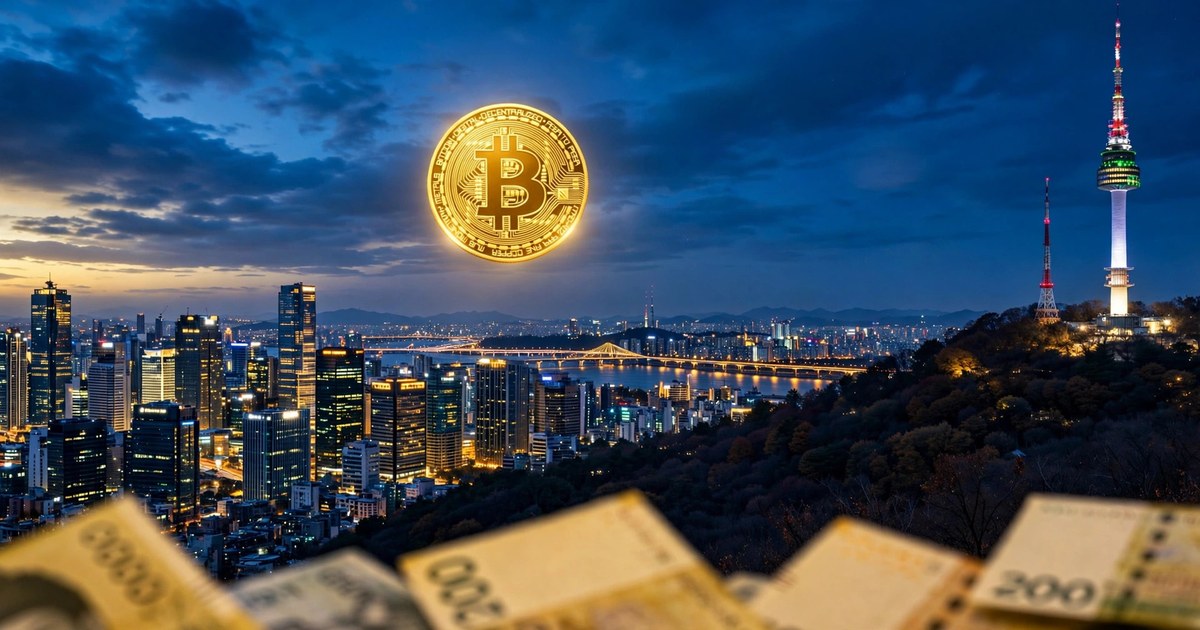
South Korea just gave Bitcoin buyers two more years of tax-free gains — and you can still buy BTC in won for a flat 0.05% fee on the country's biggest exchange. On November 5, 2026, Finance Minister Lee Hyoung-il announced the government will ask parliament to delay the 22% crypto gains tax from January 2027 to January 2029, the fourth postponement since the tax was first written into law. If you live in South Korea, that means every won of Bitcoin profit you book before 2029 is — under current law — untaxed. But there is a catch that trips up almost every newcomer: you cannot just download any exchange app and deposit won. Only five licensed platforms can legally accept Korean won, each one is tied to a single partner bank, and the global apps most people know — Binance, OKX and Bybit — were removed from Korean app stores on January 28, 2026. This guide compares all five legal options, shows exactly what each one costs, and walks through the real-name bank account rule step by step.
Can You Legally Buy Bitcoin in South Korea?
Yes. Individuals can legally buy and trade Bitcoin in South Korea, but only on exchanges registered with the Korea Financial Intelligence Unit (KoFIU) that hold an ISMS security certificate. Exchanges that trade against the won must also operate a real-name verified bank account system, supervised by the Financial Services Commission and the Financial Supervisory Service. As of early 2026, only five exchanges hold verified banking partnerships: Upbit with K Bank, Bithumb with KB Kookmin Bank, Coinone with Kakao Bank, Korbit with Shinhan Bank, and Gopax with Jeonbuk Bank. Every other platform that accepts Korean users is operating in a grey zone. In October 2026, authorities blocked 27 unregistered crypto sites, and in January 2026 the three biggest global exchanges were pulled from Korean app stores for failing to register. If you are new to Bitcoin itself, start with our beginner's guide to what Bitcoin is before you open an account.
The 5 Licensed Exchanges Compared
Here is the full comparison. Fees are the standard spot rates on won pairs; the cheapest headline rate is not always the cheapest deal once coupons and withdrawal fees are counted.
| Exchange | Won-market fee | Coins listed | Partner bank for KRW | Won withdrawal | Best for |
|---|---|---|---|---|---|
| Upbit | 0.05% flat | 340+ | K Bank | ₩1,000 | Beginners and the deepest won liquidity |
| Bithumb | 0.25% standard, 0.04% with 30-day coupon | 490 | KB Kookmin Bank | ₩1,000 | Altcoin choice and the lowest possible fee |
| Coinone | 0.20% | 385 | Kakao Bank | Varies | Bitcoin staking and Kakao users |
| Korbit | 0.20% (approx.) | 100+ | Shinhan Bank | Varies | Shinhan Bank customers |
| Gopax | 0.20% (approx.) | 100+ | Jeonbuk Bank | Varies | Jeonbuk Bank customers |
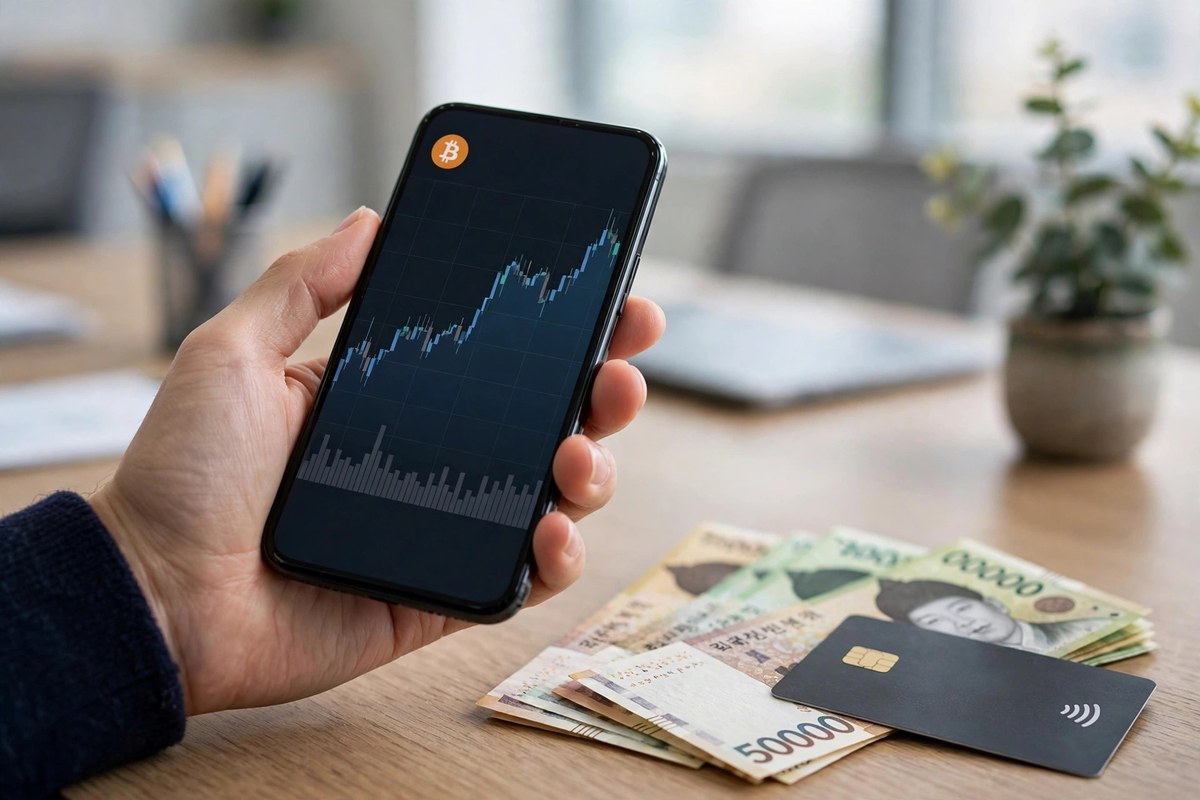
Upbit settles more won trades than all other Korean exchanges combined. Financial Supervisory Service data put its share of trading on the five won exchanges at 71.6% in the first half of 2026; by October that figure had fallen to about 64% after competitors launched fee-free campaigns, according to Datawallet's comparison of Korean exchanges. That dominance matters for buyers: deeper liquidity means tighter spreads, so a market order on Upbit usually executes closer to the quoted price than on a smaller venue. Bithumb answers with the largest coin selection in Korea at 490 assets and a coupon system that cuts its headline 0.25% fee to 0.04% — lower than Upbit — but only if you remember to renew the coupon every 30 days. Miss the renewal and you pay more than five times Upbit's rate on the same trade.
Upbit: The Default Choice for Most Buyers
Upbit is the exchange most Koreans mean when they say "crypto exchange." Founded in 2017, it charges a flat 0.05% on won-market limit and market orders — no tiers, no coupons, no surprises. Stop-limit orders cost 0.139%, BTC and USDT markets charge 0.25%, and trading in USDT, USDC and USDe has been free since July 26, 2026. Won deposits are free but must come from a K Bank account in your own name, and won withdrawals cost ₩1,000. Bitcoin withdrawals cost 0.0009 BTC, the lowest of the big two.
Bithumb: The Cheapest Fee — If You Do the Admin
Bithumb, founded in 2014, is Korea's oldest major exchange and its largest by coin count, with 490 assets listed. Its standard won-market fee is 0.25%, but a renewable 30-day coupon cuts that to 0.04%, the lowest rate on any licensed Korean exchange. BTC-market trades are free, and won-market API trading has been free since August 21, 2026. Funding requires a KB Kookmin Bank account, following the switch from NH Nonghyup in March 2025. There are no futures or margin products — Bithumb is a spot-buying venue with staking for Korean users, auto-trading and third-party bots.
Two 2026 incidents explain why Bithumb's price is worth watching rather than assuming. In February 2026, a promotional payout error credited about 620,000 BTC to hundreds of users — far more than the exchange's reserves. Then on March 17, the FIU imposed a ₩36.8 billion fine and a six-month partial suspension on new-customer transfers over anti-money-laundering failures. Neither event stopped trading, but together they are a reminder to keep only trading funds on any exchange.
Coinone, Korbit and Gopax: The Smaller Three
Coinone charges a flat 0.20% fee for main-market trades and banks with Kakao Bank, which makes it the natural pick for the millions of Koreans who already bank with Kakao. It also launched Korea's first Bitcoin staking service in 2025 via the Babylon Protocol — a way to earn yield on BTC without bridging it to another chain. VIP traders with monthly volume above ₩3 billion can reach 0% maker fees. Korbit, partnered with Shinhan Bank, and Gopax, partnered with Jeonbuk Bank, are smaller venues whose main attraction is convenience: if you already hold an account at their partner bank, onboarding is one step shorter. For most buyers the realistic choice is Upbit or Bithumb, with Coinone as the third option for Kakao Bank customers and anyone who wants to stake Bitcoin. Before deciding how much to buy, read our honest guide on whether Bitcoin is a good investment in 2026 — it covers the risks, the drawdowns and how to size a position you can actually hold.
How to Buy Bitcoin in South Korea: 5 Steps
The process is the same on all five licensed exchanges. The only part that surprises newcomers is step two: your bank account decides your exchange, not the other way around.
Step 1: Pick the exchange that matches your bank
Check which bank you hold a real-name account with. K Bank means Upbit, KB Kookmin Bank means Bithumb, Kakao Bank means Coinone, Shinhan Bank means Korbit, Jeonbuk Bank means Gopax. Opening a new bank account just to use a particular exchange is possible, but it adds days to the process — for most people, the bank they already have is the right answer.
Step 2: Verify your identity and link your real-name account
Sign up with your email, submit your ID and a live selfie, then link the real-name verified bank account in your own name at the exchange's partner bank. This is the rule that defines Korean crypto: under the Specific Financial Information Act, won deposits must come from a bank account in your own name at the exchange's partner bank. No third-party deposits, no cash, no exceptions. Foreign residents need an Alien Registration Card, a Korean phone number and a Korean address, plus the partner-bank account — without all four, the domestic exchanges are effectively closed to you.
Step 3: Deposit Korean won
Send won by bank transfer from your linked account. Deposits are free on Upbit and Bithumb. There is no card option for won deposits on the domestic exchanges; cards only work on international platforms, at much higher fees.
Step 4: Place your order
Search for BTC/KRW, check the price, and place a limit order if you want a specific price or a market order if you want instant execution. On a ₩1,000,000 purchase, Upbit's 0.05% fee costs ₩500; Bithumb's standard 0.25% costs ₩2,500, or ₩400 with the coupon active. That ₩2,100 difference is small on one trade and large across a year of regular buying. If you plan to buy every month, the coupon habit or the flat 0.05% rate is worth more than any sign-up bonus.
Step 5: Decide where the Bitcoin lives
Coins left on an exchange are an IOU from that exchange. After the $6.3 billion Binance hack in October 2026 — the largest in crypto history — and the Bithumb payout error earlier this year, the case for self-custody is no longer theoretical. If you are holding for months or years, withdraw to a wallet you control. If you are trading actively, keep only what you need for the next few trades on the exchange. Staking is the middle path: Coinone's Babylon-based Bitcoin staking and the wider staking market let long-term holders earn yield, and our crypto staking guide for 2026 explains how it works across ETH, SOL and ADA.
The Tax Delay to 2029: What Actually Changed on November 5
The biggest news for Korean Bitcoin buyers this month has nothing to do with price. South Korea's 22% tax on crypto gains — 20% national tax plus 2% local tax on annual gains above a ₩2.5 million deduction (about $1,870) — was due to start on January 1, 2027. On November 5, Finance Minister Lee Hyoung-il announced the government will ask the National Assembly to push it to January 1, 2029, a day after the ruling Democratic Party formally requested the delay, as AsiaTokenFund reported. Lawmaker Park Min-kyu had already introduced an amendment on October 16 with the same 2029 date. Nothing is final yet: current law still says 2027, and only an amendment passed before January can stop it. But with the presidential office, the ruling party and the finance ministry all aligned, a fourth postponement is now the expected outcome.
This is the fourth delay for a tax first approved in 2020 and originally scheduled for 2022, then pushed to 2023, 2025 and 2027. The reason given this time is unusually technical: under the OECD's Crypto-Asset Reporting Framework (CARF), South Korea begins exchanging crypto transaction data with partner countries in 2027, but the United States — home to several offshore platforms Korean traders use heavily — does not join until 2029. Taxing domestic exchange users from 2027 while offshore gains stayed invisible would punish the platforms that comply and push traders offshore, officials argued, a problem KuCoin's coverage of the delay also highlights. Alongside the delay, the ministry wants a three-year loss carryforward, so a loss realized in 2029 could reduce taxable gains through 2032. For buyers, the practical meaning is simple: two more years in which crypto gains are not taxed, and a reporting system that will eventually see everything anyway. Keep records of every purchase price from day one — when the tax does arrive, your cost basis is the difference between paying 22% and paying it on the wrong number.
| Date | What happened |
|---|---|
| 2020 | Tax framework approved: 20% national + 2% local tax on annual gains above ₩2.5M |
| 2022 → 2023 → 2025 → 2027 | Start date postponed three times |
| Oct 16, 2026 | Lawmaker Park Min-kyu introduces amendment to delay to January 2029 |
| Nov 3, 2026 | National Assembly finance committee agrees more time is needed |
| Nov 5, 2026 | Finance Minister announces government will seek the delay to 2029 |
| Before Jan 2027 | National Assembly must pass the amendment, or the 2027 start stands |
| Jan 2029 (proposed) | Tax starts, with a three-year loss carryforward; US joins CARF data exchange |
Can Foreigners and Tourists Buy Bitcoin in South Korea?
Tourists effectively cannot use the five domestic exchanges: without an Alien Registration Card, a Korean phone number, a Korean address and a real-name account at the partner bank, there is no way through onboarding. Foreign residents who have lived in Korea for more than a year and hold an ARC can open accounts, and the process is the same five steps above. If you are visiting short-term, the realistic options are to buy before you travel or use an international platform that accepts cards; some services charge from 1.49% for card purchases, roughly thirty times Upbit's 0.05% won-market fee. The same logic applies in reverse for Koreans travelling abroad: our guide to buying Bitcoin in Germany shows how the process differs in a MiCA-regulated European market.
5 Mistakes That Cost Korean Bitcoin Buyers Money
- Using an unregistered exchange: Binance, OKX and Bybit were removed from Korean app stores in January 2026, and 27 unregistered sites were blocked in October. If a platform cannot legally take won, your deposits have no local protection.
- Forgetting Bithumb's coupon: the 0.04% rate only applies while the 30-day coupon is active. Let it lapse and the same trade costs 0.25% — more than five times as much.
- Depositing from the wrong account: won must come from your own real-name account at the partner bank. A transfer from another bank, a family member's account or a fintech wallet will be rejected or frozen.
- Leaving long-term holdings on an exchange: the Binance hack and the Bithumb payout error both happened in 2026. Withdraw holdings you do not plan to trade into a wallet you control.
- Ignoring your cost basis: the tax is delayed, not cancelled. Without purchase records, the 22% rate will eventually be calculated on numbers you cannot prove.
Bitcoin Price Context: Why November 2026 Is a Buyer's Market
Timing matters less than the mechanics above, but the context is worth knowing. Bitcoin traded near $76,000 on November 5, 2026 — about 40% below its $126,080 peak — after a $120 billion market-wide sell-off driven by a rout in AI stocks and more than $1 billion in leveraged liquidations, as CoinDesk reported. The Fear and Greed Index sat in Fear territory. For a first-time buyer, that is the point of a plan rather than a prediction: decide a fixed won amount, buy on a schedule, and let the fee comparison in this guide — not the daily chart — decide where you buy.
Frequently Asked Questions
What is the cheapest way to buy Bitcoin in South Korea?
Upbit's flat 0.05% won-market fee is the cheapest rate you can get without doing anything extra. Bithumb's 0.04% coupon rate is technically lower, but only while the 30-day coupon is active; at its standard 0.25% it is the most expensive of the five. For a one-off buyer, Upbit wins. For an active trader who renews the coupon every month, Bithumb wins by a hair.
Do I need a Korean bank account to buy Bitcoin in Korea?
Yes, for won deposits on any licensed domestic exchange. Each exchange accepts won only from its partner bank: K Bank for Upbit, KB Kookmin Bank for Bithumb, Kakao Bank for Coinone, Shinhan Bank for Korbit and Jeonbuk Bank for Gopax. The account must be a real-name verified account in your own name.
Is Bitcoin taxed in South Korea in 2026?
No. There is currently no crypto capital gains tax for retail investors. The planned 22% tax on annual gains above ₩2.5 million was scheduled for January 2027, but on November 5, 2026 the government announced it will seek a delay to January 2029. The change still needs the National Assembly to amend the Income Tax Act before January 2027.
Can I use Binance in South Korea?
Not through the official route. Binance, OKX and Bybit were removed from Korean app stores on January 28, 2026 for failing to register with the Financial Intelligence Unit, and 27 unregistered sites were blocked in October 2026. Use one of the five FIU-registered exchanges instead.
What is the kimchi premium?
The kimchi premium is the gap between Bitcoin's price on Korean exchanges and its price on global exchanges. It exists because won cannot move freely in and out of Korean exchanges — capital controls and the real-name account system keep the Korean market partly sealed off, so local demand can push the Korean price above the global price. A large premium means you are overpaying relative to the world price; check it before a big purchase.
Is it safe to keep Bitcoin on Upbit or Bithumb?
Both are FIU-registered, ISMS-certified and supervised by Korean regulators, which makes them far safer than unregistered alternatives. But no exchange is risk-free: Upbit faced an FSS sanctions review after a November 2025 theft, and Bithumb was fined ₩36.8 billion in March 2026. Keep trading funds on the exchange and move long-term holdings to a hardware wallet.
Conclusion
South Korea is one of the most tightly regulated crypto markets in the world, and that regulation is actually good news for buyers: five licensed exchanges, a real-name banking system that keeps fraud out, fees as low as 0.05%, and now a likely two-year extension of tax-free gains while the 22% levy waits for US tax data in 2029. The winning move is simple — match your bank to its exchange, buy on Upbit's flat rate or Bithumb's coupon, record every purchase price, and move holdings you plan to keep into your own wallet.
Disclaimer: This article is for information only and is not financial advice. Exchange fees, tax rules and availability change frequently — verify the current fee schedule and the status of the tax amendment before you trade.