How to Buy Bitcoin in Peru in 2026: 5 Exchanges Compared — Fees, Yape and Plin Payments and the 5% Tax Question
Yape's 20 million users can now buy Bitcoin in minutes — but Peru has no licensed exchange and no crypto tax law, so the wrong platform can cost you 4.5% in card fees. Here are 5 exchanges compared, the cheapest way to pay in soles, and the 5% tax question SUNAT still hasn't answered.
Yape has more than 20 million users in Peru — and in 2026, many of them are using it to buy Bitcoin. The catch? Peru has no licensed crypto exchange, no dedicated crypto tax law, and no official list of approved platforms. The platform you pick, the way you pay in soles, and the records you keep decide whether your first purchase is smart or expensive.
Bitcoin is trading near $76,000 in early November 2026, roughly 40% below its all-time high of $126,080. For Peruvians, that discount is exactly why searches for "how to buy Bitcoin in Peru" keep climbing — but buying at the right price means nothing if fees, spreads, and a surprise tax bill eat the gain. This guide compares 5 exchanges that actually work in Peru, shows the cheapest way to pay with Yape, Plin, PagoEfectivo or a bank transfer, and explains the one tax question even Peru's tax authority, SUNAT, has not answered yet.
Is Bitcoin Legal in Peru in 2026?
Yes. Buying, holding, selling and trading Bitcoin is legal in Peru. What it is not: legal tender. The Banco Central de Reserva del Perú (BCRP) has said repeatedly that cryptocurrencies are not legal tender and are not backed by any central bank. The official currency remains the Peruvian sol (PEN).
Peru's regulatory picture is unusual because the country regulates the businesses, not the asset. There is no single comprehensive crypto law and no licensing regime for exchanges — just anti-money-laundering rules:
- Supreme Decree 006-2023-JUS (July 2023): brought virtual asset service providers — known locally as PSAVs (proveedores de servicios de activos virtuales) — into the anti-money-laundering system as obligated subjects reporting to the UIF-Perú, the financial intelligence unit inside the SBS (Superintendencia de Banca, Seguros y AFP).
- SBS Resolution 2648-2024 (in force August 2024): set the detailed AML and counter-terrorist-financing standard (the SPLAFT regime) that PSAVs must follow.
- The Travel Rule: providers must collect and share originator and beneficiary information on transfers — in effect since around August 2026.
- Bill 1042/2021-CR: the proposed Framework Law for the Commercialization of Cryptoassets passed the congressional Economics Commission but still awaits a full vote. It has not become law.
The practical consequence is blunt: no Peruvian authority supervises your exchange account, and no platform is endorsed or prudentially supervised by the state. Foreign exchanges with no Peruvian company or branch fall outside UIF rules entirely, so disputes are handled under each platform's own terms, and crypto held on any exchange is outside deposit insurance. That is why the comparison below weighs security and proof of reserves as heavily as fees — after the record $6.3 billion Binance hack in late October 2026, "where do I keep my coins" is no longer a footnote.
One more thing to watch: the BCRP is running a digital money pilot until March 2027 and wants closer monitoring of stablecoins, while SUNAT is drafting a rule to receive crypto transaction data. The rules are tightening even without a licensing law.
5 Exchanges Compared: Fees, Soles Funding and Yape/Plin
There is no single "best" exchange for Peru, because the cheapest route depends on how you pay. P2P trades settled through Yape or Plin are usually the fastest way to turn soles into Bitcoin; bank transfers are cheapest for larger amounts; cards are the fastest and the most expensive.
| Exchange | Spot fee | Paying in soles (PEN) | Yape / Plin | Security note |
|---|---|---|---|---|
| Binance | 0.10% maker/taker | P2P in soles, CIP bank code, cards | Yes — via P2P | ADGM-regulated; SAFU emergency fund of 15,000 BTC; monthly reserve reports |
| Bybit | 0.10% | PagoEfectivo bank code (BCP, BBVA, Scotiabank, Interbank), PEN bank withdrawals | Yes — Bybit Pay since 14 January 2026 | Monthly reserve reports verified by Hacken; September 2026 report put Bitcoin at 104% of customer balances |
| OKX | 0.08% maker / 0.10% taker | P2P in soles, bank transfer, cards | Yes — via P2P | Self-custody wallet built in; monthly proof-of-reserves reports; zero-fee P2P |
| Bitget | 0.10% | P2P in soles, bank transfer, cards | Yes — via P2P | Protection fund; monthly reserve reports; copy trading for beginners |
| Kraken | 0.23% maker / 0.40% taker | Bank transfer in dollars; cards | No direct Yape/Plin | One of the longest-running regulated exchanges; strong security record |
Binance is where most Peruvians start: the deepest P2P market in soles, with dedicated pages listing Yape, Plin, BCP and Interbank, plus 500+ cryptocurrencies. Its 0.10% spot fee is standard, and the SAFU fund plus reserve reports give it a security story most rivals cannot match. The shadow is the October 2026 hack itself — Binance was the victim, but the $6.3 billion theft is a reminder that even the biggest exchange is a target. Never leave more Bitcoin on Binance than you are willing to lose in a bad week.
Bybit ranks first for soles funding in several 2026 comparisons: PagoEfectivo deposits through BCP, BBVA, Scotiabank or Interbank, PEN bank withdrawals, and Bybit Pay, which has supported Yape and Plin since 14 January 2026. Its 0.10% spot fee matches Binance. The caution flag: Bybit itself lost about $1.5 billion in Ether in February 2025, in an attack the FBI attributed to North Korea. Its reserve reports are verified by security firm Hacken.
OKX is the fee leader of the five, at 0.08% maker and 0.10% taker, with zero-fee P2P and a built-in self-custody wallet that makes it easy to move coins off the exchange — the single most important security habit a beginner can learn. Its P2P market accepts Yape, Plin and bank transfers.
Bitget matches the 0.10% spot fee, offers P2P with Yape and Plin, and adds copy trading for beginners — a learning tool, not a shortcut, because copied trades lose money exactly as fast as your own.
Kraken is the most expensive on this list at 0.23% maker and 0.40% taker, and it has no direct Yape or Plin route, so Peruvians usually fund it by bank transfer in dollars or by card. What you pay for is regulation and a long, clean security record — a fair trade for larger amounts, a poor one for a first S/100 test purchase.
Regional option worth knowing: Buda.com is a Latin American exchange popular with Peruvian beginners for its simplicity and Spanish-language interface, though its fees and liquidity are generally worse than the global platforms. A reasonable first stop; a poor choice if you trade often.
How to Buy Bitcoin in Peru: 5 Steps
The process is the same on every platform; only the funding rails change.
Step 1 — Pick your exchange and verify your identity. Have your DNI ready and a Peruvian bank account or mobile wallet registered in your name. Every legitimate exchange requires KYC — a platform that lets you buy Bitcoin with no ID check is a red flag, not a feature.
Step 2 — Fund your account in soles. For a first purchase, start small: Peruvian buying guides suggest about S/100 for a test. P2P with Yape or Plin is the fastest route — pick a seller with hundreds of completed trades and a completion rate above 98%, and never release payment outside the platform's escrow. For larger amounts, a bank transfer or PagoEfectivo code is cheaper and leaves a cleaner paper trail for your tax records.
Step 3 — Place your order. A market order buys instantly at the current price; a limit order lets you set the price you are willing to pay. At Bitcoin's current ~$76,000, a 0.10% fee on a S/500 purchase is about S/0.50 — trivial. The real cost is the spread: check the final amount of BTC you receive, not the headline fee.
Step 4 — Move your Bitcoin to your own wallet. This is the step most beginners skip and most regret. After the Binance hack, the lesson is simple: exchanges are for buying, not for storing. A hardware wallet or a reputable software wallet puts the keys in your hands. Our comparison of the best crypto wallets in 2026 walks through the options, and the beginner's guide to hot vs cold wallets explains the trade-off in plain language.
Step 5 — Save every receipt. Screenshot the Yape or Plin payment, keep the bank receipt, export the exchange's transaction history, and note the date, the amount in soles, and the BTC received. Peru's tax position is unsettled (see below), and clean records are the difference between a five-minute tax return and a painful one.
Paying in Soles: Yape, Plin, PagoEfectivo, Bank Transfer or Card?
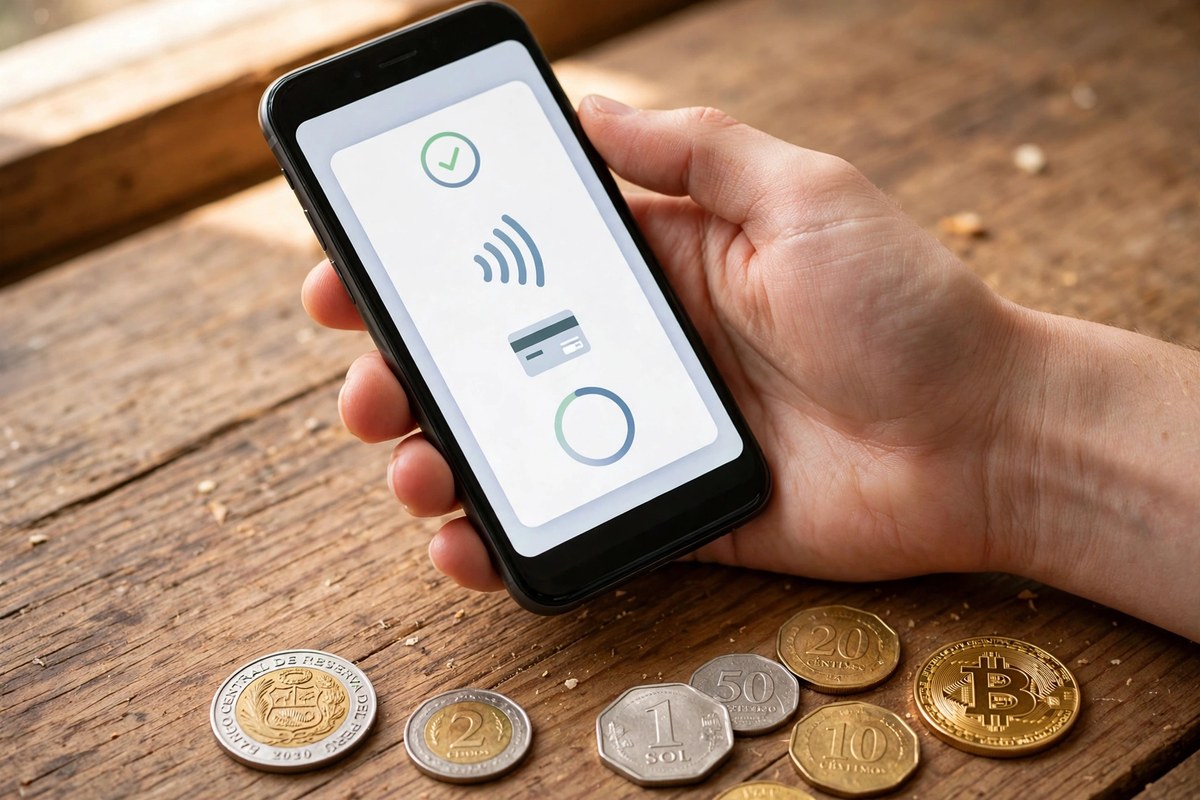
Yape and Plin dominate daily payments in Peru — Yape alone has more than 20 million users and handles over 750 million transactions a month. That is why P2P is the default way Peruvians buy Bitcoin: the buyer and seller are both already on the same app, and the transfer is instant.
But instant is not the same as free. Here is the honest cost ranking for a typical purchase:
- Bank transfer (soles or dollars): usually the cheapest funding method. Slowest for a first purchase, but the spread is smallest and the paper trail is cleanest. Best for amounts above S/1,000.
- Yape / Plin via P2P: instant, low or no platform fee, but the P2P seller's price includes a spread that is often 1–3% above the market rate. Best for small and medium purchases where speed matters more than the last sol.
- PagoEfectivo: pay a generated code at BCP, BBVA, Scotiabank or Interbank. A solid middle ground — no card fees, no P2P counterparty risk — and the main way Bybit users fund in soles.
- Credit or debit card: fastest, but the most expensive: card purchases typically add around 4.5% in fees on top of the trading fee. On a S/1,000 purchase that is S/45 gone before you own a single satoshi. Use cards only when speed genuinely matters.
One rule from Peru's bancarización law matters here: payments above S/2,000 or US$500 must use a formal medio de pago, and a stablecoin transfer is not on the list. Splitting a large purchase into smaller payments to dodge the rule creates problems with both the bank and SUNAT.
And a warning that applies to every P2P trade: the platform's escrow is your only protection. If a seller asks you to pay outside the platform, cancel the trade. If a deal looks too good — a seller offering Bitcoin 5% below market — it is a scam, every time.
The 5% Tax Question Nobody in Peru Can Answer Yet
Here is the most surprising fact in this guide: as of November 2026, Peru has no dedicated crypto tax law, and SUNAT has never published an official position on how an individual's Bitcoin gains are taxed. In a July 2023 letter, SUNAT confirmed the gap, saying Peru's legal system "does not provide specific regulation for cryptocurrencies, nor for their marketing or other types of transactions."
That leaves Peruvian buyers in a grey zone where even professional advisers disagree. The three positions you will hear:
- The 5% view: some advisers treat occasional crypto gains as capital income taxed at an effective 5% rate, the rate applied to some capital income under the Income Tax Law.
- The progressive view: other advisers argue gains fall under the foreign-source income scale, where residents add net foreign income to employment income and pay 8% to 30%. Income up to 5 UIT falls in the first band; one UIT (Unidad Impositiva Tributaria) is S/5,500 for 2026.
- The "not yet taxable" view: a third camp notes that Article 63 of the Income Tax Law requires an express statutory basis for taxing income, and without explicit crypto provisions the legal basis for taxing gains is ambiguous — so occasional gains may fall outside income tax unless the trader is frequent enough to be treated as a business.
What is not in dispute: companies pay the standard 29.5% corporate income tax on net profits, including crypto profits. The 18% general sales tax (IGV) generally does not apply to crypto transactions, and the ITF — the 0.005% financial transactions tax — does apply to soles moving through a bank account.
Change is coming, slowly. In February 2025, SUNAT's superintendent Víctor Mejía announced plans to amend the Income Tax Law to classify crypto disposals explicitly as taxable capital income, with proposed individual rates from 5% to a progressive 8–30% scale. In May 2026, SUNAT's head said the authority is drafting a rule to receive crypto transaction data and a proposal to tax gains — which the newspaper Gestión expects from 2027 at the earliest. As of October 2026, no published rule existed. Until it lands, the only safe strategy is boring: keep every record, declare what you can, and ask a local accountant before you sell a large amount. The 5% versus 30% gap on a big gain is the difference between a good trade and a ruined one — and it is a gap no exchange, no YouTuber and no article can close for you. This guide is general information, not tax advice.
5 Mistakes Peruvians Make When Buying Bitcoin
1. Leaving coins on the exchange. The $6.3 billion Binance hack and the $1.5 billion Bybit theft both happened to platforms people trusted. Buy on the exchange, withdraw to your own wallet, and keep only trading money online.
2. Paying by card without checking the fee. Around 4.5% in card fees turns a good entry price into a bad one. A S/1,000 card purchase costs roughly S/45 more than the same purchase by bank transfer. Use Yape or Plin P2P for small amounts and bank transfer for large ones.
3. Buying from a stranger off-platform. WhatsApp and Facebook groups are full of "sellers" offering Bitcoin below market — every one of them is either a scam or a money-laundering trap. Use escrowed P2P on a real exchange, or do not buy.
4. Ignoring the tax records. SUNAT is drafting a rule to collect crypto transaction data, and the Travel Rule already requires providers to share transfer details. The buyer who kept screenshots and exports will be fine; the buyer who deleted everything will not.
5. Buying the top because of FOMO. Bitcoin is 40% below its all-time high, which feels like a discount — but it also fell 8.45% in the last 30 days, and the Crypto Fear and Greed Index sits at 26–28, deep in "Fear". Before you buy, read our honest guide to whether Bitcoin is a good investment in 2026 and decide with a cool head — or start with what Bitcoin actually is if you are new.
Bitcoin in Peru: What Happens Next
Three dates matter for Peruvian holders. First, the BCRP's digital money pilot runs until March 2027 — its outcome will shape how Peru treats stablecoins and digital payments. Second, SUNAT's crypto tax proposal is expected from 2027 at the earliest, and when it lands it will finally settle the 5% versus 30% question. Third, the Travel Rule is already live since August 2026, so expect exchanges to ask for more counterparty detail on transfers.
None of those dates changes the core answer: Bitcoin is legal in Peru, the cheapest way in is usually P2P with Yape or Plin on Binance, Bybit or OKX, the cheapest funding for larger amounts is a bank transfer, and the biggest risk is not the price — it is leaving your coins on an exchange and your tax records in a mess. Until then, the buyer who verifies their identity, pays in soles through a tracked method, withdraws to their own wallet, and keeps every receipt is already ahead of almost everyone else in the market.
Frequently Asked Questions
Is it legal to buy Bitcoin in Peru?
Yes. Bitcoin is legal to own and trade in Peru, but it is not legal tender and no comprehensive crypto law exists. Exchanges operate under anti-money-laundering rules run by the SBS and the UIF-Perú, and a framework bill (1042/2021-CR) still awaits a full congressional vote.
What is the cheapest way to buy Bitcoin in Peru?
For most people, P2P on Binance, Bybit or OKX paid with Yape or Plin — the platform fee is 0.08–0.10% and the transfer is instant, though the seller's spread is usually 1–3%. For larger amounts, a bank transfer or PagoEfectivo code is cheaper. Cards are the most expensive option at around 4.5% in fees.
Can I buy Bitcoin with Yape or Plin?
Yes. Yape and Plin are the most common payment methods for Bitcoin P2P trades in Peru. Bybit Pay has supported them directly since 14 January 2026, and Binance, OKX and Bitget all list them on their P2P markets. Always trade inside the platform's escrow and never pay a seller outside it.
Do I have to pay tax on Bitcoin in Peru?
There is no dedicated crypto tax law yet, and advisers disagree: some cite a 5% capital-income rate, others a progressive 8–30% scale, and a third view holds that occasional gains may not be taxable at all until SUNAT publishes a rule — expected from 2027 at the earliest. Companies pay 29.5% on crypto profits. Keep full records and consult a local accountant before selling a large amount.
Which exchange is best for beginners in Peru?
Binance has the deepest soles P2P market and the most payment options, Bybit offers the most PEN funding rails including PagoEfectivo and direct Yape/Plin, and OKX has the lowest spot fees plus a built-in self-custody wallet. Kraken is the most regulated option but costs more and has no Yape or Plin route. Whichever you choose, withdraw your Bitcoin to your own wallet after buying.
How much Bitcoin can I buy with S/100?
At Bitcoin's early-November 2026 price near $76,000, S/100 buys roughly 0.0004 BTC before fees and spread, depending on the exchange rate and the seller. Bitcoin is divisible to eight decimal places, so you can start with any amount — the S/100 test purchase is a sensible way to learn the process before committing more.