How to Buy Bitcoin in India in 2026: 5 FIU-Registered Exchanges Compared — Fees, UPI and the 30% Tax That Eats Your Profit
Bitcoin costs ₹100 to start in India — but a ₹1,00,000 profit hands ₹31,200 to the taxman. The 5 FIU-registered exchanges compared on fees, UPI and safety, plus the tax traps first-time buyers miss.
You can start buying Bitcoin in India with just ₹100 — but a ₹1,00,000 profit on that trade hands ₹31,200 straight to the taxman. India has the harshest crypto tax in any major economy, a 30% flat rate plus 1% TDS, and yet more than 100 million Indians now hold crypto. This guide shows you exactly how to buy Bitcoin legally in India in 2026: the five FIU-registered exchanges worth your money, what each one really charges, how UPI deposits work, and the tax traps that catch first-time buyers.
Bitcoin traded near $76,000 on November 5, 2026 — about 40% below its $126,080 all-time high — after a brutal week in which the Nasdaq fell nearly 6% in a day and more than $1 billion in leveraged crypto positions were liquidated. For Indian buyers, that crash is also an opportunity: the same dip that scared Wall Street is the cheapest entry Indian investors have seen since September. The question is not whether to buy, but where — and how to do it without handing a third of your gains to the Income Tax Department.
Is Bitcoin Legal in India in 2026?
Yes. Buying, holding and selling Bitcoin is legal in India in 2026. The government has never banned private crypto ownership, and in March 2026 it confirmed in Parliament that no proposal to ban crypto is under consideration. But "legal" here means something narrower than most beginners assume.
Bitcoin is classified as a Virtual Digital Asset (VDA) under the Income Tax Act, and it is not legal tender — you cannot use it to pay for goods and services. There is no SEBI-style regulator standing behind any exchange the way one stands behind a mutual fund, and the Finance Ministry warned in a September 2026 release that crypto products are "unregulated and can be highly risky" with "no regulatory recourse for any loss." The framework that does exist is built from two pillars: a heavy tax regime and mandatory anti-money-laundering registration for exchanges.
The history matters. The Reserve Bank of India tried to cut crypto off from banking in 2018, but the Supreme Court struck that ban down in March 2020. In 2022 the Finance Act created the VDA tax regime. In March 2023, every crypto service provider was brought under the Prevention of Money Laundering Act, which made registration with the Financial Intelligence Unit–India (FIU-IND) mandatory. As of March 2026, 54 VDA service providers were registered with FIU-IND, while 53 unregistered providers had their apps and websites blocked. In September 2026, FIU-IND sent notices to 15 more platforms, including Weex, Bitunix and XT.com. If you want a deeper picture of how the rules evolved, read our guide to the best time to buy Bitcoin in 2026 — timing matters just as much as the platform you choose.
5 FIU-Registered Exchanges Compared: Fees, UPI and Safety
Your first filter should always be FIU-IND registration. It is an anti-money-laundering requirement, not a market licence — registration does not mean the government has vetted an exchange's solvency — but an exchange serving Indians without it is operating illegally and can be blocked without warning. The five platforms below are the ones Indian beginners actually use, ranked by what matters: fees, UPI support, coin choice and safety record.
| Exchange | Users | Spot trading fee | INR deposit | Best for | Main caution |
|---|---|---|---|---|---|
| CoinDCX | 14 million | ~0.2% flat | UPI, bank transfer, free | Beginners, low fees | No crypto withdrawals to external wallets |
| CoinSwitch | 25 million | ~0.1–0.5% | UPI, bank transfer | Biggest user base, 400+ coins | Aggregates other exchanges' liquidity |
| WazirX | Millions | 0.10–0.40% (or ₹99/month ZERO plan) | IMPS, NEFT, RTGS | Experienced traders | Lost $230 million in a July 2024 hack; only ~85.5% of balances restored |
| Mudrex | Growing fast | 0.12–0.45% | UPI, NEFT, RTGS, IMPS; 0% deposit and withdrawal | Simple UPI funding, futures in INR | Crypto withdrawal fees bite on small transfers |
| ZebPay | One of India's oldest | ~0.25% | UPI, bank transfer | Security-focused holders | Smaller coin list than CoinDCX |
The fee gap looks small until you run the numbers. On ₹10 lakh ($12,000) of monthly trading, the difference between a 0.1% fee and a 0.5% fee is ₹4,000 a month — ₹48,000 a year, enough to buy a meaningful amount of Bitcoin at today's prices. For a one-off buyer, the cheapest option is usually CoinDCX's flat 0.2% or Mudrex's 0.12% tier; for frequent traders, WazirX's ₹99-per-month ZERO plan can pay for itself in a single week.
One warning deserves emphasis. WazirX lost $234.9 million in a July 2024 hack, resumed trading in October 2025, and has restored only about 85.5% of user balances — the rest was converted into Recovery Tokens that may or may not pay out. Only about $3 million of the stolen funds has been frozen. That history does not make WazirX unusable, but it should make you think twice about leaving large balances on any exchange — a lesson the whole market learned again on October 29, 2026, when Binance lost about $6.3 billion in the largest exchange hack ever.
How to Buy Bitcoin in India: Step by Step
Buying your first Bitcoin in India takes about 15 minutes once your documents are ready. Here is the exact process.
Step 1: Pick an FIU-registered exchange
Choose from the table above. Beginners should start with CoinDCX or CoinSwitch for the smoothest UPI flow; security-conscious buyers should look at ZebPay. Confirm the exchange is FIU-IND registered before you deposit a single rupee — ask support to show its registration if it is not obvious on the site, because FIU-IND does not publish the registered list publicly.
Step 2: Complete KYC with PAN and Aadhaar
Every Indian exchange requires KYC: your PAN card, Aadhaar card and a selfie. This is not optional and it is not the exchange being difficult — it is the PMLA rule. Verification usually takes minutes to a few hours. Use the same name and mobile number on your PAN, Aadhaar and bank account, or the verification will bounce.
Step 3: Add rupees with UPI or bank transfer
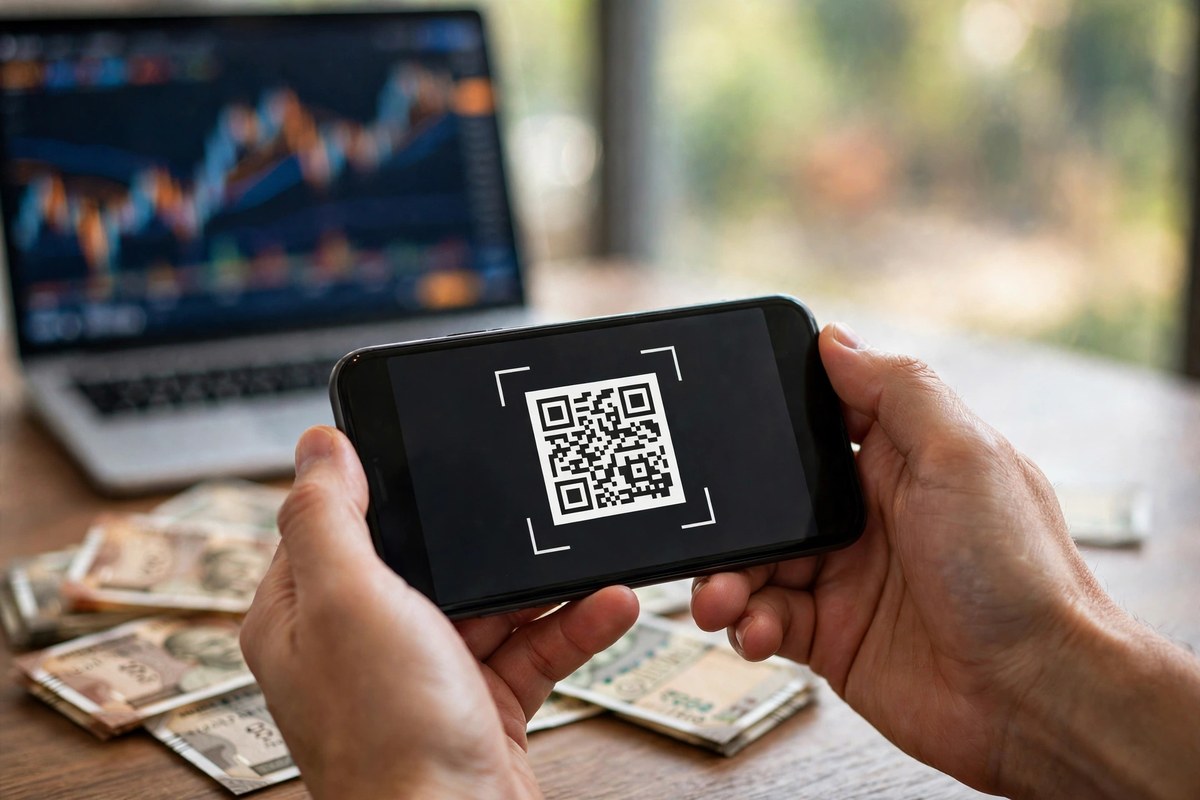
UPI is the fastest route. On CoinDCX, UPI deposits are free, with a minimum of ₹100 and a maximum of ₹1,00,000 per transaction, and Google Pay, PhonePe, Paytm and BHIM all work. Mudrex also charges 0% on INR deposits and withdrawals. WazirX leans on IMPS, NEFT and RTGS bank transfers instead. Never deposit from someone else's bank account — the exchange will reject it and your money can sit in limbo for weeks.
Step 4: Place your first buy order
You do not need to buy a whole Bitcoin. At roughly $76,000 per coin, ₹100 buys you about 0.000011 BTC — a fraction, but a real one. A market order buys instantly at the current price; a limit order lets you set the price you are willing to pay and waits for the market to come to you. During volatile weeks like this one, limit orders save beginners from buying at the top of a five-minute spike.
Step 5: Decide where to keep it
Leaving Bitcoin on the exchange is convenient but risky — exchanges get hacked, as WazirX and Binance both proved. Moving it to a personal wallet (a hardware wallet like Ledger or Trezor, or a reputable software wallet) is the safer long-term choice. One catch: CoinDCX restricts crypto withdrawals to external wallets, so if self-custody matters to you, check the withdrawal policy before you buy, not after. Our guide on how to buy Bitcoin in the UK in 2026 covers the same self-custody decision from a different regulatory angle, and the wallet logic is identical.
Bitcoin Tax in India: The 30% Rule That Changes Everything
This is the section most guides bury at the bottom. It belongs at the top of your planning, because India's crypto tax is the single biggest factor in whether your investment actually makes money.
Every rupee of profit from selling, swapping or spending crypto is taxed at a flat 30% under Section 115BBH, plus a 4% health and education cess — so a ₹1,00,000 gain costs ₹31,200 in tax. There are no slabs, no deductions except the cost of acquisition, and no loss set-off: a loss on one coin cannot be offset against a gain on another, and losses cannot be carried forward. On top of that, a 1% TDS applies under Section 194S on transfers above ₹10,000 a year (₹50,000 for specified persons). Your exchange deducts the TDS automatically and it shows up in your Form 26AS, which you claim back when you file your return.
Three consequences follow. First, short-term trading in India is brutally expensive: a trader who makes ₹5,00,000 in gains and loses ₹3,00,000 elsewhere still pays tax on the full ₹5,00,000. Second, buying and holding beats flipping, because every sale is a taxable event — swapping Bitcoin for Ethereum triggers tax just as surely as selling for rupees. Third, you must report all of it in your Income Tax Return under Schedule VDA. The tax rules carried into the new Income-tax Act, 2025, in force since April 1, 2026, so nothing about this regime is going away. If your situation is complex, talk to a chartered accountant who knows crypto before filing — the cost of an hour of advice is far less than a tax notice.
What Most People Get Wrong About Buying Bitcoin in India
Myth 1: "Bitcoin is banned in India." False. It is legal to own, buy and sell. What is banned is using it as a payment method, and what does not exist is a regulator that will rescue you if an exchange fails.
Myth 2: "FIU registration means the government guarantees the exchange." False. Registration is an anti-money-laundering check. It says nothing about the exchange's solvency, security or business practices. WazirX was a household name when it was hacked.
Myth 3: "I only pay tax when I withdraw rupees to my bank." False. Tax is triggered by the transfer of the asset — selling Bitcoin for USDT or swapping it for another coin is a taxable event even if no rupees ever touch your bank account.
Myth 4: "Losses cancel out gains." False, and this is the most expensive misunderstanding in Indian crypto. Losses cannot be set off against other income or other crypto gains. Keep a record of every trade, because the tax department can ask for it.
Myth 5: "UPI is free, so buying is free." Partly false. UPI deposits are usually free, but the trading fee, the spread between buy and sell prices, and the 1% TDS all take their cut. On a ₹1,00,000 buy, expect roughly ₹200–500 in fees plus ₹1,000 in TDS.
Bitcoin Price in India: Should You Buy During the November Crash?
Bitcoin is down roughly 40% from its $126,080 peak, and the November 5 session was ugly: the Nasdaq fell nearly 6% on fears that a Democratic Congress will slow the AI data-centre buildout, crypto miners fell 15–20% in a day, and more than $1 billion in leveraged positions was liquidated. The Fear & Greed Index sits at 34, firmly in fear territory. Short-term holder cost basis — the average price of coins bought in the last 155 days — is around $75,903, which means the market is now trading right at the level where recent buyers break even.
That is both the risk and the opportunity. If the December 9 Fed meeting brings the rate hike that markets now price at 81% probability, Bitcoin could test $72,000 or lower. If Friday's US jobs report comes in soft, the same level could be the bottom of the cycle. Nobody knows, and anyone who tells you otherwise is selling something. What is knowable is your own plan: decide in advance how much you will buy, at what levels, and over what timeframe. Our analysis of whether Bitcoin is in a bear market runs seven tests — from the 200-day moving average to ETF flows — that help you judge the trend for yourself instead of following headlines. And if you are comparing India with other markets, our guide to buying Bitcoin in the USA in 2026 shows how much lighter the tax burden is elsewhere — a useful benchmark when you weigh the 30% Indian rate.
Your First-Buy Checklist
Run through this list before you tap buy for the first time:
- Exchange is FIU-IND registered and you have seen proof
- KYC done with matching PAN, Aadhaar and bank details
- You understand the 30% tax plus 1% TDS before you trade
- You are investing money you can afford to lose — not rent, not borrowed money
- You know the trading fee and the withdrawal fee in advance
- You have a plan for where the Bitcoin lives after you buy it — exchange or personal wallet
- You have set a limit order or accepted the market price consciously
- You have a record-keeping system for Schedule VDA at tax time
FAQs
Is Bitcoin legal in India in 2026?
Yes. Buying, holding and selling Bitcoin is legal. It is classified as a Virtual Digital Asset, taxed at 30% on gains plus 1% TDS, and it is not legal tender. Exchanges must be registered with FIU-IND under anti-money-laundering rules.
What is the minimum amount to buy Bitcoin in India?
As little as ₹100 on most Indian exchanges. You buy a fraction of a Bitcoin — at $76,000 per coin, ₹100 gets you roughly 0.000011 BTC. There is no need to buy a whole coin.
Which is the best crypto exchange in India for beginners?
CoinDCX is the best all-rounder for beginners: free UPI deposits, a flat ~0.2% trading fee and 500+ coins. CoinSwitch has the largest user base at 25 million and 400+ coins. ZebPay is the pick if security is your top priority. Always confirm FIU-IND registration first.
How much tax do I pay on Bitcoin profit in India?
A flat 30% on gains, plus 4% cess — ₹31,200 on a ₹1,00,000 profit. A 1% TDS applies on transfers above ₹10,000 a year. Losses cannot be set off against gains or other income, and you report everything under Schedule VDA in your income tax return.
Can I buy Bitcoin with UPI in India?
Yes. CoinDCX, CoinSwitch, Mudrex and ZebPay all accept UPI deposits, usually free, with a ₹100 minimum and up to ₹1,00,000 per transaction. WazirX relies mainly on IMPS, NEFT and RTGS bank transfers.
Is WazirX safe after the hack?
WazirX resumed trading in October 2025 after losing $234.9 million in July 2024, but only about 85.5% of user balances were restored. It remains usable, but the episode is a reminder to keep only trading balances on any exchange and move long-term holdings to a personal wallet.
Conclusion
Buying Bitcoin in India in 2026 is straightforward but unforgiving. The rails are excellent — UPI deposits are instant and free, KYC takes minutes, and you can start with ₹100. The trap is the tax: a flat 30% on every gain, 1% TDS on every transfer, and no loss set-off means the government takes its cut whether you win or lose on the round trip. Pick an FIU-registered exchange, compare the real fees, buy with a plan rather than a hunch, and move your coins to a wallet you control. Bitcoin is trading 40% below its peak in a fearful market — for patient Indian buyers with a long horizon, that is exactly the kind of entry that rewards discipline. Just make sure the first thing you budget for is the ₹31,200 on every ₹1,00,000 of profit.
Sources: CoinGabbar, Plisio, Sumsub, BTC Media, Online NIFM, Relon Capital. Prices as of November 5–6, 2026. This article is educational, not financial or tax advice.