How to Buy Bitcoin in Australia in 2026: 5 AUSTRAC-Registered Exchanges Compared — Fees, PayID and the Tax Discount That Ends in July 2027
Bitcoin is back above $80,000 — and Australians can buy it in about 15 minutes with a free PayID deposit. But fees differ up to 10x between exchanges on a $1,000 buy, and the 50% capital gains tax discount ends on 1 July 2027. Here are the 5 AUSTRAC-registered exchanges compared, step by step.
Bitcoin is back above $80,000 — and in Australia, you can own your first slice of it in about 15 minutes, funded with a free PayID transfer from your bank. But here is the catch most first-time buyers miss: the cheapest and most expensive ways to buy the same Bitcoin differ by up to 10 times in fees on a $1,000 purchase, and the 50% capital gains tax discount that rewards long-term holders is being scrapped on 1 July 2027. This guide compares the five best AUSTRAC-registered exchanges, walks through the purchase step by step, and flags the three mistakes that quietly cost Australian buyers money.
Australia is one of the easiest places in the world to buy Bitcoin in 2026. Every major local exchange accepts PayID and Osko deposits that settle in minutes at no cost, AUSTRAC registers every legal exchange, and the tax office has published clear rules on how Bitcoin is taxed. The hard part is not buying — it is buying well. A buyer who taps "instant buy" on the wrong screen can pay $10 in fees on a $1,000 order where another exchange charges $1, and a buyer who ignores the tax calendar can hand back half of a gain they could have kept.
Why Australia Is One of the Easiest Places to Buy Bitcoin in 2026
Australia's crypto market is unusually well organised for a country of 27 million people. Digital currency exchanges must register with AUSTRAC, the financial intelligence agency, and follow know-your-customer and anti-money-laundering rules. That registration is the first thing to check before depositing a dollar: a registered exchange has verified identity procedures and reports suspicious activity, while an unregistered offshore platform offers no such protection.
The second advantage is banking. PayID and Osko let you move Australian dollars from your bank to an exchange in minutes, usually free. CoinSpot, Swyftx, Independent Reserve, CoinJar, BTC Markets and Digital Surge all accept PayID with zero deposit fees. Card purchases are the expensive exception — they typically carry surcharges and higher spreads.
The third advantage is choice. CoinSpot (Melbourne, founded 2013) serves more than three million accounts and lists over 500 cryptocurrencies. Independent Reserve (also 2013) was acquired by IG Group in January 2026 and specialises in larger investors and super funds. Swyftx (Brisbane) offers a $10,000 demo account for practising before risking real money.
Regulation is tightening, which is good news for buyers who pick registered platforms. A new anti-money-laundering regime took effect on 1 July 2026, and from 9 April 2027 platforms holding client tokens will generally need an ASIC financial services licence under the Digital Assets Framework Act 2026.
The 5 Best Ways to Buy Bitcoin in Australia in 2026
There is no single best exchange — the right one depends on how much you buy, how often, and how much hand-holding you want. The table below compares the five strongest options on the numbers that matter. Fees are entry-tier spot rates from 2026 comparisons; confirm the current fee schedule on the exchange before you deposit.
| Exchange | Trading fee | Coins | AUD deposit | Best for |
|---|---|---|---|---|
| CoinSpot | 0.1% market / ~1% instant buy | 500+ | Free PayID | Beginners, widest coin choice |
| Swyftx | 0.6%, falling to 0.1% with volume | 440+ | Free PayID / Osko | Beginners, recurring buys, SMSF |
| Independent Reserve | 0.02%–0.5% tiered by volume | 30+ | Free PayID | Large buys, SMSF, OTC desk |
| Kraken | 0.25% / 0.40% (Kraken Pro) | 600+ | Free PayID / Osko | Low fees, custody credibility |
| Coinbase | 0.40% / 0.60% | 250+ | PayID, bank transfer, card | Global brand, SMSF product |
The fee gap is the story of this table. On a $1,000 instant buy, published 2026 comparisons put the cost at $1.00 on Binance Australia, $5.00 on Independent Reserve, $6.00 on Swyftx, and $10.00 on CoinSpot and CoinJar — a 10-times spread for the same Bitcoin. The cheapest path is almost always the same: deposit AUD free via PayID, then place a limit or market order on the exchange's order book instead of using its instant-buy screen. CoinSpot's market charges 0.1% while its instant-buy screen charges around 1% plus a spread of roughly 1% to 2% baked into the quote. That one choice is worth $600 a year on $10,000 of monthly trades: CoinSpot at 0.1% versus Swyftx at 0.6% is $50 a month on the same volume.
CoinSpot remains the default first exchange for most Australians: AUSTRAC-registered, ISO 27001 certified, with 24/7 local live chat that was the fastest to reach a human in independent testing. Swyftx offers free AUD deposits and withdrawals, recurring buys for dollar-cost averaging, themed bundles, and SMSF support. Independent Reserve wins on price for larger buyers — its tiered fees fall to 0.02% at the top tier. Kraken tops several 2026 Australian rankings by pairing global custody credibility with local banking rails: its Australian arm, Bit Trade Pty Ltd, has been AUSTRAC-registered since Kraken acquired the Sydney firm in 2020, and AUD deposits and withdrawals through PayID and Osko are free with a $5 minimum. Full fee tables and current rankings are published by DataWallet's 2026 Australian exchange comparison.
Two warnings from the fine print. Binance restored AUD bank transfers in January 2026 after a 2.5-year outage, but was hit with a $10 million fine in March 2026 for misclassifying retail clients as wholesale investors. And in December 2024, the Federal Court ordered Kraken's Australian arm Bit Trade to pay an $8 million penalty over a margin product offered without the required target market determination. Neither fine affects spot Bitcoin buyers directly, but both are reminders to check which local entity you are dealing with before depositing.
How to Buy Bitcoin in Australia: 5 Steps
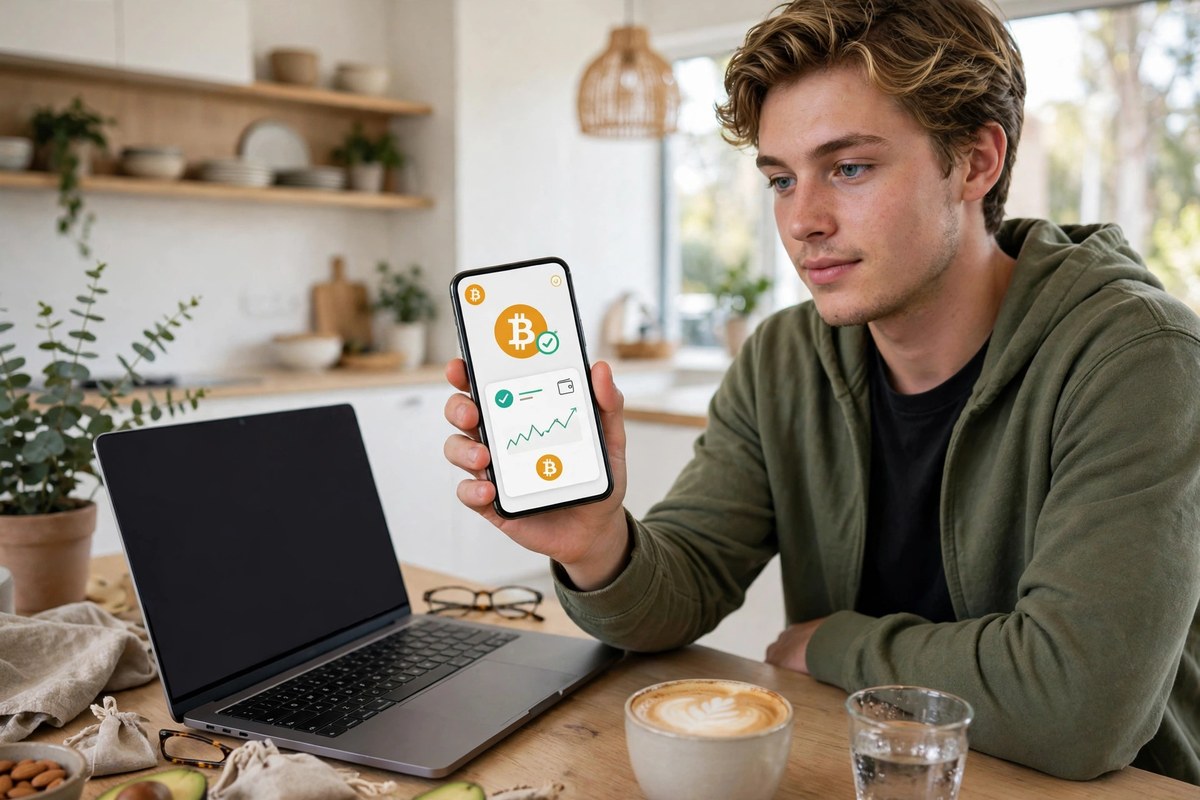
Buying your first Bitcoin takes about fifteen minutes once your ID is handy. The cheapest path pairs a free PayID deposit with a limit order on an order book.
Step 1 — Pick an AUSTRAC-registered exchange. Choose from the table above. Kraken suits low fees and custody credibility, CoinSpot or Swyftx suit the simplest local experience, and Independent Reserve suits an SMSF or trust structure. Confirm the AUSTRAC registration on the exchange's own site before you deposit.
Step 2 — Create an account and verify your identity. You will need a photo ID such as a driver's licence or passport, plus proof of address. Verification usually takes minutes on the major platforms. This is the know-your-customer check AUSTRAC requires — it is also what protects your account from being used by someone else.
Step 3 — Deposit Australian dollars with PayID. Link your bank account and send AUD via PayID or Osko. Deposits are free on most Australian exchanges and settle in minutes. Avoid funding with a credit or debit card: card purchases typically carry surcharges, and some banks treat them as cash advances. Start small — a $50 or $100 test deposit confirms the rails work before you move a larger amount.
Step 4 — Place your order on the market, not instant buy. Go to the exchange's Markets or Pro order book, select the BTC/AUD pair, and place a market or limit order. A market order buys immediately at the best available price; a limit order lets you name your price and wait. Either way you will pay a fraction of the instant-buy fee. You do not need to buy a whole Bitcoin — you can buy as little as $5 worth on Kraken, and most platforms let you start from $10 or less.
Step 5 — Decide where to keep it. Your Bitcoin can stay on the exchange or move to a wallet you control. For a first purchase, leaving it on a large registered exchange is fine. For larger amounts, move it to a hardware wallet — our guide to the best crypto wallets for beginners in 2026 compares hot and cold storage. The $6.3 billion Binance hack of 29 October 2026, the largest crypto theft on record, is the freshest reminder of why custody matters.
The 3 Mistakes That Cost Australian Buyers Money
Mistake 1 — Paying the instant-buy premium. The default buy screen on most exchanges is a convenience product priced at roughly 1% plus spread, while the same exchange's order book charges 0.1%. On a $5,000 purchase that is the difference between about $50 and about $5 in fees. Use the market interface every time.
Mistake 2 — Buying with a card instead of PayID. Card deposits carry surcharges and wider spreads, and some Australian banks charge cash-advance fees and interest from day one. PayID is free and settles in minutes on every major local exchange. There is no reason to pay for speed you already get for free.
Mistake 3 — Forgetting the tax clock starts at purchase. The ATO treats Bitcoin as a capital gains tax asset, and the 50% CGT discount for assets held more than 12 months is being abolished for gains accruing from 1 July 2027. The purchase date you set today decides which tax regime your gain falls under. Keep records of every buy — date, amount in AUD, and fees — from day one, because the ATO's data-matching program already receives transaction data from AUSTRAC-registered exchanges.
What Most People Get Wrong About Buying Bitcoin in Australia
"You need thousands of dollars to buy Bitcoin." Wrong. Bitcoin is divisible to eight decimal places, and Australian exchanges let you buy small fractions. Kraken's minimum PayID deposit is $5, and most platforms accept orders from $10. At Bitcoin's November 2026 price of roughly $80,500, $100 buys about 0.00124 BTC — a perfectly normal first purchase.
"Crypto is unregulated in Australia." Wrong. Exchanges must register with AUSTRAC and follow KYC and anti-money-laundering rules, and from April 2027 platforms holding client assets will generally need an ASIC financial services licence under the Digital Assets Framework Act 2026. Australia does not yet have a single dedicated crypto licensing regime — but the framework is arriving, and registered platforms are already inside it.
"You only pay tax when you cash out to dollars." Wrong, and this is the expensive one. The ATO treats every disposal as a CGT event: selling Bitcoin for AUD, swapping Bitcoin for another coin, spending it, or gifting it. Swapping BTC for ETH inside an app, without ever touching dollars, is still a taxable disposal. Buying Bitcoin with AUD, on the other hand, is not a taxable event.
"The 50% CGT discount will always be there." Wrong — and this is the time-sensitive part. Under legislation passed in June 2026, the 50% discount for assets held over 12 months is replaced from 1 July 2027 with cost-base indexation plus a 30% minimum tax on real long-term gains. Crypto you still hold at 30 June 2027 is deemed sold and reacquired at market value just before 1 July 2027, so gains accrued before that date keep the old treatment. Record the AUD value of every asset you hold on that date.
Australian Crypto Tax in 2026: What the ATO Actually Wants
The Australian Taxation Office has monitored crypto activity since 2014, and its position is clear: cryptocurrency is a capital gains tax asset under the Income Tax Assessment Act 1997, not currency. Capital gains are added to your assessable income and taxed at your marginal rate, from 0% below the $18,200 tax-free threshold up to 45% for high earners, plus the 2% Medicare levy. Hold an asset for more than 12 months and the gain is currently discounted by 50% — but only until the July 2027 reform takes effect. Block Earner's 2026 Australian tax guide covers the full framework.
Income is taxed differently from gains. Staking rewards, mining income, airdrops and business trading profits are taxed as ordinary income with no discount, though related expenses are deductible. Unused capital losses roll forward indefinitely and can offset future gains, but not ordinary income. Every disposal must be worked out in Australian dollars. TokenTax's 2026 Australian tax guide walks through the calculation step by step.
The ATO does not rely on self-reporting alone. Its crypto asset data-matching program collects transaction and customer data from AUSTRAC-registered exchanges including CoinSpot, Swyftx, Block Earner and Independent Reserve, and expects to receive data on 700,000 to 1.2 million individuals and entities each year. Compliance notices can arrive regardless of the dollar amount involved — keep clean records rather than assuming small trades go unnoticed. Two dates matter most: 1 July 2027, when the CGT discount reform takes effect, and 9 April 2027, when the Digital Assets Framework Act begins. SatoshiMacro's ATO tax pillar tracks both deadlines in detail.
Bitcoin Price in Australia: What $80,500 Means Right Now
Bitcoin traded at about $80,500 on 5 November 2026, up 5.4% in 24 hours after the US midterm results, with Ethereum up 7.5% to about $2,425, according to CoinStats' market update. The rebound came fast: Bitcoin had dipped to about $75,600 during the vote count, and roughly $378 million in short positions were liquidated within one hour as the price cleared $80,000. US spot Bitcoin ETFs also recorded their first net inflow of November at $74.57 million on 4 November, after October saw $515 million in net outflows.
None of that is a buy signal on its own. What it means for an Australian buyer is narrower: volatility is high, the $76,000–$82,000 range is where the near-term battle is fought, and dollar-cost averaging — small recurring buys through PayID on a schedule — removes the need to time a single entry. A regular $100 weekly buy costs the same in fees whether Bitcoin is at $76,000 or $82,000.
Checklist: Before You Press Buy
- Confirm the exchange is AUSTRAC-registered — check the registration on the exchange's site, not just its marketing pages.
- Compare the market fee, not the instant-buy fee — 0.1% versus 1% is a 10-times difference on the same order.
- Fund with PayID, never a card — free, instant, and no cash-advance surprises from your bank.
- Start with a small test deposit — $50 confirms the rails work before you move a larger amount.
- Record the purchase in AUD immediately — date, amount, fees and the exchange used, for your ATO records.
- Decide your custody plan before you buy big — exchange storage for small amounts, a hardware wallet for serious holdings.
- Note the 1 July 2027 CGT deadline — record the AUD value of holdings at 30 June 2027; it sets the tax dividing line.
- Never invest money you need within a year — Bitcoin fell from above $126,000 to below $76,000 in about a month in 2026.
How to Buy Bitcoin in Australia vs the Rest of the World
Australian buyers get a better deal than most. In the United States, buyers fund with ACH transfers or wire transfers that can take days, as our guide to how to buy Bitcoin in the USA in 2026 explains. In Canada, Interac e-Transfer plays a similar role to PayID, covered in our guide to buying Bitcoin in Canada, and in the UK a 24-hour cooling-off rule applies to first-time buyers, detailed in our UK buying guide. Europe's MiCA licensing framework is the closest parallel to Australia's AUSTRAC-plus-ASIC model, and our European guide compares four MiCA-licensed exchanges. For the exit side of the trade, see our guides on how to sell Bitcoin safely and when to sell Bitcoin: 7 profit-taking strategies.
FAQs: Buying Bitcoin in Australia
Is it legal to buy Bitcoin in Australia?
Yes. Buying, holding and selling Bitcoin is legal in Australia. Exchanges must register with AUSTRAC as digital currency exchange providers and follow know-your-customer rules. The ATO treats Bitcoin as a CGT asset for tax purposes.
What is the cheapest way to buy Bitcoin in Australia?
Deposit AUD free via PayID, then place an order on the exchange's market or order book rather than using instant buy. On a $1,000 purchase, published 2026 comparisons put instant-buy costs at $1 on Binance Australia, $5 on Independent Reserve, $6 on Swyftx and $10 on CoinSpot and CoinJar — while market orders on the same platforms cost 0.1% or less. Avoid card funding, which adds surcharges.
How much Bitcoin can I buy with $100 in Australia?
At Bitcoin's November 2026 price of about $80,500, $100 buys roughly 0.00124 BTC before fees. You do not need to buy a whole Bitcoin. Kraken's minimum PayID deposit is $5, and most Australian exchanges accept orders from $10, so a first purchase of $50 to $100 is a sensible way to learn the process.
Do I pay tax on Bitcoin in Australia?
Yes. The ATO treats Bitcoin as a capital gains tax asset. Selling for AUD, swapping for another coin, spending it or gifting it are all CGT events, taxed at your marginal rate of 0% to 45% plus the 2% Medicare levy. Assets held more than 12 months currently qualify for a 50% CGT discount, but that discount is replaced by cost-base indexation plus a 30% minimum tax for gains accruing from 1 July 2027.
Which Australian exchange is best for beginners?
CoinSpot and Swyftx are the strongest beginner choices: both are AUSTRAC-registered, accept free PayID deposits, and offer local support. CoinSpot lists 500+ coins and holds ISO 27001 certification; Swyftx offers a $10,000 demo account, recurring buys and SMSF support. If fees are your priority, use the market interface (0.1% on CoinSpot) rather than the instant-buy screen (about 1%).
Conclusion
Buying Bitcoin in Australia in 2026 is fast, cheap and well regulated — if you buy it the right way. Pick an AUSTRAC-registered exchange, fund it free with PayID, place your order on the market instead of the instant-buy screen, and keep clean AUD records from your very first purchase. The fee gap between the cheapest and most expensive route is 10 times on a $1,000 buy, and the 50% capital gains discount that rewards patient holders disappears for gains accruing after 1 July 2027.
Bitcoin is trading near $80,500 after a $378 million short squeeze carried it back above $80,000, and the next test is whether it holds $82,000 or slips back toward the $76,000 cost basis of short-term holders. Whatever it does next, the buying process does not change: small, regular, well-documented purchases on a registered exchange beat a single rushed buy on an expensive screen. Start small, use PayID, use the order book, and keep your records — the rest is patience.
General information only — not financial or tax advice. Consult a registered Australian tax agent for your circumstances, and verify fees on the exchange's own site before depositing.