Bitcoin Miners Are Quitting Mining: IREN's Mining Revenue Crashed 88% as AI Took Over — 5 Numbers That Decide What Happens to Bitcoin
IREN mined 402 bitcoin last quarter, down from 2,039 a year ago — and 88% of its revenue now comes from renting Nvidia chips to Microsoft. TeraWulf's mining revenue fell 69% in the same quarter. The great miner exodus is no longer a forecast. Here are the 5 numbers that decide what it means for Bitcoin's network, its price, and your coins.
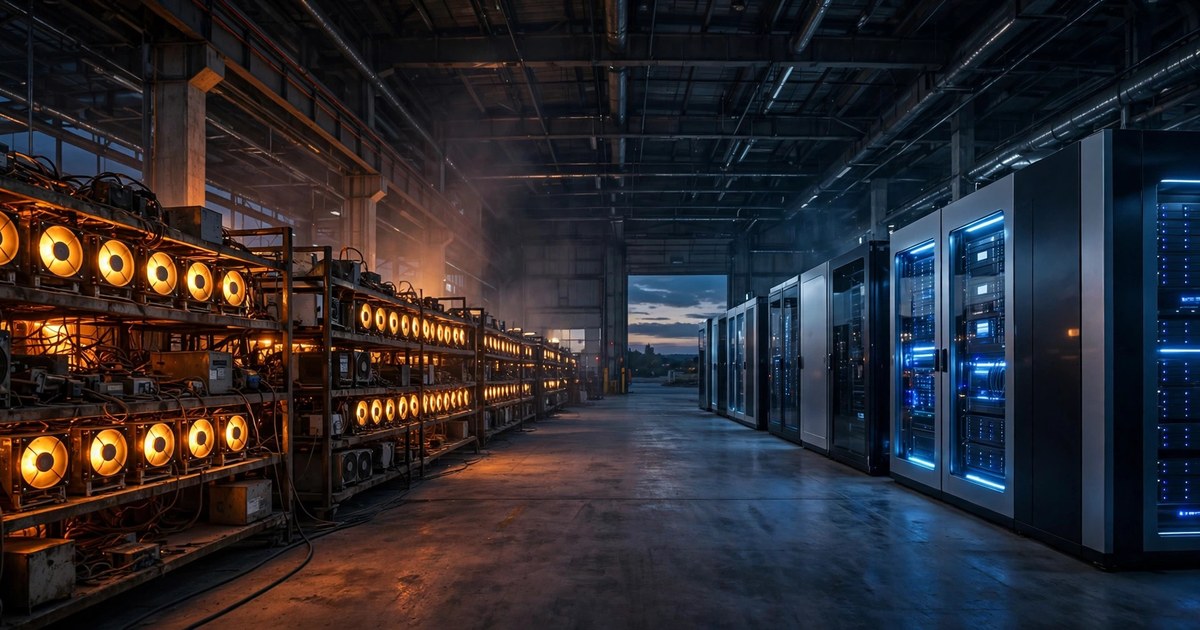
IREN mined 402 bitcoin last quarter. A year earlier, the same company mined 2,039. Its mining revenue collapsed 88% in twelve months, from $233 million to $28 million — and 88 cents of every dollar it now earns comes from renting Nvidia chips to Microsoft. Bitcoin's miners are not slowly diversifying any more. They are quitting mining, in public, in their own earnings filings, and the numbers from this week prove it.
On November 5, IREN told the SEC it aims to "substantially complete" its exit from bitcoin mining by December 31, 2026 — less than eight weeks from now. A day later, TeraWulf reported that high-performance computing leases now make up 83% of its revenue, while its mining business shrank 69% in a year. Two of the biggest names in the industry have now crossed the line in the same week. This is no longer a trend to watch. It is a handover, and it changes what secures the Bitcoin network, what miner stocks are actually worth, and what happens to your coins if the exodus accelerates.
Here are the five numbers that decide what comes next — and the three scenarios for Bitcoin's network now that its miners are leaving.
1. IREN: mining revenue down 88% in a year, AI up 182% in a quarter
IREN's fiscal first-quarter results, filed with the US Securities and Exchange Commission on November 5, 2026, are the clearest single document of the miner exodus ever published. The quarter ended September 30, 2026. Total revenue rose 66% sequentially to $228 million, beating analysts' $221 million estimate. That headline looks like a success story. The mix underneath it is the story.
AI cloud services brought in $200 million in the quarter, up 182% from $71 million three months earlier. That is roughly 88% of everything the company earned. Bitcoin mining brought in $28 million — down 58% from $67 million the previous quarter and about 88% below the $233 million it recorded in the same quarter a year earlier. IREN mined 402 bitcoin in the quarter, against 2,039 a year before. Its average operating hashrate fell from 45.3 exahashes per second to 8.8. It now sells every coin it mines the same day, so nothing sits on its balance sheet.
The company is not hiding the direction of travel. "We aim to substantially complete this transition by December 31, 2026, with immaterial bitcoin mining operations expected to continue through calendar year 2027," IREN said in its filing. Its Horizon 1 data center at Childress, Texas went into service for Microsoft during the quarter and achieved NVIDIA Exemplar Cloud status for its GB300 NVL72 systems. Its contracted revenue backlog reached $20.3 billion, up 22% in three months, with about two-thirds attributed to investment-grade counterparties or guarantees.
There is a catch, and it matters. IREN also pushed back its target of more than $4 billion in contracted annualized recurring revenue from December 2026 to January 2027, possibly late February, citing customer-requested design changes and supplier schedules. The company still reported a $263 million net loss for the quarter, narrower than the $684 million loss three months earlier. And the market did not cheer: IREN shares closed November 5 at $18.03, down 16.95% on the day. The pivot is real, but the market is now asking whether the AI revenue arrives fast enough to replace what mining used to pay.
2. TeraWulf: 83% of revenue is now rent, not mining
TeraWulf's third-quarter results, filed on November 6, 2026, tell the same story from a different angle. The company posted $76.2 million in total revenue, up 51% from $50.6 million a year earlier. Of that, $63.0 million came from high-performance computing leases at its Lake Mariner site in New York — about 83% of the total, roughly double the $31.9 million it earned from HPC in the second quarter, and up from just $7.2 million a year ago. Bitcoin mining brought in $13.2 million, down 69% from $43.4 million a year earlier, as mining infrastructure is deliberately repurposed for AI computing. One warning label: the headline $709.9 million net income rests on a $728.4 million non-cash warrant gain, and adjusted EBITDA was minus $12.8 million. At quarter end, 102 megawatts of critical IT capacity were earning rent, with another 336 megawatts under construction in the CB-4 and CB-5 buildings. Rent on CB-4 starts in phases this quarter; CB-5 follows in early 2027. TeraWulf is no longer a miner that dabbles in AI. It is an AI data center landlord that still happens to mine some bitcoin.
3. The revenue mix, ranked: who is still a miner and who is not
Put the two earnings reports side by side with the rest of the listed cohort and the pattern is impossible to miss. CoinShares research published in September found that AI and HPC revenue could reach up to 70% of listed bitcoin miners' total revenue by the end of 2026, up from roughly 30% at the start of the year. IREN was the first major listed miner where AI revenue overtook mining in a single quarter — $70.5 million against $66.7 million in the second quarter of 2026. This week it went from overtaking to overwhelming.
| Miner | AI / HPC revenue (latest quarter) | Mining revenue (latest quarter) | AI share of revenue |
|---|---|---|---|
| IREN (Q1 FY27) | $200M, up 182% QoQ | $28M, down 58% QoQ | ~88% |
| TeraWulf (Q3 2026) | $63.0M, doubled QoQ | $13.2M, down 69% YoY | ~83% |
| Riot Platforms | $28B AI hosting deal signed | Sold 20,264 BTC in 2026 for ~$1.5B | Pivoting |
| Hut 8 | Expanding AI data centers | Sold 3,102 BTC since July | Pivoting |
| Core Scientific | Multi-billion AI hosting contracts | Mining shrinking as sites convert | Pivoting |
Riot Platforms, another of the largest miners, signed a $28 billion deal to host AI computing and has sold 20,264 bitcoin so far in 2026 for roughly $1.5 billion, according to data compiled this week. Hut 8 has sold 3,102 bitcoin since July to fund $250 million in share repurchases. The miners are not just earning less from mining. They are selling the coins they already hold to pay for the conversion.
4. Why AI pays three times more per megawatt than mining
The economics explain everything. According to CoinShares, AI and HPC workloads earn approximately $1.5 million per megawatt per year. Bitcoin mining earns roughly $500,000 per megawatt. Same power, same buildings, three times the money — and the AI money comes as multi-year contracts with investment-grade customers instead of a volatile commodity price that has fallen 40% from its $126,080 peak.
That is why the pivot is not a fashion choice. A miner with cheap power and a large data center is sitting on the single scarcest input in the AI economy: electricity with somewhere to plug the chips in. Microsoft, and companies like it, will pay heavily for it. The miners worked out years ago that their real asset was never the bitcoin. It was the power contract.
There is a second number that explains the urgency. CoinShares counts more than $100 billion in disclosed AI and HPC contracts across the public mining sector — but only about $1.1 billion in annualized billing revenue, with roughly 550 megawatts actually live against more than 4 gigawatts under contract. The backlog is enormous. The cash is not, yet. That gap is why miner stocks fell 15–20% in a single day this week even as the pivot itself was confirmed by the earnings: investors are now pricing the risk that the contracts convert to cash more slowly than the mining revenue disappears.

5. What most people get wrong about miners leaving
The most common reaction to this story is that Bitcoin is in danger — that if miners leave, the network gets weaker. That is the wrong conclusion, and it is worth understanding why before you act on it.
The network does not need these miners. Bitcoin's difficulty adjusts every two weeks. When hashrate falls, mining gets easier and more profitable for whoever stays, which pulls new capacity back in. IREN's hashrate fell from 45.3 to 8.8 exahashes per second, but the global network hashrate is measured in hundreds of exahashes. One company's exit barely registers on the network total, and difficulty has fallen before without any security incident.
Miner stocks are no longer bitcoin proxies. This is the mistake that cost investors real money this week. For years, buying a miner stock was a leveraged way to buy bitcoin. That logic is now broken: IREN fell 17% on the day it reported a 66% revenue jump, because the market judged it as an AI infrastructure company with a delayed revenue target, not as a bitcoin play. If you own miner stocks to get bitcoin exposure, you now own something else.
The miners selling bitcoin is not a bearish signal for bitcoin. Riot selling 20,264 bitcoin and Hut 8 selling 3,102 are balance-sheet decisions to fund AI buildouts and buybacks, not votes on the bitcoin price. These are companies liquidating inventory to change industry. Treating every miner sale as a market top signal misreads the motive entirely.
The exodus is not a crash in mining profitability. Mining is still profitable for efficient operators — the industry earned $1.215 billion in October, even as hashprice fell 17.5%. The miners leaving are not being forced out by unprofitable mining. They are being pulled out by a better offer. That distinction matters, because a forced exit would signal a broken network. A voluntary exit signals a better business next door.
Three scenarios for Bitcoin's network now
What actually happens next depends on how fast the rest of the cohort follows IREN and TeraWulf, and on whether the AI contracts convert to cash on schedule.
| Scenario | What happens | Bitcoin network impact | Probability |
|---|---|---|---|
| Orderly handover | Miners convert gradually; efficient operators and new entrants absorb the hashrate; difficulty adjusts down then stabilizes | Hashrate dips 5–10%, then recovers; security unaffected | Most likely |
| Fast exodus | Several large miners exit within months; hashrate drops sharply before new capacity arrives | Difficulty falls, blocks slow briefly, then normalize; short-term volatility in mining stocks | Possible |
| AI contracts stall | Backlog converts slowly; miners lose mining income before AI income replaces it | Miner bankruptcies possible; hashrate sold off cheap to survivors; network still secure | Less likely, but the risk the market is pricing |
The base case is the orderly handover. Bitcoin's difficulty mechanism exists precisely for this situation, and it has handled bigger shocks — including the 2021 China mining ban, when hashrate fell by half and recovered within months. The scenario to watch is the third one: if the $100 billion AI backlog converts slowly while mining income keeps shrinking, some miners will run out of cash mid-conversion. That would be a miner-stock crisis, not a bitcoin crisis. The network would still adjust. The stocks would not.
What it means for your Bitcoin
If you hold bitcoin itself, the miner exodus changes very little in the short term. The network's security comes from the total hashrate and the difficulty adjustment, not from any single company's participation. Your coins are as secure as they were last week. What changes is the narrative: the "miners are capitulating" headlines will keep coming, and they will keep being misread as bitcoin weakness. They are not. A miner quitting to rent chips to Microsoft is a miner choosing a better business, not a miner giving up on bitcoin.
If you hold miner stocks, the ground has moved under you. The stocks that used to track bitcoin with leverage now track AI infrastructure execution, contract conversion, and power costs. Miner stocks crashed 15–20% in a day this week while bitcoin fell just 5.5% — the divergence is the market telling you the old correlation is dead. Before buying any miner stock now, ask what percentage of its revenue is still mining. If the answer is under 20%, you are buying an AI data center company at a miner's valuation, and you should judge it on that basis.
If you are thinking about mining yourself, the lesson is the opposite of what it looks like. The big miners are leaving because AI pays more — but the difficulty adjustment means their exit makes mining more profitable for whoever stays. Small, efficient operators with cheap power may actually benefit from the exodus. Our guide to whether bitcoin mining is profitable in 2026 breaks down the real costs, hardware and returns before you spend a dollar.
And if you are wondering whether bitcoin itself is in trouble, the honest answer is that the price action this week — down to about $75,300, 40% below the $126,080 peak — has far more to do with the Nasdaq's 5.5% selloff, the $1.08 billion in liquidations and the $540 million in ETF outflows than with anything miners did. Read our seven tests for whether bitcoin is in a bear market before deciding that this is one.
What to watch next: a 5-point checklist
- Watch the December 31 deadline closely. IREN says it will substantially complete its mining exit by year-end. If it hits the date, expect more miners to announce the same. If it slips, the AI-conversion risk premium on miner stocks grows.
- Track the $4 billion ARR target date. IREN's contracted annualized revenue target slipped from December 2026 to January or February 2027. Whether it lands on the new date is the single best test of whether the $100 billion backlog is real cash or paper.
- Compare megawatts billed, not contracts signed. CoinShares counts roughly 550 megawatts live against more than 4 gigawatts under contract. The ratio of live megawatts to contracted megawatts is the number that tells you if the pivot is working.
- Check the difficulty adjustment every two weeks. A falling difficulty with stable prices means miners are leaving and the network is adjusting normally. A rising difficulty means new capacity is replacing them.
- Separate the stock from the coin in your portfolio. Miner stocks and bitcoin no longer move together. If you want bitcoin exposure, hold bitcoin — our honest guide to whether bitcoin is a good investment in 2026 covers the risks, returns and sensible allocation. If you want AI infrastructure exposure, judge the miners as AI companies.
Frequently asked questions
Are bitcoin miners really quitting mining?
Yes — at least the listed ones. IREN's mining revenue fell 88% year-on-year to $28 million while its AI cloud revenue hit $200 million, and the company says it will substantially complete its exit from mining by December 31, 2026. TeraWulf's mining revenue fell 69% while HPC leases reached 83% of its revenue. Riot and Hut 8 are selling bitcoin to fund AI buildouts. The pivot is documented in SEC filings, not rumors.
Does miners leaving make Bitcoin less secure?
Not in any meaningful way. Bitcoin's difficulty adjusts every two weeks, so when hashrate falls, mining becomes easier and more profitable for the miners who stay, which draws capacity back in. The network survived a 50% hashrate drop during the 2021 China mining ban and recovered within months. One company's exit, or even several, does not threaten network security.
Why are miners switching to AI?
Money. AI and HPC workloads earn roughly $1.5 million per megawatt per year, against about $500,000 per megawatt for bitcoin mining, according to CoinShares. The AI revenue also comes as multi-year contracts with investment-grade customers, while mining income depends on the volatile bitcoin price. Miners own cheap power and big data centers — the scarcest inputs in the AI economy.
Should I sell my miner stocks?
That depends on what you thought you owned. If you bought miner stocks as leveraged bitcoin exposure, that logic no longer holds — IREN fell 17% on a day it reported 66% revenue growth, because the market now values it as an AI infrastructure company. Judge each miner on its AI contract conversion, its power costs and its balance sheet, not on the bitcoin price. This is not financial advice; do your own research.
Will bitcoin's price fall because miners are selling?
Miner selling is small relative to daily bitcoin trading volume, and the current selling is to fund AI buildouts, not a verdict on price. Bitcoin's recent fall to about $75,300 is driven mainly by the Nasdaq selloff, $1.08 billion in liquidations and $540 million in ETF outflows. Miner sales of a few thousand coins are a footnote next to those flows.
What happens to bitcoin mining after the big miners leave?
Mining consolidates around efficient operators with the cheapest power, and the difficulty adjustment keeps the network running on schedule. Smaller miners may actually benefit, since less competition means a bigger share of rewards for those who stay. Mining does not disappear — it changes hands.
Conclusion
The numbers from this week end the debate. IREN earns 88% of its revenue from AI and mines 402 bitcoin a quarter, down from 2,039. TeraWulf earns 83% of its revenue from renting data centers. The companies that built the industrial bitcoin mining industry are leaving it, on purpose, in public, and on a published timetable. The exodus is not a rumor, a forecast or a single company's strategy. It is the industry's new business model.
For bitcoin itself, that is mostly good news disguised as a scary headline. The network adjusts, the security holds, and the miners who stay get a bigger share of the rewards. For miner stocks, it is a regime change: the old rule that miner shares are leveraged bitcoin is dead, and anyone still trading them that way is trading a relationship that no longer exists. The investors who understand the difference — between the coin and the companies that used to mine it — will be the ones who profit from the handover. The ones who do not will keep being surprised when great earnings send the stock down 17%.
Sources: IREN fiscal Q1 2027 results filed with the SEC on November 5, 2026; TeraWulf Q3 2026 earnings release filed November 6, 2026; CoinShares Q1/Q2 2026 mining reports; SoSoValue ETF flow data; CoinGlass liquidation data.