25 Banks, $2 Trillion a Day: The Shared Blockchain That Lets Banks Pay Interest While Stablecoins Can't
25 of America's biggest banks are building one shared blockchain to move tokenized deposits — settling over $2 trillion a day on rails you already use — and a GENIUS Act yield ban means their tokens can pay interest while stablecoins cannot. Here is what changes in 2027, and what it means for your crypto.

Twenty-five big U.S. banks are building one shared blockchain to move their own money — and it could become the biggest on-chain payment system in the world. The Clearing House, the bank-owned operator behind the RTP and CHIPS payment networks that clear and settle more than $2 trillion every day, has hired blockchain firm Quant to build its On-Chain Money Initiative, a network that will let banks clear and settle tokenized deposits across institutions. The network is expected to open to participating institutions in the first half of 2027.
Here is the twist: this is not a stablecoin, and not a cryptocurrency you can buy. It is bank money, recorded on a blockchain, that stays inside the regulated banking system — and because of a quirk in the GENIUS Act, it can pay interest while payment stablecoins cannot. That asymmetry could decide where trillions in corporate cash parks overnight.
This article explains what tokenized deposits are, how the new network will work, why the yield rules tilt the field toward banks, what the United Kingdom proved with live transactions, and what it means for stablecoin holders — plus why a 35% jump in Quant's QNT token tells you far less than the headlines suggest.
What tokenized deposits are — and what they are not
A tokenized deposit is a digital representation of money you already hold at a bank. If you have $10,000 on deposit at JPMorgan, a tokenized deposit is that same $10,000 claim, recorded on a blockchain ledger instead of (or alongside) the bank's traditional mainframe. You are still the bank's customer. The bank still owes you the money. The deposit still sits inside the regulated banking system, with the same customer relationship and, under a proposed rule from the Federal Deposit Insurance Corporation (FDIC), the same deposit insurance treatment as an ordinary deposit.
That differs crucially from a stablecoin. A stablecoin such as USDT or USDC is issued by a non-bank company against a reserve pool; your claim is against the issuer, not a bank. A tokenized deposit is a claim on one named bank — a technicality that changes everything about insurance, interest, and control.
It also changes who can hold it. JPMorgan's JPM Coin (JPMD) represents dollar deposits at JPMorgan, moves between approved institutional clients in seconds around the clock, and cannot be held by an ordinary retail wallet — every wallet must be pre-approved. The Clearing House network extends that idea across banks, so participating banks could move tokenized deposits between one another with the fiat leg settled at the same time.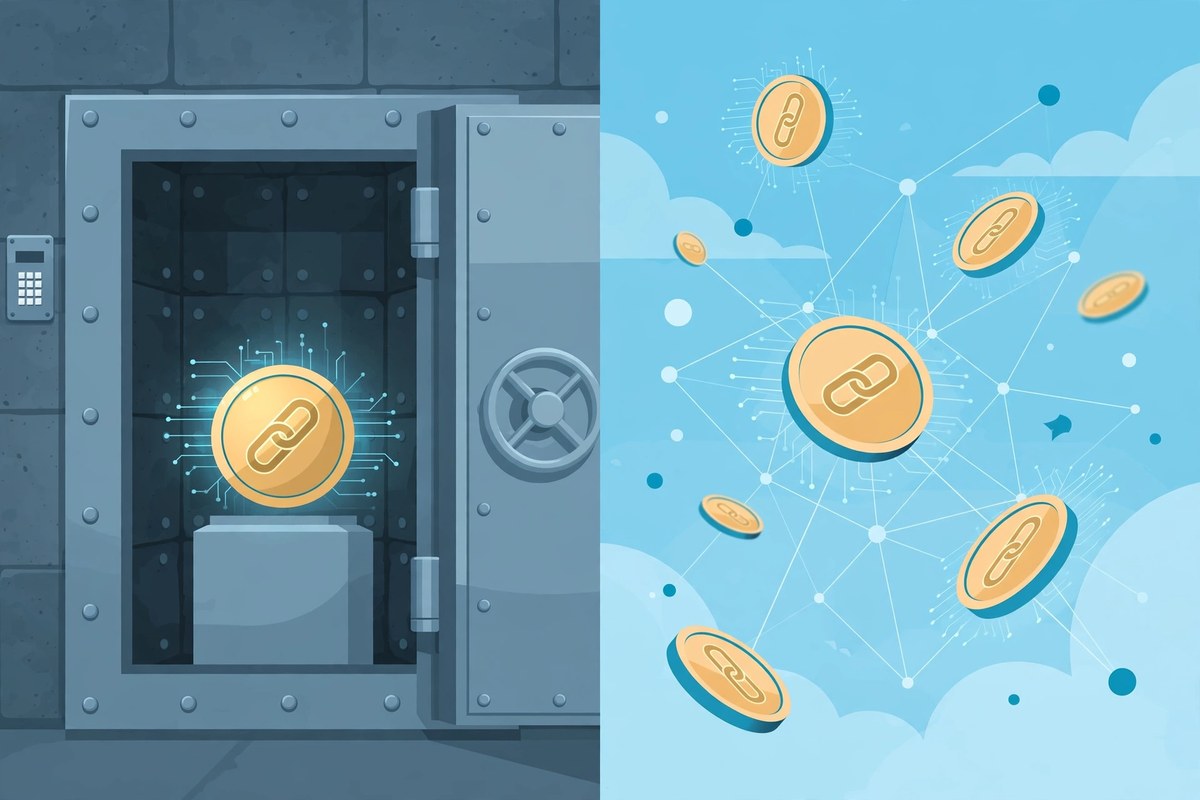
The $2 trillion plumbing underneath the announcement
Start with the plumbing. The Clearing House was founded in 1853 by 38 New York banks and effectively acted as a central bank before the Federal Reserve existed. Today it is owned by 25 of the largest U.S. financial institutions, including Bank of America, Citi, JPMorgan, Wells Fargo, HSBC, BNY, PNC, U.S. Bank, and Truist, and it operates RTP and CHIPS, which together clear and settle more than $2 trillion every single day.
The On-Chain Money Initiative, announced in June 2026, sits on top of that infrastructure rather than replacing it. Quant, selected on September 24, 2026, will supply the interoperability, orchestration, and transaction-management layer: software that burns a token on one bank's ledger, mints the equivalent on the receiving bank's ledger, and settles the fiat leg at the same moment, connected to RTP and CHIPS.
That distinction — new ledger, old rails — is the whole strategy. Banks are not adopting a cryptocurrency; they are buying plumbing. Quant's job is coordination, not custody or issuance. The network's value, if it works, is atomic settlement between two banks that trust the clearing arrangement between them.
For perspective, JPMorgan's blockchain unit, Kinexys, reports more than $4 trillion in cumulative volume and about $7 billion a day — real volume, but small next to the $2 trillion a day The Clearing House networks already settle. Even a small fraction of interbank settlement moving to tokenized rails would matter enormously.
The yield moat: why banks can pay interest and stablecoins cannot
The most commercially important part is not the technology but one GENIUS Act provision. Section 4(a)(11) prohibits a permitted payment stablecoin issuer from paying holders any interest or yield — in cash, tokens, or any other consideration — for holding the stablecoin. Framed as consumer protection, it handed banks a structural advantage.
Tokenized deposits face no such restriction. A tokenized deposit is a deposit, and a deposit can pay whatever interest the bank pays on deposits. The FDIC made the distinction explicit in a proposed rule approved on April 7, 2026, and published in the Federal Register three days later: deposit insurance is technology-neutral, so a tokenized deposit that meets the statutory definition is insured like any other deposit, up to the standard $250,000 coverage, while deposits held at a bank as reserves backing a payment stablecoin are insured as corporate deposits of the issuer and do not pass through to the people holding the token. The GENIUS Act itself expressly excludes tokenized deposits from the definition of a payment stablecoin.
For a treasurer parking eight or nine figures overnight, that difference is concrete: a stablecoin balance earns nothing from the issuer by law, while a tokenized deposit can earn the bank's deposit rate, settle instantly, and release automatically when a contract condition is met. Bank executives have warned as much as $6 trillion in deposits could migrate to yield-bearing digital dollars — which is why the ban functions as a moat around the deposit franchise.
The White House Council of Economic Advisers studied the trade-off in April 2026 and found the consumer-protection case weak: eliminating stablecoin yield increases bank lending by just $2.1 billion, or 0.02% of outstanding loans, while imposing an $800 million net welfare cost. That analysis has not changed the law, but it explains why the fight over stablecoin rewards will continue in the courts and in Congress.
The regulatory calendar keeps the pressure on. The OCC published its final GENIUS Act rule on October 21, 2026, effective January 18, 2027. It retains the issuer-yield ban but removed a proposed presumption against third-party rewards, assessing each arrangement on its facts instead. That leaves programs such as Coinbase's USDC rewards — which Coinbase calls third-party incentives, not issuer yield — in a grey zone untested in court. The stalled CLARITY Act, which failed to reach 60 Senate votes on September 15, 2026, would have closed that loophole, but it is effectively dead until the next Congress convenes in January 2027.
Tokenized deposits vs stablecoins: the comparison that matters
Confusion between these two instruments is the biggest source of bad takes on this story, so here is the comparison in one place.
| Feature | Tokenized deposit | Payment stablecoin |
|---|---|---|
| Who owes you the money | One named bank, as its customer | The token issuer, against a reserve pool |
| Deposit insurance | Yes, up to $250,000 under the FDIC's technology-neutral proposal | No pass-through insurance for holders |
| Interest or yield | Allowed — it is a deposit | Banned for issuers under GENIUS Act Section 4(a)(11) |
| Who can hold it | Approved clients of the issuing bank (and, on the new network, of participating banks) | Anyone with a compatible wallet, anywhere |
| Settlement hours | 24/7 on-chain, tied to bank rails | 24/7 on public blockchains |
| Cross-bank movement today | Not yet — each bank's ledger is isolated | Already global, across chains and wallets |
| Biggest strength | Interest, insurance, and bank-grade compliance | Open access, liquidity, and proven scale |
| Biggest weakness | Closed, permissioned, and not yet interoperable | No yield from the issuer, no deposit insurance |
Tokenized deposits win on interest and insurance. Stablecoins win on openness and scale: the stablecoin market closed the third quarter of 2026 at $300.9 billion across 195 assets and 47 chains, with 308.4 million addresses holding an active balance. No tokenized deposit network has anything close to that distribution today, because none yet lets two different banks settle with each other at all.
That is the gap The Clearing House is closing. Today every live deposit token moves inside its issuing bank: JPMD settles between JPMorgan accounts, Citi Token Services works across Citi's own network, Wells Fargo built a proprietary chain, and BNY launched a service in January 2026 for collateral and margin. Three of the four largest U.S. banks shipped three separate ledgers, none reaching the other two. Until the bridge goes live, the comparison above is a promise, not a product.
Britain already did the live test — and it worked
If the U.S. plan sounds theoretical, look at the United Kingdom on the same day Quant was selected in the U.S., September 24, 2026: UK Finance announced the Great British Tokenised Deposit (GBTD) project, built on a Quant platform, had completed its first live customer transactions in tokenized sterling deposits.
Seven banks took part: Barclays, HSBC UK, Lloyds, Monzo, Nationwide, NatWest, and Santander. Two transactions were remortgage completions, where funds were locked and released automatically at completion, and one was a consumer marketplace purchase. No crypto exchange was involved and no customer needed to understand a blockchain — the token itself enforced the conditions.
The UK test also exposes a concentration question: Quant now sits beneath the shared tokenized-deposit plumbing on both sides of the Atlantic, with both deals made public on September 24, 2026, and HSBC on both rails. Neither announcement disclosed a contract value, term, or exclusivity, nor what happens if Quant fails or is acquired — no escrow or step-in provisions were mentioned. A single private vendor beneath the largest banks' shared plumbing is a concentration risk regulators will spend the next year answering.
Five dates that decide what happens next
The story will be decided not by press releases but by a short calendar of dates:
| Date | Event | Why it matters |
|---|---|---|
| January 18, 2027 | OCC's final GENIUS Act rule takes effect | Stablecoin issuers face full reserve, redemption, and custody rules — but third-party rewards stay case-by-case |
| January 2027 | 120th Congress convenes | The stalled CLARITY Act can be revived, including its proposal to close the third-party yield loophole |
| First half of 2027 | The Clearing House network opens to participating institutions | Banks can start onboarding; the first cross-bank tokenized deposit transactions become possible |
| Second quarter of 2027 | Live cross-bank transactions targeted | The moment the bridge is actually tested with real money between two different banks |
| June 30, 2027 | European Commission's MiCA review report due | Brussels may propose rules for DeFi, staking, and lending — shaping whether Europe follows the bank-led or open model |
Between now and the first of those dates, expect three things: more banks announcing their own tokenized-deposit products (Wells Fargo said in August 2026 it will roll out corporate tokenized deposits this fall, starting with dollar-to-pound exchange); stablecoin issuers probing the yield boundary through third-party rewards; and QNT trading as a proxy for a contract it does not participate in — where retail investors are most likely to lose money on this story.
What most people get wrong about QNT
When the announcement landed on September 24, 2026, Quant's QNT token jumped as much as 35% in 24 hours, briefly above $100 for the first time that year before slipping back to around $97. Coverage framing that as banks "buying into Quant" or $2 trillion "moving onto Quant" was wrong in a costly way.
Quant is a vendor, not a settlement asset. Banks need not hold QNT to use the network, QNT does not settle transactions, and a middleware contract is not live volume. The network does not open until the first half of 2027, and onboarding still has to be worked out bank by bank. The rally priced in a future where the network succeeds and Quant stays indispensable — plausible, but a future, not a fact. The $2 trillion figure describes what RTP and CHIPS already settle in fiat today, not future tokenized volume.
The honest bull case is slower: treasurers get programmable, interest-bearing, insured digital dollars that settle instantly between banks. The honest bear case is simple: closed networks have repeatedly lost to open ones, onboarding could stretch past 2027, and single-vendor dependency could spook the risk committees whose approval the project needs. Both can be true at different horizons — which is why the dates above matter more than any single day's token price.
What this means for your crypto
For most retail holders, the direct effect in the next year is close to zero. You cannot buy a tokenized deposit, hold one in your wallet, or earn its interest unless you are a corporate client of a participating bank. If someone offers you a "bank token" or "Clearing House coin" for sale, it is a scam: no such retail product exists.
The indirect effects are real. Competition for corporate cash intensifies: treasurers earning interest on instant-settling deposits have less reason to hold idle stablecoins, pushing issuers toward third-party rewards with their own risks. Ethereum benefits quietly either way: JPM Coin already runs on Ethereum mainnet alongside Base, and JPMorgan's tokenized funds live there too. And the regulatory direction is unmistakable: the U.S. is building two parallel digital-dollar systems — an open, no-yield stablecoin system for the public, and a closed, insured, interest-bearing deposit-token system for banks.
Does the bank network kill crypto? No. It validates the technology — programmable money, atomic settlement, 24/7 rails — while rejecting permissionless access. Open networks keep what the bank network gives up: anyone can join and build. The bank network keeps what open networks cannot offer: deposit insurance, interest, and a claim on a regulated institution. The next decade will be a contest between those two bundles, not a coronation of either.
Checklist: 7 checks before you trust any "bank token" offer
- Check the issuer name first: a real tokenized deposit is issued by one named bank to its own approved clients, never sold to the public on an exchange or through social media.
- Check whether retail access exists: if an offer lets any wallet buy in, it is not a tokenized deposit — it is something else wearing the label.
- Check the yield promise carefully: interest on a genuine deposit comes from the bank under a deposit agreement, not from a Telegram group promising daily returns.
- Check the official source directly: confirm any claim against The Clearing House announcement or the bank's own press release before sending money anywhere.
- Check for the classic refund trap: scammers already reuse real hack and launch news to run fake "claim" pages — never connect a wallet to a site promising a bank-token payout.
- Check the contract question openly: if a promoter cannot explain who owes you the money — a bank or an issuer — walk away from the offer.
- Check your own custody habits: keep long-term holdings in a wallet you control, keep exchange balances to what you actively trade, and treat every new "bank coin" listing as guilty until proven otherwise.
For background on keeping your own holdings safe, see Best Crypto Wallets for Beginners in 2026; What Is Crypto Staking? explains how staking rewards differ from bank interest and from stablecoin yield. For the closest existing coverage, see JPMorgan Launches JPM Coin on Ethereum and Tokenized Stocks Explained, which covers the parallel race to put traditional assets on-chain.
FAQs
What is a tokenized deposit?
A tokenized deposit is a bank deposit recorded on a blockchain. You remain the bank's customer, and under the FDIC's proposed rule it is insured like any other deposit up to $250,000. It is not a stablecoin or an exchange-traded cryptocurrency.
Can I buy or hold a tokenized deposit?
Not as a retail investor. Current products, including JPM Coin, are limited to approved institutional clients, and The Clearing House network is for participating institutions, not public wallets. Any retail offer calling itself a bank token should be treated as a scam.
Why can tokenized deposits pay interest when stablecoins cannot?
The GENIUS Act's yield ban in Section 4(a)(11) applies to stablecoin issuers, not to banks paying interest on deposits. The Act expressly excludes tokenized deposits from the stablecoin definition, and the FDIC treats them as ordinary deposits.
When will the bank network actually launch?
The Clearing House says the network should open to participating institutions in the first half of 2027, with live cross-bank transactions targeted for the second quarter of 2027. Treat both as targets, not guarantees.
Does this help or hurt Ethereum and stablecoins?
Both, in different ways. Ethereum benefits because JPMorgan chose its mainnet for JPM Coin and its tokenized funds, citing liquidity and client usage. Stablecoins face tougher competition for corporate cash, but keep open access, global liquidity, and a $300.9 billion market that works today.
Should I buy QNT because of the bank deal?
That is speculation, not investment in the network. Quant builds middleware; banks do not settle in QNT, and $2 trillion a day describes existing fiat settlement on RTP and CHIPS, not future tokenized volume. This article is not investment advice.
Conclusion
Twenty-five banks, more than $2 trillion a day in existing settlement, one shared network opening in the first half of 2027, and a yield rule that lets banks pay interest while stablecoins cannot — those four facts are the whole story. What the next eighteen months decide is how much corporate money moves on each rail, and whether the bridge between banks works as well in production as it did in Britain's live test.
Watch the five dates, ignore anyone selling you a retail "bank coin," and judge the project by the only metric that matters: real cross-bank transactions with real money between two different banks. Until then, this is a well-funded blueprint — and blueprints do not pay interest. Sources include The Clearing House announcement on Quant and the On-Chain Money Initiative, Forkast's analysis of the GENIUS Act yield ban, Coincub's comparison of tokenized deposits and stablecoins, and The Digital Banker's report on the OCC's final GENIUS Act rule.