Why Is Crypto Down Today? 6 Reasons Bitcoin Fell to $81,000 and What's Next (Oct 28 Fed Meeting Explained)
Bitcoin crashed to $81,000 as tech stocks plunged, Bitcoin ETFs saw record $635M outflows, and $431M in liquidations hit the market. Here are the 6 reasons crypto is down today and what the October 28 Fed meeting means for what's next.

Bitcoin has tumbled back toward the $81,000 mark, Ethereum has lost the psychologically important $2,400 level, and the total crypto market capitalization has shed more than 3% in a single day. If you woke up wondering why crypto is down today, you are far from alone — the question is trending across search engines, trading desks, and social media.
The short answer: this selloff was not caused by any single crypto-specific event. It was a textbook risk-off cascade — a sharp selloff in US technology stocks spilling into digital assets, a record daily outflow from spot Bitcoin ETFs, hundreds of millions in leveraged long liquidations, and rising geopolitical tension sending oil prices soaring — all hitting the market at once, just days before the Federal Reserve's October 27–28 policy meeting. Coverage across the market press, from TradingView News to Blockchain Reporter's market analysis, points to the same confluence of forces.
In this guide we break down the six reasons behind today's drop, the key price levels traders are watching, and what could come next for Bitcoin and the broader market.
Crypto market today: the numbers at a glance
Here is where the market stood on Friday, October 23, 2026:
- Bitcoin (BTC): trading near $81,600, down roughly 2.7–3.6% over 24 hours after falling as low as $81,074 on Thursday. Bitcoin's market cap is back near $1.63 trillion.
- Ethereum (ETH): hovering around $2,380–$2,410, down about 2.6%, after briefly losing the $2,400 handle.
- Global crypto market cap: $2.82 trillion, down 3.1%, with 24-hour trading volume near $80.5 billion.
- Liquidations: more than $431 million wiped out across leveraged positions in 24 hours, hitting over 100,000 traders.
- Sentiment: the Crypto Fear & Greed Index collapsed from 68 (Greed) to 50 (Neutral) in a single day.
- Worst-hit majors: NEAR Protocol (-9%), Bittensor (-8%), Render (-7%), Zcash (-6%) — AI-linked and high-beta tokens took the hardest hits.
Just two days earlier, Bitcoin had been pushing toward $85,000 and Ethereum had broken above $2,500. That reversal is what makes today's session feel so violent — leverage built up on the way up had to be flushed out on the way down.
Reason 1: The tech selloff dragged Bitcoin down with it
The single biggest driver of today's crypto drop had nothing to do with crypto. On Thursday, US equity markets suffered their worst session since June: the Nasdaq plunged 2.6%, and the Philadelphia Semiconductor Index lost 6.7% as investors dumped chip stocks on fears the AI investment boom is losing steam.
Bitcoin traded like a high-beta tech stock — falling about 4% toward $81,130 during the US session as the equity selloff deepened, as reported by Gadgets 360. Nvidia dropped 4.4%, Meta fell 7% despite stronger-than-expected revenue (the company plans new share issuance to fund expansion), and the risk-off mood spread to every risk asset on the screen.
This is a relationship every crypto investor needs to internalize: in stress moments, Bitcoin behaves like the Nasdaq, not like gold. When stock portfolios get margin calls, crypto is often the first thing traders sell because it trades 24/7 and is easy to liquidate. For a deeper dive into how charts and correlations work, our guide on how to read crypto charts breaks down the indicators professionals watch during volatile sessions like this one.
Reason 2: A record $635 million left Bitcoin ETFs in a single day
Institutional flows told a two-sided story this week. Wednesday saw more than $500 million flow into US spot Bitcoin ETFs — but Thursday brought a brutal reversal: roughly $635 million in net outflows, the biggest single-day exit since late June, wiping out the previous day's gains and pushing October's monthly flow back into the red at around -$175 million.
ETF flows matter because they are the marginal buyer (or seller) setting the price trend. When $635 million walks out the door in one session, market makers and authorized participants must sell the underlying Bitcoin, creating real spot-market selling pressure that derivatives traders cannot absorb painlessly.
The silver lining: the inflow data before Thursday showed three straight days of net inflows totaling $1.07 billion, and analysts at Kudo.com noted that institutional demand cushioned recent losses. Understanding how these products work is essential for any investor — our complete guide What Is a Bitcoin ETF? How Spot Bitcoin ETFs Work explains creation, redemption, and why flows move the price. For the full story on Thursday's record outflow, see our detailed coverage of the $635 million ETF sell-off and what it means for BTC price.
Reason 3: $431 million in liquidations amplified the drop
Falling prices force leveraged traders to sell — and forced selling pushes prices lower, which forces more selling. That is the liquidation cascade, and Thursday's session delivered a textbook one.
According to Coinglass data cited in today's market coverage, over 100,000 traders were liquidated in 24 hours, with total liquidations surging past $431 million (other trackers put the number as high as $474 million). Long positions — bets that prices would keep rising — accounted for roughly 60% of the wipeout. Traders who had borrowed money to chase the run toward $85,000 were forced to sell into the decline, deepening it exactly as the cascade model predicts.
This is why the drop from $85,000 to $81,000 felt faster than the rally up: rallies climb a wall of worry on spot buying, while leveraged liquidations fall like an elevator. Until leverage in the system is reset, any bounce is likely to be fragile — new longs will be cautious, and short sellers will fade rallies.

Reason 4: The Fed meets on October 28 — and markets hate uncertainty
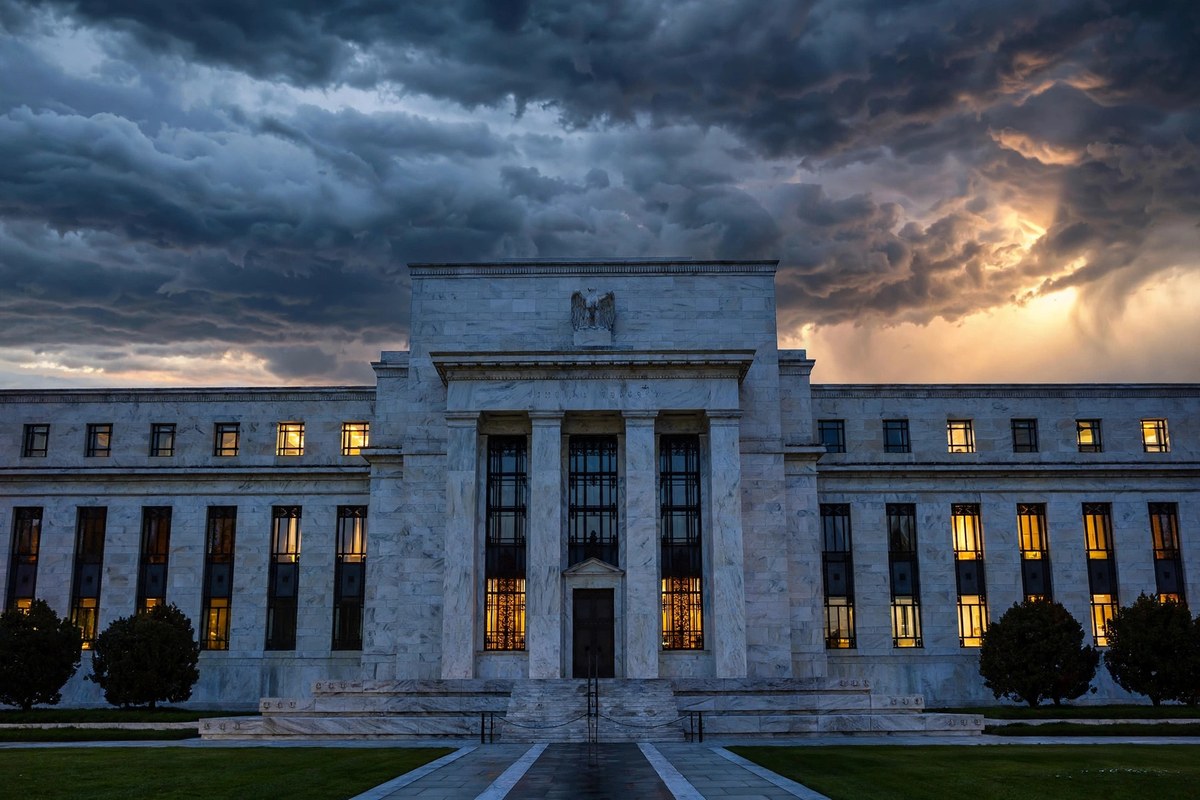
The Federal Reserve's Federal Open Market Committee meets October 27–28, with its decision due Wednesday, October 28. The target range currently sits at 3.75%–4.00% after September's 25-basis-point rate hike, and the market now overwhelmingly expects the Fed to hold — the CME FedWatch tool and prediction markets put the odds of another October hike at only about 6–8%, down from 14% a week earlier.
So why is an expected hold weighing on prices? Because the path after October is the real question. A December rate hike is now fully priced in, and September's inflation report came in hotter than expected while Brent crude pushed above $110 a barrel. Traders are de-risking ahead of the decision, not wanting to carry maximum leverage into a potential surprise.
As Crypto Finance noted in an emailed analysis: "The FOMC meets 27–28 October, with the decision on Wednesday, 28 October. With inflation risk still elevated and risk assets already tightening financial conditions, the market will watch closely for any shift in the Fed's reaction function."
Macro now sets crypto's short-term direction more than any on-chain metric. The Fed decision — and, more importantly, Chair Powell's guidance on December — is the single most important catalyst between now and month-end.
Reason 5: Oil above $112 and Iran tensions fueled inflation fears
Geopolitics poured gasoline on the fire. President Trump said the US is not negotiating with Iran, sending US stocks lower, while Brent crude climbed 3.7% to around $112 per barrel on growing Middle East concerns. Oil above $110 feeds directly into inflation expectations — and hotter inflation means the Fed is less likely to cut rates, which is poison for risk assets.
The 10-year Treasury yield slipped below 5% as investors rotated into safer assets, leaving crypto buyers cautious. This is the classic 2022-style playbook: geopolitical shock → energy spike → inflation fear → tighter monetary expectations → risk assets sell off. Bitcoin, for all its "digital gold" narrative, traded firmly as a risk asset, not a safe haven.
Reason 6: Key technical levels broke — and $80,000 is the line in the sand
Technicals turned the selloff into a rout. Bitcoin had been consolidating in a range for months, capped below resistance; Thursday's sharp breakdown through the $87,000 region and the short-term moving averages invalidated the higher-low structure and flipped the daily chart from accumulation to distribution.
Now every trader's screen is watching the same levels:
- Support: $80,000 is the psychological line, with the 50-day exponential moving average near $80,878. Bitfinex Alpha expects a range between $81,300 and $84,400 until the Fed meeting; a close below $81,300 would expose lower supports.
- Resistance: $83,700 is the first hurdle; reclaiming $85,000 (this week's high) would be needed to repair the chart; $87,000 is the bigger structural level to retake.
- Ethereum: the $2,400 zone must hold — ETH is supported by its 100-day EMA near $2,365, while $2,800 has flipped into resistance above.
- XRP: holding above horizontal support near $1.30; a break below would target $1.20.
The ETF cost-basis angle adds another wrinkle: roughly $81,500 is the estimated average cost basis of US spot Bitcoin ETF holders. If Bitcoin trades below it for long, institutional holders sit on paper losses — a psychological headwind the market did not have when BTC was above $85,000.
What's next: three scenarios for Bitcoin and crypto
Markets rarely fall in a straight line. Here is how the next week could play out:
Scenario 1: The $80K support holds and the Fed delivers a "dovish hold"
If Bitcoin defends $80,000–$81,300 into the October 28 decision and the Fed signals no December hike, shorts covering plus dip-buying could squeeze BTC back toward $84,000–$85,000. The ingredients for a snapback exist: Fear & Greed at Neutral means positioning is no longer euphoric, and oversold bounces in October have a strong seasonal track record. Our earlier analysis of the potential $85,000 "Pumptober" short squeeze mapped exactly how crowded short positioning could fuel such a move.
Scenario 2: Grinding sideways until macro clarity
The base case. Bitcoin chops between $80,000 and $84,400 for another week as traders wait for the Fed and ETF flows to stabilize. Volatility compresses, leverage resets, and the market builds energy for the next directional move — up or down. Range traders thrive here; trend followers get chopped up.
Scenario 3: $80,000 breaks and the correction deepens
A daily close below $80,000 — especially with volume — would open the door to $75,000–$78,000, the next structural demand zone. This scenario becomes likely only if the Fed turns hawkish on December or ETF outflows accelerate. It is the bear-trap risk bulls must respect, not the base case.
What should crypto investors do right now?
Days like this separate investors from gamblers. A few grounded steps:
- Avoid adding leverage into the Fed meeting. Liquidations punished levered longs this week; spot holders survived with their portfolios intact.
- Revisit your allocation, not your emotions. If Bitcoin's drop is keeping you up at night, your position was too big — not the market's fault. Our honest guide Is Bitcoin a Good Investment in 2026? walks through sizing, risks, and smart allocation without the hype.
- Dollar-cost averaging beats timing. Trying to catch the exact bottom is a losing game; a disciplined weekly buy at $81,000 beats panic-selling and rebuying higher. (See our primer on dollar-cost averaging in crypto.)
- Keep coins you are not trading in self-custody. Exchange hacks and phishing surge during volatile weeks — our security checklist How to Store Crypto Safely covers cold storage and seed-phrase hygiene.
- Watch the three real catalysts: the October 28 Fed decision, daily spot ETF flows, and whether $80,000 holds. Everything else is noise.
Frequently asked questions
Why is crypto down today?
Crypto is down today because of a risk-off cascade: a sharp selloff in US tech stocks (Nasdaq -2.6%) spilled into digital assets, spot Bitcoin ETFs saw a record $635 million single-day outflow, over $431 million in leveraged long positions were liquidated, oil spiked above $112 on Iran tensions, and traders are de-risking ahead of the Fed's October 28 meeting.
How far did Bitcoin fall?
Bitcoin fell from near $85,000 on Wednesday to as low as $81,074 on Thursday — a drop of roughly 4–5% — and is consolidating around $81,500–$81,800 on Friday. Ethereum fell from above $2,500 to around $2,380–$2,410, losing the $2,400 level.
Will Bitcoin go below $80,000?
It could if the $80,000–$81,300 support zone fails on a daily closing basis. A break below would expose $75,000–$78,000 as the next demand zone. As long as $80,000 holds and the Fed's October 28 decision is not hawkish, the base case is a $80,000–$84,400 trading range.
What do the Bitcoin ETF outflows mean?
The $635 million single-day outflow on October 22 was the largest since late June and wiped out the prior day's $528 million inflow, leaving October's flows negative. It created real spot selling pressure. But context matters: ETFs had recorded $1.07 billion of inflows over the prior three days, so this looks like short-term profit-taking and risk reduction rather than a structural institutional exodus.
Should I buy the dip in crypto now?
Only within a plan. Buying dips works when it is part of a disciplined strategy — like dollar-cost averaging — with money you do not need short-term. Do not buy with leverage ahead of the October 28 Fed decision, and never invest more than you can afford to lose. For honest guidance on whether crypto fits your goals, read Should I Invest in Crypto in 2026?
When is the next Fed meeting and why does it matter for crypto?
The FOMC meets October 27–28, with the rate decision announced Wednesday, October 28. Crypto trades as a risk asset, so interest-rate expectations move it directly: higher-for-longer rates pressure prices, while dovish signals lift them. The market currently expects rates to hold at 3.75%–4.00% in October but has a December hike fully priced in — any shift in that guidance will move Bitcoin.
Conclusion
Today's crypto selloff was a macro story wearing a crypto costume. No exchange was hacked, no major protocol failed, and no regulation was announced — Bitcoin simply did what risk assets do when tech stocks plunge, oil spikes, and the Fed looms: it fell, fast, amplified by $431 million in forced liquidations.
The constructive read: the drivers are visible and finite. The Fed decision lands October 28, ETF flows reset daily, and $80,000 is a well-defined battleground with a clear invalidation level. Investors who keep leverage off, size positions sanely, and focus on those three catalysts will be positioned for whatever comes next — whether that is a snapback squeeze toward $85,000 or a deeper washout toward $75,000.
As always, this is market analysis, not financial advice. Do your own research, manage your risk, and never invest money you cannot afford to lose.