TRUMP Coin Crashes to $1.41 After Democrats Sweep Congress — While Bitcoin Rallies: 5 Numbers That Decide If Political Tokens Are Finished
TRUMP fell 10% to $1.41 — a 3-month low and 98% below its $74 peak — while Bitcoin climbed above $78,000 after Democrats swept Congress. MELANIA fell to $0.07 and WLFI hit an all-time low. Here are the 5 numbers that decide whether political tokens recover or keep bleeding.
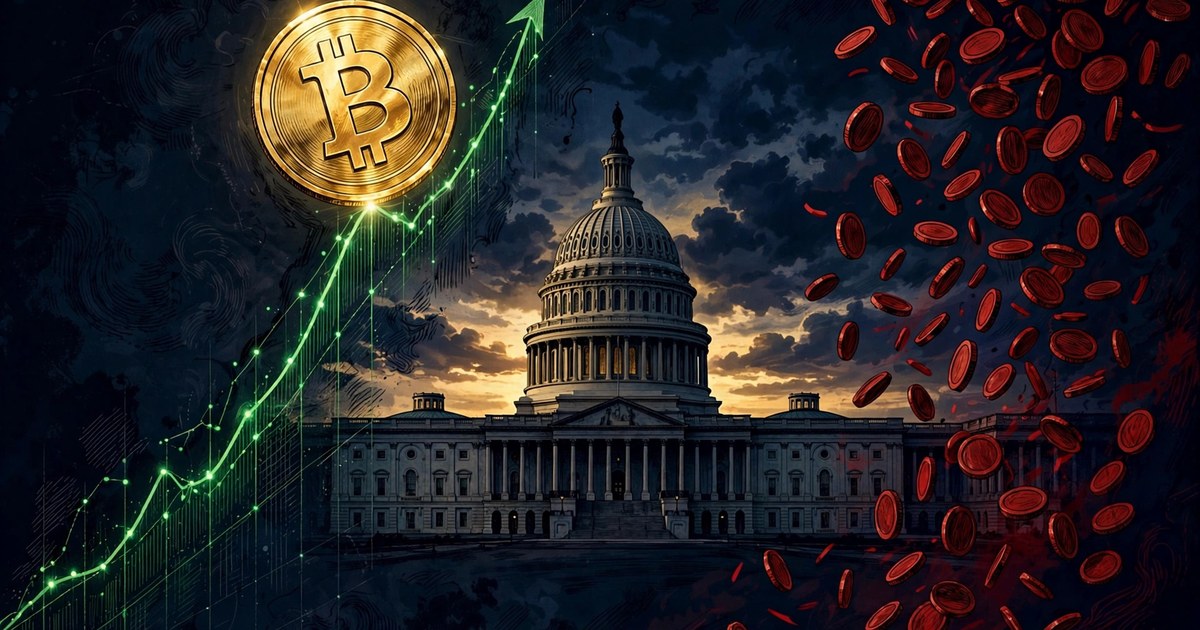
TRUMP fell about 10% to roughly $1.41 on November 4, hitting a three-month low and sitting about 98% below its January 2025 peak — while Bitcoin climbed back above $78,000 and US stocks rallied. The split is the story: the market did not panic about the Democratic midterm sweep, but it did sell the tokens most directly tied to Donald Trump.
That divergence breaks the assumption that carried political meme coins for two years — that a Trump-linked token is a proxy bet on Trump himself, and therefore on crypto-friendly policy. On November 4, the proxy broke in the opposite direction: Bitcoin, Ethereum, XRP and Solana all rose, while TRUMP, MELANIA and WLFI fell, and Trump Media shares dropped as much as 7.2% in pre-market trading. This article explains what fell, by how much, why Bitcoin shrugged it off, and the five numbers that will decide whether political tokens recover or keep bleeding.
This is not financial advice. Meme coins are among the most volatile assets in crypto, and the levels below are reported market data and scenarios, not predictions that any price will be reached.
What happened on November 4: the midterm split in one table
Early midterm results pointed to Democrats taking control of both chambers of Congress, ending unified Republican control for the final two years of President Donald Trump's term. The Associated Press called the Senate for Democrats late on November 3, and the House followed early on November 4. Stocks opened higher, Bitcoin recovered from an overnight dip to about $75,736, and the broad crypto market turned green. Political tokens went the other way.
| Asset | November 4 reported move | November 4 reported price | What it means |
|---|---|---|---|
| Bitcoin (BTC) | Up roughly 1% to 2% over 24 hours | About $77,300 to $78,500 | Recovered from a $75,736 overnight low |
| Ethereum (ETH) | Up about 1% to 2% | About $2,285 to $2,313 | Rose with the broad market, not against it |
| TRUMP | Down about 8% to 10% in the day, 7.6% in one 24-hour snapshot | About $1.41 to $1.49 | Three-month low; roughly $400 million market value |
| MELANIA | Down about 3% to 10% depending on the snapshot | About $0.07 | Down more than 99% from its all-time high |
| WLFI (World Liberty Financial) | Down about 5% over 24 hours; down about 10% to 11% on election night | About $0.049 | Hit an all-time low as results came in |
| DJT (Trump Media stock) | Down as much as 7.2% in pre-market trading | Stock, not a token | Fell even as the S&P 500 and Nasdaq futures rose |
Two details deserve attention. First, TRUMP's 24-hour trading volume was reported at roughly $130 million, versus only about $6 million for MELANIA — the sell-off in TRUMP was active selling, not a thin-market wobble. Second, the broad market's gain was modest: Bitcoin's recovery still left it about 38% below its $126,156 all-time high, and the Crypto Fear and Greed Index sat at 34, in fear territory. November 4 was not a risk-on celebration. It was a rotation away from one specific bet.
Why political tokens fell while Bitcoin rose
Political meme coins trade on narrative leverage. Their value has never come from cash flows, fee revenue or a working product used by millions; it comes from attention, identity and the expectation that proximity to power will translate into relevance, listings or policy tailwinds. When the political backdrop shifts against that story, there is no earnings report or network upgrade to cushion the fall. That is why a Democratic sweep could hurt TRUMP, MELANIA and WLFI at the same moment it left Bitcoin largely untouched.
Bitcoin, by contrast, is now priced mainly as a macro and institutional asset. Its November 4 drivers were familiar: ETF flows, the Friday jobs report ahead, the Bank of England decision due Thursday, and positioning after a $1.16 billion three-session ETF outflow streak. None of those drivers changed because of who controls the House. As CoinDesk reported, traders bought hundreds of millions of dollars in Bitcoin call options as election-day uncertainty faded, and 10x Research's Markus Thielen pointed to oversold momentum indicators and a possible move toward $82,000. That is a trading call, not a guarantee, but it shows where professional attention was: on Bitcoin's own technical and flow picture, not on the political tokens.
The 98% problem: TRUMP was already broken before November 4
It would be wrong to blame the midterm result alone. TRUMP was already down about 79% over the past 12 months and roughly 98% from its all-time high of between $73.43 and $74.27 in January 2025. MELANIA was down more than 99% from its peak. A token that has lost 98% of its value does not need a new shock to fall another 10%; it needs only a reason for remaining holders to give up, or for would-be buyers to stay away.
For a holder, the question is not whether a 10% daily fall is large — in meme-coin terms it is ordinary — but whether the midterm result removes the last plausible catalyst for a recovery. The bull case in 2025 was that political relevance would keep these tokens in headlines, on exchanges and in traders' watchlists. A Democratic Congress does not ban a meme coin, but it reduces the odds of crypto legislation shaped by the administration's allies and raises the odds of oversight hearings. As Bitcoin.com reported, TRUMP and MELANIA failed to rebound like Bitcoin even after an initial partial recovery — exactly what a fading-narrative asset looks like: it bounces less, on lower conviction, and then makes a new low.
Five numbers that decide what happens next
Number one: $1.41 and the three-month low
TRUMP traded at roughly $1.41 to $1.49 on November 4, its lowest level since August, with a market value of roughly $400 million. That level matters because the token fell out of the top 100 cryptocurrencies by market value, according to CryptoPotato's November 4 coverage. Dropping out of the top 100 reduces passive visibility, index inclusion and exchange promotion, which can become self-reinforcing. A recovery above $1.50 would not prove a new uptrend, but holding below $1.41 into the weekend would confirm that sellers, not dip-buyers, control the tape. As CryptoPotato reported, the move was about 10% in a day, on top of a year in which the token had already lost roughly four-fifths of its value.
Number two: 98% and 99% — the drawdowns from the peaks
TRUMP is about 98% below its peak. MELANIA is more than 99% below its peak. Those numbers are often quoted as if they mean the token is "cheap." They mean the opposite for risk purposes: a token down 98% can still fall another 50% and then another 50%, because percentage losses compound downward without a floor. The practical question is not "how far has it fallen?" but "what would make new money buy it?" For TRUMP, the answer in 2025 was political momentum. On November 4, that momentum reversed. Until a new, non-political reason to hold appears — real usage, a credible burn, a major listing or a governance change — the drawdown is a warning, not a discount.
Number three: $130 million versus $6 million — volume tells you who is leaving
TRUMP's roughly $130 million in 24-hour volume versus MELANIA's roughly $6 million shows where the exit was concentrated. High volume on a down day usually means capitulation or forced selling, not quiet accumulation. If volume collapses in the days after November 4 while price drifts lower, that is apathy — often worse than panic, because apathy means no buyer is waiting. If volume stays high and price stabilises above $1.41, that is at least a fight. In meme coins, watch volume before price: volume dries up first, and price follows.
Number four: $1.16 billion — the ETF outflow streak Bitcoin survived
US spot Bitcoin ETFs lost $643.2 million on October 30, $398.6 million on November 2 and $115.6 million on November 3 — about $1.16 billion over three sessions, as crypto.news reported. Yet Bitcoin still recovered toward $78,000 on November 4, and the daily outflow was already shrinking fast, down more than 80% from the October 30 peak. That contrast is the cleanest proof that Bitcoin and political tokens are no longer trading as one "crypto" trade. Bitcoin has an institutional bid that can absorb a billion dollars of selling and stabilise. Political tokens do not. If ETF outflows resume into Friday's jobs report, Bitcoin may still fall — but for macro reasons, not because TRUMP fell.
Number five: 34 — fear, but not panic
The Crypto Fear and Greed Index read 34 on November 4, in fear territory. That is a useful reality check against both extremes: it is not the capitulation reading (below 20) that has historically marked major bottoms, and it is not greed. It says traders are cautious, not terrified — which matches a market that sold political tokens, held Bitcoin and waited for Friday's employment report. For political-token holders, a fear reading of 34 is not a buy signal by itself. Fear can persist for weeks while a narrative asset grinds lower. If you want a deeper guide to reading that index without falling for its traps, see What Is the Crypto Fear and Greed Index? How to Read It in 2026.
What most people get wrong about political tokens
The biggest misconception is that a political token is a bet on an election outcome, like a prediction market. It is not. A prediction market settles at a known price on a known date. A meme coin never settles. It can fall 10% on election night, fall again the next week on unrelated selling, and fall again when traders rotate into the next narrative. There is no expiry that forces the market to be right.
The second misconception is that a famous name protects a token from going to near-zero. MELANIA's more than 99% drawdown disproves that. Fame creates the initial spike; it does not create a floor. Once the spike fades, the token trades like any other meme coin: on liquidity, attention and the willingness of the next buyer to pay more than the last seller accepted.
The third misconception is that "Bitcoin rose, so crypto is fine, so my altcoin will follow." November 4 is a counterexample. Bitcoin rose about 1% to 2%, Ethereum rose, XRP rose about 1.6% to 1.8% to $1.27, Solana rose to about $92 to $93, and Dogecoin rose to about $0.074 — yet TRUMP, MELANIA and WLFI fell. Correlation in crypto is real during panics, when everything falls together, but it breaks during rotations, when money moves from one narrative to another.
Bull, base and bear: three scenarios for political tokens
Scenarios are not forecasts. They are a way to decide in advance what you will do if each path happens, so you are not deciding under panic.
| Scenario | What would have to happen | TRUMP price signal | What it would mean |
|---|---|---|---|
| Bull: narrative returns | A new political catalyst, a major exchange push, or a viral social cycle brings fresh buyers back | Holds above $1.50, then reclaims $1.60 on rising volume | The midterm drop was a shakeout, not a regime change |
| Base: slow bleed | No new catalyst, volume fades, Bitcoin trades sideways into the jobs report | Drifts between $1.20 and $1.50 on falling volume | Most likely path for a narrative asset without a catalyst |
| Bear: capitulation continues | Further political headwinds, WLFI legal overhang worsens, or a broad risk-off day hits meme coins first | Breaks below $1.41 and then $1.20, with volume spiking on down days | The token enters a new, lower range and top-100 return becomes unlikely |

A checklist before you touch a political token again
If you are considering buying, holding or selling any political token after November 4, run through this checklist first. It is a risk filter, not a recommendation.
- Check the volume trend over seven days, not just one day, to see whether buyers are actually returning or whether a single spike is misleading you.
- Check whether the token is still in the top 100 by market value, because falling out of that group often reduces exchange and index visibility.
- Check the unlock and insider holding picture, because meme coins with concentrated holders can fall fast when a large holder decides to exit.
- Check whether you can explain, in one sentence, why a new buyer would pay more tomorrow for reasons other than politics, because if you cannot, you are betting on attention, not value.
- Check your position size against a total loss, because a token down 98% can still lose most of what remains, and no recovery is guaranteed.
- Check where you hold the token, because exchange risk is real after the $6.3 billion Binance hack, and self-custody has its own risks if you lose your seed phrase.
On that last point, the safest habit is boring and effective: keep long-term holdings you cannot afford to lose in a wallet you control, and keep only trading-sized amounts on exchanges. Our beginner guide, Best Crypto Wallets for Beginners in 2026: Hot vs Cold Wallets Compared, walks through hot versus cold storage, and How to Buy Bitcoin in 2026: A Complete Beginner's Guide covers buying step by step for new readers.
What happens next: three dates that matter more than the next tweet
First, Friday's US jobs report. The October employment report is scheduled for November 6, and it is the next macro event that could move Bitcoin, stocks and risk appetite together. A weak report could revive rate-cut bets and help Bitcoin; a strong report could do the opposite. Either way, political tokens are unlikely to be the main beneficiary — they will follow risk appetite, not lead it.
Finally, the legislative calendar from January, when the new Congress takes its seats. That is when the market will learn whether the CLARITY Act is truly dead for two years, as some analysts have suggested, or whether a narrower, bipartisan market-structure bill can still pass. For context, see Midterm Results 2026: Prediction Markets Put a Democratic Sweep at 99% — noting that prediction-market odds are not election results.
Frequently asked questions
Why did TRUMP coin fall on November 4?
TRUMP fell about 10% to roughly $1.41 as early midterm results showed Democrats winning control of Congress, ending unified Republican control. The token is traded as a bet on Trump-linked political momentum, so a Democratic sweep repriced that bet downward, even as Bitcoin and stocks rose. The fall also came on top of a roughly 98% decline from its January 2025 peak.
Why did Bitcoin rise while TRUMP fell?
Bitcoin is now driven mainly by ETF flows, macro data and institutional positioning, not by a single political narrative. On November 4, Bitcoin recovered from $75,736 toward $78,000 as midterm uncertainty faded and options traders bet on a rebound, while ETF outflows were already shrinking from their October 30 peak. Political tokens, by contrast, are driven by attention and identity, so they fell when their specific story weakened.
What happened to MELANIA and WLFI?
MELANIA fell to about $0.07, down more than 99% from its peak, on thin volume of roughly $6 million. WLFI fell about 10% to 11% on election night to about $0.049, an all-time low, and was still down about 5% over 24 hours the next day. Both underperformed Bitcoin by a wide margin: this was not a broad crypto sell-off, it was a political-token sell-off.
Should I buy TRUMP coin now that it is cheap?
"Cheap" in percentage terms does not mean undervalued. A token down 98% can still fall much further, and meme coins carry total-loss risk. Anyone considering a purchase should size the position as money they can afford to lose entirely, check volume and liquidity first, and understand that no earnings, revenue or settlement date forces a recovery. This article is educational, not investment advice.
Does a Democratic Congress kill crypto?
No. Bitcoin, Ethereum and the broader market rose on November 4, and major firms said their crypto strategies would not change because of the midterms. What a Democratic Congress does change is the legislative path: broad crypto bills face a harder road, oversight is likely to increase, and agencies such as the SEC, CFTC and Treasury are likely to play a larger role. That is slower and more uncertain, but not a ban or shutdown. For a primer on Bitcoin itself, independent of politics, see What Is Bitcoin? The Complete Beginner's Guide.
Conclusion: the market voted, and it voted for Bitcoin over politics
November 4 gave crypto a clean experiment. The same news — a Democratic sweep — produced two opposite reactions: Bitcoin and stocks rose, political tokens fell. That split tells you what the market now values in crypto: institutional flows, macro resilience and a verifiable roadmap matter more than a famous name and a news cycle.
TRUMP at $1.41 is not just a price. It is a verdict on a two-year bet that political proximity would sustain a meme coin indefinitely. That bet has now lost 98% of its value, and the midterm result removed its most plausible near-term catalyst. The token could bounce — meme coins always can — but a bounce without volume, without a new story and without a return to the top 100 would be a trade, not a revival. External context for the day's moves includes Coin-Turk's WLFI election-night coverage and Analytics Insight's November 4 price snapshot, both of which show the same split: broad crypto green, political tokens red.