Nasdaq-100 Goes On-Chain: Janus Henderson's JQQQ Fund, the $100,000 Minimum, and Why Americans Can't Buy It
A $500 billion asset manager just put the Nasdaq-100 on the Stellar blockchain — but the fund needs $100,000 to enter and is closed to US investors. Here's what JQQQ actually is, how it differs from QQQ, and what it means for tokenized stocks.

A $500 billion asset manager has just put the Nasdaq-100 on a blockchain — and most readers of this article cannot buy it. Janus Henderson's new JQQQ fund tracks America's most famous tech index on the Stellar network, yet it demands a $100,000 minimum investment and is closed entirely to US persons. That contradiction is the real story of tokenization in 2026: Wall Street is moving onto blockchain rails faster than ever, but the first products are built for institutions, not for you.
Announced on October 27, 2026, JQQQ is the first blockchain-native fund offering exposure to the Nasdaq-100 Index through an issuer-sponsored strategy, according to Janus Henderson and tokenization platform Centrifuge. The fund is issued and operated on public blockchain infrastructure, licensed by Nasdaq itself, and launched exclusively on Stellar — a network where tokenized real-world assets passed $4 billion in 2026. It is also the second licensed on-chain index fund from the same partnership, following the Janus Henderson Anemoy S&P 500 Fund (SPXA) on Base in September 2026.
So what exactly is JQQQ, how is it different from the $499 billion Invesco QQQ ETF that already tracks the same index, and does it matter for ordinary crypto investors? Here is the full breakdown — including the fine print that changes the whole picture.
What JQQQ Actually Is
JQQQ is a fund that seeks to track the Nasdaq-100 Index, home to tech giants including Nvidia, Apple and Microsoft. The index covers the 100 largest non-financial companies listed on the Nasdaq stock market. But JQQQ is not an exchange-traded fund you can buy through a brokerage app, and it is not a token someone minted to mirror QQQ shares.
The structure matters. JQQQ is a segregated portfolio of Anemoy Capital SPC Limited, a company registered in the British Virgin Islands. Anemoy Asset Management Limited is the investment manager, Janus Henderson Investors US LLC acts as sub-investment manager, and Centrifuge provides the full-stack infrastructure for issuing and operating the fund on-chain. Nasdaq licenses the index. Janus Henderson manages the portfolio; Centrifuge runs the rails.
That "issuer-sponsored" label is doing heavy lifting. Many tokenized stock products are third-party creations: an outside firm buys shares (or claims to), then issues tokens that mirror them. JQQQ flips that model — the asset manager itself issues and manages the fund, with the index provider's license behind it. The fund was designed to be issued and run on blockchain rails from day one, which the partners say could let its shares plug into other on-chain applications, feed into programmable portfolios, and possibly serve as collateral for lending. The release is careful to note that any such collateral or lending use would come from independent third parties, outside Janus Henderson's management, and is not offered or endorsed by the firm.
One more critical detail: JQQQ gives indirect economic exposure to the performance of an underlying investment product that tracks the index. It does not confer beneficial ownership or shareholder rights in the underlying stocks. You are not buying Nvidia or Apple shares — you are buying fund shares whose value follows the index.

Why the Word "Licensed" Is the Whole Story
Index providers control who can build official products around their benchmarks, and that gatekeeping is why JQQQ took so long to exist. In April 2026, Nasdaq expanded licensing of its Nasdaq-100 Index to additional asset managers, including BlackRock and State Street, while maintaining its longstanding partnership with Invesco, which operates the $499 billion Invesco QQQ Trust. That licensing expansion is what opened the door for Janus Henderson's launch.
The same pattern played out with the S&P 500: the Janus Henderson Anemoy S&P 500 Fund (SPXA) was the first tokenized index fund licensed by S&P Dow Jones Indices. Licensed index products carry the benchmark owner's blessing, standardized methodology, and institutional credibility that unlicensed copycat tokens cannot claim. For pension funds, family offices and treasuries considering on-chain allocations, that license is often the difference between "interesting experiment" and "approved for the portfolio."
This is also why JQQQ matters beyond its own size. Every licensed launch normalizes the idea that a major index can live on-chain, which pressures other index providers and asset managers to follow. The tokenization race in 2026 is no longer about whether stocks can be tokenized — it is about who gets to do it officially.
JQQQ vs QQQ vs Third-Party Stock Tokens: The Comparison
The easiest way to understand JQQQ is to put it next to the two products it sits between: the traditional QQQ ETF and the wave of third-party tokenized stocks.
| Feature | JQQQ (Janus Henderson / Centrifuge) | Invesco QQQ ETF | Third-party tokenized stocks |
|---|---|---|---|
| What it tracks | Nasdaq-100 Index, under Nasdaq license | Nasdaq-100 Index | Individual stocks, usually unlicensed mirrors |
| Issued by | The asset manager itself (issuer-sponsored) | Invesco, a traditional ETF issuer | Outside platforms, not the company or index owner |
| Blockchain | Stellar, exclusively at launch | None — traditional exchange rails | Solana, BNB Chain, Ethereum and others |
| Minimum investment | $100,000 (reported) | Price of one share | Often a fraction of one share |
| Available to US investors? | No — closed to US persons | Yes | Varies, often restricted |
| Ownership | Indirect economic exposure, no shareholder rights | Fund shares with standard ETF rights | Token claim, terms vary by platform |
| Trading hours | On-chain settlement potential; terms set by fund | Stock market hours | Often marketed as 24/7 |
| Size for scale | Part of a $1B+ on-chain platform | $499 billion in assets | Fragmented across platforms |
The table exposes the trade-off clearly. JQQQ wins on legitimacy — licensed index, issuer-sponsored, managed by a $500 billion firm — but loses on access. QQQ wins on access and scale but lives entirely off-chain. Third-party tokens win on 24/7 trading and fractional access but carry the weakest legal standing, which is exactly why companies including Microsoft, Alphabet and Goldman Sachs have publicly pushed back against some tokenized-stock offerings. If you want the full picture of how those third-party products work, read our guide: Tokenized Stocks Explained: How 24/7 On-Chain Trading Works.
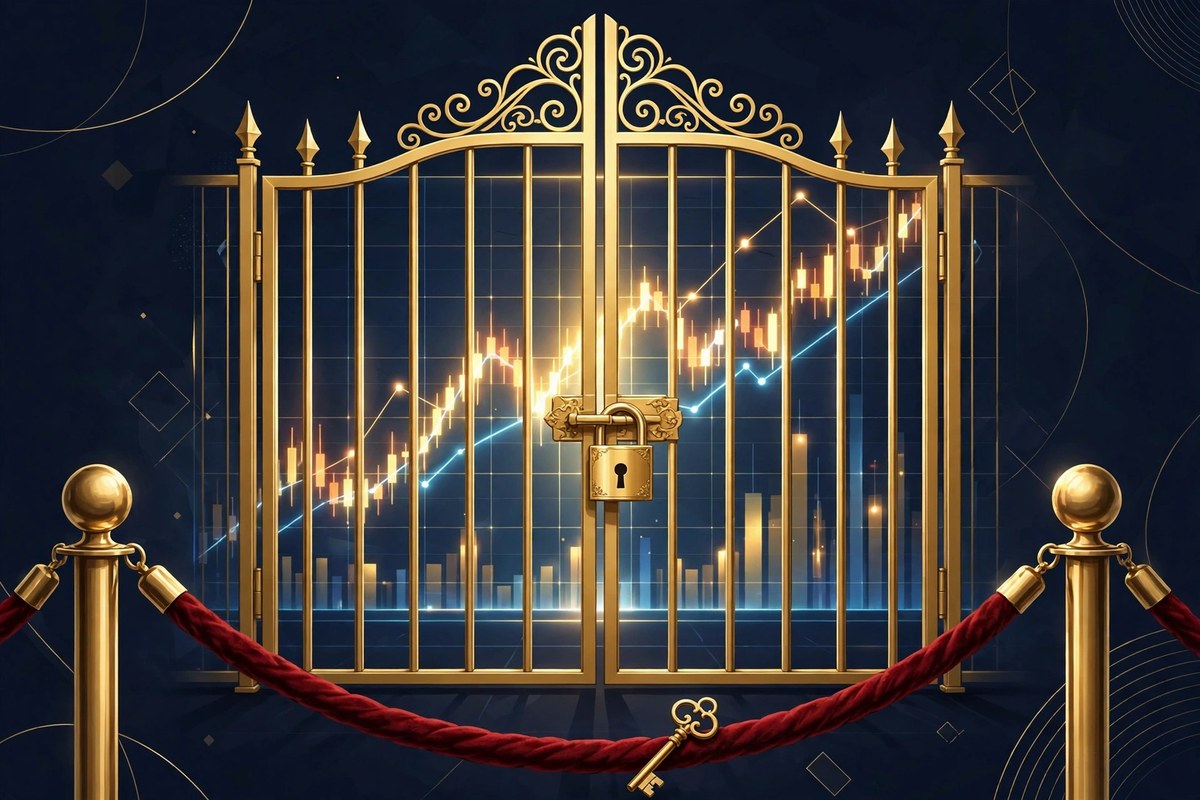
The $100,000 Gate and the US Ban: Who Can Actually Buy JQQQ
Here is where the hype meets reality. JQQQ is open only to eligible investors in jurisdictions where it can lawfully be offered — and not to US persons at all. The Wall Street Journal reported a $100,000 minimum investment, and the companies themselves disclosed no fee rate (only "competitive fees"), no custodian, and no date when the fund begins taking subscriptions.
Why would a fund tracking an American index shut out Americans? The answer is regulatory caution. Offering a blockchain-native fund to US retail investors would invite the full weight of US securities regulation, including registration, disclosure and distribution rules that the fund's offshore structure is designed to avoid. By launching as a British Virgin Islands segregated portfolio for non-US professional investors, Janus Henderson and Centrifuge can move fast without waiting for US approval.
For ordinary investors, the practical consequence is simple: you cannot buy JQQQ today through any app or exchange, and no announcement has said when — or whether — that will change. The fund is a signal about where institutional finance is heading, not a product for your portfolio this week.
Why Stellar — and What $4 Billion in Tokenized Assets Means
JQQQ launches exclusively on Stellar, a network better known for payments than for Wall Street funds. The choice is strategic. Real-world assets on Stellar surpassed $4 billion in 2026, according to the launch release, and the network offers fast, cheap settlement with built-in asset issuance features that suit regulated funds.
Stellar's win here is also a competitive statement. Tokenized Treasuries and credit have spread across Ethereum, Solana, Base and others; Stellar landing a licensed Nasdaq-100 fund gives it an institutional flagship it can point to in every future pitch. For Stellar's ecosystem, JQQQ is validation that its chain can host serious regulated products, not just payments and remittances.
The broader context is the real-world asset boom. Janus Henderson's on-chain platform now holds more than $1 billion across US Treasuries, structured credit and public equities, including the Janus Henderson Anemoy Treasury Fund (JTRSY) and AAA-rated collateralized loan obligations. The RWA market as a whole has surged in 2026 — our recent coverage tracked it jumping 81% to $39 billion as tokenized portfolios hit Solana: Ondo's 7 Tokenized Portfolios Hit Solana as the RWA Market Jumps 81% to $39B. JQQQ extends that wave from bonds and credit into the equity benchmark every investor knows.
What JQQQ Means for Crypto Investors
You cannot buy JQQQ, so why should you care? Because it tells you where the money is going, and that shapes which crypto sectors benefit.
First, tokenization infrastructure wins. Centrifuge, which powers on-chain strategies for Apollo, Janus Henderson and S&P Dow Jones Indices, with tokens live across DeFi protocols including Sky, Aave and Morpho, is the quiet beneficiary of every licensed launch. The picks-and-shovels platforms that can handle regulated issuance, compliance and settlement are capturing the institutional wave.
Second, the line between "crypto" and "traditional finance" keeps dissolving. When a $500 billion manager issues a Nasdaq fund on-chain, the question stops being whether institutions adopt blockchain and becomes which chains and platforms they choose. That favors networks with regulatory-grade tooling over chains that pitch themselves purely on speed or memes.
Third, retail access will come last, not first. The pattern across tokenized funds is consistent: institutions and professional investors get the licensed products, retail gets the unlicensed mirrors and the wait. If you are a retail investor excited by tokenized stocks, the safer path is usually the regulated ETF or the licensed fund when it eventually opens — not a third-party token with unclear backing. For background on how regulated crypto funds actually work, see What Is a Bitcoin ETF? How Spot Bitcoin ETFs Work in 2026.
5 Checks Before You Buy Any Tokenized Fund
JQQQ's fine print is a checklist for every tokenized product you will ever consider. Run through these before putting money into any on-chain fund or tokenized stock:
- Check who actually issues the product — an issuer-sponsored fund backed by the asset manager is fundamentally different from a third-party token mirroring shares it may not hold.
- Check whether the index or asset is licensed — a license from Nasdaq or S&P Dow Jones Indices means the benchmark owner approved the product; unlicensed tokens carry legal and delisting risk.
- Check what you actually own — JQQQ gives indirect economic exposure without shareholder rights, so read whether your token confers ownership, a claim, or nothing at all.
- Check who is excluded and why — minimum investments, geographic bans and accredited-investor gates tell you how regulated (and how accessible) the product really is.
- Check the fee, custodian and redemption terms — if a launch announcement discloses none of these, as JQQQ's did, treat the product as early-stage and wait for the full prospectus.
Risks and Open Questions
Tokenized fund shares carry risks beyond the underlying investments, and the JQQQ release says so explicitly: failure or compromise of blockchain networks, smart contracts, digital wallets and third-party platforms could delay or prevent transfers or redemptions, or result in losses. Tokenization also remains subject to evolving regulation — the same rules that keep JQQQ closed to US investors today could change tomorrow, in either direction.
Open questions remain. No fee has been disclosed, so investors cannot yet compare JQQQ's cost against QQQ's. No subscription start date has been announced. No custodian has been named. And the long-term question — whether on-chain shares will actually be usable as collateral in DeFi, as the partners suggest is possible — depends on third parties building that functionality, which Janus Henderson explicitly does not offer or endorse.
There is also concentration risk in the index itself. The Nasdaq-100 is dominated by a handful of mega-cap tech names, and the index fell with the broader tech sell-off in October 2026. Tokenizing an index does not diversify it; it just changes the rails it trades on.
What Happens Next
Watch three things. First, whether Nasdaq licenses more on-chain index funds — BlackRock and State Street gained expanded Nasdaq-100 licensing in April 2026, and either could follow Janus Henderson with its own product. Second, whether JQQQ discloses fees, a custodian and a subscription date, which would signal it is moving from announcement to live fundraising. Third, whether US regulators create a path for on-chain funds to reach American investors, or whether the offshore-only pattern hardens into the industry's default.
The bigger arc is clear regardless. In September 2026, the S&P 500 went on-chain via SPXA on Base. In October 2026, the Nasdaq-100 followed via JQQQ on Stellar. Two of the world's three most-tracked equity benchmarks now have licensed blockchain-native funds. The third — the Dow Jones Industrial Average — is the obvious next candidate, and the manager that launches it will not be starting from scratch.
Frequently Asked Questions
What is JQQQ?
JQQQ is a blockchain-native fund launched by Janus Henderson and Centrifuge that seeks to track the Nasdaq-100 Index under license from Nasdaq. It is issued and operated on the Stellar blockchain and is the first issuer-sponsored on-chain fund offering Nasdaq-100 exposure.
Can I buy JQQQ?
Probably not. JQQQ is not available to US persons and is open only to eligible investors in jurisdictions where it can lawfully be offered, with a reported $100,000 minimum investment. No retail access, fee, custodian or subscription start date has been announced.
How is JQQQ different from QQQ?
QQQ is Invesco's traditional ETF tracking the Nasdaq-100, with $499 billion in assets, available to US investors through any brokerage. JQQQ tracks the same index but is issued natively on the Stellar blockchain by Janus Henderson, is closed to US persons, requires a $100,000 minimum, and gives indirect economic exposure without shareholder rights.
How is JQQQ different from tokenized stocks on Solana or BNB Chain?
Most tokenized stocks are third-party tokens that mirror shares without the issuer's or index provider's involvement. JQQQ is issuer-sponsored and Nasdaq-licensed, meaning the asset manager itself issues the fund with the benchmark owner's approval — a much stronger legal standing, but with far more restricted access.
Why is JQQQ on Stellar instead of Ethereum or Solana?
Stellar offers fast, low-cost settlement with native asset issuance features, and its tokenized real-world asset market passed $4 billion in 2026. The exclusive Stellar launch also gives the network an institutional flagship product in the tokenization race.
Does JQQQ mean I own Nasdaq stocks?
No. JQQQ provides indirect economic exposure to the performance of an underlying product tracking the index. It does not confer beneficial ownership or shareholder rights in Nvidia, Apple, Microsoft or any other Nasdaq-100 company.
Conclusion
JQQQ is simultaneously a milestone and a mirage. It is a milestone because a $500 billion asset manager, a licensed index and a major tokenization platform have put one of the world's most important benchmarks natively on-chain — the second such launch in two months, after the S&P 500 fund on Base. It is a mirage for retail investors because the fund's $100,000 minimum, its ban on US persons and its undisclosed fees mean the people most excited about tokenized stocks cannot touch it.
The honest takeaway is this: tokenization is winning institutionally years before it wins for retail. The infrastructure, licenses and balance sheets are moving on-chain now; broad retail access will follow only when regulators and distributors build the path. Until then, treat every tokenized-stock launch the way JQQQ's fine print demands — check the issuer, check the license, check what you actually own, and never confuse a headline about Wall Street going on-chain with an invitation to buy in.
Sources: CoinDesk, Business Wire, Cointelegraph, Unchained, Crypto Briefing.