How to Protect Your Crypto From Hacks and Scams in 2026: Security Guide After the $24M Ostium Exploit
The $24M Ostium exploit shows hacks are evolving. Learn how to protect your crypto from hacks and scams in 2026 with this step-by-step security guide.
Introduction: The $24M Ostium Exploit and Why Crypto Security Matters More Than Ever
On October 23, 2026, crypto got another brutal reminder that security is never finished. Ostium, a decentralized trading protocol, was drained of roughly $24 million in an exploit that combined an off-chain breach with oracle manipulation. The attacker didn't crack the smart contract itself. Instead, they compromised the systems around the blockchain — the off-chain infrastructure and the data feeds the protocol trusted — and walked away with the funds.
That is what makes this hack so important. For years, crypto told itself a comforting story: put the logic on-chain, make it decentralized, and it becomes trustless. Ostium proves that decentralizing the contract is only half the battle. If the off-chain components — servers, data pipelines, price oracles — can be compromised, the whole system can be robbed without touching the "decentralized" core. A detailed technical analysis of the Ostium exploit breaks down exactly how the off-chain breach enabled the oracle manipulation.
The timing couldn't be worse for complacency. Hackers stole an estimated $2.81 billion from crypto projects in 2026, and October alone has already seen $116.1 million vanish across 26 incidents, according to CertiK data. Whether you hold Bitcoin, Ethereum, or DeFi tokens, you need a defense plan — and this guide gives you one.
The 2026 Crypto Hack Landscape: The Numbers Behind a Brutal Year
The 2026 figures paint a sobering picture. With roughly $2.81 billion stolen so far and October alone at $116.1 million across 26 incidents, the average October hack netted over $4.4 million. A roundup of this year's hack statistics puts the scale in perspective — and the Ledger implant story makes it personal for every hardware wallet owner.
- The Drift Protocol hack (~$295 million, April 2026) remains the year's biggest. On October 20–21, 2026, the exploiter moved 44,510 ETH (about $109 million) into Tornado Cash and still holds roughly $138 million. That means about 37% of the loot has been mixed beyond recovery. Coverage of the Drift exploiter's Tornado Cash moves shows how quickly stolen funds become untraceable.
- The Ledger supply-chain scandal shook the industry's foundations. On October 10, 2026, Ledger confirmed that devices sold by Indonesian reseller CryptoBilis contained unauthorized hardware implants, with an estimated $86–93 million suspected stolen. The safest advice in crypto — "buy a hardware wallet" — became a trap when the supply chain was corrupt.
- Blockaid's billion-dollar blind spot report (Oct 22, 2026) revealed that an attacker routed over $1 billion in borrowed assets through Aave to finance a Balancer V1 exploit. As Blockaid's warning on the DeFi monitoring gap explains, massive borrowed capital flows passed through a top lending protocol without triggering alarms.
- The Qubic hack ($1.4 million) drained attacker wallets through weak wallet seed generation on the project's side, halting the chain. Around $1.4 million in stolen tokens ended up frozen, per reports on the Qubic incident — a fundamental cryptographic failure, not a clever exploit.
- The NEAR Intents exploit ($3.8 million, Oct 1, 2026) continued the year's grim streak, as CoinDesk's coverage documented.
- The Ostium (AFX) exploit (~$24 million, Oct 23, 2026) paired an off-chain breach with oracle manipulation — a template attackers will copy.
The pattern is unmistakable: attackers now target off-chain infrastructure, hardware supply chains, oracle data, and users themselves. The biggest vulnerability in 2026 crypto isn't a line of code — it's the gap between what users assume is safe and what actually is.
How Crypto Hacks and Scams Actually Happen: The Main Attack Vectors
Understanding how attacks work is the first step to defending against them. Here are the main vectors, in plain language:
- Smart contract exploits still cause the largest single losses. A smart contract is code on a blockchain that manages money automatically — lending protocols, exchanges, yield farms. If the code has a bug, attackers drain the funds it holds. The $295 million Drift hack is this year's flagship: a code vulnerability let the attacker walk away with hundreds of millions. High skill, high reward — and devastating when it works.
- Oracle and off-chain data manipulation is the new frontier. Many DeFi protocols depend on oracles — feeds telling the blockchain an asset's real-world price. Compromise the off-chain systems generating that data and you can trick the protocol into mispricing assets, then drain its reserves. This is the Ostium playbook, and if you use leveraged trading or perpetuals platforms, this is the risk you carry.
- Phishing and fake wallets are how most regular users get robbed. Phishing doesn't attack the blockchain — it attacks you. Fake sites mimicking MetaMask, Uniswap, or your exchange; malicious browser extensions; fake support agents on Telegram and Discord. You connect your wallet or type your seed phrase, and funds vanish in seconds. Our MetaMask setup and security guide for 2026 walks through configuring a popular hot wallet correctly.
- Hardware wallet supply-chain tampering is 2026's scariest trend. The Ledger/CryptoBilis scandal proved a wallet can be compromised before you open the box. Tampered devices with hardware implants can leak your keys the moment you generate them — turning the industry's safest advice into a potential trap.
- Rug pulls are exit scams dressed as investments. Developers launch a token, hype it, attract deposits — then drain the liquidity pool and vanish. The code worked as designed; the "hack" was that the project was never legitimate. Meme coins and new DeFi launches remain prime territory.
- Fake token airdrops are phishing with a gift bow. You receive surprise tokens; claiming them through the "official" site asks you to sign a malicious transaction or connect your wallet — and drains it. Golden rule: never interact with tokens you didn't expect.
- Pig-butchering and investment scams are industrial-scale fraud. Criminals build fake relationships over weeks or months, then steer victims to a fake trading platform showing impressive fake profits. Withdrawal attempts trigger "fee" demands — or the platform vanishes. These scams account for a huge share of 2026's fraud losses and disproportionately target newcomers.
How to Protect Your Crypto: The Step-by-Step 2026 Security Guide
Work through this checklist in order. Each step closes a real attack vector used in this year's hacks:
- Buy hardware wallets only from the manufacturer, directly. After the Ledger/CryptoBilis implant scandal, this is non-negotiable. Never buy from a reseller, marketplace seller, or secondhand listing — even a sealed box can hide a tampered device. Order from the official website, verify tamper-evident packaging, and run the device authenticity check before generating keys.
- Treat your seed phrase like the crown jewels. Never photograph it, store it in a password manager or cloud note, type it into any website, or read it aloud. Write it on paper — better, stamp it into a metal backup plate — and store copies in two separate secure physical locations. Anyone who sees your seed phrase owns your crypto, permanently.
- Use hot wallets only for small, active amounts. Hot wallets (browser extensions, mobile apps) are exposed to the internet, phishing, and malware. Keep only funds you actively trade in them; everything else belongs in cold storage. Think cash in your pocket versus money in the vault.
- Revoke token approvals regularly. DeFi apps typically get unlimited, permanent approval to spend your tokens. If the protocol is hacked later, attackers use your standing approval to drain your wallet. Revoke unused approvals monthly. This single habit would have saved countless victims of this year's DeFi exploits.
- Verify every URL and contract address. Bookmark official sites; never reach a crypto site via links in DMs, emails, or ads. Verify token contract addresses on a block explorer against official documentation. Phishing lives and dies on users clicking instead of checking.
- Enable every security feature available. On exchanges: hardware security keys or authenticator-app 2FA (never SMS, which is vulnerable to SIM swapping), withdrawal address whitelisting, anti-phishing email codes. On wallets: passkeys and biometric locks. Attackers exploit the features you skipped, not the ones you enabled.
- Diversify across wallets and protocols. Never keep all capital in one place. The Drift, Ostium, and Qubic victims share one trait: concentration in a single protocol that failed. Cap exposure to any one protocol at an amount you can afford to lose entirely. Our beginner's guide to DeFi explains where protocol risks sit so you can size positions sensibly.
- Test with small amounts first. Sending to a new address or a new protocol? Send a tiny test transaction and confirm arrival. Clipboard-hijacking malware can silently swap pasted addresses — one test transaction is the cheapest insurance in crypto.
- Keep all software updated. Wallets, apps, firmware, OS — updates patch vulnerabilities attackers actively exploit. Enable automatic updates and check hardware wallet firmware through the official companion app only.
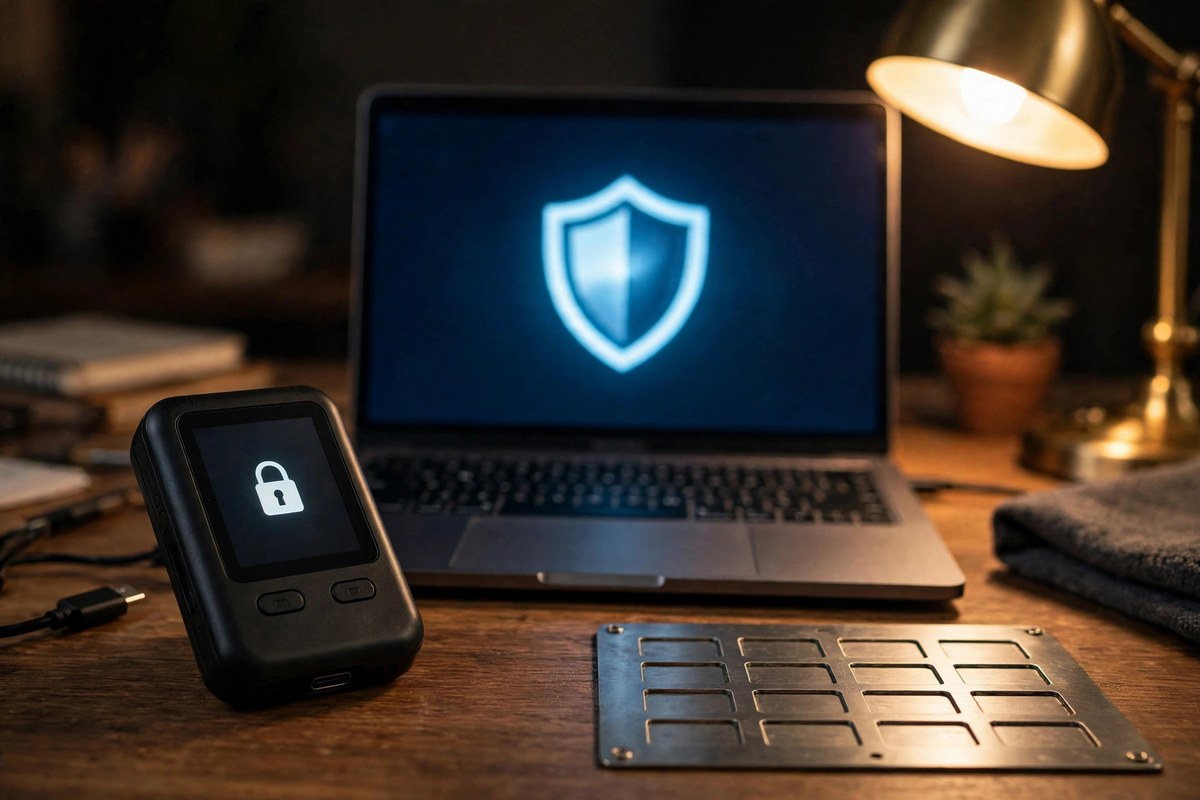
For long-term storage strategy, our cold storage and seed phrase guide covers hardware wallet setup, metal backups, and inheritance planning in detail.
Red Flags That Scream Scam
Scams follow patterns. Learn the red flags and most fraud becomes obvious on sight:
- Guaranteed returns or "risk-free" profits. No legitimate investment guarantees returns. "Guaranteed 2% daily" or "double your Bitcoin" is the signature of Ponzi schemes. Real markets have risk; anyone who says otherwise is lying.
- Pressure tactics and artificial urgency. "This closes in 2 hours," "only 50 spots left." Legitimate projects don't rush you. Scammers do — because scrutiny kills their scheme. Slow down whenever someone speeds you up.
- "Support agents" asking for your seed phrase or private keys. No legitimate team — not MetaMask, Coinbase, Ledger, or anyone — will ever ask for your seed phrase, private key, or remote access. Anyone who asks is a scammer, full stop.
- Too-good-to-be-true airdrops and giveaways. "Claim 5,000 free tokens" or celebrity doubling scams exist to get you to connect your wallet to a malicious site. If it sounds too good to be true, it's a trap.
- Clone websites with almost-right URLs. Uniswap becomes "unıswap" with a lookalike character. Check domains character by character, use bookmarks, and distrust any site reached via a link in a message, ad, or search sidebar.
What to Do If You've Been Hacked: The Emergency Playbook
Minutes matter. Follow this order the moment you suspect compromise:
- Disconnect your wallet from every site immediately. Revoke all connected sites in your wallet settings to cut off any malicious dApp with an active session.
- Revoke all token approvals. Use an approval-revocation tool on a block explorer to cancel every approval tied to the compromised wallet, stopping attackers from pulling tokens they haven't taken yet.
- Move remaining funds to a fresh wallet. Create a brand-new wallet on a clean device with a new seed phrase, and transfer what's left — after disconnecting and revoking, so the new address isn't exposed to the same malicious approvals.
- Report through every channel. Flag attacker addresses on block explorers. Contact stablecoin issuers — both Tether (USDT) and Circle (USDC) can freeze stolen funds at the contract level if you act fast with a proper report. File with local law enforcement and cybercrime units; a report number strengthens every other recovery channel.
- Understand why recovery is unlikely once funds hit a mixer. The Drift case is the textbook example: the exploiter moved 44,510 ETH (~$109 million) into Tornado Cash on October 20–21, 2026 — roughly 37% of the $295 million loot, now beyond tracing. Our Drift hack update tracks where the funds stand. Once crypto passes through a mixer, no analysis can reliably link it to the theft and no one can reverse it. Funds frozen at the issuer level or caught on a compliant exchange can sometimes be recovered; mixed funds are gone.
Document everything as you go: transaction hashes, attacker addresses, timestamps, screenshots of phishing sites or messages. If a third-party hardware wallet was involved, preserve the device — it may be evidence in the growing supply-chain tampering investigations.
FAQ: Crypto Security Questions Everyone Asks in 2026
Can stolen crypto be recovered?
Sometimes — but the odds drop fast with time. Recovery is possible when stolen funds sit on a compliant exchange or in freezable tokens like USDT or USDC, and you report within hours with transaction evidence. However, once funds pass through a mixer like Tornado Cash, recovery becomes practically impossible: tracing breaks and no one can reverse the transaction. The Drift exploiter's mixing of ~$109 million in October 2026 shows how fast funds move beyond reach. Prevention is worth infinitely more than recovery.
Are hardware wallets really safe after the Ledger implant story?
Yes — with one critical condition: buy directly from the manufacturer. The October 2026 implants were found in devices sold by the Indonesian reseller CryptoBilis, not in units shipped by Ledger itself. A genuine hardware wallet from the official source, verified on setup, remains the safest way to store crypto. The scandal doesn't invalidate hardware wallets; it invalidates buying them from anyone except the manufacturer.
Is it safe to keep crypto on an exchange?
Exchanges suit active trading balances but should never be your long-term vault — they carry hack, insolvency, and freeze risks. Keep trading funds on large, regulated exchanges with proof-of-reserves, and savings in self-custody. Enable hardware-key 2FA, withdrawal whitelisting, and anti-phishing codes on every exchange account.
What is the safest crypto wallet in 2026?
For most users: a hardware wallet bought directly from the manufacturer, used with the verified companion app, with the seed phrase on metal in two separate physical locations. That defeats remote hackers (keys never touch the internet), phishing (transactions need physical confirmation), and supply-chain risk (direct purchase). But no wallet protects you from approving a malicious contract or sending funds to a scammer — security is the wallet plus the habits in this guide.
How do I know if a DeFi protocol is safe?
No DeFi protocol is risk-free, but filter out the worst: multiple independent audits (read what auditors actually flagged), a long incident-free track record, a public reputable team, substantial total value locked, and a bug bounty program. Be extra cautious with unaudited launches, anonymous teams, and unusually high yields — high yield is compensation for high risk. Never deposit more into one protocol than you can afford to lose completely.
Should I still use DeFi at all?
Yes — with eyes open and survivable position sizes. DeFi remains one of crypto's most powerful innovations, and findings like Blockaid's "billion-dollar blind spot" are pushing the industry toward better monitoring. Use established, audited protocols, keep positions small relative to your portfolio, revoke approvals regularly, and treat yields as risk compensation, not free money.
Conclusion: Security Is a Habit, Not a Product
The $24 million Ostium exploit, the $295 million Drift hack, the Ledger implants, the billion-dollar Balancer blind spot — 2026 has proven that no corner of crypto is automatically safe. Attackers evolved past simple contract bugs into off-chain breaches, oracle manipulation, hardware tampering, and industrial-scale social engineering. The $2.81 billion stolen this year is the bill for underestimating them.
But most user-side losses are preventable. Buying your hardware wallet from the manufacturer, guarding your seed phrase, revoking approvals, verifying URLs, testing with small amounts, learning the red flags — these aren't advanced techniques. They're habits, and every one removes an entire attack category from your threat surface.
Start today with the highest-impact items: audit where your crypto sits, revoke approvals you don't recognize, and verify your hardware wallet's origin. In a year when hackers stole billions, the cheapest insurance in crypto is being harder to rob than the next target — and now you know exactly how.