Ethereum Gas Fees Crashed 58% to 3.5 Cents — Why That's Bad News for ETH Holders
Ethereum's median fee fell from 35 cents to 3.5 cents in 2026 — total fees down 58%. Great for users. Terrible for holders: the burn has nearly stopped and 842,000 new ETH entered supply this year.

Ethereum Gas Fees Crashed 58% — and That Is Bad News for ETH Holders
Ethereum's median transaction fee has collapsed from 35 cents to 3.5 cents in 2026, and total fees paid in ETH are down 58% year over year. Users are celebrating the cheapest Ethereum transactions in years. ETH holders should not be. The same upgrade-driven efficiency that made transactions nearly free has almost switched off the fee burn that was supposed to make ETH scarce — and 842,000 new ETH entered supply in the first ten months of the year. Here is what the numbers actually say, why the next upgrade could push fees even lower, and what it means for your ETH.
Ethereum is trading at about $2,237 on November 8, 2026 — down 16.7% in the past month, down 34% over the past year, and roughly 57% below its all-time high of $4,946 set in August 2025. The network has never been busier, and the asset has rarely looked weaker. That contradiction is the story of Ethereum in 2026.
The 5 Numbers That Explain Ethereum's Fee Collapse
The data comes from Ethereum Institutional's State of the Ledger report, published November 5, 2026, and from Coin Metrics data counted by Coindoo. The picture is unambiguous: Ethereum scaled, fees fell off a cliff, and the burn stopped working.
| Metric | 2025 | 2026 (Jan–Oct) | Change |
|---|---|---|---|
| Median transaction fee | 35 cents | 3.5 cents | −90% |
| Total fees paid (ETH) | 160,676 ETH | 67,665 ETH | −58% |
| Daily transactions | ~1.41 million | 2.17 million | +54% |
| Average base fee | 2.00 gwei | 0.27 gwei | −87% |
| ETH supply | 121.34 million | 122.18 million | +842,000 ETH |
Read that table twice. Ethereum processed 54% more transactions and collected 58% less in fees. The median user now pays a tenth of what they paid last year. That is a triumph of scaling — and a problem for everyone holding ETH as a scarce asset.
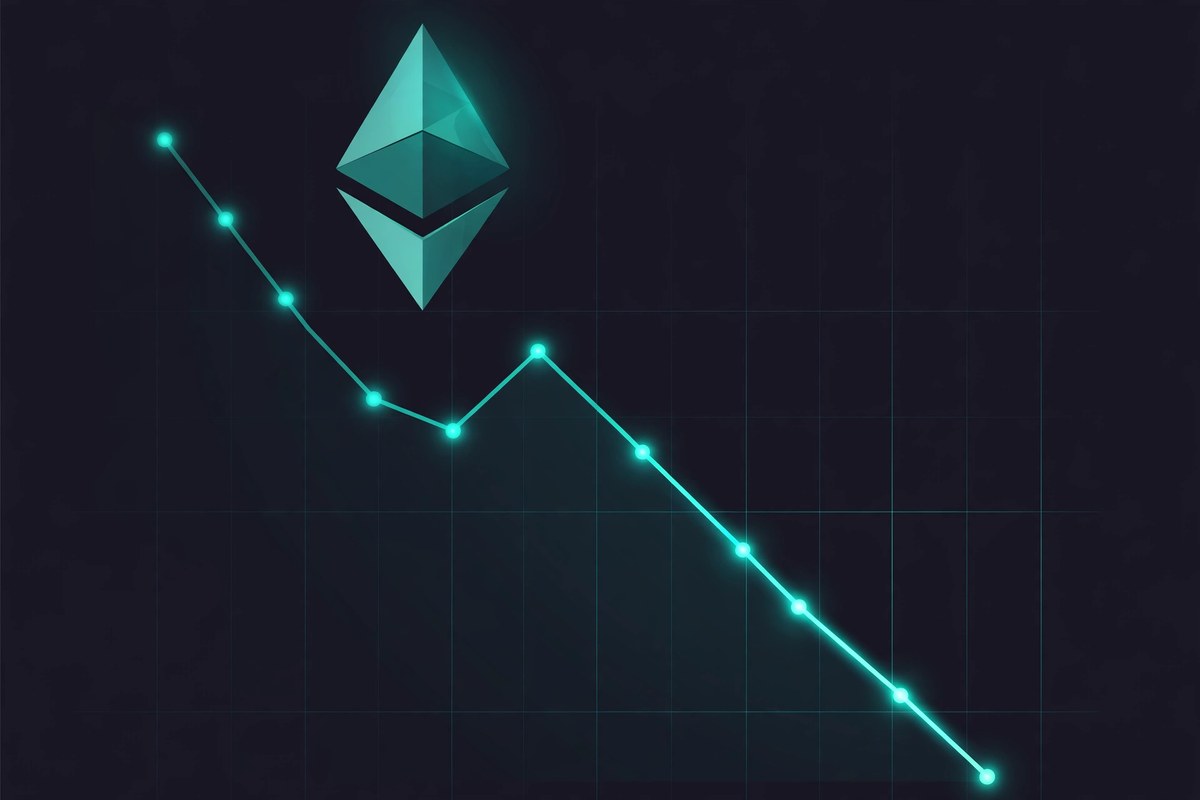
Why Ethereum Fees Fell Off a Cliff
Three forces combined to crush fees in 2026. None of them is a mystery, and none of them is reversing on its own.
First, the block gas limit doubled. Blocks now carry a 60 million gas limit, up from 30 million in 2024, and they run near their target. Under EIP-1559, the base fee only rises when blocks run above target. With double the room and demand spread across it, blocks sit at target and the base fee has nowhere to go but down. The average base fee in 2026 through mid-October was 0.27 gwei, against 2.00 gwei across 2025.
Second, the Fusaka upgrade expanded capacity further. Fusaka activated in December 2025, building on Dencun's proto-danksharding from 2024 by increasing blob capacity and data availability through PeerDAS. Layer-2 networks got cheaper data, more activity moved off the main chain, and mainnet congestion — the thing that used to spike gas prices — largely disappeared. Gas trackers recorded average gas prices around 0.196 gwei in 2026, with moments as low as 0.055 gwei, versus roughly 6 gwei on average in 2025.
Third, demand fell at exactly the wrong time. ETH is down 25% year to date and the market is in fear. The Crypto Fear & Greed Index read 25 on November 7, its first Extreme Fear reading since August. Fewer speculative transactions mean less competition for block space, which means lower fees — a feedback loop that keeps fees pinned near zero while prices fall.
The result is visible in everyday use. A simple ETH transfer that cost around 80 cents in early 2026 now costs closer to 20 cents, and complex swaps that once cost several dollars now cost pennies. For anyone who actually uses Ethereum, this is the best the network has ever felt. If you want the full mechanics of how gas pricing works, our guide Ethereum Gas Fees Explained: How ETH Transaction Fees Work and 9 Ways to Pay Less in 2026 breaks down base fees, priority fees, and timing tricks in plain English.
The Catch: The Burn That Was Supposed to Make ETH Scarce Has Nearly Stopped
Here is the part most coverage skips. Since the Merge, Ethereum's investment case has rested on a simple mechanism: every transaction burns part of its fee, and when network usage is high enough, the burn exceeds new issuance and ETH becomes deflationary. "Ultrasound money" was the slogan. In 2026, that mechanism has effectively switched off.
The 30-day burn came to just 2,417 ETH — less than 3% of what was issued over the same period. Data from ultrasound.money puts the break-even base fee, where the burn would match issuance at today's gas use, at roughly 13.6 gwei. The 30-day average base fee stands at about 0.37 gwei — more than 35 times lower. Fees would need to rise roughly 35-fold just to stop ETH supply from growing.
And supply is growing. ETH supply rose from about 121.34 million on December 31, 2025, to 122.18 million on October 31, 2026 — an increase of roughly 842,000 coins, or 0.7%. That is not a rounding error. At current prices, that is nearly $1.9 billion of new supply entering the market in ten months, diluting every existing holder while the asset falls.
This is the core tension in Ethereum's design in 2026: the network got so good at scaling that it destroyed its own scarcity engine. Users win. Holders pay. Anyone deciding whether to buy more ETH should understand that trade-off before clicking buy — our beginner's guide How to Buy Ethereum in 2026: A Complete Beginner's Guide to Your First ETH Purchase covers exchanges, fees, and storage, and What Is Ethereum? The Complete Beginner's Guide to How ETH Works in 2026 explains the Merge, staking, and issuance from the ground up.
What Most People Get Wrong About Cheap Gas
The myth: "Low fees mean Ethereum is winning, so ETH must go up." Low fees mean the network is winning as infrastructure. They do not mean the token is winning as an asset. A highway with no tolls is great for drivers and terrible for the toll company. Ethereum's fee revenue is the toll, and it just fell 58%.
The myth: "More transactions will fix the burn." Transactions are already up 54% — and fees still fell. The gas limit doubled, so each transaction competes for space that is twice as plentiful. Activity would need to roughly double again from here, at current fee levels, before the burn even approaches issuance. More usage helps, but capacity grew faster than usage.
The myth: "Glamsterdam will save ETH holders." The next upgrade, Glamsterdam, is designed to raise the gas limit toward 200 million — more than triple today's 60 million — and cut fees for common operations by up to 78%. That is wonderful for users and, on the current math, worse for the burn. Cheaper fees mean less ETH destroyed per transaction, not more.
The myth: "Staking offsets the dilution." About 30% of all circulating ETH is staked, and staking does pay rewards — but those rewards come from the same issuance that is growing supply. Stakers get more coins; non-stakers get diluted. The network as a whole still inflates at roughly 0.7% a year at current fee levels. Our guide Crypto Staking Explained: How to Earn Passive Income From ETH, SOL, ADA and More explains how staking yields actually work and what they cost in real terms.
Glamsterdam's Twist: Some Fees Are About to Explode — Upwards
Glamsterdam is not just "fees go down." Buried in the upgrade is a repricing of Ethereum's scarcest resource — blockchain storage — that could shock developers who are not paying attention.
The Ethereum Foundation's protocol team has opened a public audit repository, last updated November 6, 2026, asking auditors to hunt through the gas repricing in EIP-8037 and EIP-8038. The numbers are stark: writing to a fresh storage slot will cost 110,020 gas, up from 22,100 today — a nearly five-fold increase. A transfer to an empty address jumps from 25,000 to 183,600 gas. Code deposit rises from 200 gas per byte to 1,530. The new constant driving this, CPSB (cost per state byte), is set at 1,530 gas.
Why? Because storage is permanent — every byte written lives on every full node forever — while computation is temporary. Ethereum has been underpricing permanent storage for years, and Glamsterdam corrects that. The trade-off is deliberate: cheap computation, expensive state. Smart contracts that write lots of storage will get dramatically more expensive, while simple transfers and swaps get cheaper.
The timeline is uncertain. Glamsterdam was originally targeted for the first half of 2026 and still has no mainnet date; Ethereum Institutional expects it in early 2027. The Hoodi testnet fork was postponed on October 22 to study one repricing change, and no new date has been set. Both EIP-8037 and EIP-8038 carry Last Call status with a review deadline of November 1, 2026, already passed. Until the fork ships, the only number that matters for holders is the monthly net supply figure — and it has pointed up all year.
ETH Price: $2,237, 57% Below Its Peak, and the ETF Money Is Still Leaving
The fee story does not exist in isolation. ETH is the worst-performing top-cap asset of 2026 relative to network health, and institutional flows confirm the mood. U.S. spot Ethereum ETFs lost $365.3 million in the week of November 2–6, extending their losing streak to six consecutive weeks. BlackRock's iShares Ethereum Trust alone shed $90.8 million on November 6. The only inflow of note all week was $53 million on November 4.
Bitcoin is not helping. BTC trades near $75,900, spot Bitcoin ETFs recorded $1.28 billion in weekly outflows — their largest since June — and the whole market is waiting on the October CPI report due November 10. ETH opened 2026 at roughly $3,100, bottomed at $1,743 in February, and has never convincingly recovered. The drawdown from the $4,946 all-time high is about 57%.
The most painful data point belongs to the treasury companies. BitMine holds 5.28 million ETH at an average cost of $3,513, sitting on a $7.35 billion paper loss that would swell past $10 billion if ETH fell to $1,600. The companies that bet hardest on ETH as a treasury asset are underwater by billions — and their buying was supposed to be the floor.
3 Scenarios for ETH: What the Fee Data Says Happens Next
| Scenario | Trigger | Fee / Supply Outcome | Price Implication |
|---|---|---|---|
| Bull: usage catches up | CPI cools, Fed pivots, risk appetite returns | Base fee climbs toward 5+ gwei; burn narrows the supply gap | ETH reclaims $2,500, then tests $3,000 |
| Base: cheap gas persists | Sideways market, Glamsterdam ships early 2027 | Fees stay under 1 gwei; supply grows ~0.7% a year | ETH grinds between $2,000 and $2,400 |
| Bear: the floor breaks | Hot CPI Nov 10, ETF outflows accelerate | Activity drops further; burn falls to near zero | ETH tests $2,000, then the February low near $1,743 |
The base case is the most likely on current data: fees stay cheap, supply keeps growing slowly, and ETH trades sideways until either usage explodes or macro turns. The bull case needs a genuine demand shock — not just more transactions, but transactions willing to pay real fees. The bear case needs only a continuation of what is already happening.
What Ethereum Users Should Do While Gas Is Nearly Free
Cheap gas is a window, not a permanent condition. If you use Ethereum, this is the cheapest it has ever been to do the housekeeping you have been putting off.
- Consolidate your wallets now: moving tokens between your own wallets costs pennies today — do it before fees rise again, and store long-term holdings in cold storage. See Best Crypto Wallets for Beginners in 2026: Hot vs Cold Wallets Compared before you move anything.
- Revoke old token approvals: every dApp approval you granted in 2021–2025 is still live; revoking them costs almost nothing in gas right now.
- Claim and restake rewards: staking rewards, airdrops, and LP positions that were not worth claiming at $5 a transaction are worth claiming at 3.5 cents.
- Do not confuse cheap fees with a buy signal: low gas tells you the network is empty, not that the asset is cheap — check the supply and ETF flow numbers above before adding to a position.
- Watch the monthly net supply number: until the burn approaches issuance, ETH is an inflating asset — the single most important monthly figure for holders, more than price.
FAQs
Why are Ethereum gas fees so low in 2026?
Fees collapsed because capacity grew faster than demand. The block gas limit doubled to 60 million, the Fusaka upgrade expanded layer-2 data capacity, and a fear-driven market reduced speculative transactions. The average base fee fell to 0.27 gwei in 2026 from 2.00 gwei in 2025, and the median transaction now costs about 3.5 cents versus 35 cents last year.
Is ETH inflationary again?
Yes, at current fee levels. ETH supply grew by about 842,000 coins (0.7%) from December 31, 2025 to October 31, 2026, because the fee burn — just 2,417 ETH over 30 days — covers less than 3% of new issuance. The base fee would need to reach roughly 13.6 gwei, about 35 times the current 30-day average, for the burn to match issuance.
Will Glamsterdam make gas fees even lower?
For most users, yes — Glamsterdam targets fee cuts of up to 78% for common operations and a gas limit near 200 million. But it also reprices storage sharply upward: writing to a fresh storage slot rises from 22,100 to 110,020 gas. The upgrade has no confirmed mainnet date and is expected in early 2027.
Does low gas mean ETH price will go up?
Not necessarily. Low fees are great for users but reduce the fee burn that supports ETH's scarcity narrative. ETH is down 34% over the past year despite fees falling 58%, and spot ETH ETFs have seen six straight weeks of outflows. Cheap gas is a sign of an empty network, not a buy signal on its own.
What is the cheapest time to transact on Ethereum?
Right now, almost any time. With the average base fee at 0.27 gwei and the median transaction at 3.5 cents, timing barely matters in 2026 — a sharp contrast to 2021, when fees regularly exceeded $50 during congestion. Weekends and off-peak hours still help marginally.
Should I stake my ETH while supply is growing?
Staking pays rewards funded by the same issuance that grows supply, so stakers roughly keep pace with dilution while non-stakers fall behind. About 30% of ETH is staked. Whether staking makes sense depends on your time horizon and whether you are comfortable locking funds — see our staking guide linked above for the full trade-off.
Conclusion
Ethereum in November 2026 is a paradox: the best network it has ever been, and one of the weakest assets in the top ten. Transactions are up 54%, the median fee is down 90% to 3.5 cents, and total fees paid have fallen 58%. Users have never had it better. But the burn that was meant to make ETH scarce has nearly stopped, 842,000 new coins entered supply this year, and Glamsterdam will push fees lower still while repricing storage five-fold for developers. The next upgrade is not a rescue for holders — it is more of the same trade-off, sharper. Until the base fee climbs anywhere near the 13.6 gwei break-even, ETH is an inflating asset with a shrinking fee engine, and its price will follow flows and macro, not the elegance of its engineering. Watch the CPI print on November 10, watch the monthly net supply number, and use the cheap gas while it lasts — it may not stay this cheap forever, but neither will the patience of ETH holders.
Sources: Ethereum Institutional State of the Ledger report (November 5, 2026) via Coindoo; Coin Metrics fee and supply data; ultrasound.money burn data; Ethereum Foundation Glamsterdam audit repository via Blockchain Reporter; CoinGecko and TradingView market data via TradingNews; SoSoValue ETF flow data; Finnhub market data. This article is for informational purposes only and is not investment advice.