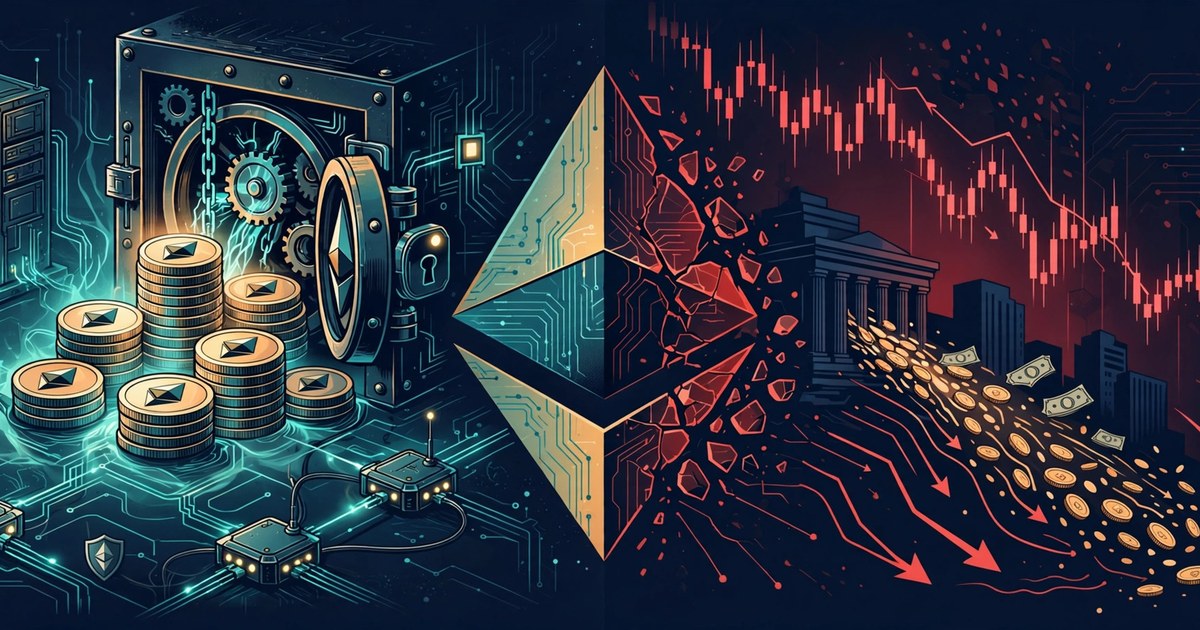
Devcon 8: Vitalik Warns AI Could Crack Crypto's Math in 5 Years as ETH Holds $2,264 — 5 Numbers That Decide $2,209 or $2,300
Vitalik Buterin opened Devcon 8 in Mumbai warning AI could crack crypto's math in 5 years — while ETH holds $2,264 after 6 straight days of ETF outflows. Here are the 5 numbers that decide $2,209 or $2,300.

Vitalik Buterin opened Devcon 8 in Mumbai on Tuesday wearing a smiley-face mask and a cloak covered in eyes — and warned that artificial intelligence could speed through 50 years of mathematics in five years and break the cryptography protecting Ethereum and Bitcoin. At the same moment, Ether traded at $2,264, down 16% in a month, with US spot Ether ETFs bleeding for a sixth straight trading day. The contrast is the story of Ethereum right now: builders planning for a verifiable future while traders sell the present.
Devcon 8, the Ethereum Foundation's flagship developer conference, runs November 3–6, 2026, at the Jio World Centre in Mumbai's Bandra Kurla Complex — the first time Devcon has ever been held in India. Doors opened at 8:30 a.m. IST, and the opening ceremony followed at 9:30 a.m. on the Lotus Stage with Buterin, Devcon team lead Nathan Sexer, Taiwan's former digital minister Audrey Tang and Ethereum researcher Justin Drake. Buterin's own framing for the location was pointed: "Devcon 8 is in Mumbai to recognize and champion what India is already building."
This article breaks down what Buterin actually warned about, why it matters for anyone holding ETH, and the five numbers that decide whether Ether holds $2,209 or reclaims $2,300. For the basics of the network itself, see our What Is Ethereum? beginner's guide.
What happened at Devcon 8 on day one
Buterin did not unveil a token or a product. He described a problem: modern technology asks users to trust too much and lets them check too little. His keynote tied Ethereum's mission to six goals: formally verified operating systems, open silicon, self-sovereign health technology, free discourse, private communication and trustworthy artificial intelligence. The common thread, according to coverage of the keynote, is reducing dependence on institutions that users cannot independently check.
His most concrete example was hardware wallets. Buterin warned against relying on opaque devices, condensed into one line that quickly spread across crypto social media: "Not your silicon, not your life." The point was blunt — if nobody can tell whether a device has extra radios or hidden parts leaking keys, the user cannot verify the thing guarding their money. Later in the day he joined Ethereum Foundation researcher Nicolas Consigny at a session on Kohaku, Ethereum's privacy-focused wallet initiative, where he said Tor, the anonymity network used to protect online identity, is "far from perfect."
The conference agenda reflects the same shift. Devcon 8's sessions centre on auditable, decentralised alternatives to today's technology — privacy, security, open infrastructure and public goods — not on immediate token releases or product launches. Ethereum already counts more than 1 million developers across its history, and the stated aim this week is to carry its core principles into hardware, health technology and AI.
The AI warning, in plain English
On the day he opened Devcon 8, Buterin posted on X that his worry is not quantum computers arriving tomorrow. It is something subtler: that algorithms capable of breaking today's cryptography may already exist in principle but remain undiscovered — and that AI could find them far faster than humans would. His words, quoted widely: "what if the equivalent of quadratic sieve for ECDLP or pairings (and similarly, more-powerful-than-today algorithms for breaking lattices) exist, and we've just not yet managed to find them – but AI speedrunning 50+ years of math in 5 years will."
Unpacking that sentence matters, because it names three specific targets:
- ECDLP — the elliptic curve discrete logarithm problem. This is the math that protects private keys on both Ethereum and Bitcoin. If it fell, the keys guarding wallets would be at risk.
- Pairings and validator signatures. A technique behind the signatures Ethereum validators use to vote on blocks. Breaking pairings would strike at consensus itself.
- Lattices and post-quantum replacements. The mathematical structures behind most post-quantum cryptography — the replacement systems meant to survive quantum computers. Buterin's point is that even the replacements could harbour undiscovered weaknesses.
His benchmark, the quadratic sieve, is an early-1980s algorithm that sped up factoring large numbers and weakened RSA-style encryption. The analogy is deliberate: a single mathematical breakthrough once rewrote what was considered safe, and AI could compress the decades such breakthroughs used to take. The warning connects to his recent work — last month he unveiled an "AI paranoid mode" for private chats and backed an AI model that deliberately cut hacking skills, and in April 2026 he published a note on a self-sovereign LLM setup that favours local models and cleaned prompts before any remote model call.
At Devcon he framed the response as "defensive decentralised acceleration": deceleration — trying to ban or freeze progress — is not happening, and domination — putting the best tools in one strong group's hands — is the default if nothing changes. The alternative he pressed for rests on open software, verifiable silicon, zero-knowledge proofs, local models and formal verification of security claims. It is also why the post-quantum debate is live inside Ethereum right now, with proposals such as EIP-8288 circulating as the community argues over how fast to move. Readers worried about the quantum angle specifically should read our explainer Is Bitcoin Safe from Quantum Computers? Coinbase's Post-Quantum Plan Explained — the same cryptography questions apply to ETH.

ETH at $2,264: the price reality check
While Buterin talked about the next decade, traders were watching the next dollar. Ether stood at $2,264.25 at 11:54 UTC on November 3, according to CoinGecko data — down 0.75% from $2,281.26 the day before, with a market capitalisation of about $276.66 billion and 24-hour trading volume of $9.16 billion. The token has lost 16.04% over the past month, down from $2,696.98 on October 4, and is 38.79% lower than a year ago. A separate Investing.com quote page showed $2,248.95, a market capitalisation of $274.22 billion and a 52-week range of $1,507.60 to $3,913.85 — a reminder of how far ETH has fallen from its highs.
CoinGlass liquidation data showed about $418.79 million in crypto liquidations over 24 hours, with ETH positions accounting for around $60.71 million. The technical picture is firmly bearish in the short term: ETH sits below its key short-term trend levels, with immediate resistance at $2,271 and key support at $2,209. One technical read puts a likely near-term consolidation range at $2,209 to $2,307, while another flags $2,222 as support and $2,315 as resistance. In plain terms: reclaiming $2,271 turns the setup neutral-to-bullish; losing $2,209 opens the way toward the $2,000 zone.
The ETF exodus: six straight days of selling
The heaviest weight on ETH is institutional. US spot Ether ETFs recorded net outflows of $139.7 million on November 2, their sixth consecutive trading day of withdrawals, according to Farside Investors data. BlackRock's iShares Ethereum Trust (ETHA) accounted for $138.3 million of that total, and BlackRock's staked Ether fund ETHB lost a further $4.6 million. Morgan Stanley's MSSE was the only product to attract money, taking in $3.2 million, while the remaining funds recorded no net flows. Total net assets across the 11 funds stood at $13.18 billion — about 4.8% of ETH's market capitalisation — while cumulative net inflows remained $12.15 billion.
October was worse. US spot Ether ETFs lost $1.61 billion in October, ending three consecutive months of net inflows, after attracting about $3.05 billion between July and September. Total net assets fell from $17.60 billion at the end of September to $13.22 billion at the end of October. BlackRock's ETHA alone recorded outflows totalling 580,145 ETH over the past month, according to SoSoValue. The Ethereum Foundation, meanwhile, has been expanding efforts to attract government and institutional adoption, including a dedicated public-sector website — but those developments have yet to translate into fund flows.
None of this means every redemption produced an identical amount of immediate selling in the spot market — fund flows are not a direct measure of every participant's positioning. But six straight days of redemptions, led by the largest fund, is a clear signal that regulated demand has cooled.
The counterweight: buyers the headlines miss
Against the ETF selling, three quieter forces are absorbing supply. First, corporate buyers have not stopped: BitMine, one of the largest corporate ETH holders with nearly 5% of supply, keeps accumulating even while sitting on more than $4 billion in unrealised losses, and is prioritising share buybacks over new ETH purchases for now. Second, staking demand is strong — 1.37 million ETH are waiting to be staked, and the network recently set a record of 43.8 million staked ETH. Third, exchange supply is thin: only about 14.5 million ETH remain on exchanges, a 10-year low, which means less readily sellable supply overhangs the market.
There is also a quirk worth knowing: with the base fee at just 0.06 Gwei, ETH has shifted to daily net issuance — new supply is being created faster than fees burn it. That is the opposite of the "ultrasound money" narrative from busier times, and it is one reason traders watch network activity as closely as price. ENS, the Ethereum Name Service, has also abandoned plans for a dedicated layer-2 network, a small sign that even established projects are rethinking expansion while fees are this low. If you want to understand the staking side of this story, read our How to Stake Ethereum: Complete 2026 Guide.

5 numbers that decide $2,209 or $2,300
| Signal | Reading | What it decides |
|---|---|---|
| ETH price | $2,264 (Nov 3) | Between support $2,209 and resistance $2,271 |
| ETF flows | -$139.7M on Nov 2, 6th straight day out | Whether institutional selling is exhausting or accelerating |
| ETHA monthly outflow | 580,145 ETH in a month | How much BlackRock exposure has been cut |
| ETH waiting to stake | 1.37M ETH in queue | Whether long-term holders are locking supply despite the sell-off |
| ETH on exchanges | ~14.5M, a 10-year low | How thin the readily sellable supply really is |
Three scenarios for the week ahead
| Scenario | Trigger | Target |
|---|---|---|
| Bull | ETH reclaims $2,271 and ETF outflows slow | $2,307, then $2,315 resistance |
| Base | Flows stay mixed, Devcon produces no catalyst | Range-bound $2,209–$2,307 |
| Bear | $2,209 breaks with ETF selling intact | $2,000 zone, then a test of deeper support |
The base case is the most likely for now. Devcon has historically worked as a showcase for research and builders rather than a short-term price catalyst, and this week's sessions are more likely to shape Ethereum's longer-term direction on privacy, security and post-quantum readiness than to move the daily chart. The near-term price outlook depends on whether ETF redemptions slow, whether corporate buyers such as BitMine keep absorbing supply, and whether the delayed Glamsterdam testnet upgrade gets a new date — the Hoodi activation was postponed on October 22 with no replacement date set, leaving another uncertainty hanging over the network.
What most people get wrong about this week
"Devcon will pump ETH." It almost never does. Devcon is a developer conference, not a product launch. Its announcements shape years, not candles. Anyone buying ETH this week purely on Devcon headlines is trading the wrong catalyst.
"Vitalik said quantum computers will break crypto." He did not — not this week. His warning was about undiscovered mathematics and AI acceleration, which is a different risk from a quantum computer arriving on a known date. The distinction matters because the defences differ: post-quantum cryptography guards against known quantum attacks, while Buterin's worry is about attacks nobody has found yet.
"ETF outflows mean everyone is dumping." Fund redemptions and spot selling overlap but are not identical. At the same time ETFs sold $1.61 billion in October, corporate treasuries kept buying and staking queues grew. The market is splitting: regulated funds de-risking, long-term holders locking up supply. That split — not a single narrative — is what the $2,209 and $2,271 levels are actually pricing.
For readers new to the market, two guides are worth bookmarking before acting on any of this: our How to Buy Ethereum: Beginner's Guide and Is Ethereum a Good Investment in 2026?. And if the market mood feels extreme, our Crypto Fear & Greed Index Explained shows how to read sentiment without trading on it.
What to watch before Devcon closes
- November 4–6 sessions: privacy and post-quantum tracks, plus any update on the delayed Glamsterdam Hoodi testnet schedule.
- Daily ETF flows: a single day of inflows after six days out would be the first sign the institutional bleed is pausing.
- $2,209 and $2,271: the two levels that decide whether ETH ranges, recovers or breaks down.
- Friday's US jobs report: the macro event that could override everything crypto-specific this week.
- Hardware and wallet security: Buterin's "not your silicon, not your life" line puts verifiable hardware on the agenda — check our comparison of Ledger vs Trezor hardware wallets if you hold meaningful amounts.
FAQs
What is Devcon 8?
Devcon 8 is the Ethereum Foundation's annual developer conference, held November 3–6, 2026, at the Jio World Centre in Mumbai, India — the first Devcon ever hosted in India. It gathers developers, researchers and builders to discuss blockchain infrastructure, privacy, security and the future of open technology.
What did Vitalik Buterin warn about at Devcon 8?
Buterin warned that AI could speed through 50 years of mathematics in five years and discover algorithms that break today's cryptography — specifically the elliptic curve discrete logarithm problem protecting private keys, pairings behind validator signatures, and even lattice-based post-quantum systems. He framed verifiable technology, including open silicon and zero-knowledge proofs, as the defence.
Why is Ethereum's price falling if Devcon is happening?
Devcon is a builder showcase, not a price catalyst. ETH is under pressure from six straight days of US spot ETF outflows, including $139.7 million on November 2, and a 16% monthly decline. The conference shapes Ethereum's long-term direction; fund flows and macro data move the daily price.
What are the key ETH price levels right now?
Immediate support sits at $2,209, with resistance at $2,271. Reclaiming $2,271 opens $2,307–$2,315; losing $2,209 points toward the $2,000 zone. ETH traded at $2,264 on November 3.
Are Ethereum ETFs still seeing outflows?
Yes. US spot Ether ETFs lost $139.7 million on November 2, the sixth consecutive trading day of outflows, led by BlackRock's ETHA at $138.3 million. October saw $1.61 billion in total outflows, ending three months of inflows.
Should I buy ETH at $2,264?
That depends on your horizon, not on Devcon headlines. Short-term traders watch $2,209 support and whether ETF outflows slow; long-term holders point to record staking, thin exchange supply and corporate accumulation. This article is not financial advice — size any position for the possibility that $2,209 breaks.
Conclusion
Devcon 8's opening delivered the most important Ethereum speech of the year and barely moved the price — and that is exactly the point. Buterin is arguing that the real contest is not this week's candle but the verifiability of the entire technology stack: operating systems, silicon, health data, communication and AI. The market, meanwhile, is voting with ETF redemptions and a $2,264 price tag. Both can be true at once. Watch $2,209 and $2,271 for the trade, watch the post-quantum and privacy tracks for the thesis, and remember the line from the man in the smiley mask: not your silicon, not your life.
Sources: CryptoTimes, BeInCrypto, CryptoBriefing, ad-hoc-news, Invezz, CoinGecko, Farside Investors, SoSoValue, CoinGlass.