Bitcoin vs Stocks: Which Is the Better Investment in 2026?
Bitcoin vs stocks in 2026: the S&P 500 is up ~14% while BTC is down ~6%. We compare returns, volatility, correlation and risk to answer which one deserves a place in your portfolio.

Bitcoin is trading around $81,000 this week, roughly a third below its all-time high above $126,000 set in October 2025 — while the S&P 500 keeps grinding to record highs, up about 14% in 2026. That split-screen is the most important market story of the year for retail investors: stocks are having one of their best years in a decade, and Bitcoin — the asset that was supposed to outperform everything — is having one of its worst relative to equities in six years. If you are trying to decide where to put fresh money in 2026, this is the comparison that matters. This guide breaks down the Bitcoin vs stocks question with real data: year-to-date performance, five-year returns, volatility, correlation, risk, and who each asset actually suits — so you can decide which one earns a place in your portfolio.
Bitcoin vs Stocks in 2026: The Scoreboard So Far
Let's start with what the numbers say, because they are unusually clear this year. Since January 1, 2026, the S&P 500 has returned roughly 13.6% while Bitcoin has returned about -5.7%, according to StatMuse data compiled in early October. Other snapshots tell the same story: a Bitcoin Wire comparison through the first week of October put the S&P 500 at +14.2% year-to-date, Bitcoin at -2.3%, Ethereum at -9.1%, Solana at -3.1% and BNB at -9.8%. U.S. large-cap stocks have significantly outperformed every major cryptocurrency so far this year.
Gale Finance's risk-return data through October 22, 2026 puts Bitcoin's one-year return at -24.5%, with a current drawdown of -34.9% from its highs and a five-year CAGR of just 5.8%. Over the five years from October 2021 to October 2026, the S&P 500 returned 78.8% versus 45.5% for Bitcoin — meaning that even on the longer lens, plain index funds have beaten Bitcoin for anyone who bought five years ago, a reversal of the story crypto investors have told for a decade.
The underperformance is not a blip. According to Glassnode data cited by Memeburn, Bitcoin outperformed the S&P 500 on only about one-third of trading days over the past three months — a historic shift from Bitcoin's typical role as a higher-beta asset that rallies harder when stocks rally. Investors are facing high Bitcoin volatility but are receiving progressively less extra return for that risk than they get from simply holding the stock market.
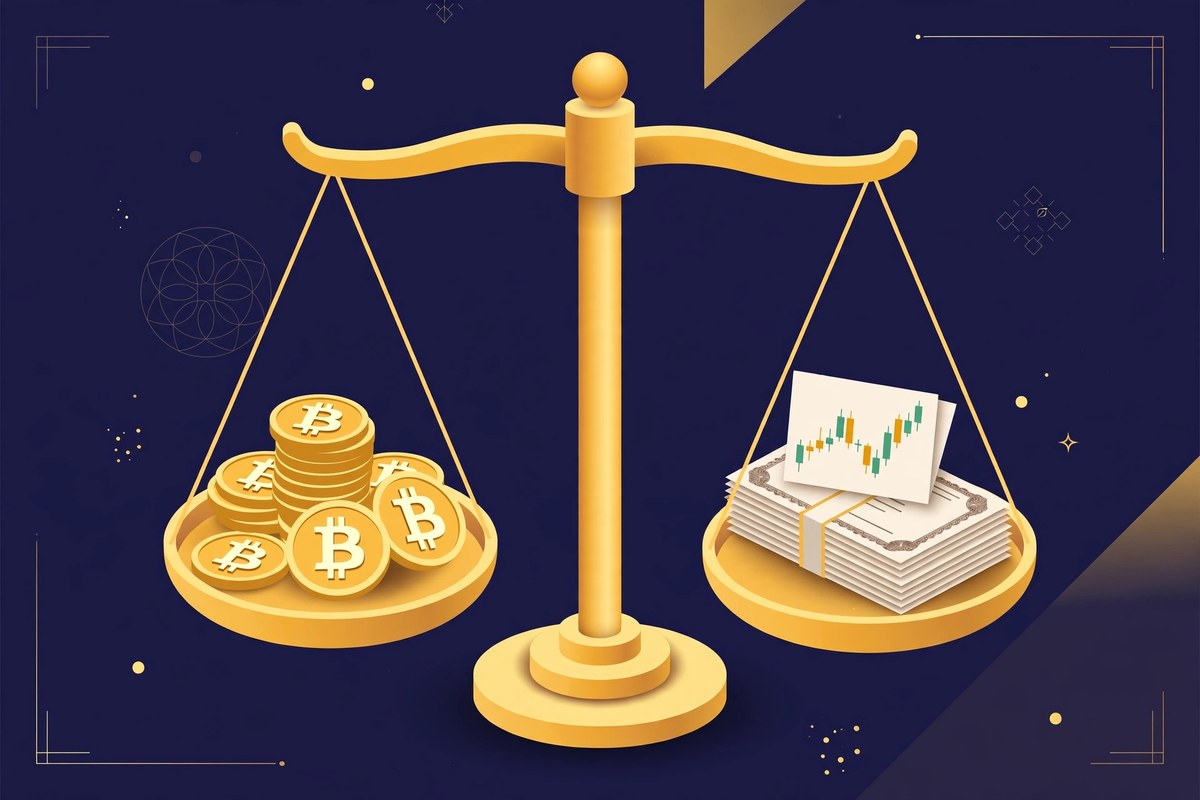
Why Stocks Are Winning This Year
Several forces combined to make 2026 the year stocks left crypto behind. Understanding them matters because it tells you whether the gap is likely to close or keep widening.
The AI investment boom is siphoning capital. The S&P 500's resilience has been powered by strong corporate earnings expectations, continued AI infrastructure investment, and resilient economic activity. Trillions of dollars have flowed into semiconductor and technology stocks on the AI thesis, and analysts argue that this frenzy has directly siphoned capital away from crypto. Bitcoin lost the attention war: when the market's marginal dollar chases AI chips, it is not chasing digital gold.
Bitcoin's four-year cycle hit its bear phase. Bitcoin peaked above $126,000 in October 2025 and then traced the familiar post-peak capitulation: a lower-high, lower-low sequence into February near $60,000 and a deeper June trough near $58,000. From that June low the market recovered hard into September's spike toward $87,000, but the move stalled and BTC slid back toward $80,000 this week. The calendar-based cycle model says 2026 is simply the drawdown year — and so far it has behaved like one.
Derivatives deleveraging broke the old beta relationship. Research from Woofun AI notes that from the end of August 2025 into early 2026, Bitcoin fell about 43% while the S&P 500 rose about 7% and gold surged 51%, and attributes much of the divergence to the deleveraging process after the spot Bitcoin ETF boom cooled. As derivatives leverage washed out, macro factors stopped amplifying Bitcoin's price the way they used to.
Rate expectations rewarded productive assets. With the Federal Reserve's October 28 decision looming and Treasury yields elevated, capital has preferred assets that generate cash flow — dividends and buybacks from profitable companies — over an asset whose return depends entirely on someone else paying more later. Opportunity cost is Bitcoin's silent tax, and it has been high all year.
The Decoupling: Bitcoin and Stocks Are Breaking Up
Here is the twist: even as Bitcoin underperforms, its relationship with the stock market is fundamentally changing. Bitcoin's 30-day rolling correlation with U.S. stocks has fallen to its lowest level since the FTX crash in November 2022, according to Woofun AI — bottoming at -0.299 in December 2025, rebounding to around 0.18 in January 2026, with the three-month rolling correlation hovering near zero through mid-2026. The two assets have officially entered what analysts call a "decoupling" phase.
BlackRock's own research puts the 10-year correlation between Bitcoin and the S&P 500 at just 0.18, and notes the long-term average has generally sat between 0.25 and 0.32, spiking only during crisis sell-offs when everything falls together. The current reading below 0.20 sits at the opposite extreme — evidence, BlackRock argues, that Bitcoin is gradually shedding its "highly leveraged tech stock" behavior and behaving more like an independent asset class.
For investors, that cuts both ways. On one hand, Bitcoin no longer reliably amplifies stock rallies, so it has stopped doing the job many bought it for. On the other hand, true diversification value comes from assets that zig when others zag — and Bitcoin is finally doing that. Monday's rare divergence, when Bitcoin rallied 2.6% while the S&P 500 fell 0.52%, showed the mechanism still works; it just needs the right conditions. If you want to understand how Bitcoin's market personality is evolving, our guide on whether Bitcoin is a good investment in 2026 walks through the honest risks and red flags alongside the bull case.
Bitcoin vs Stocks: Head-to-Head Comparison
This table compares the two on the dimensions that actually determine investment outcomes:
| Factor | Bitcoin | Stocks (S&P 500) |
|---|---|---|
| 2026 YTD return | ~ -5.7% | ~ +13.6% |
| 5-year return (2021–2026) | ~ +45.5% | ~ +78.8% |
| Volatility | Extreme (60–80% annualised swings common) | Moderate (~15–20% in normal years) |
| Worst drawdown in cycle | -50%+ (Oct 2025 peak to June 2026 trough) | Single-digit pullbacks in 2026 |
| Income | None (no dividends, no yield) | ~1.3–1.5% dividend yield + buybacks |
| Trading hours | 24/7, 365 days | Weekdays, market hours |
| Cash-flow backing | None — price is pure supply/demand | Corporate earnings and growth |
| Regulation | Evolving; ETFs now available in the U.S. | Deeply established investor protections |
| Accessibility | Spot ETFs, exchanges, apps | Brokerages, 401(k)s, IRAs |
| Supply | Capped at 21 million | Companies can issue more shares |
The comparison exposes Bitcoin's core trade: you accept dramatically higher volatility and drawdowns, no income, and no cash-flow anchor in exchange for capped supply, 24/7 access, and the possibility of explosive upside when the cycle turns. Stocks give you the opposite — smoother compounding backed by real earnings, with dividends that pay you while you wait.

Returns vs Risk: What the Numbers Actually Say
Raw returns flatter stocks right now, but investment decisions should be made on risk-adjusted terms. Bitcoin's five-year CAGR of about 5.8% through late October 2026, paired with drawdowns near -35% and regular -50% cycles, means investors endured equity-like fear for worse-than-equity returns over this window. That is the definition of bad risk-adjusted performance — and it is why even crypto-native analysts are calling 2026 one of the most difficult periods in the market's history despite the absence of a 2022-style shock.
Stocks, by contrast, delivered roughly 14% in 2026 with single-digit pullbacks and a dividend yield on top. The Sharpe ratio — return per unit of volatility — has not even been close this year.
But zoom out further and the picture shifts. Bitcoin bought at any major bear-market bottom — early 2019, late 2022, mid-2026 — has historically outperformed stocks by multiples over the following two to three years. The asset's edge has always been timing the cycle, not holding blindly. Our analysis of when to sell Bitcoin and how to build an exit plan is essential reading if you are considering the cyclical approach rather than buy-and-hold.
The honest summary: over the trailing five years, stocks won on both absolute and risk-adjusted terms. Bitcoin's historical outperformance came in concentrated bursts that required buying deep drawdowns and surviving years of pain — a strategy most investors fail to execute.
Who Should Buy Bitcoin vs Stocks in 2026
There is no universal answer, but the profiles are clear:
- Choose stocks if: you want steady compounding, you need the money within five years, you value dividends and lower volatility, or you are investing through a retirement account where crypto access is limited. An S&P 500 index fund remains the default right answer for most people — 2026 has only reinforced that.
- Choose Bitcoin if: you have a high risk tolerance, a time horizon of 5–10+ years, you can stomach 50%+ drawdowns without panic-selling, and you want exposure to an asset with a hard-capped supply outside the traditional financial system. Treat it as a satellite position — most prudent allocations put 1–5% of a portfolio in Bitcoin, not 50%.
- Consider both if: you want diversification. Bitcoin's current low correlation with stocks (around 0.18 on a 10-year view, near zero on recent readings) is precisely what makes a small allocation interesting: it can behave differently from everything else you own. Our beginner's guide on how to invest in crypto covers buying, storing and securing your first Bitcoin safely.
One rule that never changes: never invest money you will need soon into Bitcoin. The 2026 cycle proved again that "number go up" is not a strategy — position sizing is.
The Tokenization Twist: Why the Line Between Stocks and Crypto Is Blurring
Here is where the Bitcoin vs stocks debate gets genuinely new in 2026: the two worlds are converging. The SEC updated its Innovation Exemption page in October 2026 with the first three venues seeking to trade stocks on-chain — TSV LLC, OKXICE (a joint venture between OKX and ICE, the company that owns the NYSE) and Perpetuals.com — and the SEC's Division of Examinations has made asset tokenization a core focus of its fiscal 2027 priorities. Wall Street is laying the pipes to trade stocks as tokens, 24/7, on blockchain rails.
That convergence reshapes the comparison. If stocks become tokenized and trade around the clock with instant settlement, some of Bitcoin's structural advantages — 24/7 access, fast settlement, no intermediaries — get competed away by the very asset class it competes with. Conversely, if your stock portfolio can live on-chain, the distinction between "crypto investor" and "stock investor" starts to dissolve: it becomes one portfolio, one wallet, one market. The investors who understand both sides now will be best positioned for the merged market that tokenization is building.
What to Watch Next
Three catalysts will decide whether Bitcoin closes the gap with stocks before year-end:
- The Fed's October 28 decision. Rate cuts lower the opportunity cost of holding a non-yielding asset like Bitcoin and typically weaken the dollar — both tailwinds. A hawkish hold extends stocks' advantage.
- The AI capex cycle. As Memeburn's analysis put it, sustained Bitcoin outperformance requires a reversal of the capital rotation into AI stocks. Any crack in the AI spending narrative — earnings misses, capex cuts — is the signal that institutional money could rotate back toward alternative assets. CryptoQuant's CEO has made exactly this call: if AI stocks crash, capital rotates back into BTC.
- ETF flows and the $80,000–$87,500 supply wall. Spot Bitcoin ETFs have still posted billion-dollar inflow days in October (including $527M on the biggest day since September), but price has failed to hold above $87,000. A confirmed break of that supply zone reopens the path toward $90,000–$97,000; failure keeps $75,000 and the rising 50-day average in play as downside targets.
For a deeper dive into how Bitcoin stacks up against its closest crypto rival rather than stocks, see our Bitcoin vs Ethereum comparison for 2026.
Frequently Asked Questions
Is Bitcoin a better investment than stocks in 2026?
On the numbers so far, no: the S&P 500 is up about 14% in 2026 while Bitcoin is down roughly 6%, and stocks have also won on the five-year lens (78.8% vs 45.5%). Bitcoin's case rests on future cycle upside and diversification, not on 2026's scoreboard.
Why is Bitcoin underperforming the stock market this year?
Four main reasons: the AI stock frenzy siphoned capital into tech shares, Bitcoin entered the bear phase of its four-year cycle after peaking above $126,000 in October 2025, derivatives deleveraging broke Bitcoin's old high-beta relationship with stocks, and elevated rates raised the opportunity cost of holding a non-yielding asset.
Are Bitcoin and stocks still correlated?
Barely. Bitcoin's 30-day correlation with U.S. stocks has fallen to its lowest since the FTX crash, with recent three-month readings near zero. BlackRock puts the 10-year correlation at just 0.18. They increasingly move independently — which is both why Bitcoin missed the stock rally and why it can diversify a portfolio.
Should I sell my stocks to buy Bitcoin?
Almost certainly not all of them. Stocks provide earnings-backed compounding, dividends and lower volatility; Bitcoin provides asymmetric upside and diversification. Most financial planners suggest 1–5% of a portfolio in Bitcoin as a satellite position, keeping the core in diversified equities.
Can Bitcoin outperform stocks again?
Historically, yes — but only in concentrated bursts, typically after deep drawdowns and when catalysts align (Fed rate cuts, a bottoming four-year cycle, renewed ETF demand, or a rotation out of AI stocks). Glassnode data shows Bitcoin beat the S&P 500 on only about a third of trading days in the last three months, so patience and timing matter more than conviction alone.
What is the safest way to invest in Bitcoin in 2026?
For most investors, a regulated spot Bitcoin ETF (such as BlackRock's IBIT) inside a brokerage or retirement account is the simplest and safest route — no private keys to manage, no exchange custody risk. Buying on a reputable exchange and moving coins to a hardware wallet is the alternative for those who want self-custody.
Conclusion
Bitcoin vs stocks in 2026 is not a close contest on the scoreboard: the S&P 500 is up around 14% while Bitcoin is down, stocks won the five-year window too, and Bitcoin's volatility bought investors no extra return this year. The honest answer to "which is the better investment" right now is stocks — for the core of a portfolio, for money you need within years, and for anyone who values sleep.
But the deeper story is more interesting than the scoreboard. Bitcoin is decoupling from equities, tokenization is merging the two markets, and the catalysts that could flip the script — Fed cuts, an AI-stock rotation, a confirmed cycle bottom — are all live possibilities into year-end. The smart play for most investors is not choosing a winner but sizing both correctly: stocks as the foundation, a small Bitcoin allocation as the diversifier with explosive optionality. In a year when everything familiar stopped working the way textbooks said it would, that is the allocation built for whatever comes next.